
★★★★
“The eternal love triangle gets a spectacular, if chilly, swordplay reworking.”

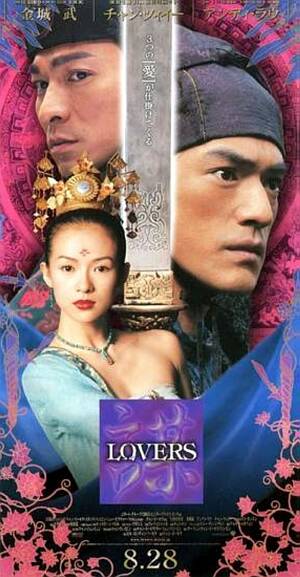 Since the success of Ang Lee’s Crouching Tiger, fellow arthouse director Zhang Yimou seems to have become obsessed with one-upping Lee. First was Hero, a sumptuous and multi-levelled tale of revenge and betrayal starring Jet Li; now, we get House which while slightly smaller in scale, is clearly going for the same tragically romantic feel as CTHD. Policeman Leo (Lau) suspects Mei (Zhang), an arrested blind prostitute, is part of the titular rebel group, so sends Jin (Kaneshiro) to win her confidence by helping her ‘escape’, then going with her to the Flying Daggers’s base. However, it gives nothing away to say that Mei and Jin start having feelings for each other, as they battle through the countryside, and it’s no surprise to discover that several other characters aren’t what they seem either.
First things first: Zhang cements her position as the finest action actress currently working. The fights here, under the direction of Ching Siu-Tung, are memorable, fluid and are among the best I’ve seen in a long time, mixing straight martial arts, wirework and CGI to elegant effect. [The CGI does go overboard, for example, when used to create falling snow which never actually lands on the characters!] Unfortunately, the film has but two speeds: full-steam and grinding halt, and between the battles becomes very talky, without much genuine emotion. After you realise the multiple levels of deceit, it’s impossible to commit to a relationship with any of the characters; honesty is largely missing for the first hour and half. What this needs is humanity, which CTHD found in the fine acting of Chow Yun-Fat and Michelle Yeoh.
Originally, Anita Mui was part of the cast, but on her death, the script was rewritten – one wonders if she might perhaps have given the film a warmer heart? Still, the eye-candy side of things is luscious; costumes, cinematography, sets and sound come together [the Ukraine largely standing-in for China] to make one of those epics where any shot could be printed, framed and hung on the wall. Pity it has little more emotional depth than your average photo.
Dir: Zhang Yimou
Star: Zhang Ziyi, Andy Lau, Takeshi Kaneshiro, Song Dandan
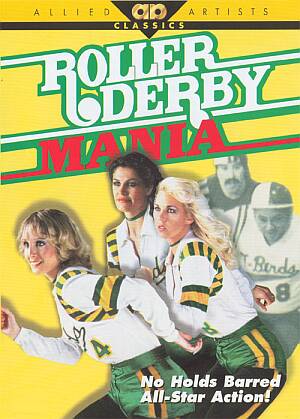 This dates back to 1986, which is a little odd, as the sport was pretty much in one of its down-turns at the time – the excesses of RollerGames were still a couple of years away at that point. This isn’t probably the best place for a novice to start, as there’s no explanation at all about the sport, since it assumes you know what’s going on, how bouts are staged, scored and what the rules are . There’s a little about the history (including a cute song from the 1940’s), but it’s mostly action featuring the Los Angeles T-Birds.
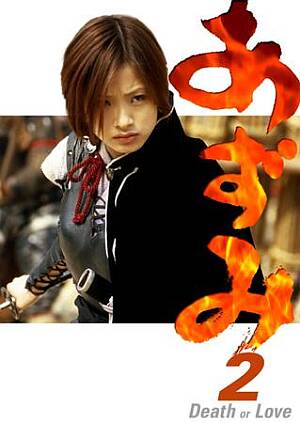 I went into this with low expectations, based on some scathing reviews and the lack of Ryuhei Kitamura, whose directorial style made the first such a joy. I’m pleased to report then, that this surpassed expectations, with some nice imagination and a bevy of action heroines (including Kuriyama, whom you’ll know as Gogo Yubari from Kill Bill, Volume 1), as well as the expected high body-count. It follows on loosely from the original, but heads in a slightly different direction; our heroine is still intent on her mission, but is diverted by a wandering samurai, part of a rogue gang, who reminds her of Nachi, her childhood friend she had to kill at the opening of the original film.
 This frothy concoction is light-hearted entertainment, which doesn’t exactly pack much of a wallop, but has some nice characters and situations. Heroine Chun (Kim), is a young cop, galled when her undercover mission is swept away by a rival; she gets another chance, but to her dismay, this involves going back to school to watch the daughter (Nam) of a gang member who has agreed to testify against his boss, but has since vanished. Of course, a hot-tempered cop with martial arts skills fits
  Perhaps I was expecting too much, after reading reviews that
 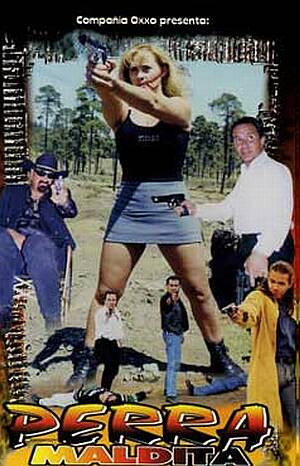 Camelia (Palmer) sees her way out of the ghetto in Ramiro (Saenz), a friend of her father’s who always has more than enough easy money. She convinces him to employ her as an apprentice, but discovers she likes sharing his life of drug-deals and casual slaughter. But they soon find out, they may not be the only ones capable of a good double-cross…
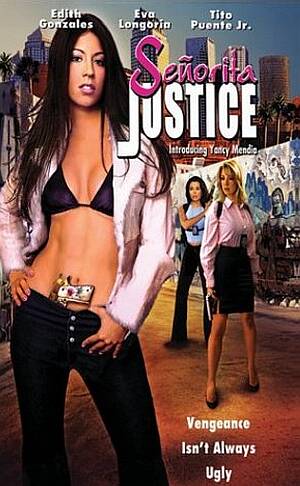 This is an interesting contrast to Sunland Heat which took a woeful script and executed it briskly enough to work. Here, the story isn’t bad – Anna Rios, a Hispanic lawyer (with a special forces background!) goes back to her roots, after her brother is gunned-down, and uncovers a maze of murky deals. It’s the execution which is largely inept, “Kantz” providing further evidence that one-name directors suck at GWG films – see also Charlie’s Angels: Full Throttle (McQ), Catwoman (Pitof), Ecks vs. Sever (Kaos) and Tomb Raider 2 (Jandebont).
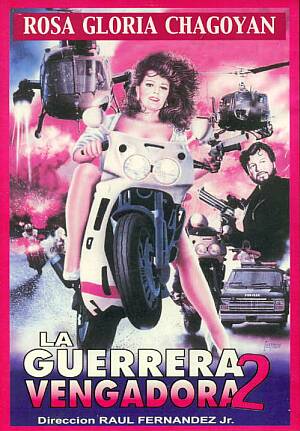 Chagoyan is perhaps the nearest thing Mexico has to offer to an action heroine. She best known for her role in Lola la Trailera (‘Lola the Trucker’), in which, she played the daughter of a haulier – she takes over his business and goes out for vengeance, after he’s gunned down for refusing to assist a drug-cartel. Almost a decade later, that director’s son would helm this, in which Chagoyan plays a teacher who moonlights as a crime-fighting vigilante. Not having seen part one isn’t much of a problem; presumably it explains her origins, and perhaps how she gets to spend so much time away from her job. All we see here is one class, before she and her midget sidekick take on a gang who kill one of her pupils (with a surprising amount of blood, it has to be said). Then, when she’s blamed for kidnapping the daughter of the police chief, she has to find the real culprits and clear her name.
 This Brazillian-shot entry has a lot of good ideas, and some excellent moments, but comes up short with a script that borders on the incomprehensible. For example, in the middle of the film, the hero and heroine are both shot with tranquilizer darts – but no subsequent mention or explanation of this ever appears. This kind of sloppy plotting plagues the movie; it’s almost half-way through before the basic story becomes clear.
 There’s lots to appreciate, not least the actors. As opposed to many films, Hagen here actually looks like she could kick your ass, and the flashback fight sequence is excellent – I’d like to have seen more of that, and all the battles are well staged and shot. While Perry is somewhat bland, he’s effective in action; Richardson is a B-movie veteran for almost two decades (Hollywood Chainsaw Hookers, Attack of the 60-foot Centrefold, etc.), and has a nice, world-weary air here. But Putney (left) is perhaps the best find as Daniel’s gun-toting sidekick, Jackie; the final scene between her and her boss is fabulously intense. And there are other cool little aspects, in things like Daniel’s henchmen.