★★★
“For Flux’s sake…”
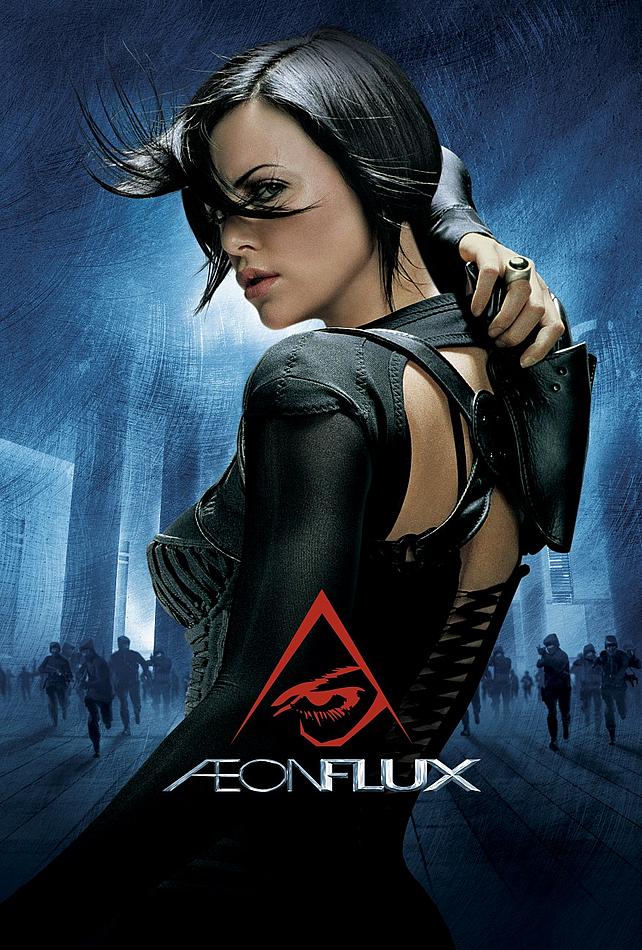 It is too early to start speculating about a girlswithguns.org curse? I mean, we’ve only ever put two banners for movies on our home-page: the first was Catwoman which ended up getting Razzie nominations across the board, and now we have Æon Flux, a film deemed so bad by its studio, they decided not to show it to critics. And given some of the other dreck put out by Paramount this year, with a full promotional push…the results were probably inevitable.
For, y’see, many “proper” critics do not like being deprived of their free screenings with reserved seating, and being made to pay $9 to see the movies with (ugh!) a proper audience. I strongly suspect a significant number phoned in their review without bothering to see see – or, at least, pay attention to – the film, under oh-so-“witty” titles like “Flux Sux”. If the studio basically tells you a movie blows, why argue? [It takes phenomenal guts to go against the tide, but Flux did get some good reviews]
Truth is, of course, it’s not as bad as they’d have you imagine. Not brilliant, sure, but worse films come out, almost any weekend. I’m always happy to see a nicely-detailed take on the shape of things to come, and Flux certainly delivers there, with a Brave New World-like utopia, where everyone is happy…at least on the surface. Of course, if you’re familiar with the excellent Equilibrium, you’ve seen this kind of thing before – but say what you like about the Nazis, they had some great architects, and the same is true here. Particular kudos also to costume designer Beatrix Aruna Pasztor, who deserves an Oscar nomination for her efforts, which have a sleek, futuristic style to them that’s undeniably impressive.
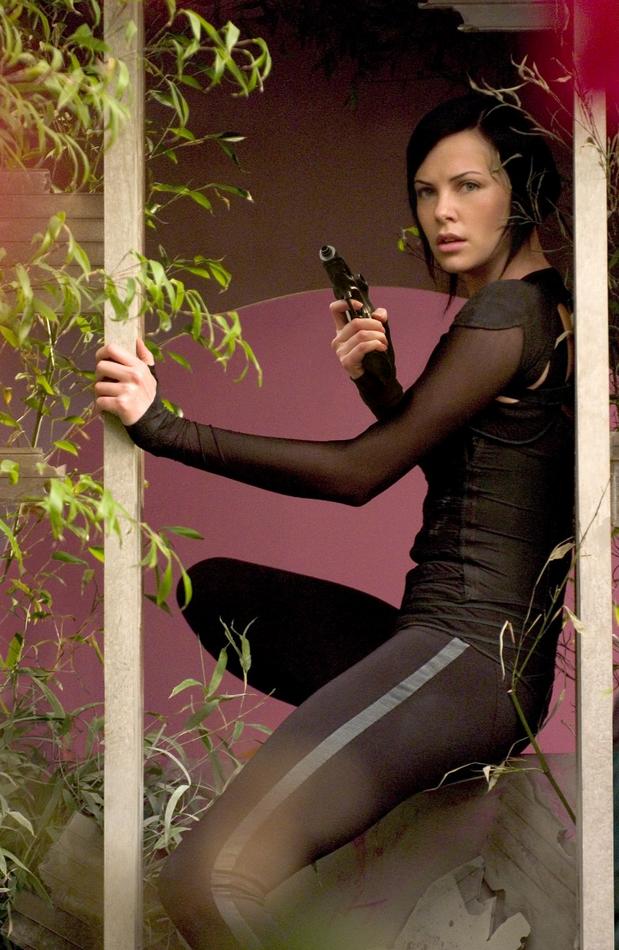
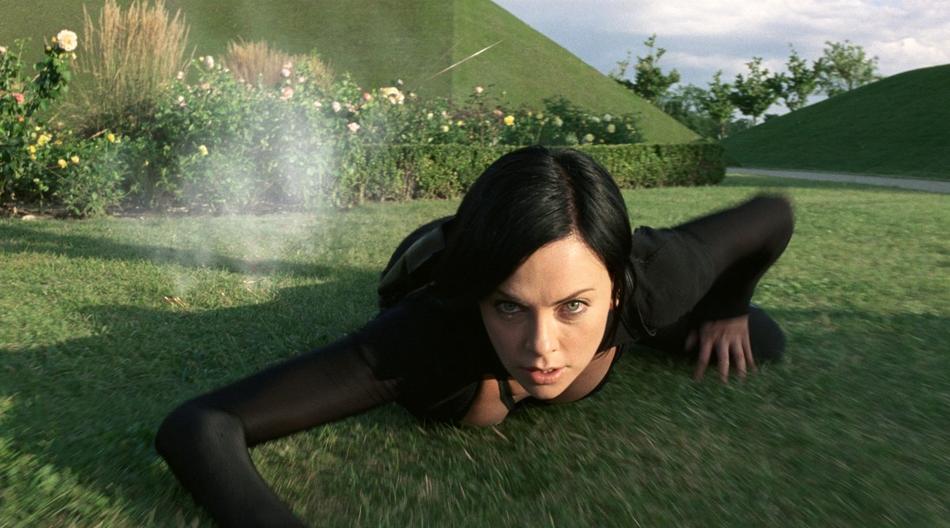
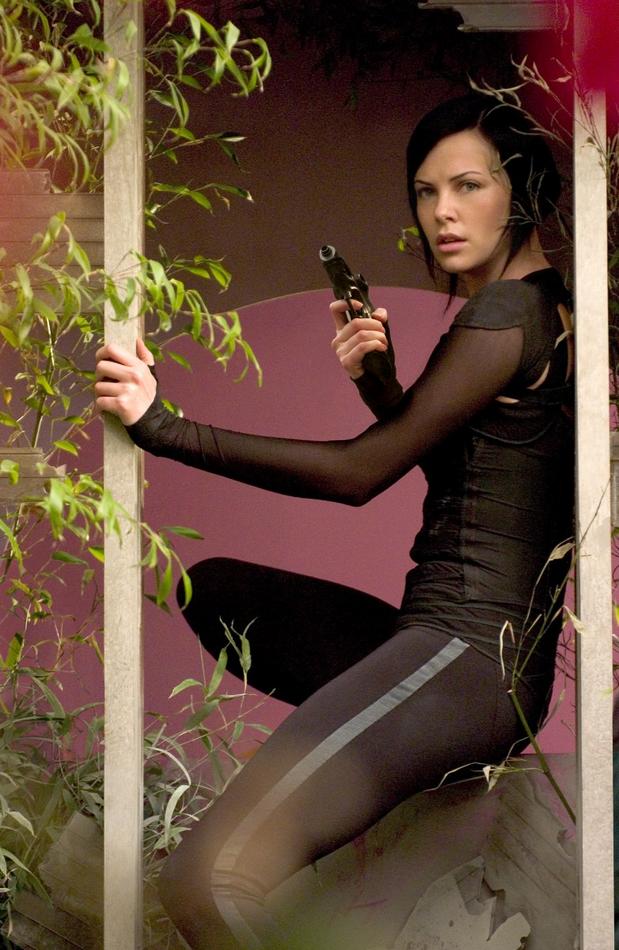
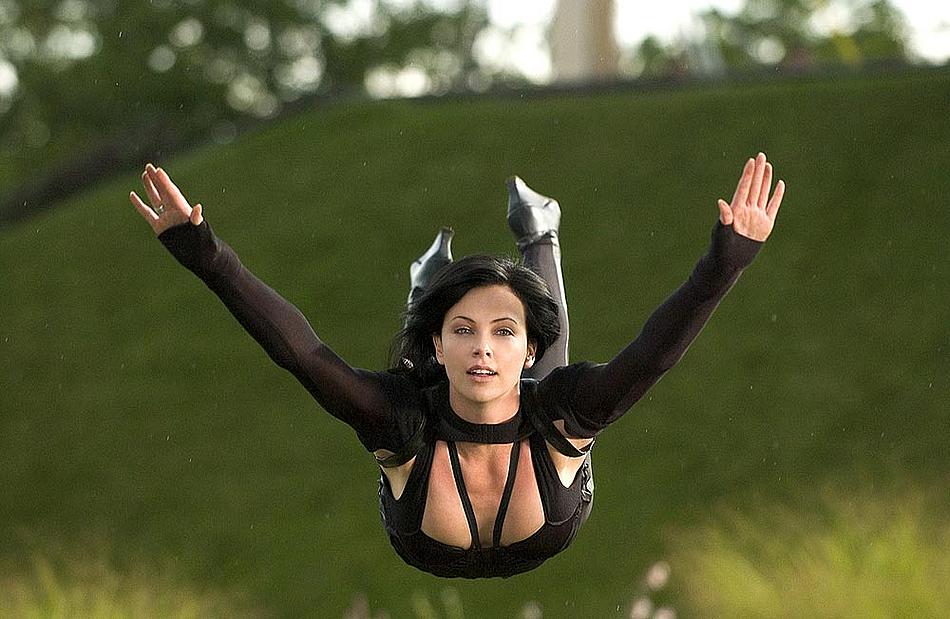
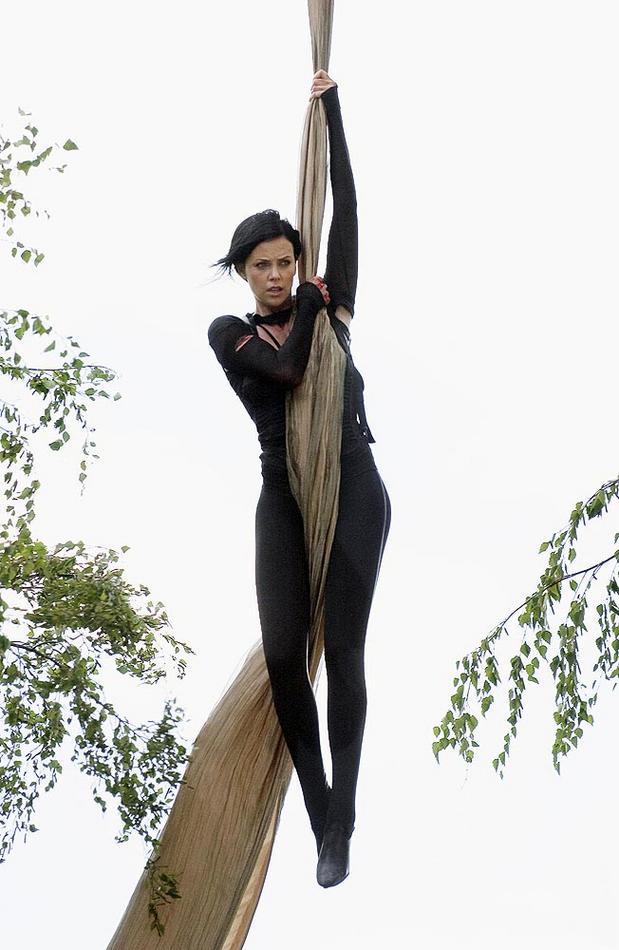
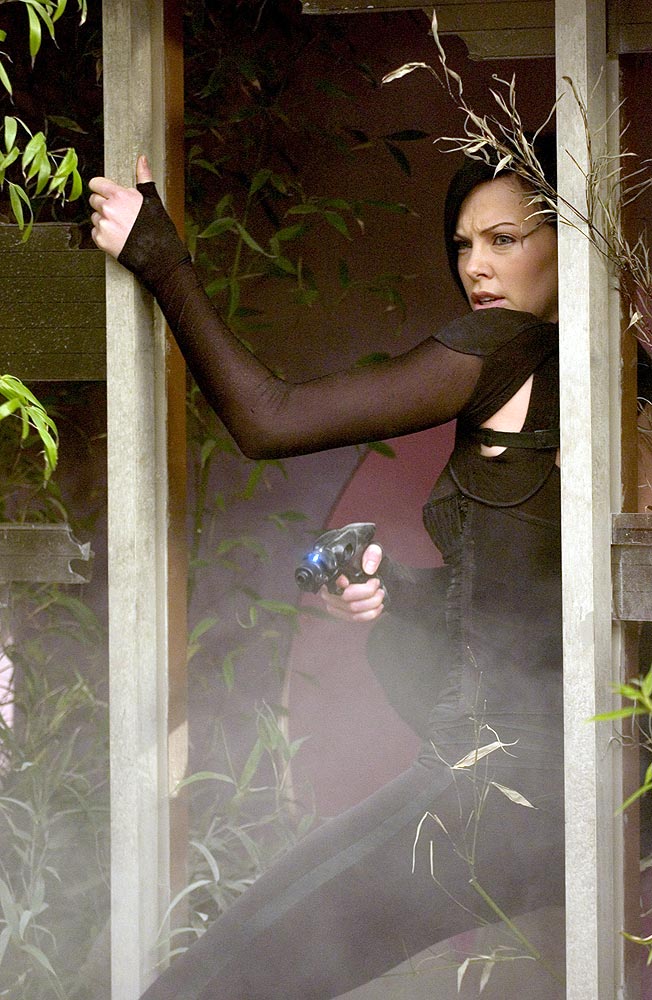
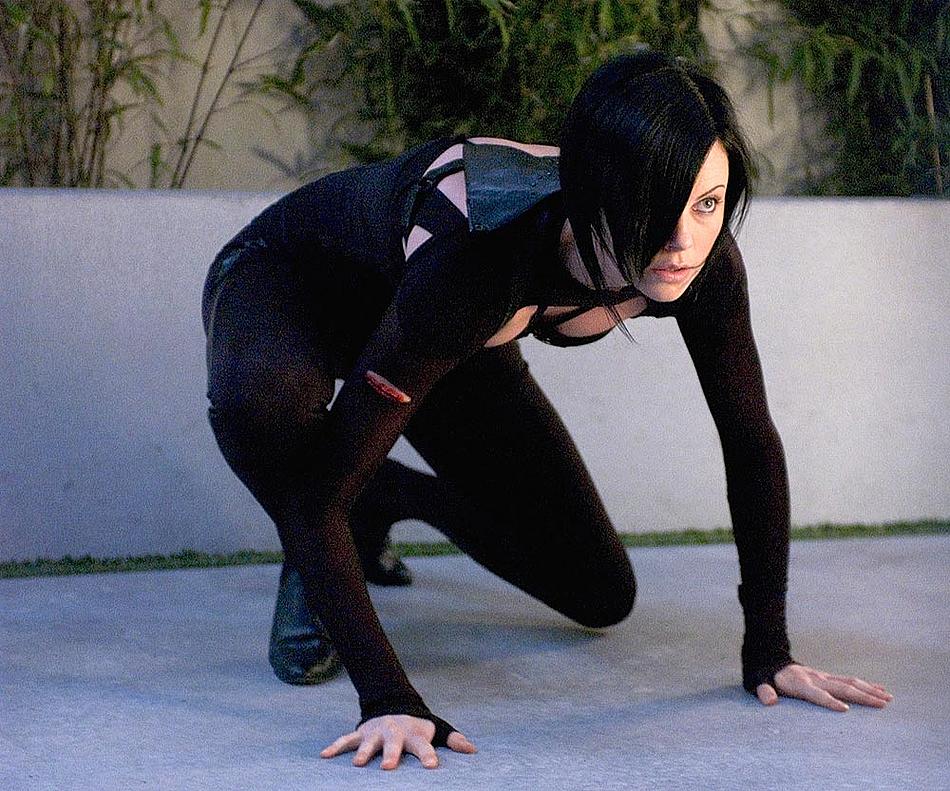
Theron also has the necessary gravitas for the role, and to my ears, even sounded like the character did. She has the tall, spindly appearance too, though the hair is definitely well wide of the mark, and her clothes are – inevitably – toned down from the “fetish wear on amphetamines” depicted in the series. That’s probably a necessity for the PG-13 rating, which also hampers the film in other ways – I’ll say more on that later. But as an adaptation in general, it’s so wide of the mark, you’d be better off ignoring this aspect entirely.
However, it would probably have been foolish to expect otherwise. Given the dense, impenetrable nature of the series, there’s no way a studio was going to spend $60m to make something like that, to open on 2,000+ screens across America. The storyline here is much more linear, logical…and, well, probably less interesting. 400 years after a virus wipes out 99% of the world’s population, Æon is a Monican rebel, fighting the powers-that-be in Bregna, the only city left. However, when her sister is killed by the authorities, it becomes personal, and she takes on a mission to kill Trevor Goodchild (Csokas). However, when she faces him, she finds herself unable to complete her task, and from there she discovers that life is not quite what it seems. Though the revelations are more likely to provoke a shrug than any actual surprise.
 The main problem, however, is Karyn Kusama, whose previous work, Girlfight was very good, but was an up-close and personal character study, about as far from the sprawling SF sensibility require here as imaginable. This, I think, summarizes part of the problem with Hollywood and “girls with guns”: they appear to think all action heroines are the same. Hey, you did a film about an inner-city schoolgirl who uses boxing as an escape valve? You’d be perfect to helm an effects-packed, post-apocalyptic, science-fiction movie starring a supermodel gone berserk! No. No. A thousand times no. They should perhaps have gone with producer Gale Anne Hurd, who does at least have an action/SF background, from her work on the Terminator series, Aliens, Hulk, etc. Kusuma seems out of her depth, sad to say.
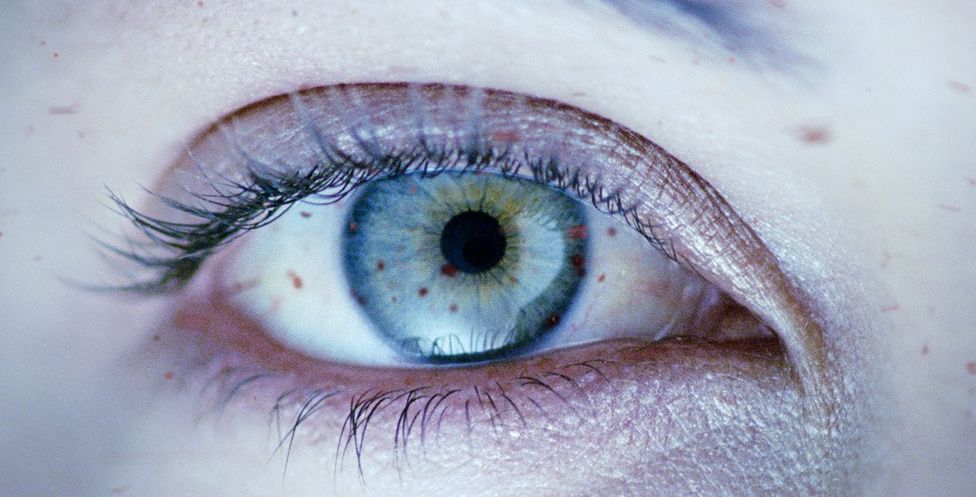
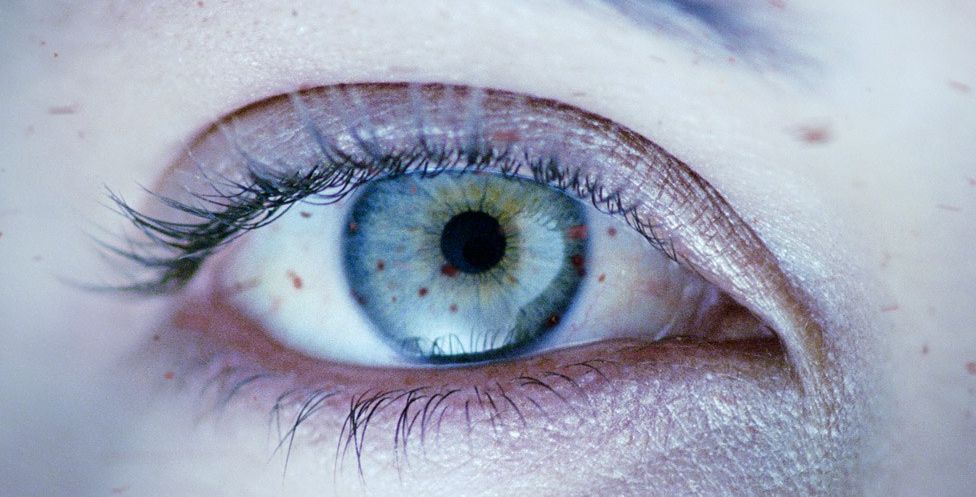
 There is some inspired gadgetry, such as Æon’s little explosive balls, which do tricks on command, and her eye, which can see chemical additives in a glass of water. There is also what is presumably a VR implant, letting her enter the 25th century version of a chat-room to get orders from McDormand. The hair-do on Æon’s boss is from the “through a hedge backwards” school of hairdressing, so it appears that customizable avatars were also wiped out by the pandemic. But like most of the costumes and set design, the futuristic infrastructure is generally well-realised.
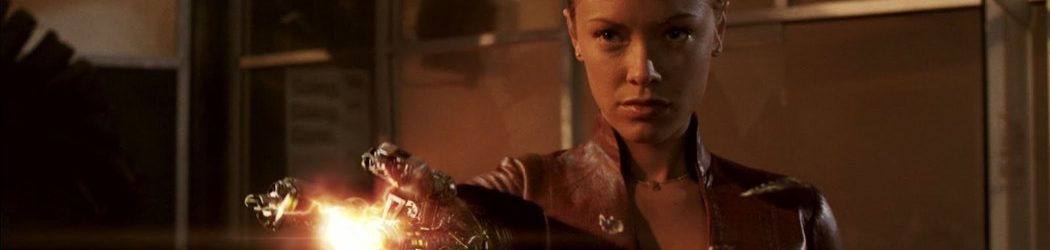
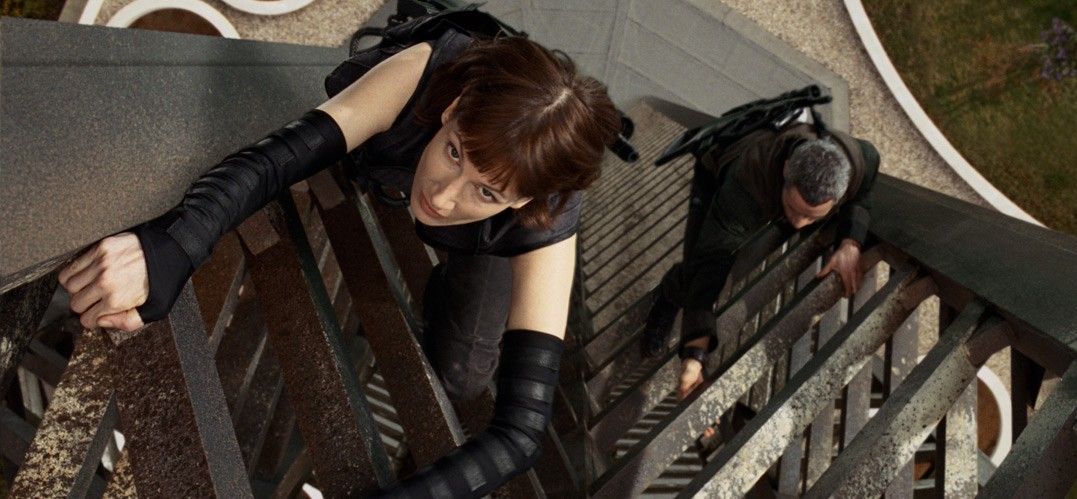
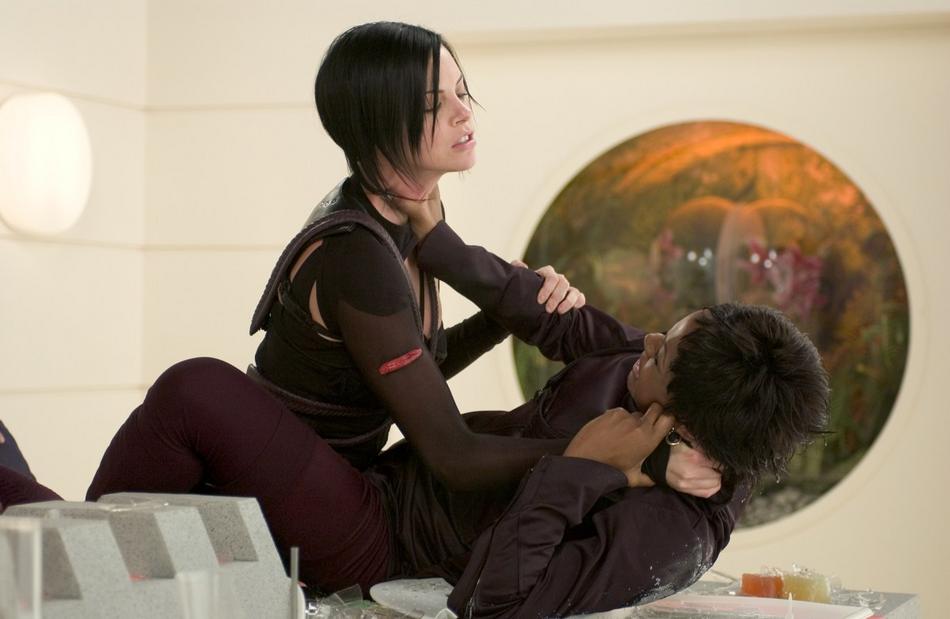
The supporting cast come off variably well. Okenodo (left) plays another rebel, with hands in place of her feet, a nice touch that deserved better exploration. “I like my shoes” is Æon’s response when asked why she doesn’t get the same surgery – that’s the kind of perfect, cool, cast-off line the film needs more of. Csokas, and Miller as his ambitious brother who will do anything to keep the status-quo, are solid; but McDormand and Pete Postlethwaite are both badly wasted in throwaway roles, the latter dressed to look embarrassingly like, as one review put it, a Hot Pocket.
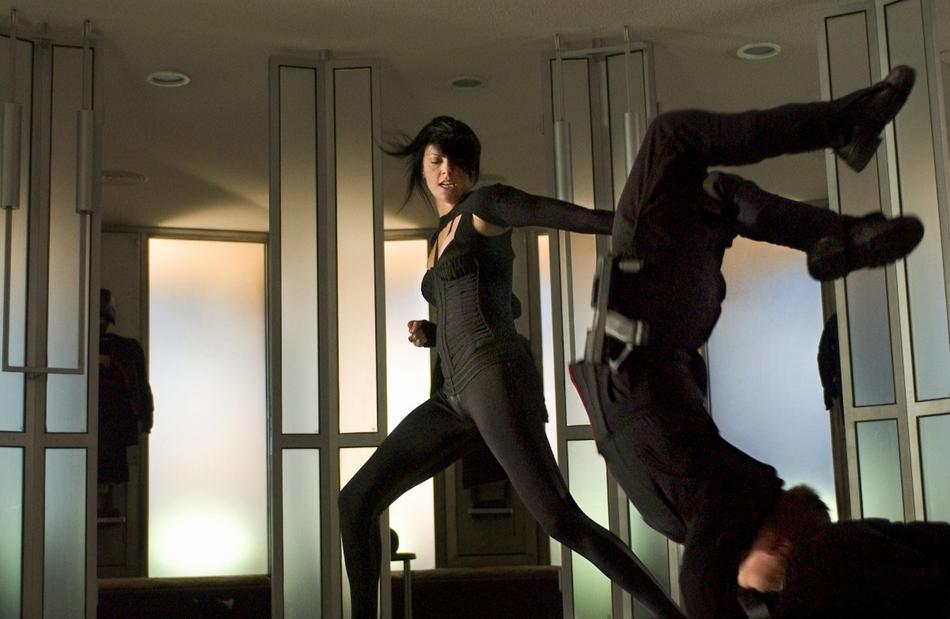
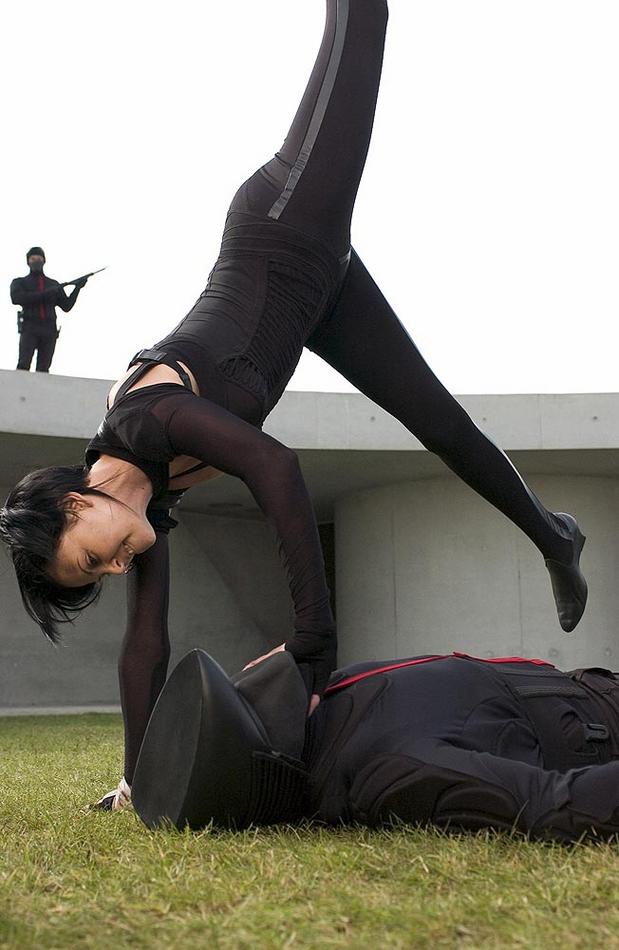
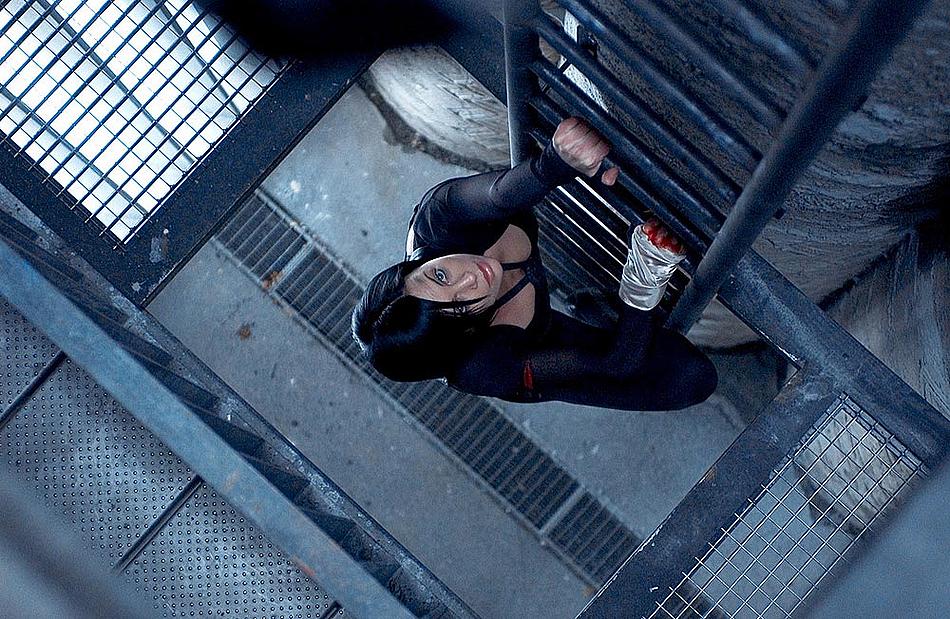
Then there’s the action. Save the final battle, which actually reaches the giddy body-count levels beloved of the animated series, they’re poorly-edited – second-unit director Alexander Witt helmed Resident Evil: Apocalypse, which has exactly the same problem. You’ve got a heroine to whom calm, athletic poise is apparently second nature: why not show her for longer than two frames, without cutting somewhere else? Hell, Theron got injured making this – not that you could tell by the time this went through the MTV blender. As a result, the fights pose no threat to the heroine, since you haven’t got a clue what’s going on: your average video-game causes more concern for the participants.
This brings me back to that PG13-rating, which means the violence doesn’t have any edge to it – at one point, Trevor Goodchild takes two bullets to the torso, and it barely slows him down. In the animated series, death was an ever-present occupational hazard for Æon, and the result had a dark, tough feel that is very much missing here. Instead, the tone is indistinguishable from any other heroic SF. The sexual tension is also much reduced – though keep an eye out for Theron’s real-life squeeze, Stuart Townsend, who cameos in the opening scene, passing a message with his tongue to our heroine. That, and Æon trapping a fly with her eyelash, are about the only moments truly recognisable from the series – and, truth be told, largely prove only that some things work better in animation.
That’s a fitting summary for the film as a whole. This is not the disaster you might expect from some reviews (hell, it’s a million times better than what we watched the next night, the woeful and inept National Treasure, which somehow managed to become a smash-hit). However, there’s no denying that this is a disappointing conversion of a classic series. Its failure at the box-office puts the final nail in a very mediocre year for the action heroine at the box-office, that staggered from bad to worse: Elektra. Domino. Æon Flux. Shudder. We’ll move rapidly on, and raise a glass of Christmas cheer, in the hope that our favourite genre finds some better success in 2006. When’s Underworld: Evolution out?
Dir: Karyn Kusama
Stars: Charlise Theron, Marton Csokas, Johnny Lee Miller, Sophie Okonedo
a.k.a. Aeon Flux



 Just imagine Jennifer Aniston watching this film: every time Ange appears on the screen, or gazes lovingly at Brad, Jen shrieks maniacally, “Die, sluuuuuut!” Such thoughts will keep you entertained during the sluggish first hour – you’ll need them, while you wait for the characters to realise what we know from the start: Mr. and Mrs. Smith are both assassins, now targeted by their respective agencies. For that is when the fun finally starts, not the overlong lead-up, where Brad + Angelina can only sustain the plot’s conceit (that – tee-hee! – they don’t know each other’s real jobs) by abject stupidity that flies directly in the face of their characters. She’s supposedly a top-level assassin with 300+ kills to her name, yet doesn’t notice hubby’s Batman-sized lair beneath the potting shed? Puh-lease…
 We don’t know whether the Smiths are “good”, “bad” or independent contractors, an interesting approach (we have no moral compass beyond their actions), yet disappointing. For another weakness is that the villains are merely faceless minions, when the genre needs a Big Bad for the climax – the obvious one here is the people that ordered the terminations. Liman, whose Bourne Identity was also about a killer with a contract on his head, might appreciate this more than most, and word is two such endings were shot, just not used. Still, I suspect that the sequel – likely inevitable, given this was one of 2005’s top ten at the US box-office – could very well be more fun than the original. At least we’ll have all the tedious set-up out of the way.
 Director Boll has a rep as the worst filmmaker ever, making movies based on video games entirely for tax writeoff purposes. But have things got out of hand? I mean, Bloodrayne was in the IMDB All-time Bottom 50
 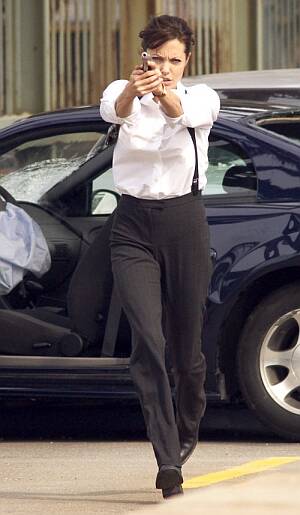 Rarely has a film started so promisingly, and gone so consistently downhill. The start is fabulous, with one of the most shocking moments I’ve seen…though if you’ve seen the trailer, you’ll have had it spoiled. But regardless, the first time we meet FBI profiler Illeana Scott (Jolie), on special assignment to Montreal, she’s lying in a grave. She is hard as nails, and takes absolutely no crap from anyone: her local friend, Captain Leclair (Karyo) hardly needs to bother protecting her, despite the nicely-handled cross-border tension. The case is that of a serial killer who, as the title suggests, inhabits the lives of his victims: the crack comes when his mother (Rowlands), believing him dead for two decades, spots him in Montreal by chance. However, the only other person to have seen the suspect is art-gallery owner James Costa (Hawke), but Scott starts finding her emotions getting in the way of her work…
 As Kim Possible proves, there’s certainly scope for a high-school action heroine who has to save the world from evil. Unfortunately, here, the potential largely gurgles down the plughole, in favour of a smug, self-satisfied romantic comedy, that manages to be as bland as a film about teenage lesbians could be. Amy Bradshaw (Foster) gets a perfect score on the test hidden within the SAT, and is recruited into a spy academy; there, with her classmates (Good, Ritchie and the always amusing Devon Aoki), she carries out secret missions, wears plaid skirts and agonises over her relationship with her boyfriend.
 The action isn’t too bad initially, with a sprightly shootout in a restaurant. However, that’s your lot, save the “daring” lesbian angle. Though, being mainstream cinema, it’s just a couple of clothes-on kisses, and bad, unconvincing romance is no fun, regardless of a character’s orientation. This aspect is so po-faced and politically correct – it is, clearly, supposed to be taken Very Seriously – that proceedings come to a grinding halt, while what appears to be the director’s iPod on shuffle plays as a witless soundtrack. Look! An Erasure song! How appropriate! ‘Cos, y’know, they’re
 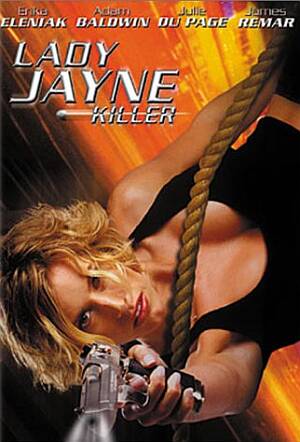 Memo to self: don’t tell your wife the star of a film was in Playboy. Chris’s interest, already somewhat on thin ice, evaporated entirely, pretty much the moment I made that mistake, and I almost had to handcuff her to the bed to prevent a sudden trip to the supermarket. The concept here is kinda cool: Mom Emily (Eleniak) vs. anti-Mom Jayne (du Page). The latter is a hitwoman for the Mob, with 20 kills to her credit when she decides to abscond with a million in cash. She ends up hitching a ride beside Emily and her 16-year old son Kerry (Lelliot) on their way to San Antonio, with the former owners of the money in hot pursuit. And the cops. And the FBI. Then Kerry – when not fantasizing about Eleniak in the shower [cue Chris’s neo-departure!] – decides to solves Mom’s financial problems with thievery of his own.
 The opening hour of this must be great entertainment for sadists, watching Demi Moore get pummelled, ground-down, chewed-up and beaten into a bloody pulp by the war machine, as part of Navy SEAL training. The first woman to go through it, she could open the door for others if she succeeds – which is exactly why the stops are pulled out to ensure she fails. While the most obvious face of this is Master Chief Urgayle (Mortensen – his character here would eat Aragorn for lunch), her political mentor Senator DeHaven (Bancroft) also finds the pressure coming down to pull the plug on this social experiment. But Jan…er, Jordan O’Neil (Moore), won’t give up at any cost, demanding absolutely equal treatment. Of course, after what seems like a 75-minute training montage, she wins the respect of her colleagues, overcoming the Senator’s intervention thanks to a peskily imperfect fax machine.
 This SciFi Channel original movie is based on a comic-book series, but makes some radical changes to the storyline, though the basic idea is intact: a woman becomes immune to injury after the usual mysterious something happens to her [radioactive spider bite, barrel of toxic waste – the usual graphic novel contrivances, in other words]. In the comic, she was an undercover cop; here, she is a Special Forces soldier in Chechnya who is exposed to an experimental biological agent. Naturally, she subsequently finds herself much sought after, by both good and bad factions, since she’s the first to survive the treatment.
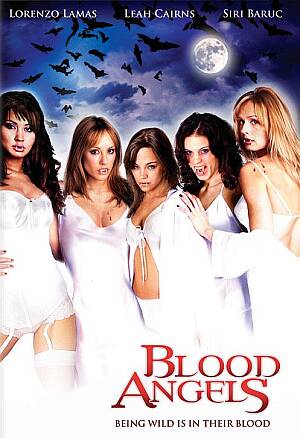 I’ve recently seen movies involving vampires who run a strip-club (Vamps), and witches who run a strip-club (Witches’ Sabbath). Now, we have vampires who’re putting on a rave. It’s nice to see creatures of the night who keep themselves busy. Actually, here, they’re not fully-fledged vampires: indeed, the aim of the rave is a ritual to complete the job, give them shape-shifting powers, etc. – generally, upgrade from the shareware version of vampirism. Of course, one of the vamps has a sister (Baruc) turn up – she looks like Dorothy from The Wizard of Oz, which is fairly appropriate, as she’s definitely not in Kansas any more. And their creator, Mr. Jones (Lamas), from whom they escaped, is keen to reel them back in…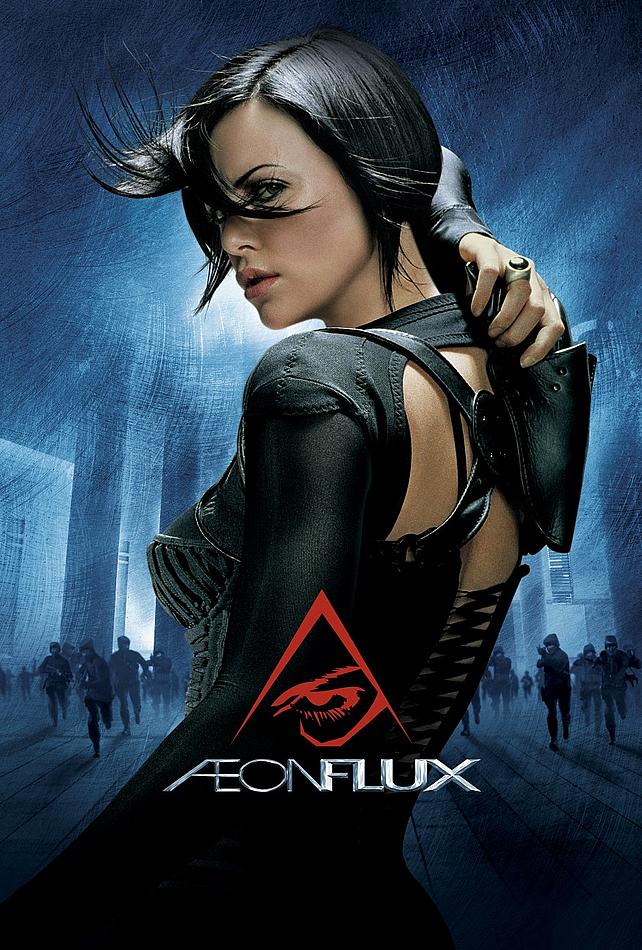

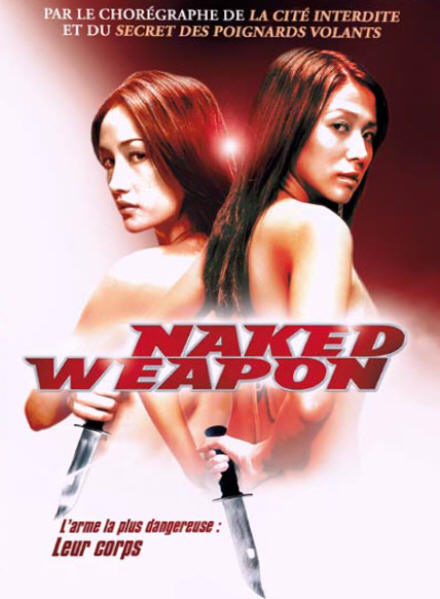
 After a decade of “sequels” that weren’t worth the video-tape they were apparently filmed on, Wong Jing finally went back to the well in 2002 for what is, in truth, a surprisingly-tame movie. Given the names of the lead actresses (“Maggie Q”, “Anya”) sounded more like porn starlets than anything, I was expecting loadsa sleazy fun, but they’re model names, and this is probably closer to
 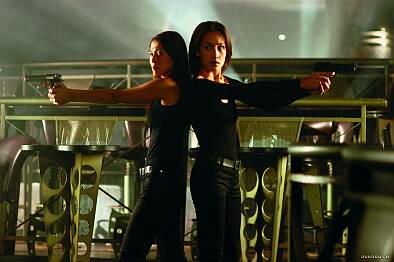 Instead, there’s a laughable scene after an assassination attempt on her by Jill, at the behest of Madam M, who realises she could lose Charlene back to her mother. Jack ends up carrying the wounded parent to the hospital, but keeps stopping to converse with Charlene, which had us screaming, “The hospital! It’s over
  Is it better than Naked Killer? A difficult call, and one that likely depends on your state of mind – as well as whether the word “good” could ever be applied to Killer, a lurid blast that really could come from Hong Kong, and probably only from before the Chinese takeaway of the colony. Weapon is certainly better-crafted and has more crossover appeal: our son was going to pick it up in Blockbuster, till we informed him it was already part of our unwatched pile. On the whole, I think Weapon is the one more likely to be watched again in future – if only because Killer would require the room to be carefully swept for lurking minors and maiden aunts first.