




★★★
“a.k.a Underworld: Look, We’re Really Sorry About The Last One. Here’s Kate Beckinsale In PVC Again.”
 Actually, we quite enjoyed the third part, but we’re Bill Nighy marks. Still, nice to get back to the basics mentioned above, and the storyline here was a good one, even if more than a tad reminscent of Ultraviolet. After the revelation that vampires and lycans exist, humanity goes on a pogrom against the two species, driving them underground. Selene is captured, and wakes up to find herself, a dozen years later, in a wrecked research lab. Initially, she suspects Michael Corvin, but discovers a young girl, Eve (Eisley) to whom she has a connection; turns out to be another vampycan hybrid. Research company Antigen, under Dr. Jacob Lane (Rea) were using the two of them to make a vaccine, until Eve escaped, freeing Selene, and are now desperate to get their subjects back. But are their motives quite as altruistic as they appear?
Plenty of action, plenty of Beckinsale (I’m glad Corvin was basically absent), interesting scenario. Unfortunately, the CGI Lycans are utterly, utterly horrible, like something from a mid-90’s console game. There’s absolutely no sense of them being anything other than a visual effect added later, and this distracts terribly from a lot of the battle scenes. I’m generally pretty good at suspending disbelief; here, it was the CGI equivalent of the fake Bela Lugosi in Plan 9, holding his cape in front of his face. It was that much of an attention-grabber. The film was originally made in 3D, and one wonders whether that’s part of the problem: I saw it in regular format, and was vastly underwhelmed. Indeed, too much even of things like Selene’s falls, were obviously pixels being moved with a mouse.
That’s a shame, as there’s a fair bit to enjoy here, providing you’re looking for nothing more complex than straightforward ass-kicking. They could probably have done with developing the human angle and make this fight a three-way dance – after initiating the first purge, we are hardly seen again. However, Beckinsale has the presence and – when not replaced by her virtual stunt-double – continues to look the part with splendid self-confidence, in a way few actresses can manage. It’s an improvement over Evolution, certainly, though the series remains one where all the entries have had their flaws, preventing it from achieving the greatness which one feels they could have achieved.
Dir: Marlind + Stein
Star: Kate Beckinsale, India Eisley, Stephen Rea, Michael Ealy
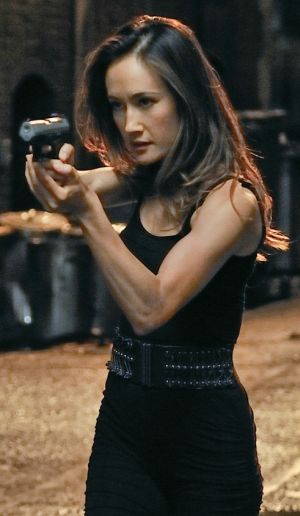 When we last saw Nikita (Q), she’d gained some help for her struggle against Division in the shape of fellow defectors from the organization, Michael (West) and tech guy Birkhoff. But she’d lost protege Alex (Fonseca), who had stayed with Division to further her lust for revenge on those who’d killed her parents, while reclaiming her family fortune. Meanwhile, Nikita’s nemesis and former boss Percy had been usurped by Amanda (Clarke), and was now in a plexiglass box in the basement. Throw in Oversight, the government committee supposedly in charge of Division under Senator Madeline Pierce; CIA agent Ryan Fletcher and Pierce’s son Sean, who join Team Nikita; Owen, a rogue guardian, keeper of one of Percy’s black boxes… And I haven’t even got to Michael’s love-child, a source of much angst for all concerned.
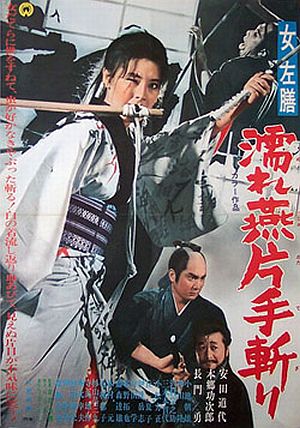 A sequel to One-Eyed One-Armed Swordswoman, this stands more than well enough on its own merits, with an interesting and complex storyline and engaging characters. As a young girl, Lady Sazen (Ohkusu) lost both an arm and her eye to the devilish Lord Daizen-dayu, who coveted the titular sword owned by her father. Sazen barely escaped with it and her life, and is now a wandering swordswoman, roaming the countryside. She saves a girl being chased by some thugs, and it turns out that she knows all the inside dirt on a corrupt priest, and he won’t stop until she has been silenced. Meanwhile, Daizen-dayu hasn’t given up on the sword, and has hired another samurai to get it from Sazen, bu any means necessary.
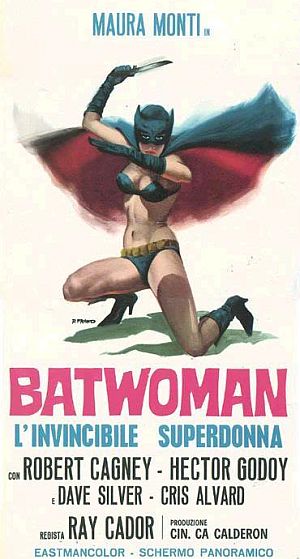 Someone is abducting wrestlers, extracting serum from their pineal glands and dumping the bodies in the ocean, at various locations around the world. Most recently, Acapulco. Investigating the crime is Batwoman (Monti), a rich socialite who has a masked alter-ego that fight crime. Oh, and is also a pro wrestler. Which makes her ideal for this case, since she can hang around the gym and check out suspicious characters, while working on moves with her fellow luchadorettes [Not a real word, but I like it]. Who is involved? The blind lottery ticket salesman? The chief of police? Or Dr. Williams (Cañedo), who won’t let anyone on to his ship, which is called Reptilicus, by tha way, and who possesses a sidekick called Igor? Go on, take a wild stab in the dark…
 I have no problem with rape/revenge movies, providing the balance is skewed more towards the revenge than the rape. Ms. 45, for example, has about five minutes of rape and 60 of revenge. This is fine by me. I am all about the revenge, which should be nasty and brutal, exactly what sexual predators deserve. Actually, so should the rape be, because portraying it any other way is very, very questionable. But that’s something which hardly needs depicting: I’m quite happy taking it as read, thank you very much. Here, the depicted brutalization of four young women goes on far longer than necessary to serve any
  To the makers’ credit, they are perfectly up-front about this being made for pennies, with home video equipment and edited on a laptop. But even though I’m not averse to that – heck, I’ve been involved with films on such microbudgets myself – there’s still too much here that’s avoidably bad. For instance, if you are going to put the President of the United States in your film, be sure you have access to someone with a grasp of English that extends past “D+, must try harder”. If you don’t, then leave them out.
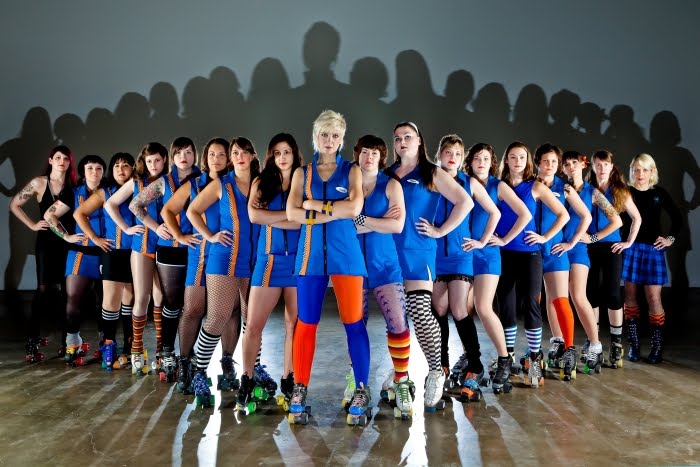 Not that there is any shortage of said personalities, such as the mother and daughter who both take part in the sport, or the three sisters who have been roller-skating virtually their entire life, and are feared across the entire Seattle league. There are, admittedly stories about romance and marriage included, but even these have a close connection to roller-derby, like the guy who proposes after his girlfriend became part of the championship-winning team [I can relate to this, having proposed to my wife immediately after the Arizona Diamondbacks won the 2001 World Series!]. I also enjoyed the insight into the different teams, like the Sockit Wenches (right) or the Derby Liberation Front, and the different ways in which they both perceive themselves and are perceived from the outside. Each has a different group personality, which of course, attracts other like-minded individuals, reinforcing that aspect of the team.
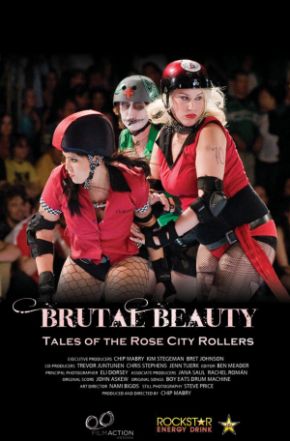 For the next entry, we leap forward to 2009, and Portland – a city which all we know about, we learned from Portlandia. And, on that basis, of course it’s a city which has roller derby, where it sprung, virtually fully-fledged to four-figure crowds. This is less of a landmark doc, in that it doesn’t cover the beginning, middle or end. It’s basically a year or so in the lives of the participants in the Rose City Rollers, which is the Portland league. It covers both their local season, and then, once that’s over, follows the travelling team, the Wheels of Justice, first as they head down to San Francisco to take on their hated rivals, then over to Denver for the regional championships.
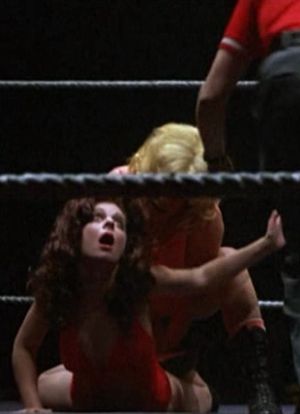 Rosa Rubinsky (Baff) is working as a waitress at a wrestling venue, when her swift dispatch of an over-affectionate coworker gets her noticed by a promoter (Bechler). He convinces her to try out, under the watchful eye of Mildred Burke [playing herself – she held the Women’s World Championship for about 20 years], and after some initial shock, discovers she likes the theatrical sport. Despite never having been outside the state of New York, she goes on the road, along with a set of other women wrestlers, and they travel up and down the East coast, putting on shows, though Rosa is still deemed too “green” to get in the ring. That changes after she meets the current women’s champion, Terrible Tommy (O’Brien, another genuine wrestler of the era). A bout for the belt is arranged, in which Rosa – known now as “Rosa Carlo, the Mexican Spitfire” – will take on Tommy for the title.