




★★★
“Not quite Bollywood.”
 If you’ve seen Bollywood films, you might expect the same here – a light, breezy romp, interspersed with gratuitous musical numbers. Wrong, on every conceivable level. It’s an almost unrelentingly grim portrayal of the life of Phoolan Devi (Biswas), sold off by her family at the age of 11, abused by her husband (Shrivastava) as well others in the higher-ranked Thakur caste, and basically treated worse than an animal. She’s eventually abducted by a gang of bandits, whose lieutenant Vikram (Pandey) is sympathetic to her: when the leader tries to rape her, Vikram shoots him in the head, and takes over, making Phoolan his co-chief. However, after the group’s true leader is released from prison, he’s none too happy, and sets out to teach Phoolan a lesson than will make her earlier misfortunes seem like paradise.
How much of this is true, is open to debate. Devi was supposedly so upset by the film, she threatened to set herself on fire outside a cinema if the film weren’t withdrawn, but the depth of her anger can be questioned, since she ended up being paid off by the producers. The basics do seem true, and it’s a remarkable story, centred on a performance from Biswas that leaves nothing in the locker. It’s also entirely unlike any other Indian movie I’ve ever seen, being foul-mouthed, brutal, and even contains some full-frontal nudity – though that is far more unsettling than anything else. However, in depicting the hellish life of low-caste women, it goes beyond the eye-opening to the stage where you almost find yourself thinking, “Oh, look: she’s being raped again.” Less would be substantially more, in terms of impact.
It’s definitely more drama than action, with her gang’s raid on a village the main set-piece in this area. Another thing that doesn’t quite work is Biswas being a full decade older than the character she’s playing. In reality, Devi’s rise to bandit infamy and eventual surrender to authorities was all over, while she was still a teenager, which is quite stunning. The movie certainly exposes a side of Indian life unlike one you’ll have seen, even if probably not one you’ll want to see again. But it certainly shows that someone is pushed far enough, they will push back.
Dir: Shekhar Kapur
Star: Seema Biswas, Nirmal Pandey, Aditya Shrivastava, Saurabh Shukla
 Wow. This is dreadful, and I speak as someone who enjoyed its predecessor, appreciating its excessive updating of Little Red Riding Hood. Bright tries to capture lightning in a bottle here, this time going for Hansel and Gretel, but it’s largely a miserable failure, imploding in screeching one-note performances from the two leads and far too many scenes of teenage girls vomiting. Yep. Girls vomiting. The scenario has Crystal Van Meter (Lyonne) sentenced to 25 years in prison, by a judge (a cameo by John Landis) fed-up of her petty criminality. There, she meets fellow desperado Angela “Cyclona” Garcia (Celedonio), a teenage serial killer with even more anti-social tendencies. After much binging and purging, the pair break out and go on the lam, heading for Tijuna and Sister Gomez, whom Garcia believes can solve their problems. But the Sister is not quite what she seems… as should be clear when I tell you she’s played by Vincent Gallo.
 Despite the name, there isn’t much raging, especially in the first half, which is more about the struggle for ownership of a company. It starts with an attack on the current chairman and his wife Bin (Ng) while on a trip to the Phillippines, after which she takes over the company. That doesn’t last long, as Tammy (Cheung) has designs on its finances, aiming to asset-strip it for his own purposes and divest Bin of her shareholding. To this end, he frames her and Chin (Leung), her best friend who is the wife of the company’s accountant, for drug smuggling: Chin takes the rap and is sent to 10 years jail. It takes all Bin’s resources to get her out, and when he does, Tammy sends his henchmen to kill their mother [ok, its not clear
  The film manages to cram just about every cliché of martial-arts films into its 92 minutes, with a plot driven by four major threads:
 The entertainment value you get from this may depend on your expectations. It undoubtedly works best as a party-tape, show-casing the “no wires, CGI or stunt doubles” approach, but I have to beg to differ with some of the critical savaging it has received. Even
  No, seriously. That title was actually used for the movie in Germany, shamelessly evoking the Jolie vehicle. It’s understandable, since they do have a lot in common. Secret agent Ahn Su-Ji (Kim) splits up with her boyfriend Jae-Joon (Kang), who is upset over her deceit, not knowing it’s in the name of national security. Three years later, they meet up again, and it’s clear the spark is still there. However, she doesn’t know that he is now an agent for another branch of the Korean intelligence services. Of course, with the amazing luck that only ever happens in action rom-coms like this, they are working on the same case, and closing in on the same plan to detonate a biological weapon in Korea. Their actions each come to the attention of the other’s organization who both decide they are dealing with a traitor.
 Galia is a sex-slave, kept in captivity in an Israeli brothel. After a failed escape-bid, she is told she has one chance to get back to Russia and be reunited with her daughter: kill an enemy of the man holding her hostage. This she does, but one murder becomes another, with the lure of getting her passport returned and freedom being used to keep her working, just as when she was a prostitute. But at least she has some freedom, and moves into an apartment opposite Elinor (Tayeb), who has problems of her own, in the shape of an abusive husband. The two women bond, both sharing dreams of escaping their violence-plagued lives. However, acting on those dreams is unlikely to be easy, with the men in their lives unlikely just to let them walk.
 Obviously inspired by a certain raider of tombs, this has Yuan as Georgia, who was rescued from an orphanage, along with her sister (Koinuma) and trained in… well, raiding tombs. When their foster father vanishes while on an expedition seeking the secret of immortality, the two siblings head off to look for him, only to come under attack from a range of locals, natives and the local fauna. Meanwhile, Professor Ivy Chan (Shimada) links up with billionaire art-collector Michael Lui (Wong), and discovers that shady forces are after a relic possessed by Ivy, and that they need to follow the girls into the remote jungle.
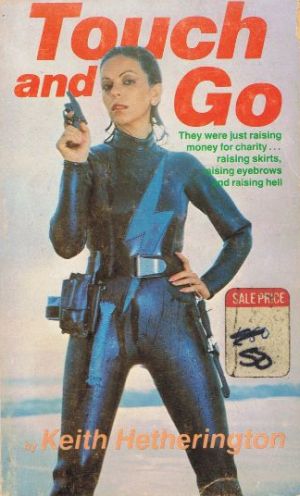 This 1980 film was originally called Friday the Thirteenth, but went through a title change in production, after they discovered some other film with that title being made… No hockey-masks to be seen here: instead, it’s the story of three young women, Eva (Hughes), Fiona (Contouri) and Millicent (Duncan), who start robbing places, largely for amusement – they donate the proceedings to an orphanage. However, after one of their victims ends up making far more money than they do, thanks to a bogus insurance claim, they switch targets and set their sights on a bigger fish, in the shape of a luxury hotel which contains a bank, jewellery store and other treats. This requires expanding their team, but with larger hauls come larger risks, as they find out, even once the actual crime has been carried out.
 I find the line between “terrorist” and “freedom fighter” an interesting one, drawn not so much by any objective measure, but by the viewer’s perspective and historical hindsight. Qiu Jin is a good example: she fought against the perceived oppression – particularly of women – by the Qing dynasty in the early 20th century, and ended up getting publicly beheaded for her support of revolutionary factions, by the government of the time. Now? A heroine and a martyr, who has an official museum ‘n’ stuff. Funny how things work out.