




★★½
“You just can’t get good henchmen these days.”
 If ever I become an evil overlord, I will ensure my minions’ idea of security does not involve walking slowly in the open, towards an attacker, while firing wide of them from a range no greater than a slightly oversize dinner-table. That’s the first thing we take from this, which begins with a thoroughly implausible scene where Rei (Ono, who had been a part of 90’s J-pop group CoCo) manages to drown her target, a German industrialist, despite him being roughly twice her size, and without anyone in or around the swimming-pool noticing anything. She then climbs out, pulling a gun from who knows where, kills bodyguards who’d fail the Imperial Stormtrooper accuracy exam, and abseils down the side of the building to escape. That sets the tone for much of what follows, combining a reunion with someone from her past, a blossoming relationship with a chef, and her boss’s traditional surly reluctance to allow anything as banal as “personal happiness” to distract his #1 killer from her work.
It’s rather bitty, and there are too many scenes of Rei sitting around her apartment, staring wistfully into space or oiling her breasts. I should point out, however, this is actually oiling of the breasts that turns out to be necessary to the plot, which has to be worth an extra half-star in anyone’s book. As usual, it’s a different actress in the role, but Ono is a significant part of the problem here, as she just isn’t convincing as a hard-assed hitwoman, lacking the presence or even, apparently, the basic competence for the role. Fortunately for the film lasting more than five minutes, those she’s going up against are even worse, being unable to hit a barn if they were inside it. The film does redeem itself in the final 20 minutes or so, when all the threads tie together, and we realize that her boss was not kidding when he said, “There’s no place for you, except in Zero Section.” Things thereafter return to a grim and pessimistic worldview, and this shows the series at its most effective.
However, once you get past the initial mission to kill the German, there isn’t enough genuine action in this for it to be memorable. Maybe it’s a function of the low-budget, with your production being much cheaper, when you are filming your lead actress trying to look intense, instead of needing to expend money on blood squibs, blanks and other actors [I think it was renowned B-movie director Jim Wynorski who once described nudity as the cheapest special effect]. But it’s a method that is harder to pull off successfully, and in this particular instance, I can’t say the approach makes for more than marginally passing entertainment.
Dir: Norihisa Yoshimura
Star: Mikiyo Ono, Reina Tanaka, Kou Watanabe
 Aoki appears to have streaked like a star across the pinky violence firmament, appearing only in the trilogy of which this is the first, and one other film, Gakusei yakuza, before returning to the streets whence she came. Or I like to think that was her origin, anyway, and this is less a dramatic work, than a documentary depicting her life. Sharing the same name, Rika is the child of rape, a GI impregnating her mother before being deployed to Korea, and it’s not long before one of her mother’s boyfriends/customers [the film is sketchy on this detail] has taken a similar approach to Rika. She ends up heading an all-girl gang, but is sent to a reformatory after an opposing, male gang leader accidentally dies during a fight with her. But it’s not long before our heroine escapes, only to find some rivals have taken advantage of her absence, and the rest of the gang has been abducted and are about to be sold off to Vietnam. The boss offers to sell them to her instead, and Rika blackmails her father into paying up, only for the women to be sold anyway.
 This obscurist Hong Kong revenge flick is a little different, mainly because the couple at the heart of the film are lesbians. Admittedly, this is largely for crass, exploitative purposes: the dialogue quoted above, pretty much confirms the makers want to tut-tut disapprovingly at the love that dare not speak its name, while simultaneously depicting it in salacious detail. Such is the nature of Cat III in the mid-90’s, this seems to want to be something like Naked Killer, released two years earlier to this in 1992, but just doesn’t have the desire to go for the full delirious insanity, necessary to pull the concept off. Particularly in the middle section, it drags horribly, with the story diverting off into the usual triad drug-smuggling, betrayal and cop investigations that we’ve seen a million times before.
 The introduction tries to make it seem as if this could take place at any point in history, but there’s not much effort put into maintaining the illusion. The guns and overall setting – best described as “distressed warehouse” – puts this firmly into the post-apocalypse genre, though it’s very much at the bargain basement end of the spectrum. The heroine (adult actress Asuka) stumbles across naively innocent Anne (Akiyama), being pawed by some bad guys after straying into the danger zone to pick flowers; clearly a kinder, gentler apocalypse. After punching them out, assisted by remarkable reactions and her metal exo-skeleton, Anne is escorted back to her
 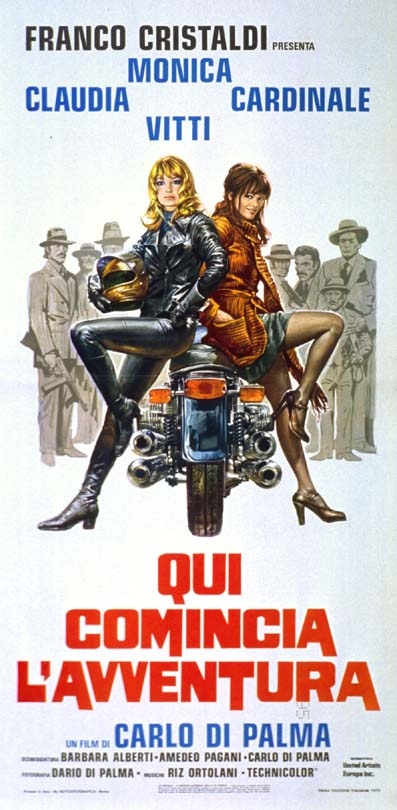 Claudia (Cardinale) has a humdrum life working in a laundrette, with a sleazy husband and no hope of anything more exciting in her future. Into the laundrette storms the titular woman, Miele (Vitti), whose devil-may-care attitude enthralls Claudia, and gives her the courage to throw away her staid existence and follow the blonde on the road. Miele is initially resistant to the idea of a travelling companion, but rides to the rescue, driving her bike through the railway station where Claudia is being harassed. Miele must make a mysterious appointment in Northern Italy with her lover, but that’s okay, as Claudia has a cousin, on the way, in Naples. However, as the two make their way, it gradually becomes clear that Miele could give Baron Munchausen a run for his money, when it comes to spinning tall tales, and both her mouth and impetuous actions, are as likely to get the pair into trouble as out if it.
 It takes real effort for a film that’s barely an hour long, significantly to overstay its welcome, but SBG manages to do exactly that, thanks to its woeful combination of shoddy action and tedious sex scenes. The heroine is teenager Mirai Asamiya (Hashimoto, about as much an actual teenager as I am), who has been transferred to a new school at the behest of her father. Little does she know, at least initially, that she is simply a tool for his revenge, headmaster Bush (Hotaru) having seduced Mirai’s mother away from her husband, and run off with her. To this end, Mirai has been brought up with what we should call, a very particular set of skills: we’ll spare you the details of exactly what the “Venus Crush” involves, but it does lead to the classic line, “He doesn’t know how dangerous your vagina is!” Before she can reach her target, she has to get close by dethroning and replacing his current enforcer of discipline, Susan (Taguchi), and also get past Bush’s lesbian daughter (Kiyokawa).
 I never really think of the Dutch as the organized crime type, but this film convinces me otherwise, based as it is on actual events from just before World War II. Oss is a town in the Southern half of the Netherlands and, it appears, everyone there is on the take one way or another, from insurance scams to larger scale shenanigans, all the way up to the mayor and the local priest. The federal government has sent military police to the town to keep order, but that only rankles the locals, for the cops are Protestants and they are Catholics. Johanna (Hoeks) hopes to escape a life of crime, planning to open a restaurant when her husband, Ties (Schoenaerts), gets out of jail. But it’s not as easy as it seems. Her spouse is happy to pimp her out, and local boss and Ties’s uncle, Wim de Kuiper (Musters), drags him back into his old ways. When Ties tries to force Johanna to have an abortion, she hatches a plan to have him killed by her lover (and client), Jan, although the plan only puts her deeper in the clutches of de Kuiper. But when she discovers just how low he is prepared to go, she decides he and the rest of his cronies are going down.
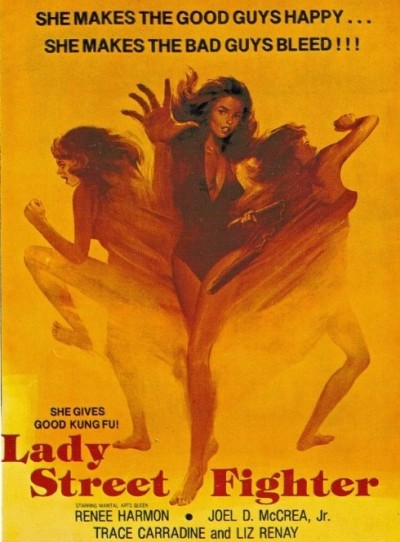 Let me start off by repeating myself, in case you missed it, because I want to be absolutely clear on these points. This is legitimately terrible. This is among the worst films I’ve ever seen. And I speak as someone with over 25 years of watching really bad films. That half-star is solely for amusement to be gathered from how bad this is, because there are basically no redeeming features here at all, and I speak as someone who will tolerate almost any pile of shit with an action heroine in it. This movie is largely responsible for the addition of the word “almost” to the previous sentence, despite being mercifully brief at a mere 72 minutes in length. The half-star is simply because I did reach the end without gnawing a limb off to escape. I think I deserve some kind of Internet prize for that.
 This film’s origins as a stage play are painfully apparent, and you can also see why the distributor’s felt it needed to have 45 minutes cut out before it could be released, as frankly, it’s a bit of a bore. The battle to recapture Orleans is the only action of note here, even though that represented the start of the Maid’s campaign to restore France to its proper ruler (Ferrer), rather than the end. After that, this more or less skips forward to his coronation, then Joan’s capture, spending the rest of the movie – and there’s a lot of it – going through the trial, and the railroading of the heroine into, first throwing herself on the church’s mercy, then recanting her recantation and returning to wearing men’s clothes, thereby sealing her fate. There’s not much here which you won’t have seen before, if you’ve seen any of the other versions of the story, touching the usual bases from Joan’s revelations that she’s going to be the saviour of France, through her trip to see the Dauphin, and so on. It does downplay the “voices” aspect, especially early on, perhaps a wise move since it’s difficult to depict, without making her seem like a religious fruitcake.
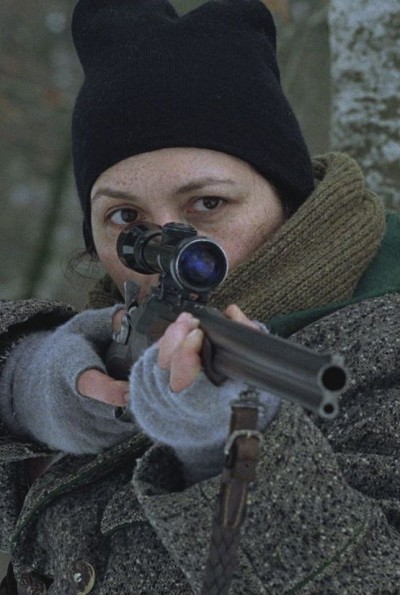 This is a very different kind of GWG film: indeed, it could almost be called an inaction heroine movie. It starts from a very simple presence. A woman (Gedeck) wakes up in a cabin in the Austrian Alps. When she tried to head to a nearby village, the path is blocked by an unseen, impenetrable barrier that has sprung up overnight, and now defines the boundary of her world. Everyone outside is dead. What do you do? How do you survive, both short- and long-term? Could you handle the loneliness? Can you retain your humanity, when you are, apparently, the only human being left?