




★
“Future schlock.”
 There are spells where I find myself going through a stream of mediocre movies, wondering when I’ll see something genuinely good. Then, I stumble into the likes of this, which leaves me yearning for the heady delights of mediocrity. It was in trouble right from the start, with five minutes of opening voice-over that did nothing but leave me confused. Then again, if your story requires five minutes of opening voice-over in the first place, you should probably rethink your storytelling techniques. The same could be said for a post-apocalyptic scenario in which food is in short supply, yet black pleather cat-suits are apparently easily available, in a range of sizes to fit all needs.
A plague has swept the land, turning the bulk of the population into flesh-eating “Joiners”. That is not the worst of it. For it turns out, Chaos is harvesting souls to usher in an unending period of unimaginable torment. Perhaps one where pleather cat-suits might be slightly difficult to come by. Humanity’s sole hope is the three descendants of the Greek goddess Nike: Nicole (Finch), Lindsay (Wood), and Alina (Di Tuccio). They are brought together under the tutelage of Rhodri (Cosgrove), trained in the arts of battle and sent off to face Chaos in their pleather cat-suits. He turns out to be a pasty-faced baldie, like Voldemort with a nose, though the final battle is so underwhelming you may wonder if the final reel went missing.
Let me be clear: there is hardly an element of this which reaches even the level of semi-competent. The most obvious flaw is a world, supposedly collapsed into anarchy and… dare I say it, Chaos, which looks utterly indistinguishable from our current one. Lawns are well-maintained, there is not a broken window is to be seen, and the neighbourhood even has a well-stocked boxing gym open. It’s truly the least convincing apocalypse ever. Into this fit our trio of heroines, who are, similarly, the least convincing saviours of the world ever. Their combat skills are negligible, and I have to assume they were cast solely for their ability to wear a pleather cat-suit (something I allow they do better than I could). Admittedly, their performances are not exactly helped by having to deliver laughable lines, such as, “Goddess power, bitch!”
The above is written as someone who has watched and, indeed, made his fair share of poverty-row cinema. The number one rule of this is: just because you can write it on the page, does not mean you can film it. You need to be permanently aware of the limitations which your lack of resources impose, and operate within them. The makers here seem to have no such idea, writing their way into a corner which a hundred times their budget would have struggled to escape. Ambition is laudable. This instead plays like a child in a cardboard box making “Vroom! Vroom!” sounds, and does not a Ferrari make.
Dir: Rebecca Matthews
Star: Rebecca Finch, Rita Di Tuccio, Georgia Wood, Peter Cosgrove
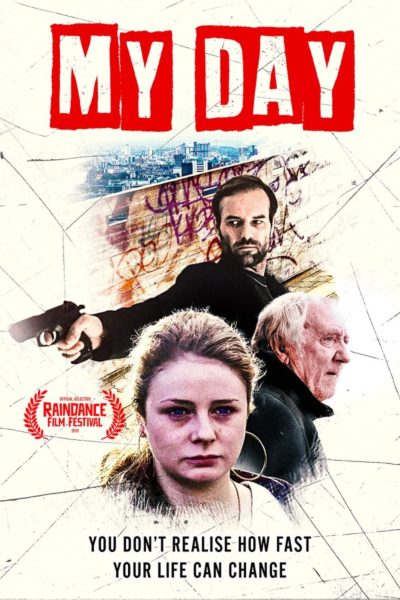 Sixteen-year-old Ally (Smith) is living her life very much on the fringes of society. Coming from a broken home, she is now homeless on the streets of London, relying on the dubious charity of questionable friends. Though Ally does have her limits as to what she’s prepared to do, she has no issue with occasional bits of work, delivering drugs for dodgy couple Carol and Gary. It’s this that gets her into trouble: a job goes wrong, after the customer tries to rape her, and Ally flees – without either the drugs or the money. Carol and Gary are bad enough. Yet even they live in mortal fear of their boss, Eastern European gangster Ilyas (Adomaitis). He wants his merch back – and Ally, as interest, for sale to his sex trafficking friends.
 Lou Farnt (Brayben) is stuck in her life, with a dead-end job, no apparent friends to speak of, and still living with her domineering mother (Ball). She seeks escape from one self-help guru after another, spending her money on their books, DVDs and audio-tapes, though with little or no apparent positive results. Then, she meets the unconventional Val Stone (Roe), who lives in a seaside caravan and promises to change Lou’s life forever. After some qualms, she agrees to depart with Lou, who does indeed deliver on her promise. For, as the title suggests, Val is a psychotic if smart killer, who is specifically targetting those same gurus. Either she regards them as a curse on humanity with their vapid schemes, or she simply wants to dispose of the competition.
 Seeing this described as “an experimental thriller,” set my alarm bells ringing. I’ve seen enough “experimental” film in my time, to realize it’s typically a code-word meaning “incoherent rubbish.” The above rating is thus partially a reflection of my relief that this did not fall into that category. You still, very definitely, have to manage your expectations here. If you go in expecting a slick, Jason Bourne style adventure, you will be sorely disappointed. For this is a no-budget entity, largely guerilla filmed by a one-man crew, and with a lead actress who has no real experience. It has already significantly surpassed all my expectations, simply through not being a total disaster.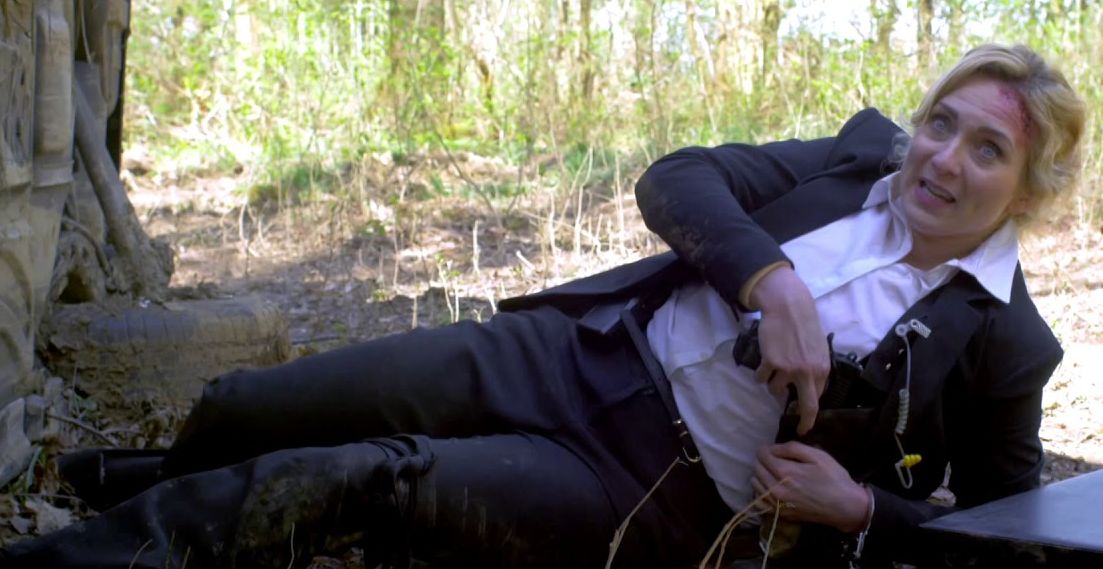
 There are indeed, six reasonably attractive ladies here, and they do indeed spend most of the film in a warehouse. Can’t argue about that. The problems, unfortunately, are numerous, and start with the fact that 6HCiaW is not, in itself, a concept sufficient to sustain a feature. The half-dozen women in question are models, hired by moderately creepy photographer Adrian (Malam), for what he announces will be his final photoshoot before retiring. Which is a bit odd, since he looks no older than thirty. Whatevs. Unfortunately, after he overhears the models making fun of him, Ade goes a bit loopy – a situation not helped by the steroid-like substance “Pump ‘n’ Gro'” which he has been ingesting. So he locks the models up in cages, injects them with the same stuff, and makes them fight each other inside an electrified cage. As you do.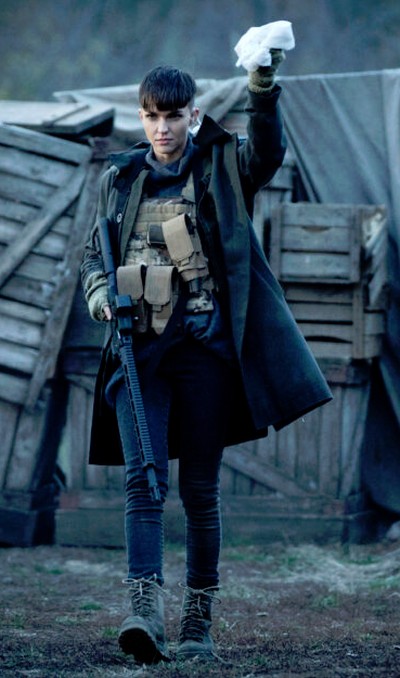
 I must confess, I was perversely intrigued when I read a review on the IMDb, apparently from one of the directors, disowning this film: “Terrible, and despite it having my name on it, I had no say in the final cut.” While it is true to say that the synopsis – “Based on true events, a girl fights for her life on the Road – Tears Of Souls – chased by a gang of slave traffickers” – is almost entirely inaccurate, it’s not
 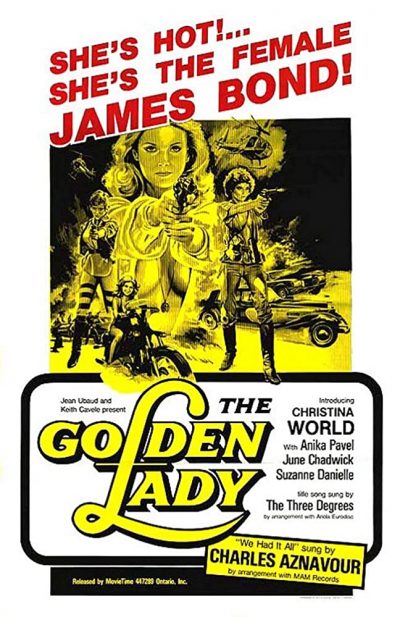 This British film occupies an odd middle ground between Ian Fleming and Jackie Collins – with a garnish of… The Village People? Yeah, there were points where I genuinely wondered what I’d strayed into. The titular female is Julia Hemingway (Skriver, under the rather laughable screen name of “Christina World”, which seems more like a dubious theme-park), who is a corporate espionage specialist. She accepts a commission to infiltrate the bidding for oil rights in a Middle Eastern country, on behalf of one of the four participants.
 A promising idea has its concept snuffed out by shaky execution and even worse writing. Sam (Rogers) is a former solder and now single mother. When her child falls sick, Sam heads for the chemist’s for medicine. She never gets there, being abducted in a van and rendered unconscious. She wakes in a large warehouse-like facility in the middle of nowhere, which turns out to be a military production facility. She’s not the only woman there, and finds that an invisible adversary, using advanced tech to cloak his presence, is taking advantage of the weekend to turn the place into a stalker’s amusement park. However, Sam’s background perhaps gives her a very particular set of skills, unavailable to the other victims.