




★★½
“Hard to see the appeal.”
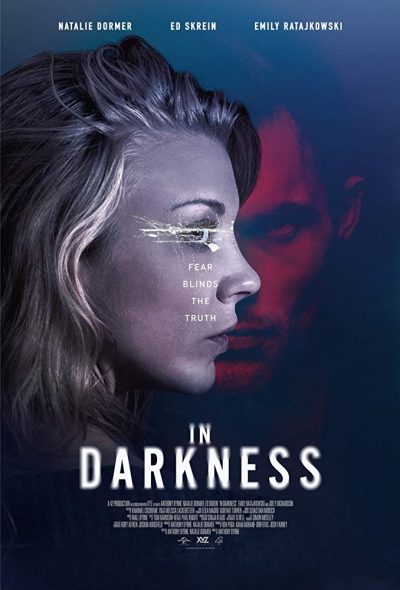 I literally had to check at the end of this, to see if M. Night Shyamalan had been involved. Because rarely since the likes of Signs – or, worse still, The Village – has a final twist so completely derailed a movie. As soon as it happened here, I was immediately listing off the scenes previously which now made absolutely no sense at all. While it’s hard to provide more information without massive spoilerage, it turned a film which was doing not badly, into one which is a poster-child for poorly-conceived ideas.
Sofia (Dormer, who also co-wrote the script with the director) is a blind piano player, living in a London apartment. One night, she hears an argument in the flat above, and its occupant plummeting to her death. Turns out the victim was the daughter of an accused Bosnian war-criminal, Radic (Bijvoet), a man with a murky past and present, whose asylum status is being challenged. The hunt is then on for a USB drive containing incriminating evidence of Radic’s business dealings, with a brother and sister pair of “security consultants”, Marc and Alex, (Skrein + Richardson) heading the chase. Mark saves Sofia from Radic’s thugs, who believe she knows the location of the USB drive. But what is their agenda – and what is Sofia’s? For, as gradually becomes clear, her presence in the affair may be considerably more than coincidental.
This starts off impressively enough, taking you into the world of a blind person living in one of the world’s biggest cities, with some particularly effective sound design. The script is very cautious with its release of information, depicting things that aren’t necessarily explained for some time. Who is sending Sofia notes in braille, that she burns after reading? Or what is the significance of her tattoos, which are not what you’d expect from a classical musician. It’s all quite intriguing, We’re deep into the film before her motives become clear, and it may be too late. For by that stage, we’re already passed the point where people are acting in ways necessary to the plot, rather than that make sense to the viewer.
It feels as if Dormer saw one too many of those awesome Korean revenge films, and decided she wanted to make one while on vacation from Game of Thrones [She, Skrein and James Cosmo, who plays Sofia’s mentor, have all appeared in that show]. She just apparently forgot, those inevitably possess a razor-edged script, in which what drives a character is always kept front and centre. Here, by the time you are given sufficient reason to care about Sofia, you have already waded through too many scenes that are dead weight. Sometimes, this is because you don’t have the necessary information yet; in others, it’s just because the makers thought they were needed. None of which excuses the revelation in the last shot; it’s been while since I’ve come as close to throwing something (remote control, coffee table, dog) at the TV set.
Dir: Anthony Byrne
Star: Natalie Dormer, Ed Skrein, Joely Richardson, Jan Bijvoet
 Joan Butler (Bernadette) is an enforcer for mob boss Frank (Foster), with a zero-tolerance policy for those who disrespect her – whether they are on her side or not. When this eventually causes some of her gang to turn on Joan, she’s brutally beaten to a pulp, and apparently killed. However, she rises from the dead, now a figure who lives in the darkness, and one who has acquired the power to manipulate shadows. She sets about her mission of revenge against Frank and those who killed her. This is much to the distress of her on/off boyfriend Anthony (Celigo), a social worker. But her feelings for him and desire to protect the unfortunates with whom he works, puts them all at risk, when Frank realizes they represent her weak spot.
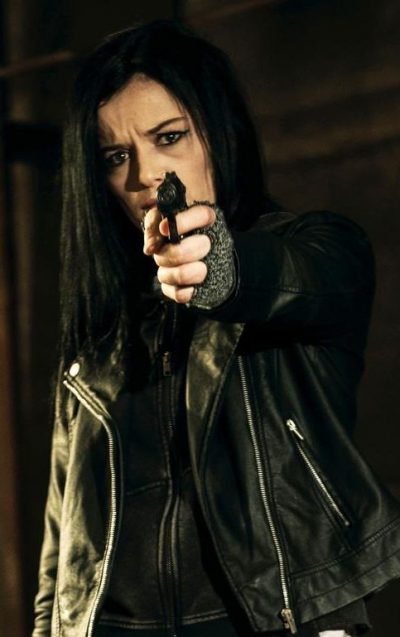 This wasn’t quite what we expected. In fact, replace “quite” with “at all”. It starts off as looking like some kind of revenge porn, with pathologist Margaret Powers (Tyson) kidnapping Finnbar (Ward), the man she’s certain murdered her son. Finnbar was apparently able to get away with it, because he was the son of a notorious local criminal, Tommy O’Neil (Hayman). She wants Finnbar to confess to his crime, and recruits her son’s ex-girlfriend, Zoe (Jarvis) to help in getting her vengeance. Initially, the capture goes well, with the two women then holing up in an abandoned warehouse by the docks, to begin the interrogation. However, this is where the film starts to diverge from the expected, as it turns out Zoe’s intentions are not in line with Margaret’s, as they initially appeared.
 There is entertainment value to be found even in bad movies. Bad action, horror and SF are sometimes just as amusing as the good stuff. But bad comedy is almost irredeemable: that’s why Mystery Science Theater 3000 rarely go there. Bad comedy just… sits there, dull and unamusing, almost worthless. And that’s what we have here. It’s a somewhat interesting idea, with some potential. Unfortunately, the execution – mostly in the script and direction – are so woefully inept that even the brave efforts of Florence Henderson, in her final film, aren’t enough to salvage it. And wasting the talents of Pam Grier needs to be some kind of cinematic capital offense.
 Proof that a lack of originality is not necessarily a bar to being an entertaining movie, this pulls together elements from all over the place, but probably most notably, The Long Kiss Goodnight and John Wick. You have the “former assassin now leading an idyllic family life, until her past catches up with her” of the former. And the “Oh, they’re surely not going to kill tha… Hoo-boy. The hero/ine is going to be VERY angry with them” of the latter, among other elements.
 The elevator pitch version of this sounds like a million other kung-fu films: Shen Ping Hong (Li) seeks revenge on the people who killed her parents and left her crippled. But there’s rather more going on beneath the surface, and shades of grey on both sides. One of her targets, Lord Kao Hung, regrets what happened and wants to help Shen regain the use of her legs. But Shen only agrees to let his son Tien-Ying (Yueh) help, in the belief that it will make her mission of vengeance easier. It feels almost like she’s a mad dog, lashing out at anyone who tries to help; keeping the severed heads of her victims in jars is a clue there. Meanwhile, Kao’s associates – and Tien-Ying’s ex-girlfriend (Chiao) – think he’s helping because he wants to get Shen’s jade sword for his own ends, and are intent on getting their revenge in on her first.
 This feels less like a novel, than a novelization of a screenplay, adapted by a not particularly proficient writer. The text is littered with paragraphs which seem more like stage directions than literature, and is startlingly repetitive. For example, in one section near the beginning of the book, five of seven consecutive paragraphs start with, “As she/Kayla…” It’s not necessarily a bad screenplay, with an idea containing some potential. But it would be in need of several rewrites before any studio exec would sign off on it.
 This takes place in upstate New York during the 1812 war between Britain and America, when combatants are courting the Mohawk tribe to join forces with them. The natives are suspicious of both, and won’t commit to either. Working for the British is Joshua (Farren), who is in a slightly odd, three-way relationship with Mohawk warrioress Oak (Horn) and fellow native Calvin (Rain). On the other side is Hezekiah Holt (Buzzington), and his small band of Americans, who are out for redcoat blood. When they blame the Mohawk for murdering some of their number, their violence quickly extends to encompass Oak and Calvin, as well as Joshua. After Oak is left all alone, she goes on the war-path to take revenge on Holt and his men.
 Marginally competent, and just not very exciting, this low-budget offering is the story of December (Kurishingal). As a young girl, she watched as the rest of her family was slaughtered by Law (Ramsey) and his villains, the result of a debt owed by her father. A decade or so late, she has grown up and taken to the streets as a vigilante, seeking vengeance on those responsible. Or, until she finds them, any other perpetrators she comes across during her night-time ramblings through the mean back alleys of the city. Helping her mission, is that she now works for the police, which puts her in a prime position to ensure, for example, that any evidence pointing in her direction goes “missing”.