
Literary rating: ★★★★★
Kick-butt quotient: ☆
Warning –my review doesn’t contain any spoilers for this book, but it does divulge a major series plot development from the preceding book!
 In the 10th century B.C., the kingdom of Sheba (or Saba –the S and Sh sounds were still fluid in the Semitic alphabets of that day) straddled the Arabic and African sides of the southern entrance to the Red Sea, and enjoyed considerable income from its control of that trade route. Both the Old Testament books of I Kings and II Chronicles record a state visit by the Queen of Sheba to King Solomon. Neither of these writers record her name (it varies in the legends, but the most common name given is Balkis or Belkis –English transliterations vary) or much about her, and written records from Sheba at this time have not survived; but she’s also mentioned in the Koran. Jewish, Arabic and Ethiopian legends (the latter written down in the ancient writing Kebra Negast, or “Glory of Kings”) some of which probably preserve actual handed-down oral history, greatly elaborate the story, and the latter makes Solomon out to be the father of her son and heir, Menelik. (The royal house of Ethiopia historically claimed descent from Solomon through Menelik.) The legends of the Masai and other African peoples south of Ethiopia also credit Menelik with a great (and obviously historically memorable) expedition through their territories. This real-life material provides the basis for Jade del Cameron’s fifth adventure.
It’s now the autumn of 1920, and an American silent film company is in Nairobi, preparing to journey south (into what is today the country of Tanzania) to fabled Mount Kilimanjaro, there to film a movie, set partly in ancient and partly in modern times, based on a supposed legend of Emperor Menelik having climbed the mountain to die and be buried near the summit with his treasure. Ever ready to visit other African locales to do an article and photo shoot for “The Traveler” magazine –based on the real-life magazine of that era “Travel”, as Arruda mentions in her fascinating-as-always Author’s Notes– Jade’s agreed to go along as second-in-command (with primary responsibility for looking after the expedition’s female members) to the group’s guide –though she’s less than delighted to learn that the guide is Harry Hascombe, whom series readers have met before. The trip will also give her a chance to think seriously about, and hopefully finally sort out her mixed feelings, about her beau Sam Featherstone’s marriage proposal. But shortly before departure, things get off to an ominous start with a strange murder-suicide just outside Nairobi’s Muthaiga Club.
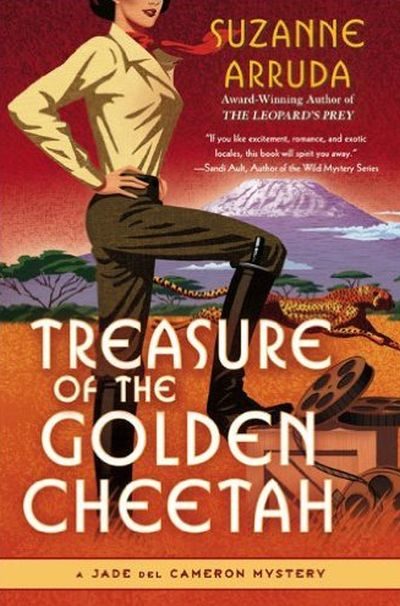
Much that I’ve said in my reviews of previous books in the series applies to this one, too. All the things that attract its fans are here: a strong, tough heroine with admirable character and with the guts and physical conditioning to handle dangerous challenges (yes, that knife in her boot on the cover picture is going to have to come out of its sheath!), well-drawn and sometimes likeable supporting characters, adventure and danger in a well-realized exotic setting, chaste romance, good writing with bad language kept to a minimum and no explicit sex, an undercurrent of supernaturalism and mystery that never turns the book into supernatural fiction but that adds a dash of that flavor. But I can say that this is one of the strongest books in the series, and presents one of the best constructed mystery plots –in several of the books, I fingered the culprit early on (and twice in the first chapter!), but I didn’t here! This one kept me guessing (wrongly) almost down to the wire. The behind-the-scenes look at the film industry of the 1920s enhanced the book; and though I didn’t recognize the tie-in to Hemingway’s “The Snows of Kilimanjaro” (never having read that story) until the Author’s Notes explained it, I can recognize now that it was masterfully done. I also appreciated the personal growth here of Jade’s young Kikiyu friend, Jelani.
There are only (so far) two more books in this series; Barb and I have already started reading the sixth installment, The Crocodile’s Last Embrace. I’m hopeful Arruda will eventually write more of them; Jade’s a heroine we both want to keep on spending time with!
Author: Suzanne Arruda
Publisher: New American Library (Obsidian imprint), available through Amazon, both for Kindle and as a printed book.
A version of this review previously appeared on Goodreads.
 This is set in a world where various kinds of magic exist, alongside humans. The former include shapeshifters, vampires, faes (fairies), mages and the despised “Legacies”. The last-named cover the heroine, Levy Michaels, and that’s a bit of a problem. The reason for the hate, is because some of her kind were responsible, in previous generations, for a very nasty bit of spellcasting called “The Cleanse”; it was basically intended to cause occult genocide, and only narrowly avoided. Since then, Legacies have been harried and hunted by the other kinds. Levy’s late parents taught her to hide her abilities and pass as human, and she does so now, albeit occasionally having to handle those who track her down.







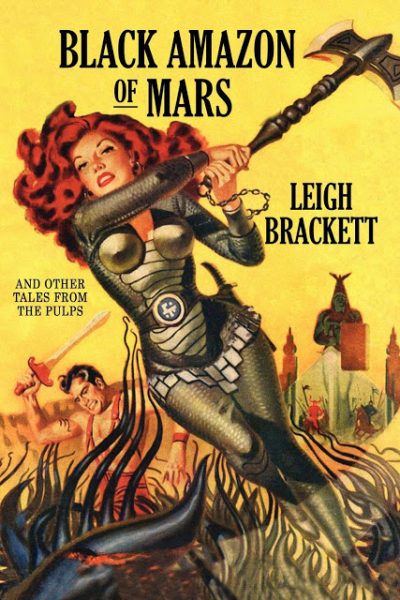 Normally, I like to start a series at the beginning. But I chose to read this second novella of Brackett’s Eric John Stark series, as my long-awaited first introduction to her work, because Amazon offered me the chance to read it for free on my Kindle app. (And yes, I’ll definitely be buying a paper copy!) That means there are unanswered questions here about Stark’s origins and background, and about the Martian world –what kind of “beasts” are used as mounts here, for instance, or what the economic base of a city-state like Kushat is– that probably have answers in the first book, or earlier stories. (The author wrote about the character in both formats, and not all of the corpus is still in print.)
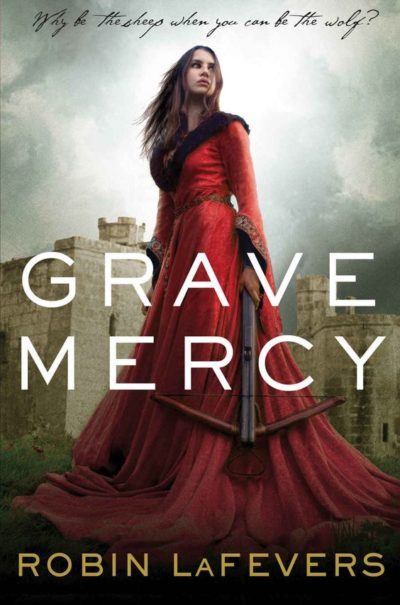 This works rather better as historical fiction than an action novel, and is set in the late 15th century, when the province of Brittany was fighting to remain independent from France. Such high-level political machinations are far above the heads of most inhabitants, who are busy with everyday survival. At the beginning of the book, this includes the heroine, 17-year-old Ismae, who is more concerned about her upcoming, unwanted marriage – more of a sale by her father, to be honest – to a brutal husband. Rescue comes in an unexpected form, as she is whisked away to the Convent of St. Mortain, devoted to one of the pagan gods, absorbed into the Catholic faith as a saint. Mortain’s field is death, and Ismae, who has a natural immunity to poison, is trained in his dark arts. She becomes a tool used by the Mother Superior – albeit for political ends as much as religious ones.
 “A cleaved head never plots.”
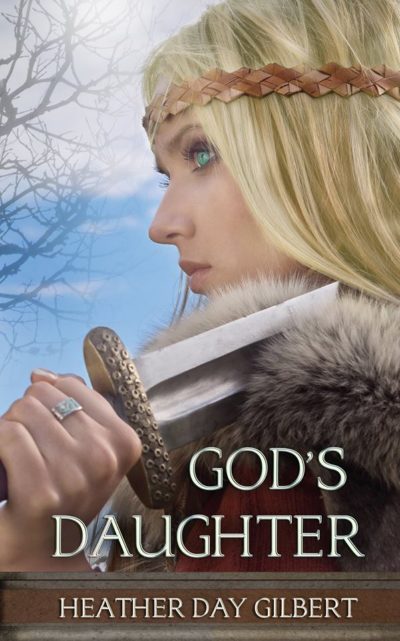 Gilbert follows the factual account of events in the sagas faithfully (even including the two conversations I find suspect). But she fleshes out the picture with a more sympathetic vision, and a broader reconstruction of a plausible context, that gives us a very different picture of what (may have) actually happened on the Vineland coast a thousand years ago. The Freydis who emerges here isn’t an evil harridan, and isn’t psychotic. What she is is a tough-as-nails young woman who’s the product of a society that puts a premium on physical courage and fighting ability, who’s had to fight tooth and nail for anything she’s ever gotten, who didn’t feel loved as a child, never knew her birth mother, and doesn’t show love or give trust very easily, a female warrior (in her culture, that wasn’t a contradiction in terms) who killed men in combat while she was still in her teens, who doesn’t readily take orders from any man, woman, or deity, and who isn’t a total stranger to the effects of the special kind of dried mushrooms imbibed by Viking “berserkers” –which are as potent as modern-day “angel dust,” and just as dangerous. She’s also a smart, competent woman (it says something that she’s the expedition leader here, not her husband) with principles as strong as steel, and deep reserves of love and loyalty. And like all of us, she’s a woman on a spiritual journey … which might not end where it began. In real life, the Vikings of succeeding generations never forgot her. Modern readers probably won’t, either.
 Disclaimer at the outset: I haven’t read this novel from cover to cover. Seven years ago, I read the prologue and first three chapters; this time around, I read the first seven (re-reading the ones I’d read before), and skimmed the last ten and the epilogue –though I skimmed very thoroughly, taking about three hours and absorbing all of the major plot points. I feel qualified to give it a fair rating and review; but the level of bad language and grungy sexual content, blended with the tedious prose style and the wall-to-wall cynicism of the author’s literary vision (if we can call it that) made this too distasteful to read word-for-word any further.
 For a writer who was so inclined, the subject matter here would be a gold mine for moral and social reflection. The storyline cries out for exploration of the (im)morality of a drug trade that corrupts and destroys every life it touches, of the roots of demand for drugs in modern society, of the inequities in Mexican government and society for which the drug trade is a symptom and a result, of the failure of the prison system as an instrument of rehabilitation or justice, and any number of other serious themes. Readers who bring the raw materials for such reflection with them to the book may indeed think about these things, but without any direct encouragement from the author. His basic message appears to be nihilistic cynicism; and if anything, he tends to glorify drug trafficking, in somewhat the same fashion as the “narcocorridos” that he quotes at times.