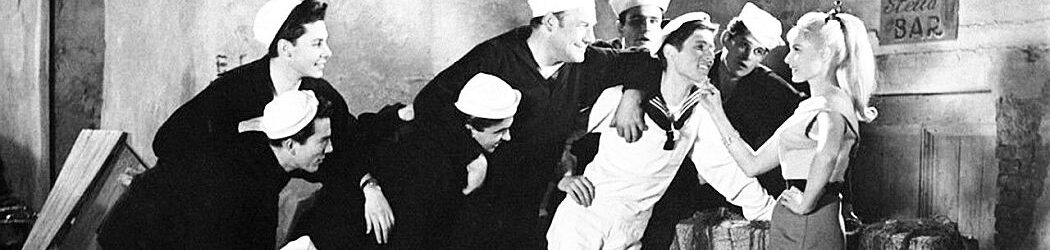

The Kitchen

★★½
“Rather over-baked”

Regardless of its flaws, this does at least show that comic-book adaptations needn’t involve superheroes and Thanos snaps. This is instead a crime story, beginning towards the end of the seventies in Hell’s Kitchen, a working-class area of New York. Following a failed armed robbery, the husbands of Kathy (McCarthy), Ruby (Haddish) and Claire (Moss) are sent to jail, leaving the wives to fend for themselves. To make ends meet, the trio begin to move in on the territory of local boss Little Jackie, who has been taking money from local businesses, without delivering the promised protection. When Jackie goes after them, he is killed by the women’s ally, Gabriel (Gleeson), who begins a relationship with Claire. But the husbands’ return to Hell’s Kitchen looms on the horizon, as the women’s growing power also brings them unwelcome attention – both from the authorities and the Mafia who dominate the city.

More than slightly reminiscent of Widows, this is considerably less plausible. The area at the time was controlled by the Westies, a powerful Irish-American group, and the film gives you little or no reason to believe why they’d roll over and let a bunch of amateurs – and women at that – muscle in and take over. In reality, I strongly suspect they’d be squashed like bugs at the first collection of protection money. One woman leading a crew might be possible (see Dangerous Lady for a good example); tripling down, as the movie does, stretches credibility to breaking point. It doesn’t help that there is only one decent character arc between them. That belongs to Claire, who goes from abused wife and perpetual victim, to the group’s enforcer under the tutelage of Gabriel. One of the film’s best scenes has him giving a lesson on dismembering a body to dispose of it. Kathy can’t watch at all, and Ruby is similarly appalled; Claire is entirely fascinated. It’s clear something has been awakened inside. And her incarcerated husband isn’t going to like it much.

It’s a shame she is largely relegated to the sidelines, being the most interesting of the trio – as well as the one most suited to this site, as the poster suggests. Instead, it’s mostly the blandly uninteresting Kathy who takes centre-stage. Even Ruby would have been an improvement, her black heritage adding an element of racial tension, with her husband’s family reluctant to accept her into their bosom. We’re also asked to accept them as heroines without explanation, ignoring the inherently scummy nature of the protection racket which they operate. But they’re nice about it, so that’s okay! Then again, I’ve never bought into the “They’re just taking care of their family” excuse, especially when, as here, efforts to get gainful, legal employment are all but absent. Berloff seems to be aiming for a Scorsese-like approach, down to the use of contemporary pop songs as a commentary on proceedings. While there are worse auteurs to ape, you’ll likely be left with little more than a desire to go watch Goodfellas.

Dir: Andrea Berloff
Star: Melissa McCarthy, Tiffany Haddish, Elisabeth Moss, Domhnall Gleeson
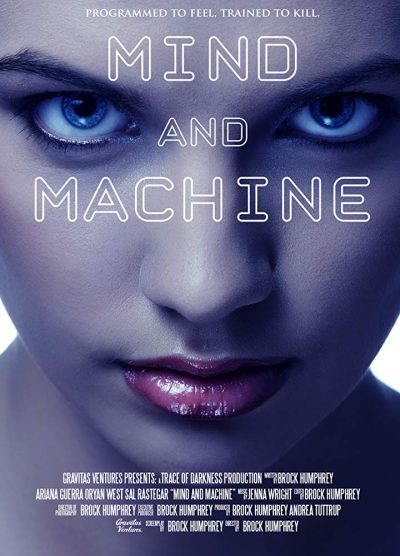
Mind and Machine

★½
“Circuit bored.”

Intelligence without morality to govern it, is psychopathy. So what happens when you create an intelligent machine, but deliberately avoid installing any kind of moral compass? It’s an interesting idea for a film. Not that you’d know it from this unconvincing effort, which sucks the potential out of it. In this near-future – it’s set in 2024, close enough to now, no actual work is required on the part of the makers – androids have become part of everyday society in many roles. Crime boss Isaac Lynch (Restegar) orders technician Leo Cameron (West) to make one without a conscience, so that it can be used as an assassin, saving those pesky hitman fees. Only Leo crafts the robot, Maya (Guerra), in the image of his late wife. On the plus side: he gets to see his wife again. On the other hand: she’s an amoral killer. Didn’t think that through too well, did he?

And that’s the problem here: not much of this makes sense. Not Leo’s actions. Not the way nobody else came up with the idea first; most obviously, the military would be all over this in reality. Not how Isaac’s entire criminal organization consists of about three people, yet is still capable of pushing technological innovation into uncharted territory (and he also kills a customer, rather than letting him pay their debt). Not even the way Maya – and this is so obvious, it’s not a spoiler – eventually rebels against Isaac’s orders. It seems like writer/director Humphrey decided where he wanted the film to end up, but couldn’t be bothered to figure out how it could logically reach that point.

I’ll give Guerra credit for her portrayal of Maya, which is credibly lacking in emotion. Though again. there’s no consistency there, nor any explanation for her decision to revolt, after being made to torture an undercover agent. Why is killing unproblematic for this machine, yet torture represents a breaking point? And the lead actress’s reluctance to disrobe does lead to one of the most embarrassingly unconvincing body doubles I’ve ever seen: Guerra’s hair is black and straight, while that of the woman standing in for her, is brown and wavy. If you can’t do it well, Humphrey should have written it out of his script, since it’s not as if it was necessary to the plot.

Maybe he needed it for running-time purposes. Because this barely qualifies as a feature, lasting a mere 70 minutes, and that includes a slow, slow end credit crawl. It certainly feels considerably longer, and my interest steadily waned, as it failed to provide any interesting answers, or ask any interesting questions. A slowly-developing self awareness and independence, and more focus on Maya, rather than (the thoroughly uninteresting) Leo and Isaac, might have been the way to go. But then, that was Ex Machina, wasn’t it? This is a poor imitation thereof, and one which sporadic bursts of low-rent violence can do nothing to rescue.

Dir: Brock Humphrey
Star: Ariana Guerra, Oryan West, Sal Rastegar, Bobby Hernandez

Sleeping Dogs Lie

★★
“Dogged by issues.”

Account Armando (Cabellero) has made a series of questionable decisions, the two largest of which are: a) skimming from his organized crime connected client, Mr. Nakamura, and b) cheating on his wife Eleni (Giannatou) with his secretary, Luna (Zanella). These both come to a head when Eleni walks in on the pair of them, and the three of them take a long drive to a remote house in the desert, with Armando in the trunk of the car. There, Eleni prepares to extract the access information to the account where he has stashed the ill-gotten gains – an account Luna is rather unhappy to discover was created in her name. However, Armando knows this information is the only thing standing between him and a hole in the desert, so won’t give it up easily. And what, exactly, are Luna’s allegiances? Is she on his side or that or Eleni?

After a satisfactorily intriguing start, this falls apart after Armando breaks free of his bonds, and vanishes into the blackness surrounding the cabin. Far too much of the film thereafter consists of running around in the near darkness, and you’re left peering into the gloom, trying to figure out who is doing what, and to whom. [Low-budget film-makers need to realize that their product is far more likely to be seen on the small screen than a big one, and light/shoot on that basis] Though the problems start earlier, with a script that seems a draft or two short of polished. For instance, Eleni talks at length to Armando about how the foot is the most sensitive part of the body, then drives a nail right through… his hand?

It doesn’t help that the lead actress appears to be operating largely in her second language. What we get here is an object demonstration of the difference between speaking English, which she does perfectly well, and acting in English. It’s the latter which is an issue, and one made all the apparent by a scene or two where she gets to revert to her native Greek. The difference, in a positive direction, is palpable. Maybe it should just have been made entirely in Greek and Spanish?

But the weakness here is mostly the storyline, which relies too much on contrived incompetence necessary to the plot. By which I mean, if the trio had a lick of sense, events would have unfolded in three radically different directions. Eleni, in particular, stops being the intelligent and resourceful woman she initially appears, the one which I was looking forward to seeing, taking her revenge on an idiotic and unfaithful husband. Instead, by the time this ends, with one final twist beyond what is either necessary or plausible, you’ll be hard pushed to muster any reaction beyond a sigh, or possibly a small, marginally derisive snort.

Dir: Konstantinos Kovas
Star: Markella Giannatou, Miguel Angel Caballero, Joanna Zanella

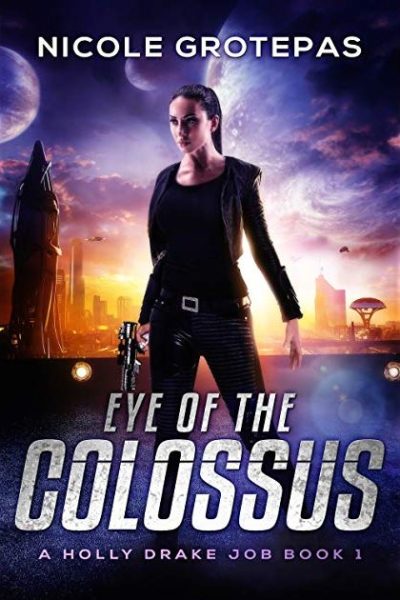
Eye of the Colossus, by Nicole Grotepas

Literary rating: ★★½
Kick-butt quotient: ☆☆½

This probably picked up half a star in the final couple of chapters, because up until the end, the plot seemed to have some huge deficiencies. While most of these were certainly addressed by the final resolution, it still left a rather questionable taste in my literary mouth [if you see what I mean!]. The heroine is Holly Drake, who has been unjustly sent to prison after killing her abusive husband. Unfortunately, he was a police officer, and some of his dubious colleagues helped ensure Holly went to jail for it. On release, her previous career as a teacher is no longer an option, and she’s largely thrown on to the charity of her sister, Meg, also a cop.

It’s Meg who gives Holly a lead to potential employment, albeit of a shady nature. But Holly has few options, and has to accept the job, which involves retrieving a necklace which has been stolen from its rightful owner, before it can be whisked away. To complete the task, she needs to put together a team with the various skills necessary, and also acquire a piece of tech called the Skelty Key, which is needed to defuse the security around their target. For someone with no background in the underworld, all of this poses a significant challenge, even discounting entirely the actual job itself. [Why she was hired at all is one of the eventually explained plot deficiencies]

This is nominally science-fiction, taking place in a six-moon system around Ixion, a gas giant. There are several different races, in addition to expat Earthlings like Holly, and the relationship between them is occasionally fractious. However, I never got any particular sense of “alienness”: you could rewrite this to be on Earth with almost no SF elements. There’s also not much in the way of an antagonist here. Early on, the “Shadow Coalition” appear to be trying to stop Holly from carrying out her mission; this aspect seems to peter out, as if the opposition got bored and drifted away. This combination perhaps turns it into more of a “crime procedural” than SF; that’s less criticism than an observation.

What is my main criticism is its sluggish pacing. You’re more than 90% of the way through before you get to the heist which is the book’s focus, and it’s a bit of a drag to reach that point. While self-contained enough overall, it’s clearly a set-up for future volumes, and I must confess, these are somewhat intriguing. There’s some stuff which happens to Holly late on, toughening up her character from the rather whiny one she has been to that point, and we also discover the harrowing circumstances leading to her incarceration. I just can’t help feeling we could have got to the same place considerably more economically, in about one-third of the page-count, and we would all have been considerably better off.

Author: Nicole Grotepas
Publisher: Amazon Digital Services, available through Amazon, both as a paperback and an e-book
Book 1 of 3 in the Holly Drake Job series.

Counterfeiting in Suburbia

★★½
“Fake it till you make it.”

High-schoolers Reilly (Albuquerque) and Erica (Wallace) have discovered a way to literally print money, forging hundred-dollar bills. They then use these to buy high-end fashion, and sell these ill-gotten gains on to their schoolmates for genuine cash. The more cautious Reilly wants to stop, but realizes she can do good by helping Karen (Butler), her aunt and guardian, who is in financial trouble. So when Erica is insistent they expand, Reilly goes along with it, and they use the school’s art-class resources to up their game, laundering the fake money through foreign exchange stores. However, this criminal empire comes under threat, after art teacher Tim Sylvester (MacCaull) discovers what they’re up to. Because by chance, he owes a large sum of money to some nasty people, and starts a relationship with Erica, to make sure she’ll keep working for his benefit.  Worse still, the Secret Service have been alerted to the flood of funny money, so are also investigating.
I have… questions. What made R+E get into counterfeiting to begin with? For when the film starts, they’re already printing out the Benjamins on their home printer. And where do you get the special paper? While there have been cases of people using inkjet printers for this purpose, it seems these involved wiping $5 bills, then reprinting them with higher denominations. [Googling to find this out has probably got me on a watch-list…] And while the film makes the point, especially in high-end stores, that most purchases using credit-cards means assistants are less familiar with spotting fake bills, this surely doesn’t apply to currency exchanges? As a credible piece of scripting, this ends up skipping most of the necessary check-boxes, and I doubt it’s based as much on a true story as claimed.

It’s not entirely without merit though. The underlying idea – teenagers gradually getting out of their depth, and not realizing it until they are too far in – is a decent one. The contrast between the two leads is effective as well: Erica is perpetually touting them as being like Thelma and Louise, and is unfazed when Reilly points out how that ends. There’s also a contrast in motives between the girls – though you wonder a bit why they’re friends, given their divergent natures. Reilly is entirely selfless, and is using her illicit income for what she perceives as “good” [though never quite considers the negative implications of her acts]. Erica, on the other hand, is apparently doing it for the thrill or the LOLs, and you’re never sure quite what this loose cannon might do.

By coincidence, this was watched the same weekend as Body of Sin, and the two films are similar. Both focus on two young women of disparate characters, whose decision to team up and go over the border of legality has severe consequences. Both also have severe problems in the script department. Body was perhaps better technically, but this gets the edge – simply for the sheer uselessness of the only sympathetic male character, which may arguably be more feminist than anything the women do. While some way short of great, it just about passes muster, if you’re in an undemanding Netflix mood.

Dir: Jason Bourque
Star: Larissa Albuquerque, Kayla Wallace, Sarah Butler, Matthew MacCaull

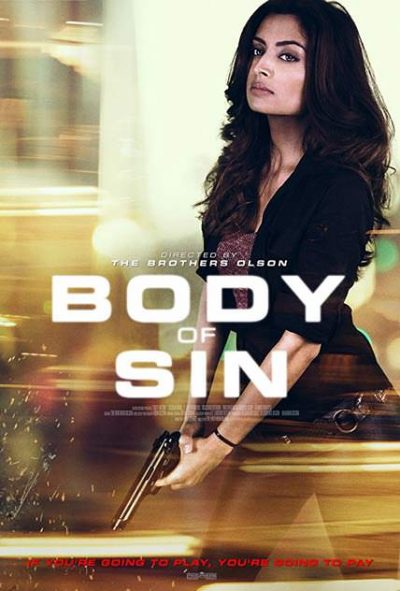
Body of Sin

★★
“Diamonds are clearly not forever.”

Erica (Kriis) is an attractive con-artist, who seduces married men in hotels, then drugs and robs them, knowing they’ll never be able to report the crime. She has just brought on an apprentice, Lauren (Patrikios), to learn the dubious trade, watch her back, etc. Their next score turns out to be the jackpot. as they discover the target was carrying a stash of diamonds with a seven-figure value. Absconding with their ill-gotten gains, the pair decide to lay low for a while, and head to Erica’s hideout on the holiday destination of Isabelle Island. They’re disturbed to read news reports that the target turned up dead in the room, and it quickly appears that the owner of the diamonds is closing in on them. But who is the threat? Local policeman, Mike (McCullough), for whom Lauren has a thing? Visiting boat-owner and part-time magician Tom (Berdini), with whom Erica has a fling? Or the creepy bald guy who arrives on the island and appears to be stalking Erica?

The performer who makes the best impression here is Tybee Island in Georgia, playing the role of Isabelle Island. It seems like a very nice place to take a holiday, picturesque and relaxing. Everyone else? Not so much. In particular, you could have Meryl Streep and Helen Mirren, and they’d still struggle to do anything with a script which resembles French lace, in that it’s a lightly-connected series of holes. For instance, when robbing the target, Erica first comes across an empty briefcase, before locating the diamonds in a tube, hidden in the toilet cistern. Inexplicably. she still takes the briefcase – which, of course, turns out to contain a tracking device. For the film’s entire duration, people both good and bad don’t behave in ways that make logical sense, and Creepy Bald Guy is probably the Worst Stalker Ever, though in his defense, there does turn out to be something of an explanation.

The leads are decent enough. There’s a nice contrast between the utterly cynical and untrusting Erica, who believes she’s on some kind of crusade to punish deceitful men, and the more naive and open Lauren, who gradually becomes more appalled, the more she discovers about her partner. I’d far rather have seen this angle exploited, with the two women turning from Thelma and Louise buddies, into vicious competitors, battling each other for the diamonds. Instead, they literally stand around while the (eventually revealed) good guy and villain tussle it out, mano a mano, on the edge of a convenient cliff. No prizes for guessing how that ends. The other thing is, for a film basically predicated on sexual attraction… it’s  tame stuff. Given Kriis bears some resemblance to Penelope Cruz – though she’s Indian rather than Hispanic – this was disappointing. If ever you want proof that technical competence alone is not sufficient to justify a movie’s existence, this should be Exhibit A.

Dir: The Olson Brothers
Star: Elisha Kriis, Ellie Patrikios, William Mark McCullough, Riccardo Berdini

Shadow of the Lotus

★★
“Give the man a hand!”

We know very well that, on low-budget films, people have to wear many hats. Hell, my IMDb entry began when a film I was supposed to be helping my wife produce, had an actor drop out. You can only respect those who can turn their hands to multiple jobs. And, yet… There’s a point at which it become self-defeating, because nobody can be good – or even competent – at so many positions. Lotus appears to have set new records in this area, with Jeff L’Heureux having his name listed in the end credits at no fewer than thirty different points, from director to make-up artist. That’s wearing an entire department store’s worth of hats, most apparent in the running time. For this is an 85-minute movie which runs for 124 minutes. L’Heureux the editor desperately needed to have had a word with L’Heureux the director and L’Heureux the writer about that.

There are two crime triads: the Black Lotus and the Red Dragons. Sarah (Huang) works for the former, but when she attempts to leave the organization, is shot, set ablaze and left for dead [Memo to self: if ever I become an evil overlord, I will not set my enemies on fire within easy rolling reach of the Pacific Ocean…] Naturally, she’s still alive, and comes back to begin disrupting the somewhat precarious plans of her former gang to form an alliance with the Dragons – I guess with the goal of forming some kind of super-triad under Gensho Woo (Geoff Wong). In the process, she encounters and subsequently teams up with local cop Claire (Neale), who has been trying to work things from the legal end. Sarah, needless to say, has no such limitations…

As noted, this is desperately in need of severe trimming, with hardly a single scene which does not go on for too long, where not altogether superfluous. This is particularly apparent in the early stages: it feels like an hour before things actually get going, with endless chit-chat between the players that’s blandly uninteresting. Things do improve in the second half, even if I found myself irrationally irritated by the way Sarah held her gun sidewise, like an amateur gangsta wannabe. The main plus is former colleague Jade (Macalino), who gets the chance to unleash her inner psycho. You could perhaps argue her performance is rampant over-acting, yet it’s still a heck of a lot of fun to watch, and the film is the poorer for Jade’s eventual departure.

L’Heureux is clearly inspired by, and trying to reproduce, the style of classic Hong Kong cinema from the likes of John Woo. That’s laudable enough an aim. Though the action is competent, it does fall short of these lofty goals, mostly lacking the passion and intensity which Woo’s actors brought to his films. This was never a function of their cost – admittedly, having Chow Yun-Fat was just a slight help to him there – though in defense of this, it appears to have been the director’s first feature. Plenty of room to improve next time, especially if he gets the help he needs to avoid spreading himself thinner than margarine on toast.

Dir: Jeff L’Heureux
Star: Vicky Huang, Melanie Neale, Alex Law, Candice Macalino

Miss Bala (2018)

★★½
“Cultural appropriation”

As the lazy joke goes, I preferred this film the first time I saw it, when it was called… Well, actually, it was called Miss Bala then too, this being a remake in (mostly) English of the Mexican movie from 2011. Its remake status probably explains why both protagonist and cartel boss antagonist are American citizens: convenient to avoid those pesky subtitles, yet it also allows the director to avoid blaming poor, downtrodden Mexico – in an interview, she pinned the drug business on “American demand, and of course, American guns.” Calling that a gross simplification is an insult to gross simplifications.

It keeps a similar structure to the original, albeit with tweaks necessary to get a Yankee involved. Rather than a beauty pageant contestant herself, Gloria (Rodriguez) is a Los Angeles make-up artist visiting her friend in Tijuana. After witnessing a nightclub shoot-out after which her friend vanishes, and making an incredibly stupid decision to tell the first cop she sees about it (really, I’ve spent one weekend in Mexico and know better than that), she ends up under the thumb of Los Estrellas, a cartel run by Lino Esparza (Córdova) – hey, also brought up in America! After unwittingly dropping off a car-bomb that blows up a DEA safe-house, Gloria also ends up under the thumb of Brian Reich (Lauria), a federal agent who makes her operate as an undercover mole inside the gang.

When Chris discovered the director of this was responsible for Twilight, she paused and then asked with a concerned expression, “They’re not going to turn into sparkly vampires, are they?” Fortunately, they don’t. Yet the adjustment in story is almost as problematic, because it seriously weakens Gloria’s motivation to comply. Rather than having her direct family be threatened, it’s just some friend and her little brother; we’re given no reason to understand her desperate willingness to do anything to save them. There’s also the sudden transformation into a heavily-armed beauty queen at the end, where one quick session of “Fire at them from the pointy end” training apparently turns her into the evening-gown clad angel of death shown in the picture.

Hardwicke even complained the film’s poor reviews were due to male critics preferring the more passive heroine of the original. Uh, no. It’s more that the 2011 version didn’t go full Peppermint – and with less justification. It was because its original heroine was atypical which made it work better. The remake manages to reproduce the flaws, while weakening the best element: depicting the futility of struggling against immensely powerful forces on both sides of the law, which really don’t care, save for how they can use you for their own purposes. Depressing, maybe; yet it had a realism this version could use, wanting instead to be both empowering wish-fulfillment and gritty narcocinema. Hardwicke should have swallowed her faux-feminist outrage, and just given us 90 minutes of Rodriguez shooting shit up in a long dress.

Dir: Catherine Hardwicke
Star: Gina Rodriguez, Ismael Cruz Córdova, Matt Lauria, Ricardo Abarca

Killing Joan

★★
“Eating crow.”

Joan Butler (Bernadette) is an enforcer for mob boss Frank (Foster), with a zero-tolerance policy for those who disrespect her – whether they are on her side or not. When this eventually causes some of her gang to turn on Joan, she’s brutally beaten to a pulp, and apparently killed. However, she rises from the dead, now a figure who lives in the darkness, and one who has acquired the power to manipulate shadows. She sets about her mission of revenge against Frank and those who killed her. This is much to the distress of her on/off boyfriend Anthony (Celigo), a social worker. But her feelings for him and desire to protect the unfortunates with whom he works, puts them all at risk, when Frank realizes they represent her weak spot.
There are worse films to rip-off than The Crow, and Bartoo is far from the first person to have gone down this route, even in the girls-with-guns genre: see also Mohawk and .357: Six Bullets for Revenge, for examples of the vengeful resurrectee. The problem is, taking as your inspiration a film which is widely regarded as a cult classic: what you produce is, almost inevitably, going to suffer in comparison. That’s certainly the case here, with most of the flaws coming from a script which can’t be bothered to offer any more than the halfest-assed of explanations for her resurrection. It also provides no internal consistency. At times, the reborn Joan is returned to ethereal form by light; at others, not so much. Even the shadow tendrils which are her power, are inexplicably absent in the film’s opening scene, a flash-forward of things to come.

It’s a bit of a shame, since the version of Joan with a pulse is actually a somewhat interesting character, who takes no guff from anyone – especially men. This comes off as a natural trait, probably essential for survival in her line of work. Yet the sense of sisterhood hinted at in the early scenes is rapidly abandoned, in preference for a series of eyebrow-raising twists, where we discover half the people in the film have mystical powers. It builds instead to a disappointing battle against Frank’s sidekick, Donna (Katarina Waters, who wrestled in WWE as Katie Lea Burchill), which is more a showcase for mediocre visual effects and poor fight choreography than anything. Then we get a crappy “love conquers all” finale, that the film singularly fails to pull off – The Heroic Trio, this definitely is not.

Bernadette is probably the best thing about this, and is certainly the only performance to make any impression. Though thanks to the writing, even she can only move the needle from irredeemably tedious to largely uninteresting. Amusingly, she seems to be making a career out of revenge-seeking vigilantes, since the actress can also be seen in the recent sequel, I Spit On Your Grave: Deja Vu, playing the daughter of original victim Jennifer Hills.

Dir: Todd Bartoo
Star: Jamie Bernadette, Teo Celigo, Erik Aude, David Carey Foster

Betrayed Women

★★★
“You’re a nice guy, Mr. Darrell. But here’s the hitch. I ain’t a nice girl.”

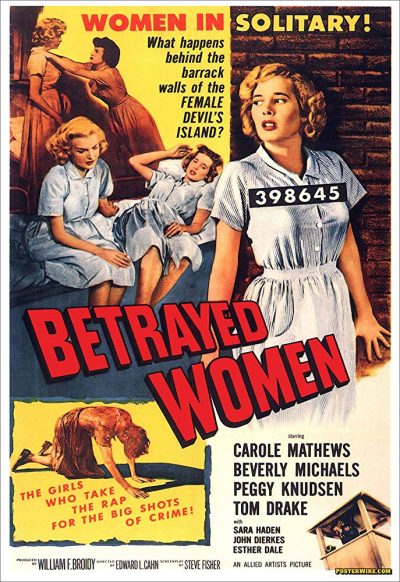
First, let me just say: that poster is a true work of art. Seriously, how can anyone look at that and not want to see it? Even knowing there’s no possible way it could deliver on what is promised, it’s among my all-time favourite posters. With that out of the way, we’d better move on, since for a 70-minute film, there’s a great deal going on. Honey Blake (Michaels) becomes the latest inmate at the infamous State Prison, after her gangster boyfriend, “Baby Face”, is gunned down by the law. She’s there barely five minutes, before she’s getting put in solitary for back-talk, etc.

Also in the slammer is Nora Collins (Knudsen), who is due to be released in a couple of months, and is in a surreptitious relationship with prison inspector Jeff Darrell (Drake). He’s trying to improve the lot of the inmates, but is getting push-back from hard-bitten Head Matron Ballard. Finally among the prisoners, is Kate Morrison (Mathews), who holds the secret of where $50,000 in robbery loot is stashed. She’s none too pleased with Honey’s taunts about Kate’s boyfriend having just got married, but after bonding through the traditional cat-fight, the pair plan and execute a daring escape. Taken along as hostages are Nora and Jeff, along with Ballard – who proves to be singularly unsuited for a trek through the swamps, pursued by the authorities and their blood-hounds. Kate’s boyfriend is making a beeline for the same spot, so felons, escapees and the law are all on an inevitable collision course.

The critical and commercial success of Caged in 1950 (including three Oscar nominations), led to a slew of imitators in the years that followed. Most – including this one – were considerably cheaper and more down-market, but this one benefits from the fast pace mentioned above, and also a great central performance from Michaels. It’s obviously a product of its era, and so is considerably tamer than most of its ilk: there’s nothing here which would raise eyebrows even on the Lifetime network. [A WiP film the whole family can enjoy!] However, many of the genre tropes are still there: not just the cat-fight, also the lecherous guard and even a fire-hose, turned on Kate after a failed escape attempt.

Michaels is a joy to watch, and I’ll have to track down some of her other work. How can you resist titles like Wicked Women or Blonde Bait? Her impact here creeps up on you. It was only in the final showdown, as she hunkers down inside a farm-shed with her hostages, surrounded by the police that I realized two things. Firstly, I genuinely didn’t know if she was going to live, or go down in a blaze of glory like her lost love, Baby Face. Secondly, I actually cared about the outcome. And no, I’m not going to spoil it. The star retired from public life the following year, declining all interviews about her career in crime flicks, and eventually died, here in Phoenix, in 2007. Even then, she shunned the limelight, requesting no obituary or funeral service.

Dir: Edward L. Cahn
Star: Beverly Michaels, Carole Mathews, Peggy Knudsen, Tom Drake