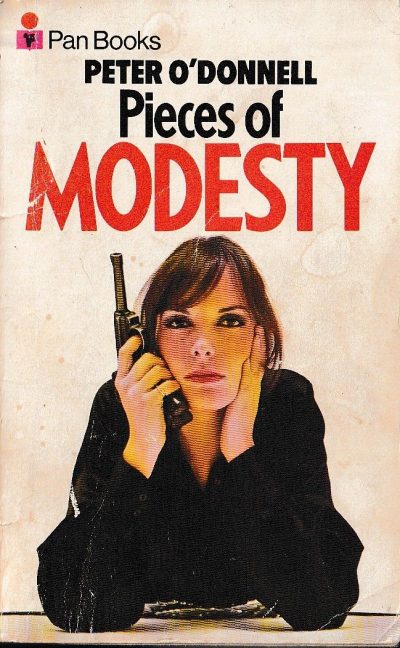
The six stories in this collection of short fiction featuring iconic heroine Modesty Blaise were all originally published in the Australian publication Pix in Jan.-Feb. 1970. O’Donnell intended them to be published in book form with illustrations by Jim Holdaway, then the artist for the Modesty Blaise comic strip; but Holdaway died that year, and the book-form collection wasn’t published for another two years. (See https://en.wikipedia.org/wiki/Pieces_of_Modesty .) In the interval, however, at least one of the stories, “A Better Day to Die,” was reprinted in an American magazine (I don’t recall which one), where I read it –I think in the spring of 1970, while I was still in high school. It was my first introduction to the character, and one of very few exposures I’d had in fiction to a kick-butt heroine (they were much less numerous in my youth than they’ve since become). My teenage self was pretty awe-struck by Modesty in action; so that gave me an abiding interest in her fictional exploits, although this is still only the second book by O’Donnell that I’ve read.
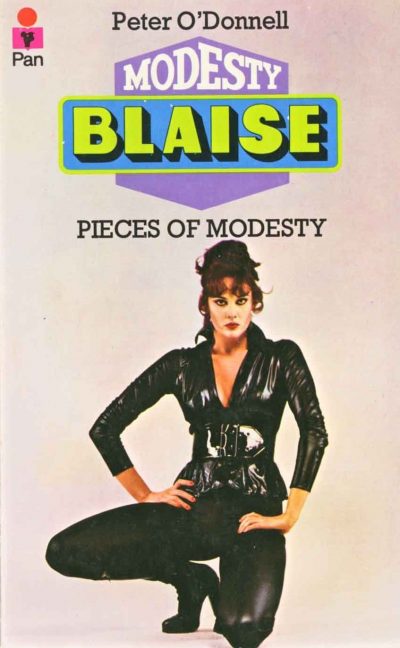 While this is the sixth installment of the series, because the stories are strictly episodic and not connected to each other, and are set at various times in the 60s, they don’t really have to be read after the first five novels to be understood and appreciated. (It would probably be best to read the first novel first, just to provide a foundation.) In a couple of stories, references are made to events, and characters reappear, which are probably drawn from the novels; but any information about past events that we need to know is supplied. Five of them are written in third person; “I Had a Date with Lady Janet” is unique in that Willie narrates it in first person, which helps to develop his character more deeply. The settings are mostly British or continental European, with one tale taking place in South America. All six adventures involve Modesty in a wide variety of situations, which illustrate various aspects of her personality and abilities; that may explain the collection’s odd title. (Don’t worry –Modesty is not dismembered!)
O’Donnell writes with a very readable, professional style, and creates captivating story-lines centered around well-developed characters. His plots aren’t overly convoluted, and their various elements dovetail nicely; that doesn’t keep some of the stories from having surprise twists, which grow naturally from the soil of the tale itself, as legitimate surprises should. (I did guess the general outline of one, before the author revealed it.) This is, of course, action-adventure pulp fiction; unusual, extreme and sometimes life-threatening situations are the norm, and our main characters are larger than life. That doesn’t mean the writing lacks literary quality, nor that it’s without realism, psychological and otherwise. Neither of those are in fact lacking; and neither is moral vision, and the ability to evoke serious thought about ethical questions. The author just evokes the kind of thought about them that today’s literary-critical clerisy doesn’t welcome, because he thinks that right and wrong are real categories, and that virtues such as courage, loyalty and justice actually ARE virtues.
In commenting on individual stories, I want to avoid spoilers. I’ll say simply that “A Better Day to Die” presents a serious, balanced and fair debate between absolute pacifism and the position that violent resistance to murderous and other harmful aggression is a legitimate last resort to protect the inoffensive, including oneself. (Modesty maintains the latter, and O”Donnell clearly agrees with her, as I do –but she respects the pacifist position.) “The Giggle Wrecker,” set mainly in East Berlin in the days of the Cold War, brings back the memory of that era vividly, and to my mind refutes the claim of some that there was an absolute moral equivalency between the West and Soviet totalitarianism. Willie’s narrative and “A Perfect Night to Break Your Neck” are noteworthy for their positive portrayal of physically handicapped characters (both of whom not only pull their weight, but enjoy serious romantic relationships with partners who appreciate them as persons).
 “Salamander Four” is the only selection here that indicates Modesty’s openness, on occasion, to uncommitted sex (although there’s no explicit sexual content there, or in any of the stories), but the psychology of it is understandable and she comes across to me as misguided rather than callous and selfish –it’s clear that her intention isn’t knowingly to be hurtful or exploitative. Finally, “The Soo Girl Charity” is the most disturbing of the stories, in that (though without being graphic) it provides a look into the dark reality of the exploitation of women by sexual sadists, and into the even darker reality of what pounded-in cultural brainwashing of females to accept patriarchy and male domination actually does to their psyches. (I didn’t feel that the victim here being Asian indicates racism or cultural stereotyping; I think that simply reflects a reality that, at least in the 60s, traditional rural Asian cultures still tended to promote that kind of brainwashing to a greater degree than Occidental ones –even though the sexism of our culture is bad enough.)
One quibble I had with the latter story is that I thought the premise had Modesty and Willie acting (at least, for their current post-Network situation) out of character in a couple of respects. A more important issue was with a comment about a brutal gang rape of a teen girl that occurs in one of the stories. That the incident could realistically be expected to happen, given the mentality of thugs put in a position to dominate unarmed females, I don’t deny (sadly, it would be more unrealistic if it didn’t); O’Donnell doesn’t treat it graphically and clearly disapproves of it. But afterwards he has Modesty thinking, at one point, “Just as well it had been Rosa. She was a sturdy peasant type with nerves like sisal. In a little while she might even begin to relish the cachet of having been raped by guerillas.” To be sure, the author doesn’t suggest that she relished the rape itself. But in the first place, I don’t think being raped carries any cachet, in a culture that sees virginity as a valuable commodity and sees rape victims as “damaged goods.” In the second place, I can’t imagine that this would be a reaction Rosa would ever have, nor that the idea would be one that Modesty (who was a rape victim herself in the past) would ever think. It comes across as the kind of insensitive, emotionally tone-deaf perception a male author might have who doesn’t have any real ability to imagine the actual psychology of a rape victim.
Overall, though, these caveats didn’t keep me from really liking the collection as a whole. Modesty is one of my favorite action heroines, and one whom I see as, on the whole, a pretty good role model –she has her faults, which are recognizable; but if both male and female readers pick up on emulating her virtues, they’d find a great many to aspire to. I’m glad to have spent this interlude in her fictional world, and still hope to read more of the Modesty canon eventually.
Author: Peter O”Donnell
Publisher: Souvenir Press, available through Amazon, currently only as a printed book.
A version of this review previously appeared on Goodreads.



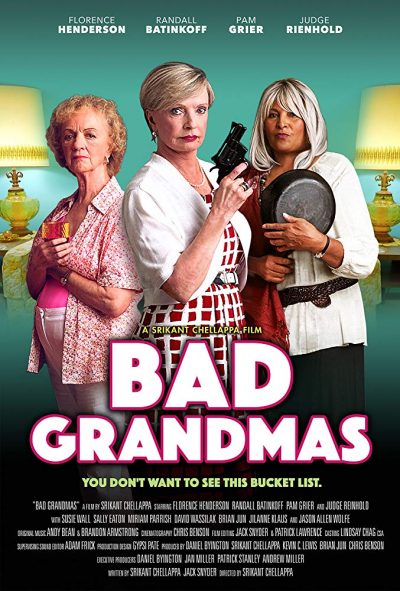 There is entertainment value to be found even in bad movies. Bad action, horror and SF are sometimes just as amusing as the good stuff. But bad comedy is almost irredeemable: that’s why Mystery Science Theater 3000 rarely go there. Bad comedy just… sits there, dull and unamusing, almost worthless. And that’s what we have here. It’s a somewhat interesting idea, with some potential. Unfortunately, the execution – mostly in the script and direction – are so woefully inept that even the brave efforts of Florence Henderson, in her final film, aren’t enough to salvage it. And wasting the talents of Pam Grier needs to be some kind of cinematic capital offense.
 Lan Hsiao-Tieh (Lu) is one of four illegal immigrants to Hong Kong, who manage to escape from the human traffickers bringing them to the colony – albeit after Lan has been raped by one. She and her friends just about manage to eke out a living on the edge of society, which treats them very unkindly in comparison to legal residents: for example, working as a coolie, they get only a fraction of the wages. As a result, they’re forced into criminal activity. One of the victims of the resultant pick-pocketing is the feared Chief Detective Lu (Lui), who tracks down the gang and makes them an offer: go undercover and help in his investigation of a Triad gang called the Eagles, in exchange for legal status. Lan is doubtful – until she realizes that one of the targets is the man who raped her. With the assistance of training from a retired thief, Lan is inserted as the moll of the gang’s leader, Hao (Tien Feng).
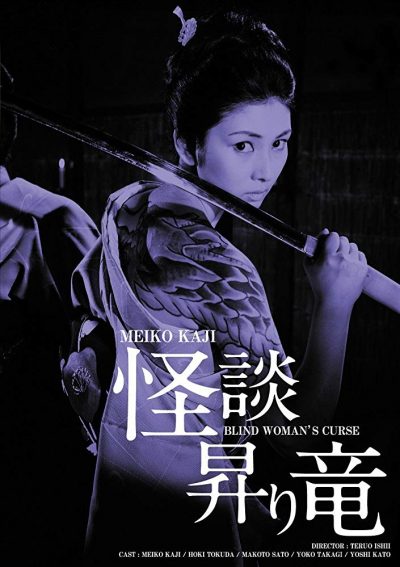 Akemi Tachibana (Kaji) is second in command of her yakuza gang. During a battle with another group, she accidentally blinds Aiko Gouda (Tokuda), the sister of an enemy – an incident Akemi believes leaves her cursed, after a black cat laps up the blood spilled as a result. Following three years in jail, she returns to find the clan on the verge of war against their rivals, the Dobashi group. Various members of the Tachibanas are turning up dead, and with their tattoos flayed off. Turns out that Gouda has joined the Dobashi gang, with the aim of extracting vengeance on the woman who took her sight, even though Akemi has borne the guilt of that event ever since.
 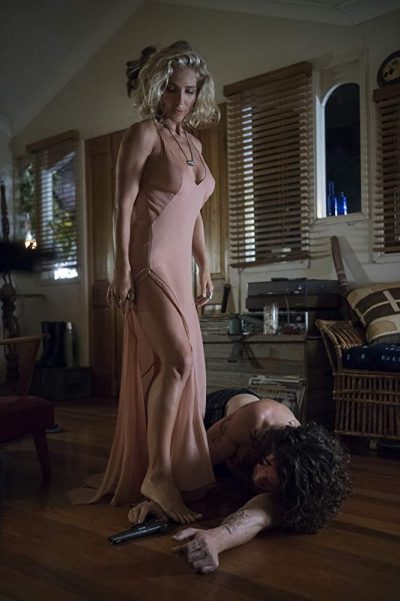 Cal McTeer (Best) has just got out of prison after serving a 12-year sentence for arson leading to murder, a crime she committed as a teenager. Returning to her home town of Orphelin Bay, she finds her brother, Augie (Jakubenko), now working as a conduit for drugs, with the connivance of at least some local cops, and supplied by the mysterious Adrielle Cuthbert (Pataky). She oversees a commune near town called L’Attente with a zero-tolerance policy for dissent, and uses the proceeds of her narco-aquatics to fund a worldwide search for mysterious fragments of pottery. Turns out she is queen of the Tidelanders: the offspring of humanity and legendary sirens who inhabit the ocean. Though Cal doesn’t know it initially, a near-death experience shows that she is of similar stock. Adrielle doesn’t like the competition. And neither does local gangster Gregori Stolin (Koman), who is intent on muscling in on Augie’s business, and cutting out the middleman, to work directly with Adrielle.
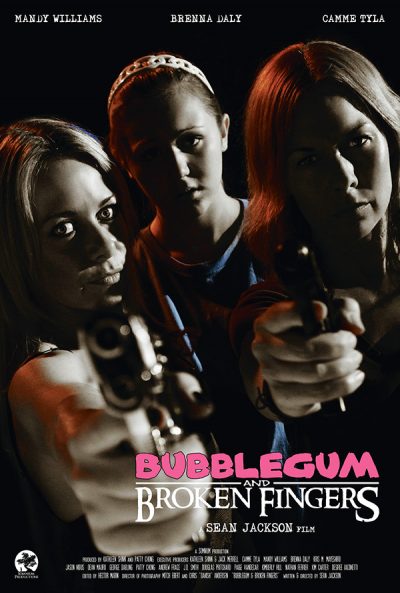 Outside of Kill Bill, I’ve never been a fan of Quentin Tarantino. But this film did give me some appreciation for him. Because it’s only when you see Tarantino done badly, that you realize the aspects he does well. It undeniably takes some skills to keep a story-line involving multiple sets of characters in the air, especially when centered on a Macguffin like a suitcase whose contents are never revealed. Jackson tries to do exactly the same thing here, and the result is, frankly, a mess, where you’re left caring little or nothing about any of the participants.
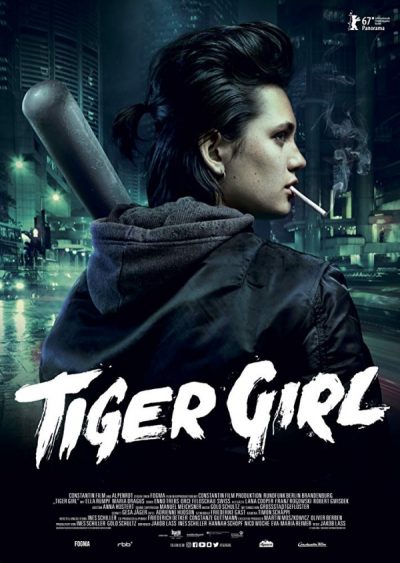 Maggie (Dragus) just failed the police entry exam in humiliating fashion, and is now taking a course to become a security officer, despite her meek nature. She encounters Tiger (Rumpf), a street punk girl who is everything Maggie is not: brash, confident and perfectly willing to go toe-to-toe with anyone she feels deserves it. The pair strike up an unlikely friendship, with a purloined uniform allowing Tiger to join Maggie in her security work, and in turn engage her increasing fondness for mayhem and violence. Meanwhile, Tiger’s example helps bring Maggie – or ‘Vanilla’, as Tiger calls her in half-mocking endearment – out of her shell. Though Tiger’s drug-dealing friends are less than impressed to find her palling around with a wannabe cop. And as Maggie begins to adopt a more… physical approach to confrontation, it becomes clear that Tiger’s restraint is something Maggie does not possess.
 The leader of all-girl biker gang the Hellcats is brutally beaten and murdered, by Repo (Kosobucki). Her replacement, Kat (Neeld), tries to get to the bottom of the killing, and take vengeance on the perpetrators. Complicating matters is Repo’s position in the Vipers, another motorcycle club with whom the Hellcats have previously had generally friendly relations. Part of that is due to Kat’s on-again, off-again relationship with their leader, Snake (Kabasinski); he also has the advantage of being cosy with some of the local cops, who divert confiscated drugs back to the Vipers for resale. But was he aware of – or did Snake perhaps even order? – Repo’s actions?
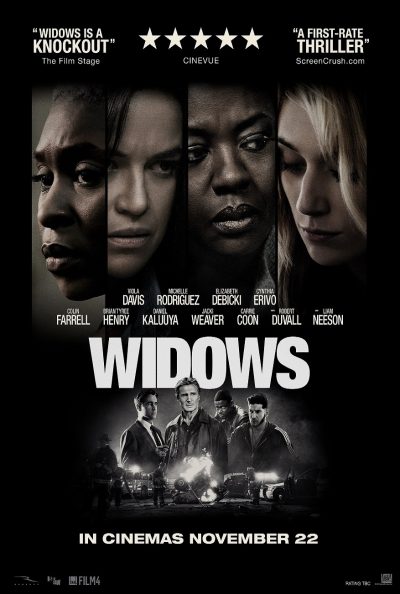 This is based on a TV series from Britain, which ran for two seasons in the eighties – I’ve seen it, but for some reason never got round to writing about it. The show would have been right in our wheelhouse, being written by Lynda LaPlante, who also created
 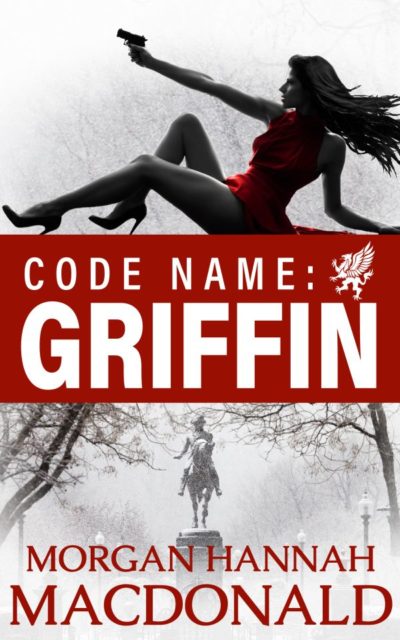 A painfully clunky mix of spy and crime thrillers, this really needs to decide which it wants to be. Alexandria Kingston – code name Griffin, in case you hadn’t guessed – was an abused child, with the good fortune to be rescued and brought up by Margaret Murphy, the head of Irish organized crime in Boston. Though to avoid Alex being targeted for leverage, she was never acknowledged to be part of the family. As an adult, Alex joined the CIA and became a top field agent, jet-setting over the globe on demand. But when her foster mother suffers a stroke, she returns to Boston to find herself in the middle of a war for control of the turf. The rival Killeen clan, sensing an opportunity, pounce. It’s up to Alex and her brothers to defend the family – and then take the battle to the Killeens.