



★★★½
“The godmother of blaxploitation’s debut in the field.”
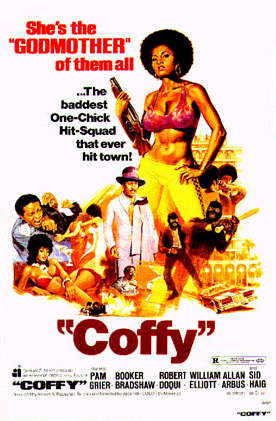 Neither star Grier nor director Hill were exactly strangers to the world of exploitation when they made this, but their combination here created a whole new subgenre, crossing action heroineism with black cinema. Following her would come Foxy Brown, Cleopatra Jones and the rest, but let it be said, Coffy was the first of any significance.
It’s a robust tale – or at least one reused frequently since with minor changes. Nurse Coffy (Grier) goes after those she sees as responsible for leaving her kid sister a drug-addled vegetable, be they low-level pusher, high-level supplier or the politician in cahoots, who just happens to be her lover. There’s no hanging round here; almost before the credits have finished, we get someone’s head being blown off with a shotgun, and Hill brings a hugely gleeful air to the violence. This is perhaps exemplified best by a marvellous and justifiably classic catfight in which Coffy, razorblades hidden in her hair, takes apart an entire escort agency’s worth of hookers.
Dramatically, it’s less successful, with neither the supporting characters nor the plot holding your interest. It often borders on the painfully obvious; when her cop friend turns down a bribe, you just know he’s going to end up hooked to one of those hospital machines that goes “Beep”, and inside five minutes, yep, there he is. Beep. He then vanishes from the film shortly thereafter, though it’s never clear whether he dies or not. At least this does mean we don’t get the even more painfully cliched “flowers on the grave” sequence. But as a Pam Grier vehicle, it’s fine, and if little more than a vehicle for sex ‘n’ violence, with questionable morality and a hackneyed storyline, it is at least done enthusiastically enough to pull you along with it.
Dir: Jack Hill
Star: Pam Grier, Booker Bradshaw, Robert Doqui, William Elliott
 Karen and Will Jennings have an idyllic life – money, a
 Karen has to handle the ever-dangerous Joe, while Will (Stuart Townsend) is kept occupied by Cheryl, and Joe’s cousin (Pruitt) looks after Abby, who turns out to be severely asthmatic. The cutting back in forth is designed, partly to increase tension – it does – but perhaps more importantly, cover some dodgy plot elements. As with all kidnappings, how do the criminals expect to collect the ransom? This is never made quite clear, and as the film goes on, it unravels to a frankly implausible finale involving a light aircraft, a logging truck and a mile of busy highway.
 Odds are you won’t see the key twist here coming, but on the other hand, it renders the preceding hour almost redundant. This sums up the entire film: as an exercise in technical style, few directors are as good at camerawork as De Palma, yet little here withstands scrutiny, despite an abundance of smoke, mirrors and Romijn-Stamos. She plays Laure, a jewel thief who cons her partners out of $10m in diamonds, then is lucky enough to fall into another identity. Seven years later, they get out of jail, still miffed, and she’s now married to the American ambassador. When paparazzi Bardo (Banderas) exposes her identity, she instigates a complex plan to play her various problems off against each other.
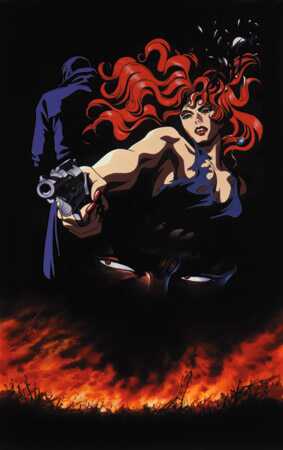 Four stars but no seal of approval? That’s because this is about the most wildly variable animated film I’ve seen. The story and characters are great, but the frequent sex scenes are incredibly tedious and clearly put in solely for the teenage male fan (all pneumatic breasts and moaning). It’s rare for me to say this, but they are genuinely gratuitous, and the film could have coped fine without them.
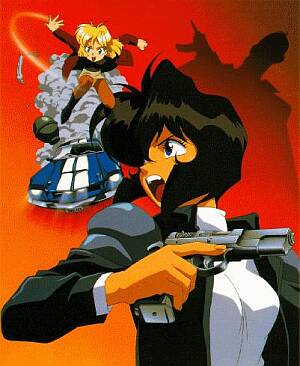
 Watching this dubbed was, for once, viable since despite its Japanese origins, it’s firmly set in and around Chicago. So we did sit through some of it in English, but the accents were woefully Cal-girl and thus we’d recommend sticking with the Japanese, even more unlikely though it might be. That out of the way, this is an action-packed romp, in three episodes but effectively one story. Rally Vincent and May Hopkins, one a crack marksman, the other an explosives expert, own a gun store, but are blackmailed by the ATF into helping nail an arms ring. It’s not as simple as it seems, since the perps have connections at a high level, and the services of a former Soviet Special Forces hitwoman.
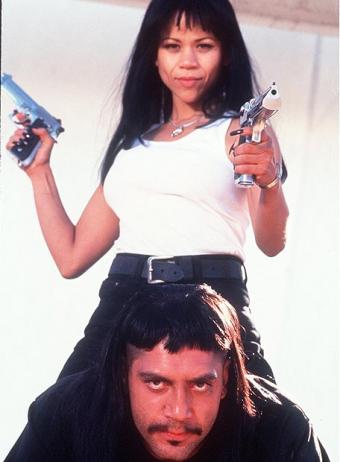
 The first half of this is quite excellent. A young girl, Ikko, daughter of a Yakuza boss, sees her parents murdered on the orders of her step-sister but is rescued by the Black Angel (Takashima), a female assassin, and escapes to America. 14 years later, she returns (Hazuki), calling herself the Black Angel and starts wreaking revenge on those responsible – who retaliate by calling in the
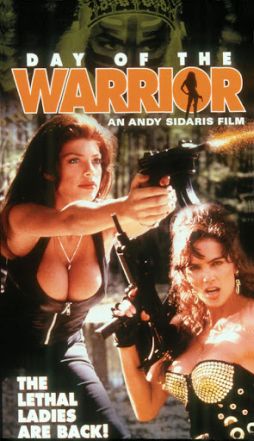 Andy was back on the helm for this one, but appears to have opted to go beyond subtle self-referential digs into full-blown camp, and I tend to think this takes away from the overall experience. The intent is clear when we are brought into the office of Willow Black, the head of L.E.T.H.A.L. (The Legion to Ensure Total Harmony and Law), and find her exercising on a treadmill in an outfit more suited for an exotic dancer. Which makes sense, because if you’re a female agent of LETHAL, you can bet you’ll be going undercover as a stripper or a porn actress – not quite the empowering government job one might expect. It also appears that breast enlargement surgery is required for all such operatives.
 While containing many of the same elements as usual e.g. boobs and bombs, this does at least throw in a new angle, in the shape of some Confederate gold buried in the woods since the Civil War – I can only presume Sidaris must have befriended a Civil War re-enactment battalion. Out enjoying a bit of off-road action, amusingly-named federal agent Becky Midnite (Simpson) and her two co-workers stumble across a diary written by one of the soldiers transporting the gold. However, their plans to search for the treasure are disrupted by efforts to kill them, courtesy of mob boss Santiago. He is upset after they shut down his operation that involved shipping drugs in hollowed-out watermelons. Fed up with the ineptness of his minions, he hires even more amusingly-named assassin Jewel Panther (Strain) to carry out what they have failed to do.
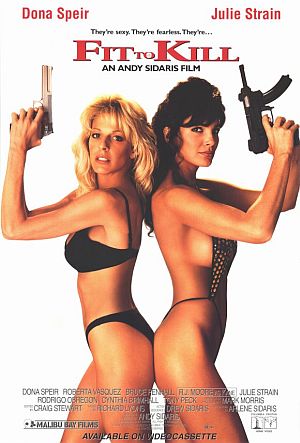 Hang on, two movies ago, criminal mastermind Kane was Japanese – now, he’s the son of a Nazi officer who went on the run after the war with a diamond stolen from the Russians? I know I’m watching these all of our order, but still… They even refer to a pendant with a tracking device in it, given to the Japanese version of Kane, even though Moore now appears to be channeling Julian Sands, not Pat Morita. I’m so confused. Still, logic, continuity and coherence are not really the point here, are they?