



★★★
“Several virgins short of a six-pack.”
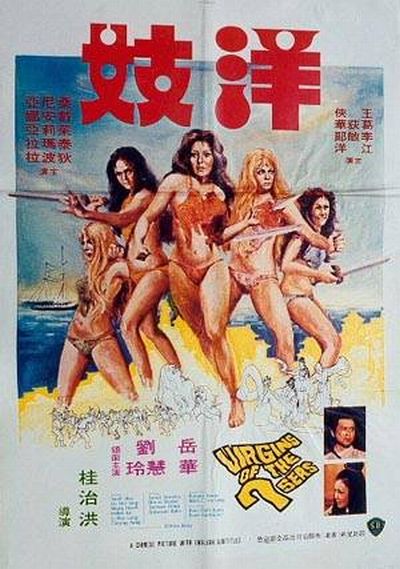 In the 1970’s legendary Hong Kong studio Shaw Brothers sought to broaden their market with a series of co-productions. The results included the likes of Legend of the 7 Golden Vampires, from a partnership with Britain’s Hammer Studios, plus Cleopatra Jones and the Casino of Gold. But perhaps the most bizarre such product is this, which crosses martial arts with the softcore sex films from the time, the best-known of which is probably Hofbauer’s Schulmadchen Report (Schoolgirl Report). The results are… Well, I’d be hard-pushed to call them great cinema, but I would have to confess to being rather more entertained than I expected.
Contrary to one of the alternate titles, Enter the Seven Virgins, there are actually only five women here, and some of those aren’t exactly virgins. They are captured by pirates, and brought to their island lair, where buccaneer boss Chao (Hsieh) leers at them and puts them through a training course designed to get them ready to be sold into white slavery. Except, he doesn’t know that one of his minions, Ko Mei Me (Liu), is actually working, along with her brother, to take him down, and trains the captives in martial arts, as well as the ancient Chinese art of spitting olive pits at such high-velocity, they can punch a hole through a vase. After copious amounts of gratuitous nudity, the women eventually break free, get recaptured, escape again, and take on Chao and the rest of his henchmen in a battle which makes up for in duration, what it may lack in quality.
Actually, that’s a little unfair: considering the Western cast were more used to films with titles such as Campus Pussycats, they perform credibly enough. There’s not as much stunt doubling as I expected, and they’re clearly giving it all they have, occasionally impressively. Bray stands out in particular – and I mean that literally, since it seems she’s taller than most of the men in the cast. Liu, however, clearly has the most experience, and its understandable why she gets given most of the action. In some ways, this can be seen as a primitive ancestor of Category III films such as Naked Killer: while lacking quite the same lurid insanity, and featuring a degree of casual racism that’s fairly off-putting [apparently, the sight of Western flesh is enough to send most Chinese men into drooling imbeciles], it’s still fun for the undemandingly open-minded. Admittedly, a fondness for Benny Hill may help, and providing you can get past hearing Chinese people dubbed into German, as well as subtitles that may have lost their way a bit in translation. I’m still trying to figure out the meaning of, “It’s a bank holiday, it’s Mothers’ Day in Africa.”
Dir: Kuei Chih-Hung + Ernst Hofbauer
Star: Liu Hui-Ling, Wang Hsieh, Sonja Jeannine, Gillian Bray
a.k.a. Virgins of the Seven Seas
a.k.a. Enter the Seven Virgins
a.k.a. Karate, Küsse, blonde Katze [Karate, kisses, blonde cats]
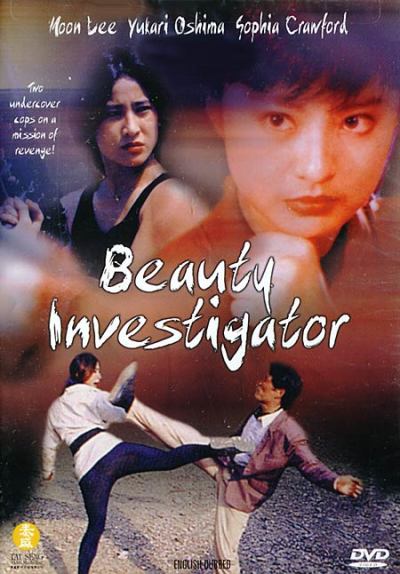 Ellen (Lee) and Grace (Kim) are police officers, who are first on to arrive when the latest victim of a serial sexual predator is found in a dumpster. After a brief diversion to catch a purse snatcher – really, how dumb must you be to do that at a murder scene? – they are sent undercover as nightclub hostesses, since that’s the profession of all the victims. While fending off both lecherous customers and employers, they stumble across an arms smuggling outfit, whose leader Bill (Tsui) has pulled a fast one over his Yakuza partners, with the help of a hired hitwoman (Oshima, whose character in the end credits is named as, I kid you not, “Japanese Jap”!). Rather than letting their superiors know, they decided to investigate themselves. Probably not the wisest of moves: as they’ll discover by the end of the movie, discretion is indeed the better part of valour…
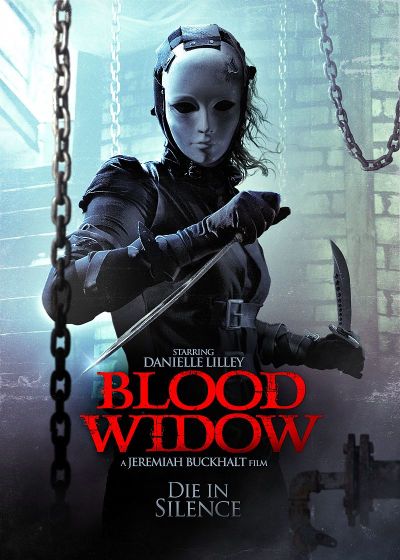 In the slasher genre of horror, the perpetrators seem almost exclusively male: Michael Myers, Jason Vorhees, Freddy Krueger, etc. Women can play an important role, and we’ve covered some of them here before – but it’s much more often as the “final girl”, than the one wielding the machete. However, it’s often forgotten that, in the original Friday the 13th movie, the killer was not Jason, but his mother, so there is some precedent for the female antagonist. See also Nurse 3D, American Horror Story: Coven or perhaps best of all,


 Following on more or less directly from the events of
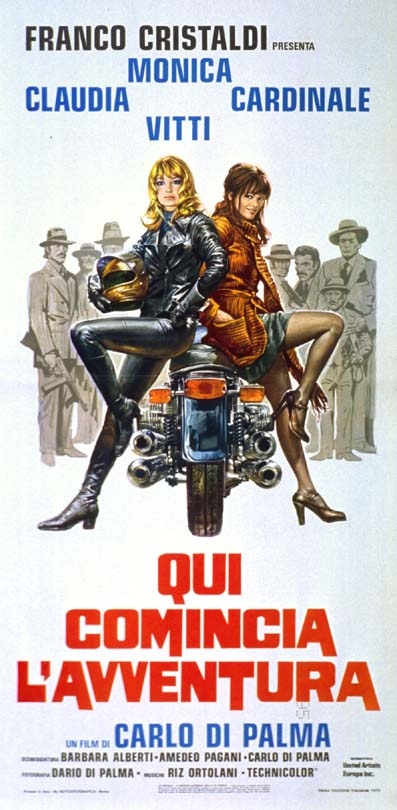 Claudia (Cardinale) has a humdrum life working in a laundrette, with a sleazy husband and no hope of anything more exciting in her future. Into the laundrette storms the titular woman, Miele (Vitti), whose devil-may-care attitude enthralls Claudia, and gives her the courage to throw away her staid existence and follow the blonde on the road. Miele is initially resistant to the idea of a travelling companion, but rides to the rescue, driving her bike through the railway station where Claudia is being harassed. Miele must make a mysterious appointment in Northern Italy with her lover, but that’s okay, as Claudia has a cousin, on the way, in Naples. However, as the two make their way, it gradually becomes clear that Miele could give Baron Munchausen a run for his money, when it comes to spinning tall tales, and both her mouth and impetuous actions, are as likely to get the pair into trouble as out if it.
 I might have enjoyed this more, if I hadn’t recently sat through 25 episodes of basically the same plot, in Blood+. Generic anime storyline, #7: supernatural entity, trying to bring about the end of the world because… That’s what they do? In this case, there are sages and witches, who balance good and evil. 500 years ago, however, one from each side united, and the offspring was Bayonetta (Tanaka). She is now taking out angels, but there’s also a religious cult preparing for the rebirth of their saviour, a journalist who blames Bayonetta for the death of his father, and a mysterious, very whiny little girl, who keeps calling her “Mommy”. Who that turns out to be will surprise no one.
 There’s something almost theatrical about this, because virtually the entire film takes place in a single location, the downscale home of Lorna (Gershon), who has just knocked her husband Dale (Kilmer) out with a frying-pan, after discovering he was apparently involved in a bank robbery which netted $100,000. She has now called over her best friend, local barmaid Tiny (Giddish), to try and decide what to do next, with the first step being to find the loot, which Lorna is convinced Dale has hidden somewhere in their home. However, the local sheriff (Liotta) is also sniffing around, being fully aware of Dale’s fondness for armed robbery in his younger days. It’s not long before the dead bodies are piling up, requiring alternative uses to be found for the turkey carver and industrial-strength blender. And that’s just the start of the unpleasantness.