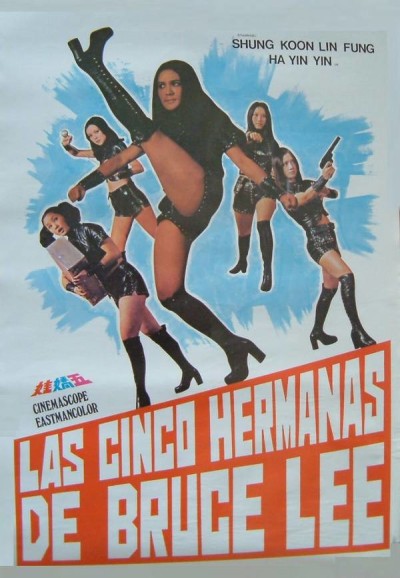
Four years after Bruce Lee’s death, and film-makers were still trying to fool moviegoers into believing their product had some connection to kung-fu’s first global star. Not sure where the deception occurred, as the print here simply overlays the new title over the (still-legible) Hong Kong one, Five Pretty Young Ladies. You really need to combine the two for any genuine accuracy: Five Pretty Kung Fu Girls, would be about right. The five are visiting Hong Kong, where their “uncle” (it’s not clear if this is a genuine relation, or just an honorific title) is a police superintendent. While at a swimming pool, they bump into a guy being pursued by a gang, and take care of the pursuers. Turns out they wanted to get their hands on a formula he had developed. Might there be some connection between this and the invisible thief who is wreaking havoc in the colony? And could the unseen one be planning to steal a moon rock, newly arrived as the centerpiece of an exhibition?
Oh, who am I trying to kid. The answer is, of course, yes to both, and the film doesn’t have any surprises to speak of. What it does have – and this is close to falling into the “only saving grace” category – is Polly Kwan as the head of the group. She’s easily the most talented in terms of fighting, and the makers know it, giving her the bulk of the action. This she handles with grace and flexibility, kicking her way out of trouble, regardless of the number of opponents. Beyond these scenes, there’s a lot of other stuff which drag proceedings to a grinding halt, such as the camping trip, climaxing with what’s probably the worst fake guitar-playing in cinema history. However, there is some entertainment value to be had from things like the matching black hot-pant uniforms worn by the girls on moon-rock guard duty, and the film’s ending teaches us a valuable lesson: when you have strapped a belt of dynamite around your waist, it’s probably best if you try not to fall over.
It is all, clearly, nonsense, with little or no effort made to differentiate the four pretty young ladies that aren’t Polly – one of them has pigtails and pouts a bit, that’s about the extent of it. But I’ve seen less entertaining nonsense, and when Kwan goes into action, becomes worth watching to a high enough degree, as to justify its existence. Unfortunately, all available prints are horribly cropped, which certainly affects the experience: truly a case where seeing more of the lead actress would be a help.
Dir: Shut Dik Star: Polly Shang Kwan, Lui Ming, Wong Lan, Yeung San-San
a.k.a. Five Pretty Young Ladies
It’s the mid-1950’s, and Bourbon Sue (D’Lite) is recruited to join the titular group (hehehe… He said, “titular”…), under leader Johnny Valentine (Shanks), and immediately thrown into the heart of a vital mission. There are three codes needed to operate a Nazi death ray, which has been dormant since the end of WW2 a decade previously. But the son of Mussolini, a clone of Hitler and the not-as-dead-as-reported Stalin are convening with the codes in a burlesque club, and it’s up to Sue and the other girls to ensure the weapon is not activated. “Seduce and destroy,” as their slogan goes, and the fate of civilization hangs in the balance – though there’s clearly no rush to save the world, with plenty of time to take in a number of performances at the club.
I’m kinda ambivalent about burlesque. The basic concept – attractive women undressing – is one I can get behind (hehehe… “behind”…), but having attended a number of shows, while entertained, I found maybe 5% of the acts at all erotic. It feels more to me like a modern dance recital, with limited clothing. And this one’s appeal is probably directly connected to your interest in burlesque; I think my wife probably enjoyed this more than I did. It’s not obviously low-budget, but its limitations are obvious: virtually the entire last two-thirds of the film takes place in the club, alternating between the stage and the dressing room, as Sue and her colleagues try to pry the codes from the axis of evil. It’s pretty limited and quite repetitive in terms of story, despite the makers’ efforts to jazz things up with flashbacks and other cut scenes. I’m not sure burlesque with a plot is something the world really needed, to begin with.
But that said, the actors are clearly having a lot of fun, not least Shanks, who spends much of the film in a wig and dress, though the beard and cigar are a bit of a giveaway – naturally, he’s the one for whom the Hitler clone falls. You get the sense a lot of the other cast members don’t have much cinematic experience, but they get by, largely through putting over their larger-than-life character with stage presence. The action here is definitely played for laughs more than anything; indeed, the whole escapade is tongue in cheek, which renders it somewhat criticism-proof. However, this also caps the impact at a fairly low level, since there can be little or no emotional connection with such a trifle. This can truly be recommended, only if you’re a devotee of old-school ecdysiast arts.
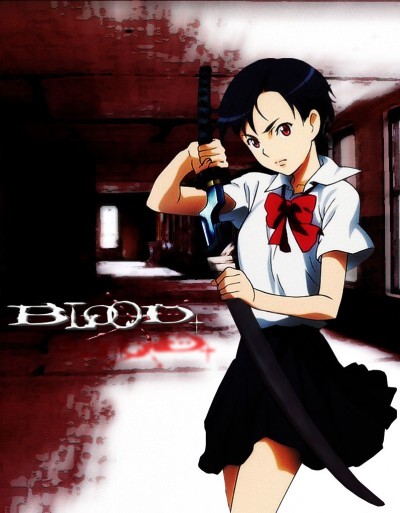
This is the third version of the same concept I’ve seen, following some years after the first animated version (released in 2000), but a couple of years before the live-action movie from 2009. What they both had over this was commendable brevity. If I’d realized the degree to which this was true, when I started the series on Netflix, I probably wouldn’t have bothered. The main problem, for anyone who has seen the other two takes, is that you know what’s going on. You’re well aware that the heroine Saya is a human-vampire crossbreed, who has now sided with humanity and dedicated her life to taking out the monsters. This was taken care of, quickly and efficiently, in the alternate versions, and we could move on to the kicking of vampiric ass. Here, however…. Not so much.
After 25 episodes – eight hours of story, even discounting credits – I still haven’t seen Saya in full-on attack mode. Indeed, I really don’t know a great deal more than I did after the first two parts, because the story unfolds at a glacial pace. A military group is trying to weaponize the “Chiropterans,” alongside a shady industrial conglomerate, Cinq Flèches. Opposing them is the Red Shield, dedicated to wiping out the Chiropterans, who can only be killed with a sword dipped in Saya’s blood. And then there is Saya’s own history: she may be a teenage girl in modern Okinawa, but she gradually remembers that she goes back through the Vietnam War, all the way to pre-Revolution Russia. Of course, telling this in chronological order would be too simple: not when she can have dramatically convenient amnesia, and recall things at whatever leisurely pace is needed by the plot.
Instead, we get a lot of chat about her not being fully “awakened” and, even more irritatingly, all the characters seem to know what’s going on, they just refuse to enlighten the audience. For instance, there’s a diary, started by the founder of Red Shield, Joel, which contains all his research; successive generations have kept it, to share with those who commit their lives to Red Shield. Do we get to know what’s in it? No, not even after Saya’s brother Kai is given the diary to read. It’s something which can be sustained for a short time, but as the episodes roll on, and information continues to be dribbled out, the approach becomes increasingly irritating. It’s a shame, since the core idea is imaginative, with scope for plenty of development, and the animation is solid, and better than I expected. There’s one wonderful episode in the middle, where an attack on a research facility unleashes children which turn into… things. I was all ready for this to be Saya’s blossoming, and the next dozen episodes to hurtle towards a thrilling conclusion. Didn’t happen.
Instead, we got more in the show’s ongoing series of inconclusive battles, with the villains muttering something dark and meaningful, before flying off into the night, and Saya recalls another incident from her past. By the time episode #25 rolled around, with the heroine finally getting to face off against the uber-mysterious Diva, I was wondering how it would all be wrapped up, but hardly unhappy to have finally reached the en… What? There’s another 25 episode chunk hidden elsewhere on Netflix? You have got to be kidding me. And, from the reviews I’ve read, these make the first batch look like masterpieces of storytelling. Don’t expect a review any time soon. Life’s just too damn short.
Dir: Junichi Fujisaku Star (voice): Eri Kitamura, Akiko Yajima, Hiroyuki Yoshino, Junichi Suwabe
Somehow, I get the feeling I should have liked this more than I did. The elements are all these – high-energy, hyper-violence and no shortage of style – but, somehow, the whole felt rather less than the sum of its parts. It’s a post-apocalyptic scenario, after the corporate wars have pretty much trashed the planet, and the Council of Nine hand out rewards for the deaths of white-collar criminals. These are collected by the titular hunters, the best being Drifter (Marsden) and Mary Death (Pitre) – the latter is a star, followed by fans and paparazzi, much to the chagrin of the former. However, the Council suddenly issue a kill notice for Drifter; he heads to confront them and sort out the “mistake”, with Mary in hot pursuit, intent on collecting the bounty. Of course, and after quite a bit of the old ultra-violence, Drifter and Mary team up, to take down the real bad guys.
An adaptation of a graphic novel, it does, at least, a better job of capturing the grindhouse philosophy than the limp Machete Kills. The inspiration – actually, it’s more shameless plagiarism – is more Mad Max 2, particularly in its stubbly hero and an extended chase sequence across the desert, in which he’s chased by a pack of nomads with painted faces. That’s perhaps the problem, because Drifter was a great deal less interesting than Mary Death to me; Marsden delivers a bland performance, over so much screen-time that this almost didn’t meet the necessary minimum standards for GWG qualification. I could also have done without the embarrassingly blunt attempts at “satire”, which feel like they came from an earnest late-night session at a liberal arts college. It’s not clever and it’s not funny.
But the bits that work, work quite nicely. There’s a great scene where Drifter is being yelled at in a soundproof office by the lead villainess (Loken), who is oblivious to the mayhem being wreaked by Mary on the other side of the glass. Indeed, virtually every time Ms. Death is on screen, the interest level increases significantly, and not merely for the obvious reasons. Pitre struts, stomps and raised the sardonic eyebrow to such impressive effect, that you wonder why you’ve never heard of her before. If Drifter is reheated leftovers of every post-apocalypse hero from the past 20 years, Death gives us something new. Hopefully, if there’s any sequel, Marsden will be “unavailable”, and the makers can concentrate much more on the heroine.
Dir: Henry Saine Star: Matthew Marsden, Christian Pitre, Barak Hardle, Kristanna Loken
★★★½
“Sam Peckinpah would likely approve – as long as he has a console in the afterlife.”
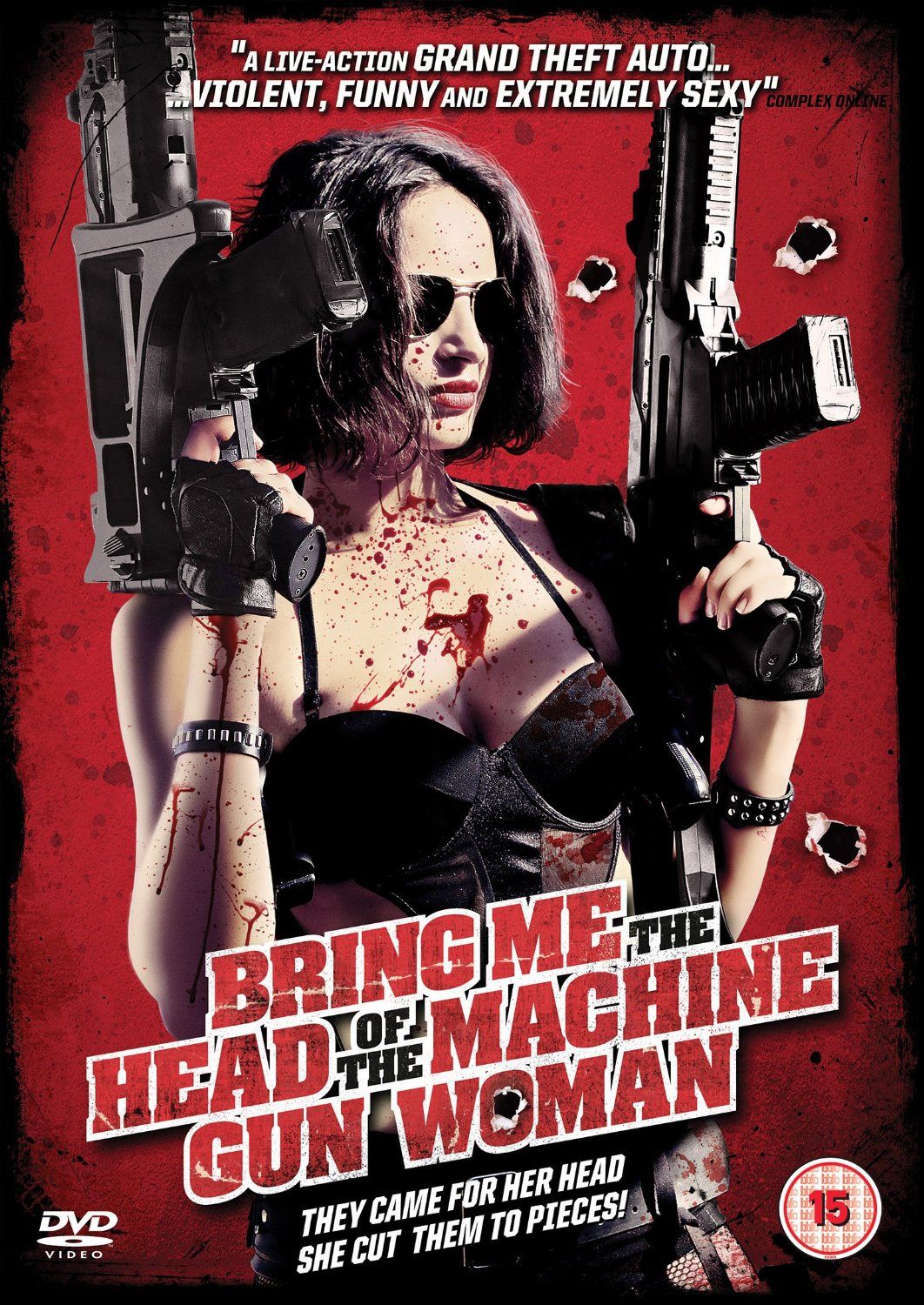
When not spinning platters as the DJ at a tango club in Chile, Santiago Fernández (Oviedo) likes nothing better than to kill, rob and steal – at least, from the comfort of his couch, as he plays a game just dissimilar enough to Grand Theft Auto to avoid a lawsuit. There is, of course, a huge difference between video-game malfeasance and the real thing, as he discovers after being unfortunate enough to overhear a conversation of local crime boss Che Longana (Alis), in which he makes the titular request, said skull belonging to his ex-girlfriend (Urrejola), who is also an assassin of no mean talent. Caught eavesdropping, Santiago’s escapes execution by promising to deliver her to Longana – a task for which he is woefully unprepared, despite the countless hours of console practice for a life of crime.
While containing nods to the grindhouse era, the style is very much more GTA, with villains being introduced by a still, on which is overlaid their value, and Santiago’s car, as he drives around town, being filmed from behind and slightly above, the standard angle for the genre. Progress is even broken down into a number of missions, whose success or failure is documented by a large on-screen graphic. Yes, it’s undeniably gimmicky; however, at a brisk 73 minutes, including credits, it’s a gimmick which just about manages to avoid overstaying its welcome. My main problem is instead a strong preference for the Machine Gun Woman – she’s never named anything else – over Santiago, because she is exactly the sort of creation, in attitude as much as dress-sense, who would be perfectly at home in a video-game. Brutal and manipulative, she’s simply more interesting than the snivelling hero, who sole redeeming feature appears to be that he loves his Mom.
By the end of the film, he’s the one charging in, with all guns blazing to rescue her – albeit, after he has forgotten to mention a tiny detail on their initial assault against the Boss Level. Still, considering the film’s events unfold in barely a day, it’s a remarkable transformation, even by video-game standards; not least in his ability to hit the broad side of a barn, something notable by its absence early on. That said, it’s still an entertaining and briskly-told tale: Espinoza is very much aware that the “cut scenes” are likely to be of lesser interest to his audience, and whizzes through them to get to the next spurt of action. The results are clearly not intended to be taken too seriously, and shouldn’t tax the attention span of even the most ardent gamer.
★★½
“Given she wears purple, wouldn’t a better title be The Mauve Moth?”
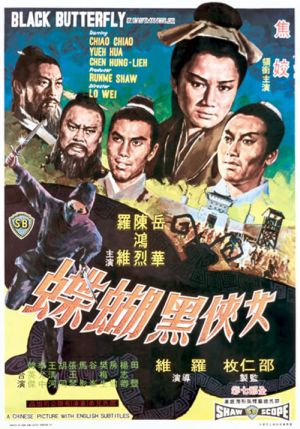
Someone is robbing the rich, and using the proceeds to buy rice for the poor. Could it be the drunken beggar (Yeung) in charge of rice distribution, who is cagey about where his new-found wealth comes from? Or the local inn-owner and former martial arts master (Tien), whose efforts at fund-raising have been rudely rebuffed? Closer. It’s actually his daughter (Chiao), whom no-one knows has any skills at all, but has apparently learned them in secret, and goes out at night, stealing valuables in order to fund the charity operations of her beggar pal. Needless to say, their previous owners are less than happy with this, and are seeking the culprit, led by policeman Xi Lang (Yueh). Things are muddied further when a group of bandits, the engagingly-named Five Devil Rock gang (I think I just found my band name!), steal an imperial seal, forcing the Butterfly’s father out of retirement, and her to reveal herself to save him.
There’s really two halves to this film. The first is, for me, more interesting, though it’s rarely less than obvious Chiao is doubled for any acrobatic work: shot of her jumping, cut to stuntman flying through air, cut to Chiao bending her legs slightly on landing. The style is also defiantly old-school and Peking Opera based, which will come across as stagily artificial to modern eyes, and you do have to remember this was made 45 years ago. However, I did appreciate the long-duration takes, and even though the action quotient was lower, the characters, performances and plot were enough to keep me interested: it plays a little like Iron Monkey, one of my all-time favourite martial arts films, and the idea of a female Robin Hood certainly has enough potential.
Unfortunately, the second half, when the bandits show up and dominate things, is rather less succesful, falling back on a number of old clichés of kung-fu cinema, such as the battle between schools. Until the finale, the heroine is largely reduced to a supporting role, ministering to her poor father, for whom the stress has become too much. While she is more active in said climax, it had me rolling my eyes at its extreme example of the trope where the villains have the good guys outnumbered – literally here, a hundred to one – but attack in ones and twos rather than rushing en masse. Here, it’s even more ridiculous, because the good guy minions beg their leaders to go in first (inevitably, getting their asses kicked), so neither side appear interested in using all their forces. While spectacular enough, I suppose, the end result just doesn’t live up to the early potential.
Dir: Lo Wei Star: Lisa Chiao Chiao, Yueh Hua, Tien Feng, Yeung Chi Hing
“I’m a Barbie girl, in a Nazi world…” That’s an equally appropriate summary here, because the heroine in this flick, set in occupied Norway during World War II, was the lead singer of Aqua, famous (or notorious, if you prefer) for a certain catchy pop ditty. She plays – and I know you’ll find this a stretch – a singer, who works in a nightclub, which caters for high-ranking Nazi officers, while she simultaneously works with the local resistance and beds SS Major Kruger (Otto). The Allies are seeking plans of a local aluminium smelting plant, a key cog in the Third Reich’s war machine, so an airstrike can be called down on to it. Local businessman Tor Lindblom (Saheim) partners with Kruger to profit from the industrial operation, and play both sides, until their pet auditor is replaced by one rather less amenable to their embezzlement.
It’s a very shiny, upbeat approach to a thoroughly unpleasant situation, with little or no death for any significant characters until the final reel. The makers seem to want to say something important about Norwegian collaborators of the time – a final caption tells us that even the worst of them received only a light sentence (it doesn’t mention that puppet president Quisling, who is depicted, was executed by firing squad shortly after the end of the war). What exactly that ‘something important’ might be, is largely unclear: that’s in line with the rest of the plot, which could fairly be described as a muddled mess, with the loyalties of the participants apparently fluid and subject to the whims of the storyline.
Which would be tolerable if any of the other aspects were credible, but neither the performances, nor that script, succeed in capturing the interest of the viewer – Nystrom’s lack of acting experience is particularly notable, and she only really comes to life when on the stage at the club, belting out showtunes. There is a nice sense of period atmosphere, which could be described as “neo-Nazi Norwegian noir“, though much like the story, there’s far too much reliance on worn-out stereotypes in lieu of anything else. While slight tension is finally generated at the end, when Eva breaks for the Swedish border, it’s more the last twitch of a dead corpse than anything of significance.
★★½
“A heavily-armed version of The First Wives’ Club.”
According to the film’s introductory narration, Thailand now has about three women for every man. This has led to many men both having an “official” wife, while also keeping a mistress, and not exactly being secretive about it – when the wife dies, the mistress gets “promoted” to replace her, which has obvious implications for both parties. In order to protect their rights, the eives form an association, the FCWI, which stands for First Class Wives International. Not to be outdone, the mistresses do the same thing, with the ECWI (Economy Class Wives International). After two members of the former are gunned down on a stretch of highway, the two groups seem set for a fiery and murderous collision between the wives and mistresses.
Except, it doesn’t really happen until the very end. Even at a brisk 77 minutes, there are way too many scenes of the two groups sitting around chatting, getting information from a guy who is selling to both sides, and deciding not to attack each other quite yet. Some of the technical aspects are also remarkably awful, given what appears to be a professional production in other ways – the audio, in particular, appears to have been recorded on a cellphone [which reminded me of another weird aspect; the informant’s cellphone appears to be right out of the 1980’s, the size of a brick, while everyone else has modern ones]. And since it appears the cast are almost entirely models, rather than even model/actresses, the performances are largely uninspiring, though Punnakan as first wives’ leader Jittra, does hold the viewer’s attention nicely when on-screen.
What also worked for me, surprisingly well, were the action choreography and cinematography. However, for that to happen, you must accept that the former is clearly intended to by hyper-stylized rather than in any way realistic. Once I understood and accepted that, I was able to enjoy those for what they are, and the camerawork is nicely fluid and, occasionally, truly beautiful, as when there’s a slow zoom out with the camera going up, over a bathtub containing a dead body. It’s moments like that which will keep you watching, through the severely tedious sitting around and feminine bickering.
★★
“Not quite the wholesale disaster this might seem…”
This will only make sense, or be in any way entertaining, if you’ve seen Bloodrayne 3: The Third Reich: because it’s basically the same film, with a really fat chick (Hollister) replacing Natassia Malthe. And when I say, “the same film,” I mean the same storyline, same actors playing the same roles, and same scenes in the same locations. Really, I suspect this must have been made at the same time, with Boll simply swapping out Hollister for Malthe every other take. As there, the heroine is a half-human, half-vampire, who finds herself involved in a Nazi plan to take the powers of vampirism and turn them to their own ends. Except here, it is, of course, a spoof – and one so extremely broad, the makers of those Epic Movie flicks would have been cringing on occasion. Fat jokes, gay jokes, Nazi jokes… No easy target is left unstoned, paved with deliberate anachronisms like Segways and Internet dating.
And yet, even if it took us two sessions to get through this, I can’t bring myself to hate it, not least because of Hollister, who goes at things with gusto. It’s clear this is an actress who does not get to play the lead often, least of all in an action flick (though for obvious reasons, the action can kindly be described as “limited”). Even if this is a parody of one, both her and Boll deserve credit for breaking down one of the taboos seen everywhere in body conscious Hollywood. There are moments here which are just surreal, such as a dream sequence where Blubberella plays a game of Risk with Hitler (played by the director!) and Fletcher in blackface. WTF? No, really: WTF? There’s also a lengthy scene parodying Precious, which is unsurprising, considering it’s about the only other film I can think of where a morbidly obese woman is the heroine.
I probably have a higher opinion of Boll than most people: when he avoids making video-game films, the results can be really good [Darfur and Rampage both kick ass]. However, comedy really isn’t his forte, and too much of this ends up missing its mark, most often through being over-played in one way or another. Rather than a shot-for-shot remake of a film that wasn’t exactly a huge success, Boll and co. might have been better off with a broader spoof of superhero films, which would have given them a bigger palette for their unsubtle satire. That said, I will admit that I did laugh, and laugh out loud, more often than I expected, and it’s a hell of a lot better than Boll’s last attempt at “offense humour,” Postal.
Dir: Uwe Boll Star: Lindsay Hollister, Brendan Fletcher, Michael Pare, William Belli
I was immensely stoked for Brave on a number of levels. First, Pixar kicks ass. With the exception of the underwhelming Cars and its pointless sequel, the quality of their work speaks for itself: Monsters, Inc is close to the finest animated movie of all time. Secondly, genuine action heroine films for the whole family are rare, to the point that they can probably be counted on the fingers of one hand over the past 25 years. Thirdly, it’s Scotland. Y’know, where I’m from. It’s the bit at the top of England. I feel I should mention this, because Pixar had originally tabbed Reese Witherspoon to voice the teenage, Scottish heroine, Merida. Fortunately, scheduling prevented this, and Pixar ended up with an all-Scottish lead cast.
I also note the somewhat troubled production: despite two names getting directorial credit, this wasn’t a co-direction. Mark Andrews replacing Brenda Chapman as a result of what Chapman called “creative differences.” This was certainly an embarrassment to Pixar, who had long been criticized for their very male-dominated output, and had made a big fuss about Brave, not just featuring a female heroine, but also written and directed by a woman. The problem, according to Andrews, was that the story was unfocused. He said, “Whose story it was – whether it was Merida or her mom’s story or Merida choosing which parent she was going to be more like – these things weren’t working.” Chapman was unimpressed, telling the NY Times, “To have it taken away and given to someone else, and a man at that, was truly distressing on so many levels.”
Does this impact the final movie? It’s hard to see how it couldn’t, either through a compromise of the original vision, or as a result of the realization, mid-way through production, that it wasn’t working. Not that it’s alone – many Pixar movies have had bumpy journeys to the screen. But in this case, the end result was greeted with muted box-office success. It seems odd to describe a movie that grossed $235 million as a disappointment, but Brave showed a lot less “legs” than most Pixar films. Almost all have gathered total US box-office receipts four times or better than their opening “wide” weekend. Brave’s multiplier, of 3.56, is ahead of only the woeful Cars 2 (2.89) in studio history.
Not to say it’s bad, because it certainly isn’t. Pixar have an absolute and complete handle on the technical aspects: even in 2D, this is the best-animated (if not necessarily the “best animated”) film of 2012. The landscapes are lush to the point of seeming photographic, the characters are richly-detailed, down to the last red-haired ringlet on Merida’s head, and in motion, you remember why Pixar is #1. And there are plenty of moments where everything comes together. Witness the sequence below, depicting a contest between three suitors to win the hand of Merica. It is filled with 100% pure awesome, climaxing with the heroine’s declaration, “I am Merida, and I’ll be shooting for my own hand,” before she literally bursts out of the confines of princessly expectations.
The problems are more with plotting – basically, the issue described above by Chapman is still present. The story starts in one direction, looking suitably action-oriented. It’s difficult to provide any specifics without giving spoilers – there’s a major plot-point not even hinted at in the trailers, which certainly surprised me. But I can see that it abruptly changes direction in the middle, going in a much less satisfactory direction, that seems almost to push Merida into the background of her own story. Even the climax relies less on any innate abilities of our heroine, such as her much-touted archery, or even her temperament, more the fortuitous toppling of a large geological entity [I doubt the film would have sold quite as well had it been named “Lucky”].
This conclusion is set up by the sort of happy compromise that is only deemed acceptable by both sides in fairy stories – anyone who has had a teenage daughter can vouch for this. I also have some qualms about the arranged marriage subplot that drives the first half of the film, which is depicted as little more than a “You’re going to do your homework, young lady, whether you like it or not” kind of way, which seems facile and dubious, even for a Disney-produced cartoon. And the introduction of “magic”, for the first time in a Pixar film, allows for the sort of convenient story developments that does nothing but weaken the overall structure. It’s not even a magical universe, instead, it’s more or less a one-shot deal, necessary to the plot.
It does fairly well in avoiding the Scottish clichés: one haggis joke, a random act of indecent exposure, and a soundtrack which oozes wannabe tartan are about it. The lack of any romantic love interest for the heroine is delightfully refreshing, and the lead actors all do a very, very good job in their roles, bringing their characters to life beautifully, to a degree that you can’t imagine any other voices coming out of their mouths. [I repeat: Reese Witherspoon?] It’s not boring. but fails to engross in the way that the better Pixar movies invariably succeed in doing. I got to the end entertained, but without any real sense of investment in Merida or her fate. Put bluntly: I just didn’t care about her, and the film succeeded mostly as a commercial for the Scottish Tourist Board. As a dramatic entity on its own merits, this falls somewhere between Brother Bear and Freaky Friday.
Dir: Mark Andrews + Brenda Chapman Star (voice): Kelly Macdonald, Emma Thompson, Billy Connolly, Julie Walters



 Four years after Bruce Lee’s death, and film-makers were still trying to fool moviegoers into believing their product had some connection to kung-fu’s first global star. Not sure where the deception occurred, as the print here simply overlays the new title over the (still-legible) Hong Kong one, Five Pretty Young Ladies. You really need to combine the two for any genuine accuracy: Five Pretty Kung Fu Girls, would be about right. The five are visiting Hong Kong, where their “uncle” (it’s not clear if this is a genuine relation, or just an honorific title) is a police superintendent. While at a swimming pool, they bump into a guy being pursued by a gang, and take care of the pursuers. Turns out they wanted to get their hands on a formula he had developed. Might there be some connection between this and the invisible thief who is wreaking havoc in the colony? And could the unseen one be planning to steal a moon rock, newly arrived as the centerpiece of an exhibition?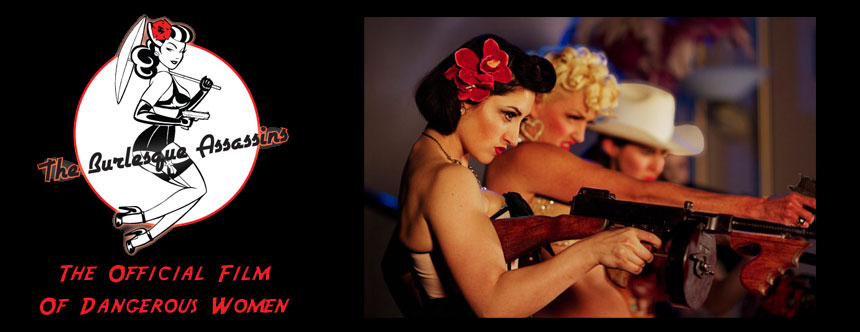
 This is the third version of the same concept I’ve seen, following some years after the
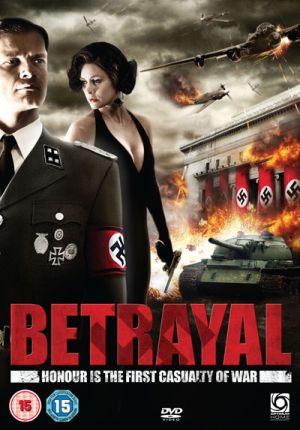 “I’m a Barbie girl, in a Nazi world…” That’s an equally appropriate summary here, because the heroine in this flick, set in occupied Norway during World War II, was the lead singer of Aqua, famous (or notorious, if you prefer) for a certain catchy pop ditty. She plays – and I know you’ll find this a stretch – a singer, who works in a nightclub, which caters for high-ranking Nazi officers, while she simultaneously works with the local resistance and beds SS Major Kruger (Otto). The Allies are seeking plans of a local aluminium smelting plant, a key cog in the Third Reich’s war machine, so an airstrike can be called down on to it. Local businessman Tor Lindblom (Saheim) partners with Kruger to profit from the industrial operation, and play both sides, until their pet auditor is replaced by one rather less amenable to their embezzlement.
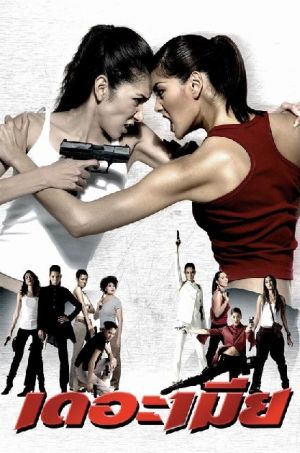 According to the film’s introductory narration, Thailand now has about three women for every man. This has led to many men both having an “official” wife, while also keeping a mistress, and not exactly being secretive about it – when the wife dies, the mistress gets “promoted” to replace her, which has obvious implications for both parties. In order to protect their rights, the eives form an association, the FCWI, which stands for First Class Wives International. Not to be outdone, the mistresses do the same thing, with the ECWI (Economy Class Wives International). After two members of the former are gunned down on a stretch of highway, the two groups seem set for a fiery and murderous collision between the wives and mistresses.
 This will only make sense, or be in any way entertaining, if you’ve seen Bloodrayne 3: The Third Reich: because it’s basically the same film, with a really fat chick (Hollister) replacing Natassia Malthe. And when I say, “the same film,” I mean the same storyline, same actors playing the same roles, and same scenes in the same locations. Really, I suspect this must have been made at the same time, with Boll simply swapping out Hollister for Malthe every other take. As there, the heroine is a half-human, half-vampire, who finds herself involved in a Nazi plan to take the powers of vampirism and turn them to their own ends. Except here, it is, of course, a spoof – and one so extremely broad, the makers of those Epic Movie flicks would have been cringing on occasion. Fat jokes, gay jokes, Nazi jokes… No easy target is left unstoned, paved with deliberate anachronisms like Segways and Internet dating.
 ★★★
★★★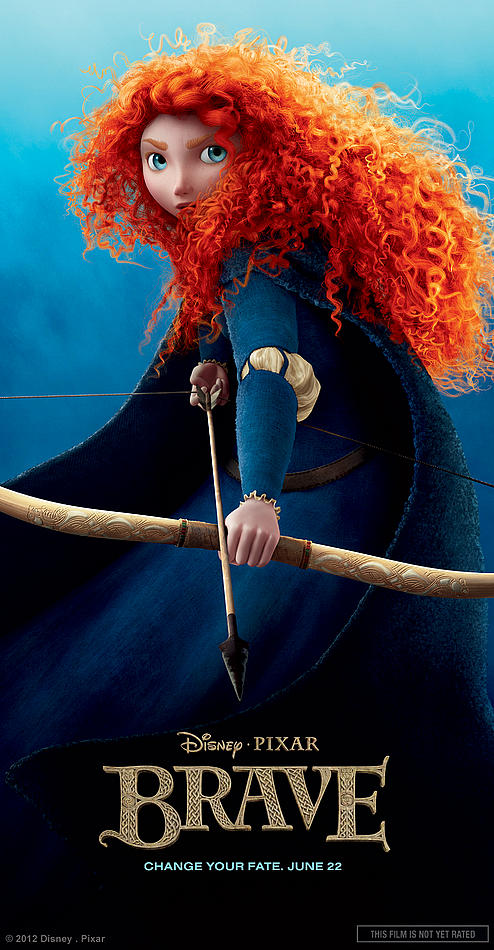 I was immensely stoked for Brave on a number of levels. First, Pixar kicks ass. With the exception of the underwhelming Cars and its pointless sequel, the quality of their work speaks for itself: Monsters, Inc is close to the finest animated movie of all time. Secondly, genuine action heroine films for the whole family are rare, to the point that they can probably be counted on the fingers of one hand over the past 25 years. Thirdly, it’s Scotland. Y’know, where I’m from. It’s the bit at the top of England. I feel I should mention this, because Pixar had originally tabbed Reese Witherspoon to voice the teenage, Scottish heroine, Merida. Fortunately, scheduling prevented this, and Pixar ended up with an all-Scottish lead cast.
 The problems are more with plotting – basically, the issue described above by Chapman is still present. The story starts in one direction, looking suitably action-oriented. It’s difficult to provide any specifics without giving spoilers – there’s a major plot-point not even hinted at in the trailers, which certainly surprised me. But I can see that it abruptly changes direction in the middle, going in a much less satisfactory direction, that seems almost to push Merida into the background of her own story. Even the climax relies less on any innate abilities of our heroine, such as her much-touted archery, or even her temperament, more the fortuitous toppling of a large geological entity [I doubt the film would have sold quite as well had it been named “Lucky”].