
★★★
“You’re never going to get to where you’re going if you acknowledge fear.”
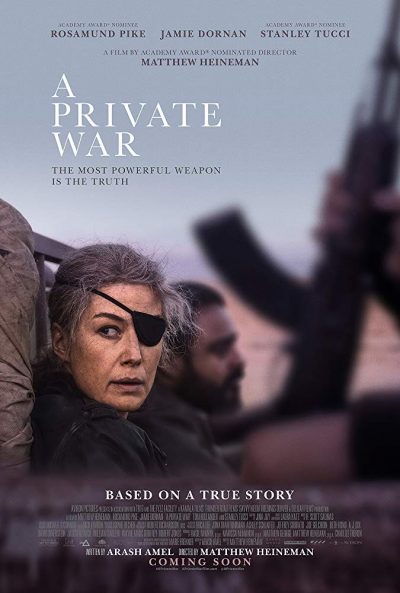 The profession of journalist is not exactly well-regarded by many people these days. So it’s nice occasionally to be reminded that they can still potentially be action heroes, risking their own lives in pursuit of the truth. In this case, it’s Marie Colvin (Pike), a foreign correspondent for London’s Sunday Times newspaper, who lost an eye while covering the civil strife in Sri Lanka, leading to a piratical eye-patch for the rest of her career. Most people would treat that as a sign from the universe to look into a change of profession. But Colvin was made of sterner stuff, despite a hellacious case of post-traumatic stress disorder, with which she largely coped by drinking heavily. So she and photographer sidekick Paul Conroy (Dornan) continue to venture into the world’s hot-spots, whether it’s Iraq, Libya or Syria. There, they expose the terrible human cost that the conflicts have on the local population, without apparent concern for their own safety.
It’s not a spoiler to say this doesn’t end well, for Colvin was indeed killed in Homs, Syria in a January 2012 explosion. And that’s kinda the thing which both drives the narrative and irritates the heck out of me. The film opens and closes with the quote from its subject at the top. However, to counter-quote her with Arthur Conan Doyle, “It is stupidity rather than courage to refuse to recognize danger when it is close upon you.” As depicted here, it seems as if the journalist almost had a death-wish, spitting in the face of danger long past what was prudent or even had much purpose. There’s little or no acknowledgement by Colvin that a dead writer won’t be able to achieve much. If you don’t get out safely to tell the stories you have gathered, what’s the point? You can argue, to some extent, it’s this and her other flaws which render its heroine human.
On the other hand, I found it extraordinarily hard to relate to Marie, with her choices and subsequent actions being so entirely alien to me. She insists on getting right to the core of suffering, even if this means asking its subjects brutal questions. Is this laudable journalism? Or a close cousin to the reporters who shove microphones at victims of tragedy and ask, “How do you feel?” Director Heinemann was responsible for the very good documentary Cartel Land, but seems to struggle a bit when he has to generate the narrative, rather than just recording it. We get only fragments that hint at Colvin’s character, such as a habit of wearing expensive bras, because she declares, “If anyone’s gonna pull my corpse from a trench, I want them to be impressed.” While there’s no denying the bravery of her chosen profession, or her qualifications for this site (albeit in the unorthodox wing!), and former Bond-girl Pike is excellent, I wasn’t left with any deeper appreciation of the why, rather than the how, of her life.
Dir: Matthew Heineman
Star: Rosamund Pike, Jamie Dornan, Tom Hollander, Stanley Tucci
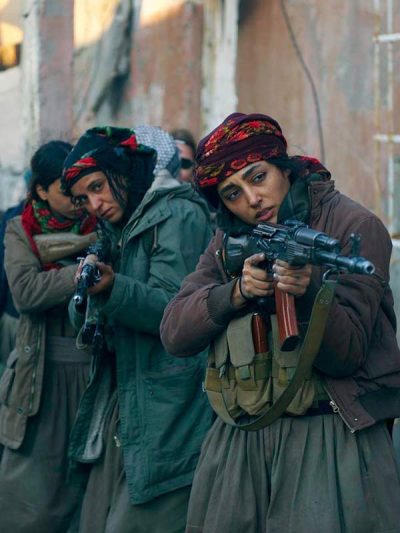 There’a a good film in here. Actually, there may be as many as three good films in here. But the way in which they are melded together, manages to rob a good chunk of the power and impact from all of them. We begin by following Mathilde H (Bercot), a war journalist clearly modelled
  This is a painfully lazy knock-off of a certain, well-known action film, in which terrorists take hostages in a multi-storey building over the festive season. This action is as cover for their actual goal, which is the robbery of a well-secured vault. But one of the inhabitants evades the initial surge, and begins to run interference. They get help and moral support over the airwaves by someone on the outside, and use the air-ducts in the building to avoid detection. Yeah. It’s like that, and you’ll probably understand why my eyes were rolling when we get the line, “Ho-ho-ho, motherfucker.” Now, there’s no doubt the makers openly acknowledge their inspiration. But pleading guilty doesn’t get you out of the crime. At least other, similarly inspired movies, e.g.
  I really must get round to reviewing Wentworth. The Australian women-in-prison drama certainly deserves coverage here, and has provided some of the best television we’ve enjoyed in the 2010’s. I keep intending to do so, but suspect that will now likely have to wait until after the show comes to a conclusion, following its ninth and final season in 2021. In the meantime, however, I do get to review the Turkish remake of the show. If you’ve seen Wentworth, this version is perhaps as unnecessary as any Hollywood remake of a familiar foreign film. Yet there are enough differences – both in story and culture – that I didn’t mind too much.
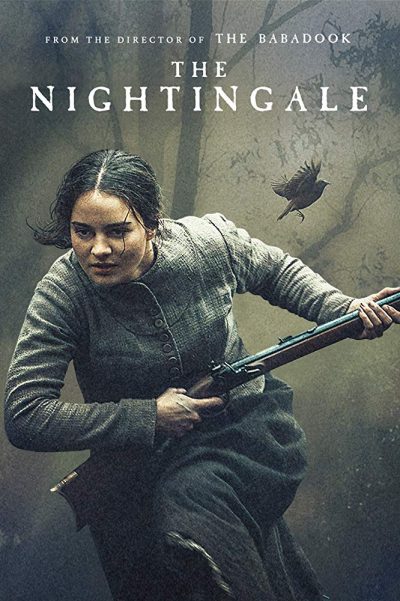 History is largely filled with people being unpleasant to each other, usually for belonging to a different race, religion, nationality or even species [if you want to go back to the Cro-Magnons pushing out the Neanderthals about 40,000 years ago]. It’s sad and unfortunate, but it’s not something for which I feel personal responsibility – not least because it tends to work in both directions. My ancestors may have been part of the British Empire who, for example, invented the concentration camp in the Boer War. But my ancestors were also subject to the ethnic cleansing of the Highland Clearances, forced out to make way for sheep. Attempts to make me feel guilty for the sins of my forefathers are thus largely doomed to fail.
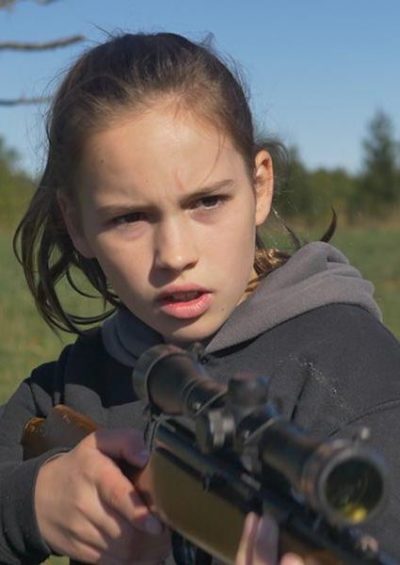 Really, for a reported budget of about $6,500 – and those are Canadian dollars, which currently works out to less than five grand in freedom dollars – this is quite impressive. You could argue that trying to create a convincing post-apocalyptic scenario on such a tiny budget is biting off more than you can chew. And there are certainly moments which just don’t work. But in its low-key approach, it’s probably a more accurate reflection than many of the way in which the world might end. Not with a bang, but with a whimper, and a slow grinding to a halt.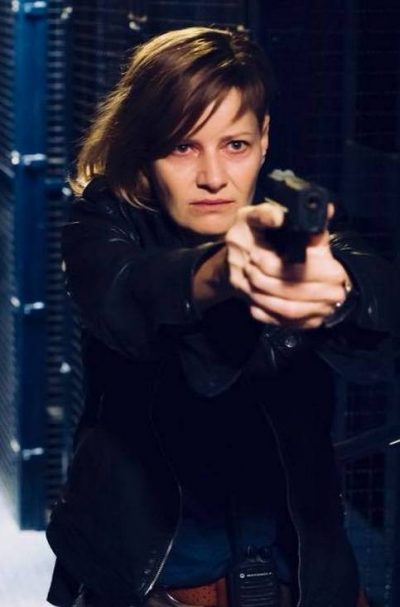
 The above is the Polish for “seven”, and in the first half-hour, you’ll be forgiven for thinking that’s what you’re watching: a Polish knock-off of David Fincher’s Se7en. Homicide cop Helena Rus (Kożuchowska) is struggling to come to terms with life, after her boyfriend is killed by a drunk-driver and, for political reasons, the criminal is allowed to go free. A welcome distraction comes in the shape of a series of ritualistic murders: every day at 6 pm, a body turns up on the streets of Wroclaw. The victims have been killed in strange and unusual ways – the first, for example, is sewn inside a cow-hide, which shrinks as it dries, crushing the victim to death. Each has a word branded into their flesh, such as “Degenerate”.
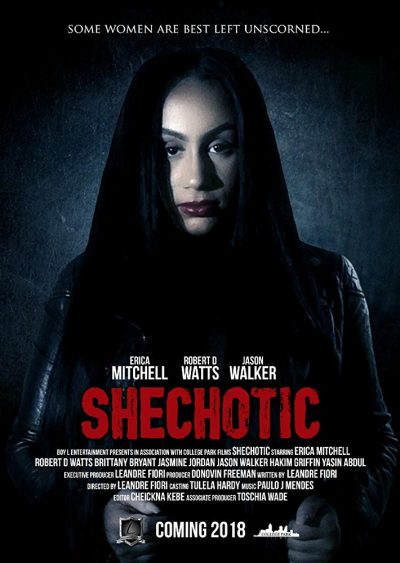 Within about two minutes of starting this, I realized I had made a terrible mistake, and was watching something barely reaching the amateur level of film production. Still, I soldiered on – albeit for some loose definition of “soldiered” – until the bitter end, mostly so I could issue an informed warning about this to any prospective viewers. Maxine (Mitchell) is rather upset when she discovers her boyfriend, music video producer Lance (Watts) has been cheating on her with Lana (Bryant). Mind you, she’s clearly a bit unhinged already: for example, telling him she’s pregnant when she isn’t. So it’s not much of a surprise when her reaction to his two-timing is to kidnap Lance, tie him up in her basement and submit him to various indignities, along with seeking revenge on Lana. Which, apparently, includes sleeping with her father (Walker).
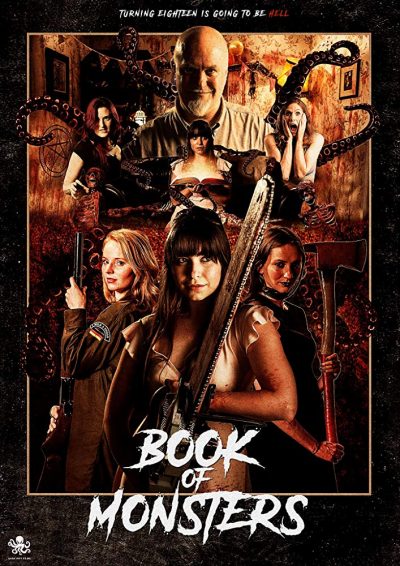 Ten years ago, the mother of eight-year-old Sophie (Craine) was attacked and killed by what her daughter insisted was a monster – a claim to which she held, resulting in her being institutionalized. Now, a somewhat recovered Sophie is about to enjoy her 18th birthday, having organized a party with her friends. But she’s about to discover that the monsters were very real, and just waiting for her to reach adulthood. Fortunately, Mom was a bit of a monster hunter, who conveniently left a book of helpful tips as well as a secret vault of tools and weapons. Together with her pals, Sophie is prepared to make a stand and defend her home against the attackers.