




★★½
“Another great concept is let down by depressingly obvious scripting.”
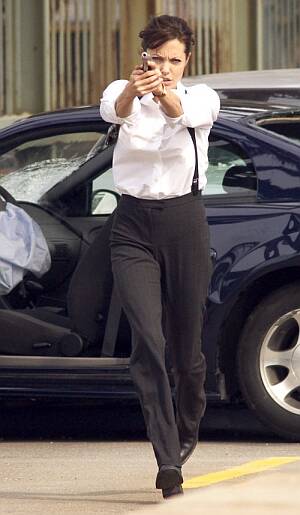 Rarely has a film started so promisingly, and gone so consistently downhill. The start is fabulous, with one of the most shocking moments I’ve seen…though if you’ve seen the trailer, you’ll have had it spoiled. But regardless, the first time we meet FBI profiler Illeana Scott (Jolie), on special assignment to Montreal, she’s lying in a grave. She is hard as nails, and takes absolutely no crap from anyone: her local friend, Captain Leclair (Karyo) hardly needs to bother protecting her, despite the nicely-handled cross-border tension. The case is that of a serial killer who, as the title suggests, inhabits the lives of his victims: the crack comes when his mother (Rowlands), believing him dead for two decades, spots him in Montreal by chance. However, the only other person to have seen the suspect is art-gallery owner James Costa (Hawke), but Scott starts finding her emotions getting in the way of her work…
Which is where the film loses its way, deflating like a leaky balloon. We are forced to watch the inevitable sexual tension between these two characters; seeing Scott go about her business would be infinitely less cliched and predictable. There is a twist that is so obvious you’d need to be unconscious not to see it coming – though I’d forgive you for falling asleep during the aforementioned sexual tension – and a final act that appears to have been taken from a bad 80’s slasher movie. These failings merely open the door for you to stare more closely at the plot, and you realise large chunks of it are on wobbly ground. For example, Scott deduces from a draft that a bookcase must conceal a hidden door: er, why not simply an A/C vent? Part Se7en, part Silence of the Lambs, this comes over as taking the less effective elements from each film, leaving the potential of a female Sherlock Holmes sadly under-realised.
Dir: D.J. Caruso
Stars: Angelina Jolie, Tchéky Karyo, Ethan Hawke, Gena Rowlands
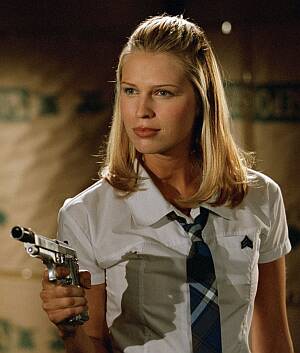 As Kim Possible proves, there’s certainly scope for a high-school action heroine who has to save the world from evil. Unfortunately, here, the potential largely gurgles down the plughole, in favour of a smug, self-satisfied romantic comedy, that manages to be as bland as a film about teenage lesbians could be. Amy Bradshaw (Foster) gets a perfect score on the test hidden within the SAT, and is recruited into a spy academy; there, with her classmates (Good, Ritchie and the always amusing Devon Aoki), she carries out secret missions, wears plaid skirts and agonises over her relationship with her boyfriend.
 The action isn’t too bad initially, with a sprightly shootout in a restaurant. However, that’s your lot, save the “daring” lesbian angle. Though, being mainstream cinema, it’s just a couple of clothes-on kisses, and bad, unconvincing romance is no fun, regardless of a character’s orientation. This aspect is so po-faced and politically correct – it is, clearly, supposed to be taken Very Seriously – that proceedings come to a grinding halt, while what appears to be the director’s iPod on shuffle plays as a witless soundtrack. Look! An Erasure song! How appropriate! ‘Cos, y’know, they’re
 Since the success of Ang Lee’s Crouching Tiger, fellow arthouse director Zhang Yimou seems to have become obsessed with one-upping Lee. First was Hero, a sumptuous and multi-levelled tale of revenge and betrayal starring Jet Li; now, we get House which while slightly smaller in scale, is clearly going for the same tragically romantic feel as CTHD. Policeman Leo (Lau) suspects Mei (Zhang), an arrested blind prostitute, is part of the titular rebel group, so sends Jin (Kaneshiro) to win her confidence by helping her ‘escape’, then going with her to the Flying Daggers’s base. However, it gives nothing away to say that Mei and Jin start having feelings for each other, as they battle through the countryside, and it’s no surprise to discover that several other characters aren’t what they seem either.
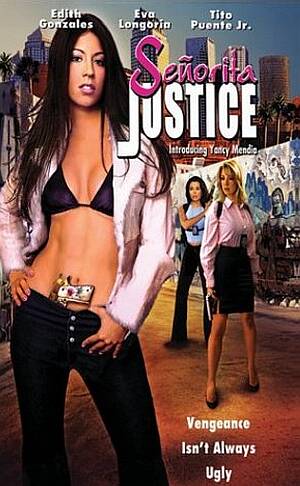 This is an interesting contrast to Sunland Heat which took a woeful script and executed it briskly enough to work. Here, the story isn’t bad – Anna Rios, a Hispanic lawyer (with a special forces background!) goes back to her roots, after her brother is gunned-down, and uncovers a maze of murky deals. It’s the execution which is largely inept, “Kantz” providing further evidence that one-name directors suck at GWG films – see also Charlie’s Angels: Full Throttle (McQ), Catwoman (Pitof), Ecks vs. Sever (Kaos) and Tomb Raider 2 (Jandebont).
 This Brazillian-shot entry has a lot of good ideas, and some excellent moments, but comes up short with a script that borders on the incomprehensible. For example, in the middle of the film, the hero and heroine are both shot with tranquilizer darts – but no subsequent mention or explanation of this ever appears. This kind of sloppy plotting plagues the movie; it’s almost half-way through before the basic story becomes clear.
 There’s lots to appreciate, not least the actors. As opposed to many films, Hagen here actually looks like she could kick your ass, and the flashback fight sequence is excellent – I’d like to have seen more of that, and all the battles are well staged and shot. While Perry is somewhat bland, he’s effective in action; Richardson is a B-movie veteran for almost two decades (Hollywood Chainsaw Hookers, Attack of the 60-foot Centrefold, etc.), and has a nice, world-weary air here. But Putney (left) is perhaps the best find as Daniel’s gun-toting sidekick, Jackie; the final scene between her and her boss is fabulously intense. And there are other cool little aspects, in things like Daniel’s henchmen.
 The picture on the right probably does a better job of explaining what Cutey Honey is about than I ever could; part-girl, part nano-technology, rebuilt post-car crash with superpowers and some interesting costumes, which require fuelling through junk food. After her uncle is kidnapped by the evil Sister Jill (Sakai) and his/her/its minions – Jill is part tree, and has also been kidnapping women en masse, in order to drain their lifeforce – only Cutie (Sato) can save the day, assisted by a no-nonsense policewoman (Ichikawa) and a journalist who, basically, acts as “Exposition-San” (Murakami).
 I liked, and enjoyed the original film, and at first, this seems to have a great chance at surpassing it. The opening fight between our two heroines, one (Choi) a slave-trader, the other (Chung) an enforcer for the Empress, is a masterpiece that combines wire-work, CGI and gimmickry – camerawork from Azumi and what looks like a mutant Klingon batleth – to fabulous (if not fully convincing) effect. All this in a mythical kingdom where women rule, and men are reduced to “dumbbells”, while the cast includes both Jackie Chan and Donnie Yen. Even if the connection to the original is tenuous at best, the potential here doesn’t need to be specified.
 On the plus side, both Twins put in surprisingly solid performances – Choi, in particular, is much less irritating than before, though remains outshone by Chung. However, they still aren’t enough on their own to sustain a movie, despite the parade of celebrity cameos, especially when co-stars Chen and Fong are woefully short of the mark. With a $10.2 million budget, I just wish they’d spent a few more dollars on the script and some decent actors. Then, it might have lived up to the marvellous first fifteen minutes.
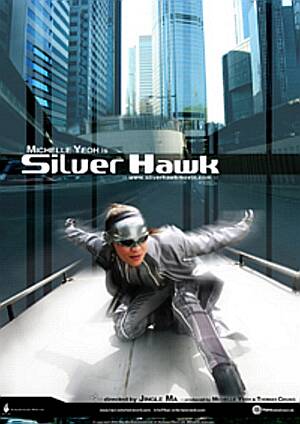 There’s no doubt about the aesthetic they’re aiming for here; heroine with secret identity, sneering evil nemesis, gadgets, etc. Take a Marvel comic from the 60’s, transplant it to the modern Far East, and there you are. Indeed, this period is apparently where SilverHawk originated; unfortunately, the makers failed to learn from similar failures such as The Avengers, The Mod Squad and Wild Wild West, and the results are lacklustre.