
47 Meters Down: Uncaged

★★★
“One for the shark buffet, please.”

Director Roberts returns for a sequel to 47 Meters Down, once more diving (literally) into similar territory. Here, he doubles down, this time sending four young women underwater to be trapped and become shark bait, rather than two. Munching ensues. But there’s enough variety in this iteration for it to prevail, after a pretty shaky opening act. This plays like some bizarre version of Mean Girls, with heroine Mia (Nélisse) getting pushed into her school’s swimming pool by a bratty fellow pupil. It’s all very short skirts, perfect teeth and family drama, to the point that Chris was beginning to look at me oddly and wonder what the hell I’d put on.

Anyway, Mia and stepsister Sasha (Foxx) bail on the intended sailing excursion to go off with pals Alexa (Tju) and Nicole (Stallone) to a secret swimming hole in the Yucatan where they, and apparently no-one of Hispanic origin, live. The pair’s dad is some kind of marine archaeologist, who found an underwater Mayan city down there, so for a lark, the four decided to do an impromptu bit of cave diving. BIG mistake. A collapse seals off the exit, and the only way out is to go on, down and through the underwater complex. Not helping, to put it mildly, are the giant white cave sharks which are apparently delighted to have a bit of variety in their diet, in the form of American teenager.

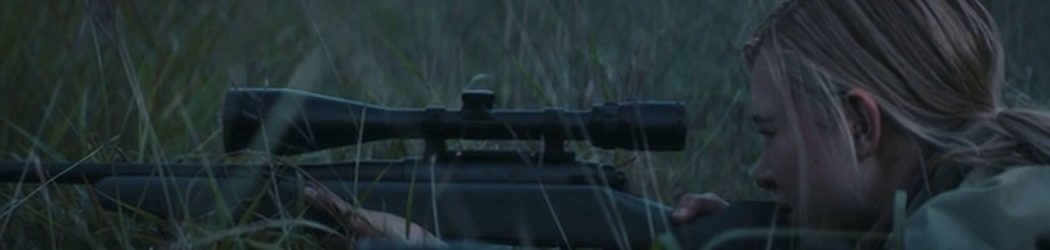
It certainly perks up when the angsty teenage drama is abandoned in favour of swimming and screaming. Roberts pushes the camera in really close for the most part. Combined with the (understandably) limited amount of light, this does make for some rather chaotic sequences. Yet on the other hand, it unquestionably emphasizes and enhances the claustrophobia which is the tension’s main contributor. The sharks are genuinely creepy too, not least having lost their sight due to the conditions – if shark eyes are chilling, then sightless shark eyes are worse still. I got the impression this was wanting to be an underwater version of The Descent, and there are much worse targets at which a horror film could aim.

It all ends in a grandstand sequence of increasing peril, as the (less than four) survivors try to make their final escape from the water. Admittedly, it does rely on sharks that apparently don’t want to commit to the munching, preferring a little love-nibble to snapping their victims in half (a similar issue to Crawl, where the non-disposable characters appeared to be made out of kevlar). Despite this cop-out, it’s a rousing enough finale, largely making me forget the early struggles. If there’s nothing much among the performances to suggest the daughters of Jamie Foxx and Sylvester Stallone should be following in their fathers’ footsteps, as adequately entertaining shark movies go, this one is certainly… adequately entertaining. And I speak as something of a connoisseur of adequately entertaining shark movies.

Dir: Johannes Roberts
Star: Sophie Nélisse, Corinne Foxx, Brianne Tju, Sistine Stallone

Women’s Justice, by Chrissy Wissler

Literary rating: ★★★
Kick-butt quotient: ☆

In the 1880’s, the town of Butte, Montana is a mining boom-town – instead of gold, it’s mostly copper which fuels its economy. The wealth comes at a cost, as the huge amounts of acrid smoke belched from the smelters and plants turns day into night, along with creating perpetually “noxious, disgusting air.” Off the train and into this smog steps Cat, a woman with no shortage of a past. A former prostitute, but also a ranch-hand, her preferred outfit of blue jeans and six-shooter is most atypical for a woman of the times. Almost immediately, she is drawn into the mysterious and suspicious death on the street of another “fallen woman,” Norma. The apparent cover-up goes right up to “Copper Kings” such as Marcus Daly (a real tycoon from that time and place), and it quickly becomes clear that whoever was behind Norma’s demise, is none to happy to find Cat looking into the matter. To find the truth, she’s going to have to navigate her way through both ends of Butte society.

What stands out for me is Wissler’s incredibly verbose style, in which a whack on the shoulder with a plank merits several pages of descriptive prose. There’s one sequence, where Cat returns to the boarding-house where she’s staying, and discovers an unexpected dinner party in progress, when it feels like chapters elapse between the front-door and dining-room. That isn’t necessarily a bad thing – it’s not like she’s Alexandre Dumas, getting paid by the word. Indeed, it’s often interesting to get a deep dive into Cat’s thoughts and motivations, since she has a past that influences much of her behaviour; not least, a hinted-at violent incident involving her sister, Alice and her abusive husband. But there were times when I would have been happier for the plot to move forward at less of a glacial pace.

There’s no denying the author’s talents at generating the nightmarish world, with its poisonous air, and yawning gulf between the haves and the have-nots. Those like Norma can be pitched from the former category into the latter in a moment – and return is almost impossible. Instead, you can end up in the tunnels below the city streets, a virtual living hell for the lowest of the low. Cat’s history gives her an ability to empathize with the lower classes, while still capable of interacting with their “betters”, though there are times when her abilities seem to come close to telepathy, in terms of reading people. She could probably make a great living as a poker player. And despite the pistol on her hip, the action is limited – she never gets to draw it at all. Even the final face-off with Norma’s killer in those tunnels, entered from one of Butte’s grandest brothels, sees her largely defer to others in the name of justice.

There are some typos and missing words in the text, and I wonder if the word “bum” – as in rear – would genuinely have been used repeatedly by an 1880’s cowgirl. It seems rather too British: surely “ass” or “butt” (not to be confused with Butte!) would have been more likely? But despite flaws, this does remains an evocative depiction of a time and place which feels different from the usual Western fare. And it’s all the better for that.

Author: Chrissy Wissler
Publisher: Blue Cedar Publishing, available through Amazon, both as a paperback and an e-book
1 of 2 in the Cowboy Cat series.

The Furnace

★★★
“Run Mary Run”

Two days after getting married, Mary Harris (Bernadette) is involved in a car accident which kills her new husband and leaves her barely able to walk. But she has one goal: to compete in the Furnace, an ultra-marathon race through the African wilderness, in which she and her late husband had been planning to take part. This aim goes strongly against the desires of her mother, but Mary won’t be deterred. With the help of her mentor (Dlamini, looking like a younger version of Morgan Freeman), nicknamed “Coffin” due to his day-job as a gravedigger, she claws her way back to fitness, and to the start-line. But is she prepared for everything the environment can throw at her, and make it to the finish? To do so, she’ll have to overcome not just the lethal heat, but also predators for whom she’d be a tasty snack, and poisonous scorpions whose venom induces disorienting hallucinations.

It’s certainly a change of pace for Bernadette, who has previously been seen on this site in Killing Joan and All Girls Weekend, as well as the largely woeful I Spit On Your Grave reboot, Deja Vu, not reviewed here. This is a film heavy on the F-word – by which I mean “faith”. Its religious overtones may be enough to write it off for many, but even as someone who possesses no real commitment there, it still worked well enough as a story about fighting through and triumphing over adversity. The race itself is the most effective section, with a constant stream of problems to overcome, and fortunately that does represent the majority of the film’s running-time. I must admit, I guessed the truth about her running companion, Raphaella (Linn) well before the film revealed it, and that angle is perhaps one where the faith-based elements become more than a little overwhelming.

Exhaustive research i.e. five minutes of Googling, couldn’t locate any race comparable with the Furnace, and it does seem a highly perilous endeavour, even with a GPS attached to participants. “If you’re stationary for more than seven hours, you’re disqualified, and we come pick you up,” says the organizer. Shouldn’t that be “If you’re stationary for more than seven hours, you’ve been eaten by hyenas, and we come pick up whatever is left in a bucket”? It’s certainly not my idea of a challenge to which I aspire, but there are people like Mary who seek to push their limits, so it’s not that far-fetched. Throw in decent cinematography and animal work and you’ve got something that  entertained me rather more than I perhaps expected, though Coffin’s voice-over does become a little superfluous in places. It’s not a film which an atheist is likely going to be able to appreciate, yet dammit, even I found myself getting fractionally emotional for the final scene. I’d probably be more inclined to credit Peters’s performance for that, rather than any kind of divine intervention.

Dir: Darrell Roodt
Star: Jamie Bernadette, Luthuli Dlamini, Laura Linn, Thandi Puren

The Old Guard

★★★
“Who wants to live forever?”

While a serviceable entry in the beloved genre of “Charlize Theron kicks ass”, this does have to be classed as disappointing in comparison to the epic awesomeness which were Atomic Blonde or Mad Max: Fury Road. This is considerably more obviously a comic-book adaptation than Blonde, and more restrained than Fury Road, resulting in a film which plays more like X-Men: The Highlander Years. Andromache of Scythia (Theron), for obvious reasons known to her mates as Andy, is a neo-immortal bad-ass who has been roaming the Earth since pre-Christian times. But she’s beginning to wonder what the point of it all is, endlessly doing jobs somewhere between mercenary and humanitarian.

Two things disrupt the playing field. The first is the “birth” of a new neo-immortal, Nile Freeman (Layne), a US marine who survives having her throat slit, and is brought on board the team, despite her severe initial doubts. The other is less pleasant: the Merrick pharmaceutical company is out to find what makes them tick, and will happily trample Andy and her friends’ rights, in the name of “the greater good.” This involves them kidnapping two members of the group for scientific experimentation, and they are intent on completing the set. Needless to say, Andy isn’t having any of that, along with some help from Nile, as well as a Merrick employee and former CIA agent who is now having second thoughts (an underused Chiwetel Ejiofor). However, it turns out Andy is approaching the “neo-” phase of her neo-immortality…

That is a bit of a cheat: they’re basically immortal, except when necessary for the plot or dramatic reasons. It’s a double-standard which also seems to permeate the film more generally, The film wants to deliver the mayhem audiences want to see, while having characters who loudly express being tired of exactly that, borne down by world-weary ennui. It’s a mindless action movie which doesn’t like being a mindless action movie, and I suspect would rather be something else. That may be the only way to explain the contrived shoehorning in of two characters’ sexuality, in a scene of no relevance that couldn’t be more clunkily woke if it tried.

It is better when letting go of the angst, and instead embracing its inner John Wick. Theron proves why she is still the top action heroine working in Hollywood, getting valuable support from Layne. There’s a lovely hand-to-hand battle between the two of them on a transport plane, for example, and Andy busting out of the church which is under attack by Merrick thugs is also a pleasure to watch. As seems almost required, there’s a scene at the end, setting up The Old Guard 2 with the apparent promise of an insane neo-immortal for the big bad there. It’s perhaps telling that it’s a prospect which may be more exciting than the humdrum stock genre plot rolled out here. Not even the best Netflix original action movie of the year (that’d be Extraction), yet entertaining enough, if your copy of Fury Road isn’t to hand.

Dir: Gina Prince-Bythewood
Star: Charlize Theron, KiKi Layne, Matthias Schoenaerts, Marwan Kenzari

Sweetheart

★★½
“Creature from the Blue Lagoon”

After a boat-wreck, Jennifer Remming (Clemons) washes ashore on a deserted tropical island, and has to make do with what she can find and forage. While there are no other people on the island, she’s not alone. It becomes increasingly clear that a “something” is predating for food at night there. She eventually finds out what it is: a large, amphibious and very hungry creature, walking on two legs, and capable of dragging its prey back into its lair beneath the water. Needless to say, she’s delighted when two other survivors wash up in a lifeboat: her boyfriend Lucas (Cohen) and friend Mia (Mangan-Lawrence). But convincing them of the threat, and the need to get off the island immediately, is a little tricky, because it turns out Jennifer has a little history of making things up. However, “being eaten” turns out to be fairly convincing proof, as evidence goes…

Have to say, the first time we get to see the creature is glorious. After some warning signs have set the scene, such as a dead shark with claw marks on the side, it’s a great reveal, which literally gave me chills. The problem is, it’s also about the last time we get to see it. For its nocturnal nature means we have to deal with it only popping up in extremely subdued lighting. While this makes sense – it being a tropical island, there’s not exactly much natural light – it makes for an extraordinarily frustrating experience. Too often, the viewer has to peer into the murk, trying to figure out exactly who is doing what, and to whom. I can only presume this was done to enhance the tension in some “lurking in the darkness” way. If so, it’s remarkably counter-productive, triggering considerably more annoyance than terror.

I did like Jennifer as a heroine: she doesn’t seem to have particular survival skills, yet managed to make a good fist of things. Certainly, much better than I would have; I suspect I’d last on a desert island, only as long as my fat reserves permitted. I also appreciated the fairly linear nature of the film: Girl Meets Monster, Monster tries to kill Girl, Girl tries to kill Monster. If only The Shape of Water had gone this route. It does get rather less effective when it’s no longer a party of one, with the usual (and considerably less interesting) bickering which follows. However, the presence of other people is probably necessary: even Tom Hanks needed a supporting performance from a volleyball to sustain Castaway for its running-time.

After an aborted escape attempt, it all builds to the inevitable final confrontation. Which, conveniently, takes place in a relatively well-lit arena, courtesy of some torches. Once we get to see it, this is quite a cool monster – perhaps slightly influenced by what the Predator wore under its mask. Just a shame it doesn’t truly show up until the party is all but over. Between that and a script with too many loose ends, it one of those cases where the film isn’t as good as the trailer.

Dir: J.D. Dillard
Star: Kiersey Clemons, Emory Cohen, Hanna Mangan-Lawrence, Andrew Crawford

Wonder Woman: Bloodlines

★★
“I wonder what they were thinking?”

Having enjoyed the previous animated Wonder Woman film, this was a significant disappointment. It doesn’t seem to fit in to any established universe and loos designed more as a quick cash-in on the success of the live-action version, than existing out of artistic desire. It begins with a broken, modern-day update of the latter’s opening, with the plane of Air Force pilot Steve Trevor (Donovan) making a crash-landing inside the bubble which has protected Themyscira  over the ages. He’s desperate to return to tell the world about the demonic entities which attacked him, and Diana (Dawson, who played Artemis in the previous animated version) rebels against her mother and the decision of the other Amazons to imprison Steve, going with him to the outside world.

Except, there’s basically no explanation as to Diana’s revolt, beyond a throwaway line about a prophecy. And in the next scene, Diana is sitting in the back of a cab on the way to house of historian Dr. Julia Kapatelis. Demonic entities? What are they? With those entirely forgotten, the film then focuses on the doctor’s daughter, Vanessa (Avgeropoulos), who turns bad, becomes Silver Swan, and eventually teams up with Doctor Poison and a slew of B-villains, of whom I’ve never heard, e.g. Giganta, Cheetah, Doctor Cyber. They plan to attack Themyscira and profit from its technology, and to that goal have revived and powered-up Medusa, who ends up becoming more of a Med-zilla.

This is all full of ridiculous and contrived circumstances. For instance, Diana “forgets” the location of Themyscira. But – what are the odds – there’s a fountain from which she can drink, which will restore her knowledge! And Julia discovered the location in her research! Or, the dispatch of Medusa will turn everyone whom she has petrified, back to being human again. Hmm, must have missed that bit in the mythology. It will certainly lead to some very confused ancient Greek warriors, who suddenly find themselves inhabiting the 21st-century… It feels as if the writers were making stuff up as they went along, and repeatedly painted themselves into corners, from which they could only fabricate escapes out of thin air.

All of which I could take, were the animation decent. When in motion, it’s okay, and some of the action scenes work moderately well. But otherwise, it’s painfully basic, with characters’ faces not moving, except for their mouths. Up until Medusa appears, there’s no indication that any of the antagonists are able to pose a genuine threat to our heroine. Their ludicrously-named group, “Villainy, Inc”, feels like something out of a superhero spoof like Mystery Men. While the initial set-up make it looks like Vanessa will become Diana’s main opponent, she just ends up just another faceless minion.  As someone familiar only with the various adaptations and not the source comic-books, this wasn’t worth my time. Heck, even the unaired TV pilot was more entertaining. 

Dir: Sam Liu, Justin Copeland
Star (voice):  Rosario Dawson, Jeffrey Donovan, Marie Avgeropoulos, Adrienne C. Moore

E.M.P. 333 Days

★★★
“A thoroughly Canadian apocalypse”

Really, for a reported budget of about $6,500 – and those are Canadian dollars, which currently works out to less than five grand in freedom dollars – this is quite impressive. You could argue that trying to create a convincing post-apocalyptic scenario on such a tiny budget is biting off more than you can chew. And there are certainly moments which just don’t work. But in its low-key approach, it’s probably a more accurate reflection than many of the way in which the world might end. Not with a bang, but with a whimper, and a slow grinding to a halt.

In this case, it’s an electromagnetic pulse weapon, detonated high in the atmosphere (most likely by North Korea, going off early radio broadcasts) and wiping out everything that use electronics. Which, these days, is virtually everything. When it does, young heroine Niamh (Ferreri, the director’s daughter) is staying with her grandmother, because Dad is away on a business trip. Initially, they hole up, trying to wait it out, but eventually resources dwindle and Niamh has to strike out on her own. Fortunately, Dad was a bit of a prepper and so she is better prepared than most girls her age for life in the new, primitive world, as well as encountering other survivors, both good and bad.

Undeniably, you have to allow a lot of leeway for the very limited resources. Even given the rural setting, it’s never clear to where 99% of the population has gone, or why; a throwaway line saying, “A bunch of people left a few nights ago,” is about as close as we get. The collapse of civilization into anarchy and chaos is depicted by a shot of Niamh and her grandmother, peering out the window and looking concerned, while somewhat riotous sound-effects are heard. All told, as the tagline above implies, it’s a very polite end of the world. It’s also a bit unusual, and therefore refreshing, to see a positive portrayal of survivalists. Rather than the usual wild-eyed paranoiacs, they’re depicted here as down-to-earth, and simply prepared for unfortunate events.

The technical aspects are quite impressive, especially on the visual front where it certainly doesn’t look like a microbudget production. However, the film does drag in the middle. From the point at which Niamh meets another young survivor, Will (Davidson), it seems to spin its wheels for the longest time, despite the pair stumbling across a rare car still capable of driving. It takes the injection of an external threat before the plot begins to move forward again, and Ferreri deserves credit for getting its depiction of killing right, as not something which should be done lightly by anyone.

The movie did tie up its loose ends up a little too conveniently, just when it was looking set fair to be nicely ambiguous. Though on the other hand, this offers a somewhat hopeful note on which to finish things. That might not be a bad thing after a generally downbeat experience, and if it remains the complete cinematic opposite of, say, Fury Road, that’s not entirely a bad thing.

Dir: Adriano Ferreri
Star: Rosa Ferreri, Liam Davidson, Derek A. Bell, Martin Saunders

The Vampire Sword, by T. L. Cerepaka

Literary rating: ★★★
Kick-butt quotient: ☆☆

This series opener got a favorable review from one of the ladies in a Goodreads group I belong to. Since I’m interested in the vampire mythos, and especially intrigued by fiction that approaches it from a Christian standpoint, her review got my attention, though I hadn’t previously heard of either the author or the series. So, when I discovered that I could download the e-book for free, I opted to give it a try.

This is basically urban fantasy, and is clearly influenced both by the Twilight Saga and the Harry Potter series (though Meyer and Rowling are each significantly more accomplished writers than Cerepaka is). What makes it somewhat distinctive in that 24-year-old Tara is a Baptist pastor’s daughter and a Christian believer herself (she made a Christian commitment at the age of 13), who takes her faith seriously, has taught Sunday school, and is singing for her dad’s congregation in a church service when the book opens. But this Sunday proves to be atypical, when an actual vampire crashes through a sanctuary window (on the second frame of the e-book) and bites her in the neck. As in the Twilight books, those who survive a vampire bite normally become vampires themselves. But as the previously clueless Tara learns, she and her dad are Sorcerers, genetically gifted with magic powers most humans (the Powerless –think, “Muggles”) don’t have.

Vampires generally don’t bite their Sorcerer enemies; they just try to kill them. But a rare bitten Sorcerer becomes a half-vampire, with some vampire traits (including a blood thirst –though vampires don’t have to indulge that with human blood, despite the strong temptation) combined with ability to use magic, though just as in the Potter books, that takes training. Unfortunately for Tara, that not only poses theological conundrums for a good Baptist young lady; half-vampires are considered by both the Vampire Council and the Sorcerer’s Parliament as unnatural abominations that need to be killed on sight. And then there’s the added wrinkle that, as Council agent Lucius soon reveals, Tara’s assailant was working for a rogue Vampire Lord who has his own agenda –and it’s an agenda the rest of the world won’t like.

If that sounds like an interesting premise with good possibilities, it is (provided you like that sort of thing –which I do!). The execution, though, isn’t nearly good enough to fully realize the potential of the idea. Throughout my reading of the book, I found myself thinking of ways in which the literary craftsmanship could be improved; obviously, that’s never a good sign! Cerepaka’s prose is minimalist (and often awkward), telling the story straightforwardly enough, but with little description or texture to enflesh the characters and situations. Since Tara is the first-person narrator, we get inside her head; but even so, neither she or the other major characters are very well-developed; we’re never even told, for instance, what she does for a living, though she has a job.

As that would imply, the novel is much more plot-driven than character-driven, and the characters tend to be mostly two-dimensional. No sense of place is evoked; our setting is Texas, where the author lives, but we only learn that in Chapter 20 of a 29-chapter book. (Until then, the references to Greensboro and South Side had me picturing a setting in North Carolina and south-central Virginia!) In a couple of places, facts are stated in the narration and then contradicted a couple of pages later. Although romance actually isn’t a significant element here – it probably is in subsequent books – what there is of it is an unconvincing, one-sided insta-love.

So, why three stars? There are a few pluses here. This is a very fast-paced book, beginning with a bang and moving along quickly through a short time-frame: just about two days for the main story), and though the prose is undistinguished, it flows relatively easily, even despite Tara’s tendency to repeat things in places or over-explain. That makes it a quick read, and I was engaged enough with the story throughout to be anxious to keep clicking to the next frame. Once I started reading it, I finished it in four days, and for me that’s pretty good time for reading an e-book! Cerepaka does display some originality in the treatment of his vampires, and in creating story elements like the Shadow Way and the Strangers, and of course the Vampire Sword itself. Though historically it couldn’t have been forged “ten thousand years ago” –metallurgy didn’t exist then, unless we imagine Robert E. Howard’s lost Hyborean Age! I appreciated the fact that Lucius is a “Pure”, a vampire who eschews human blood, and is disposed to help rather than hurt humans; and Tara’s sincere spiritual struggle with the question of whether, as a half-vampire, she still has a soul and a relationship with God, or is beyond His grace, gave the tale a certain degree of depth.

A word about Tara’s character is worthwhile, since it’s the most developed one here, and obviously the most central. Despite the deficiencies in the portrayal, she does come across as basically likable. Yes, she’s overly concerned with the fact that Lucius is handsome, sometimes to the point of making my eyes roll. But she’s a single woman in her 20s, not a plaster statue on a pedestal. The same can be said of the fact that her Christian faith doesn’t mean she never says a swear word, nor that she’s a paragon of devotional practice. She is who she is; but the person she is has a kind heart, a caring disposition towards others, and a core of guts and resolve when the chips are down. While she’s definitely in a distress situation here, she’s far from helpless; and though she’s not into violence, she’s game to do what has to be done –a fact we learn when she takes out the vampire who bit her with a head shot from a pistol her dad dropped (the bullets were silver). Another thing that helps credibility here (and also adds some depth) is that her greatest challenges in combat situations don’t hinge on her physical fighting ability (which is largely untrained at this point!) but rather on the strength and purity of her moral will.

All in all, I liked this well enough as an entertaining read.  I wouldn’t spend much money to buy it, or the two later books – but I might pick up a used copy of the sequel if I found one at a flea market or a yard sale. :-)

Author: T. L. Cerepaka
Publisher: Self-published; available through Amazon, both for Kindle and as a printed book.
Book 1 of 3 in the Vampire Sorceress series.
A version of this review previously appeared on Goodreads.

La Reina Del Sur: season two

★★★½
“The Queen comes home”

Nine years after the events of the first series, Teresa Mendoza (del Castillo) is no longer in the world of crime. She lives in Italy under a new identity, where she makes marmalade, has a hunky boyfriend and is concerned more with bringing up her daughter, Sofia (Sierra). But where would the telenovela fun be in that? Therefore. it’s not long before Sofia is kidnapped, and used as leverage to drag Teresa back into the murky world of narcotrafico. Except, it’s as much a political game this time, with her previous adversary, Epifanio Vargas (Zurita), is now running for President of Mexico. He orders Teresa to bring down the main rival for that position, by joining the gang of the drug-lord who is backing his rival’s campaign, and finding evidence which can exposie their connection. It’s not even that “simple”, with a lot of people who have long-standing scores to settle with Teresa, and the DEA lurking in the background, pulling strings on behalf of the American government.

It is certainly quite jet-setty. Perhaps because of del Castillo’s well-documented problems with the Mexican government, I’m not sure how many of her scenes were actually filmed locally. As well as Italy, it bounces around between her old stomping-ground of Malaga, Spain and Russia (reuniting Mendoza with Russian mob ally, Oleg Yosikov (Gil), though eventually settles down with the bulk of the action does take place in Mexico. There, Teresa has to round up some other old pals, to give her the necessary resources to infiltrate her target. Meanwhile, Sofia is proving quite the chip off the old block, and causing no end of problems for her captors – who include someone playing a rather dangerous double- or even triple-game. However, despite the plethora of plot threads – and the above is well short of being an exhaustive list – the script does generally pull off a very good job of delineating them without confusion.

Initially, it seemed like we might be in for a more action-oriented brand of Teresa, the first episode (embedded at the bottom, with English subs) ending with her chasing a car on a motor-bike and a rather spectacular stunt. Sadly, it only sustains this pace intermittently thereafter. To make up, we do get the very impressive Manuela, a.k.a Kira, played by Paola Núñez. A disgruntled former DEA agent, she’s one of those with a grudge against Ms. Mendoza, holding her responsible for the death of some family members. She’s definitely a bad-ass, and it’s always a pleasure seeing her and Teresa go toe-to-toe. There were some aspects of the story I did have issues with. For instance, in about a two-episode spell, we get three different cases of someone who should be dead, turning out not to be. That gets old. But all told, it’s a nicely-paced bit of television, that sustained my interest over its 60 episodes – even if it took me approaching six months to get through them all.

Star: Kate del Castillo, Humberto Zurita, Antonio Gil, Isabella Sierra

Black Lagoon: Roberta’s Blood Trail

★★★½
“When you go on a journey of revenge, dig two, uh, MULTIPLE graves…”

[Jim] Almost four years after Black Lagoon, this five-episode mini-sequel was released, re-uniting us with Revy (Toyoguchi), Rock (Namikawa) and the other members of the Lagoon Company. They remain, as before, a somewhat shady outfit, operating out of the South-East Asian wretched hive of scum and villainy, which is the entirely shady city of Roanapur. This arc is also a reunion of sorts with Roberta (Tomizawa, who has been doing voice work since back when I was a “real” anime fan, in the days of Bubblegum Crisis!) She’s the lethal Colombian maid who guards the Lovelace family, with whom Revy and crew crossed swords in one of the Black Lagoon arcs, before Roberta returned to South America.

A politically-motivate bomb explosion there took out her master, and set Roberta off on a trans-continental mission of vengeance, beginning in her country, before crossing the globe to Roanapur. That’s because the people responsible are a black ops group affiliated with one wing of the US government. They are now in town, preparing to go up into the Golden Triangle on their next mission, capturing a Laotian drug-lord. Following her are the Lovelace heir, Garcia (Ikura) and back-up killer maid Fabiola. But quite a few others are also interested in the outcome, including another wing of the US government (CIA vs. NSA), and the various factions of organized crime who run the city.

If there’s an overall theme here, it’s perhaps “redemption for past sins.” Rock, in particular, is seeking to atone for his failure to save a young girl, in the events that ended Black Lagoon. But it sometimes seems that everyone has history, of one kind or another, which has left them carrying baggage: even the NSA assassins have issues. Rock may be the central character here and, disappointingly, Revy spends much of the show on the disabled list. But despite her being sidelined, there are no shortage of strong female characters who take no crap from anyone: Roberta, Fabiola, Miss Balalaika, Eda. Say what you like, Roanapur is clearly an equal-opportunity hive of scum and villainy.

If anything, this is perhaps even more hyper-violent than its predecessor; going from cable TV to video seems to have taken off some of the restraints. Parts #3 and #4 in particular seem almost like an extended exercise in carnage around the streets of the city – amusingly, neither the authorities nor the other inhabitants appear too fazed by these happenings! It’s all a little confusing, with so many players in the game, but things settle down a bit for a solid finale, upstream in the jungles of Laos. All told, if you liked Black Lagoon, then this is almost certainly going to be appreciated in the same way. One review called this a cross between the works of John Woo and Takashi Miike, and it’s hard to argue with that as an overall assessment.


★★★★
“Back with a bang!”

[Dieter] When a couple of years ago, Jim wrote a review on the 2006 anime series Black Lagoon I was a bit heartbroken. Not that anything was wrong with his review, but as a long-time fan of the series, I felt there was so much more to be said about it. Hopefully, I can do this here. One remark before you start reading: As I will spoil things here, it would be good first to have read Jim’s review before or watched the show. 

Rei Hiroe wrote the original manga, first tried out in 2001 and put into regular release in 2002. As often is the case, an anime adaption followed, ending after two seasons and 24 episodes – simply because there wasn’t any more material left to adapt. Hiroe had long suffered from depression, with new chapters coming out at longer and longer intervals; even today, there are only 13 volumes of the series. The first 6 were covered by the original anime series and volumes 7 – 9 by this OVA (Original Video Animation), produced in 2010/11. It consists of 5 x 30-minute episodes, a bit longer than the average episode of the original series.

The story is a stand-alone, nothing new for the show. Roberta’s Blood Trail opens with a callback to the previous story. Former Japanese business man Rokuro Okajima, is now re-named Rock and an employee of criminal delivery organization Black Lagoon. He tried unsuccessfully to save young girl and Yakuza boss Yukio from the evil machinations of a gang war between another Yakuza clan and Russian mafia organization “Hotel Moscow”, led by the merciless Balalaika. But unfortunately, the “law of the jungle” prevailed, resulting in a big gun-battle between Revy and Yakuza killer Ginji, and the suicide of Yukio.

His failure left him psychologically scarred: his intentions to help others have always backfired, as trigger-happy colleague and confidant Revy notes. At the same time, the head of the Lovelace family is accidentally killed by a CIA operation in South America. It leading the family maid, Roberta, who had already appeared in a previous story arc, to go on a full-blown revenge trip against the CIA. Regrettably, she chooses as her battle ground Roanapur, a small, fictional island and city somewhere around the border of Thailand and Cambodia, and home to Black Lagoon. 

This could draw unwanted attention to the criminal underworld of Roanapur, and endanger the peace between the criminal factions there, including Hotel Moscow. Mr. Chang from the Chinese triads asks Rock to help son Garcia Lovelace, and his younger employee, Fabiola, find Roberta – the sooner she leaves the island the better. Unfortunately, this is much more difficult than thought and leads to a three-front war between Roberta, Hotel Moscow and a CIA special squad lead by Major Caxton, responsible for the death of Garcia’s father.

The whole team responsible for this story has topped even their previous efforts. This really feels like the magnum opus of Rei Hiroe and director Sunao Katabuchi. The manga encompasses three whole volumes and was even more complicated, so the director had to boil down the story to bring the entire length of the OVA to 160 minutes. This is “the big one” (to quote James Bond’s M here): a large, ambitious tale beginning in 1969 Vietnam, and ending in the current day of the story (probably the early-to-mid-90s), in the Golden Triangle. Almost every character still alive is used for this epic. While the whole story takes a little while to get into motion, once it builds up steam, it’s a relentless action ride.

But the faint of heart be warned: If previous episodes of the show were already adult content and definitely not for kids, that is even more true for the OVA. The violence depicted is very strong, with neither mangaka nor director showing any qualms about going the whole nine yards. So, there is blood, mayhem and even scenes of torture and sexual abuse.  But it’s not just about being daring, by showing extreme violence in the unforgiving world of gangsters, agents and soldiers. One theme the show constantly deals with – sometimes subtly, here more obviously – is psychological trauma.

Roberta’s rampage is not just about the death of her master. She suffers from overwhelming guilt for previous actions in her life. It’s directly indicated in her hallucinations, and also her taking medication. Former Afghanistan veteran Balalaika is asked in a key scene by Major Caxton, if psychological problems were the reason for her dismissal from the army. And in another revealing moment, Revy experiences a flashback to her youth that gives us a difficult to digest look at how she may have started on the path to the place in life where she is now. It’s a scene only in the anime, not the manga. It confirms once again that, while the manga is great and I love it, the animated version by Katabuchi is something special, and an improvement over the manga.

The story repeatedly stresses the fact that children who are mistreated by authority figures may end up as frightening, violent monsters when they grow up. They struggle with what they have become, and look back filled with pain to the innocent dreams of their youth. It’s something also covered in previous story-arcs, e. g. the vampire twins, but there is more insight (and more pain) here, and it has become a predominant theme. At the same time, Hiroe and Katabuchi do not release their anti-heroes from responsibility. Revy in particular is called out by Fabiola about her hypocrisy. If she is so unhappy with her life what stops her leaving Roanapur with Rock and opening a fruit stand in some other place? Revy’s response is little more than the usual showing-off and “I’m already dead!” speech.

On a larger scale, the OVA shows the connection between organized criminality and “legal” institutions like the C.I.A.. Roanapur, we learn, can exist the way it does only because major powers in the so-called civilized world need it, for purposes of which the public will never hear. In a way, the series opens a can of worms and it will be interesting to see if Rei Hiroe ever returns to this. He didn’t in the three manga volumes he has written since then.

Black Lagoon has never been a “happily ever after” story. Most characters have to pay a high toll here, with Rock being overtaken by “the darkness of Roanapur”, and becoming obsessed with “finally winning”, while Roberta suffers more physical losses. Yet the end seems almost cautiously optimistic. Roberta survives and is “conquered by love”, so to speak. The end titles show her and Garcia welcoming Major Caxton and company in their home. Even Rock hasn’t totally given up. His gun finger points at Roanapur as he says to Revy: “One day…!”

I just love the show. With many memorable characters, and great action scenes that remind me of American action movies of the 1980s and 70s, yet with deeper themes and reflections on human nature, plus musings that go into philosophy, psychology, heck, even the intrinsic nature of evil of large-scale organizations, it is an absolute exceptional series. And while other series like Jormungand or the always beloved Cowboy Bebop may touch similar chords, there is hardly a show that challenges Black Lagoon on its own territory. My only qualm is that the overall story is still not finished. Somehow, based on everything so far, I can’t picture an ending where Rock and Revy just walk happily into the sunset.

Dir: Sunao Katabuchi et al.
Star (voice): Megumi Toyoguchi, Daisuke Namikawa, Michie Tomizawa, Kazue Ikura