 Once upon an unspecified time, somewhere in the cosmos, a human-like, space-faring race called the qhal (or Qujal, in a later dialect) stumbled upon, and subsequently greatly extended, a system of high-tech Gates, a relic of a vanished civilization, which permitted instantaneous travel to other planets and other times. Fearing that travel into the past would prove dangerous, the qhal forbade it; but they used the Gates to travel extensively in space and future time, building up an empire that oppressed and exploited the various despised other races they encountered. This gave them much wealth and power (and universal detestation from others) –until somebody eventually tried past time-travel. The resulting cataclysm (only dimly surmised in the theories of the subsequent scientists) reached as far as the Gates themselves reached, and proved to be an apocalyptic warping of space-time that destroyed civilizations and worlds in its path. But the Gates themselves survived. We learn all of this from an omniscient narrator in the first part of the Prologue.
The other parts of the Prologue are excerpts of various (fictional) documents. In the Journal of the “Union Science Bureau,” we learn of the formation of a team charged with traveling through the Gates, for the sole purpose of closing or destroying them permanently on the far side, to prevent a repeat catastrophe. (Since nobody knows how many Gates there are, this may be a multi-generational task until the last one is reached; and it’s surely going to be a lethally dangerous mission.) Written on a low-tech, medieval-like world, a short text in the Book of Embry tells us that on “the height of Ivrel” still stand ill-regarded, rune-marked “Staines” [stones] of Qujalish origin and still imbued with their “sorceries,” which if touched produce “sich fires of witcherie as taken soul and bodie withal.” This place and others such are sought by those with Qujal blood, recognizable by gray eyes and tall stature, who are thought to lack souls, but “by sorceries liven faire and younge more yeares than Men.”
 Finally, a longer passage from the Annals of Baien-an recounts how, “In the year 1431 of the Common Reckoning,” five strangers supposedly from the distant south came to the northern realms, one of them a tall, light-colored young woman named Morgaine (who was thought to be Oujal). They persuaded the northern kings to make war on “…the witch-lord Thiye… lord of Ivrel of the Fires;” but near Ivrel, the great northern army of 10,000 men was unaccountably nearly annihilated, and the five were blamed for the disaster. All of them but Morgaine vanished without trace; pursued, she fled south and supposedly died at another place of Qujalish “Stones,” afterwards called Morgaine’s Tomb. “Here it is said she sleeps, waiting until the great Curse be broken and free her.”
Our story proper begins about 98 years after the disaster at Ivrel, when we meet young (about 20, from later clues) Nhi Vanye –the first name is the clan name, the second the personal one. He’s the out-of-wedlock son of a clan chief, grudgingly taken into the latter’s citadel because his mother, a lady from a hostile clan taken in a raid, died giving birth to him; but (as we learn later) he’s been persecuted and bullied by his two half-brothers from childhood on. By the second page, he’s in serious hot water with his father after a sword-practice bout turned deadly, leaving one half-brother dead and the other badly injured. Outlawed, disowned, dishonored and cast out, he no longer has a clan or a livelihood. His one hope is to try to work his way southward (through the territory of his half-brothers’ mother’s clan, whose members will want to kill him on sight) to an area where he has kin.
We skip over the details of that slow trip, but by the second winter of his outlawhood, surviving by hunting (and stealing what he has to) he’s close to the border –but also close to the unchancey vicinity of Morgaine’s Tomb. And when he wounds a deer, and the fleeing animal blunders through the Gate, it opens on the other side. A century before, Morgaine desperately rode into the Gate, and horse and rider have been held in suspended animation, but now, as she rides out from legend into Vanye’s reality, for her it’s as if she’s been gone just for a moment. And (being, as we can guess, part of the Union Science Bureau’s afore-mentioned team) she still has the same goal on her mind. By the following morning (long story, but sex doesn’t play any part in it; there’s no sexual content in the book), due to the complicated mores of his people, Vanye finds himself oath-bound to service as her vassal for a year. (The old kings had given her “lord-right.”) So this is to be a “quest narrative,” and hers is to close however many Gates there are, starting with taking out the Gate of Ivrel. (On this world, that’s the main Gate; the other two depend on it, and can’t survive without it.) The latter goal is now, perforce, Vanye’s as well. And Morgaine’s grimly committed to seeing it through, if it kills them both (which it very well may).
This is a tale of action and adventure, hardship and danger in a rugged land, with escapes, betrayals and subterfuge. Vanye’s a trained warrior, and Morgaine packs some high-tech weapons that she knows very well how to use; that’s fortunate, because there will be plenty of enemies in their path. Thiye’s still alive, and still ruling in the Ivrel area (and with power and domains greatly increased since the debacle a century ago). But there’s also the problem of clan chieftains who hate and fear Morgaine, or who would like to get their own hands on Qujal “magic” (or both); and a surprise enemy waits in the shadows…. It’s also a powerful tale of complex, nuanced characters, facing very high-stakes moral choices as they struggle with conflicting values, obligations and emotions. While Vanye is our viewpoint character and maker of the most significant choices, and it’s his head we’re inside, it’s Morgaine who’s the center of the tale, and her determination that drives it. (We can fairly say that she’s the protagonist; and she makes decisions too, or bears the pain of decisions made.) Cherryh’s world-building is superb, her plotting impeccable, her prose deft and evocative, and she delivers an emotional impact that’s almost breath-taking. I wasn’t even remotely prepared for how rich and rewarding this novel is!
Though this is the opener of a four-book series, there’s no cliff-hanger; the immediate situation here is brought to closure. But though I intended at first to read this as a stand-alone, I’m now in it for the long haul.
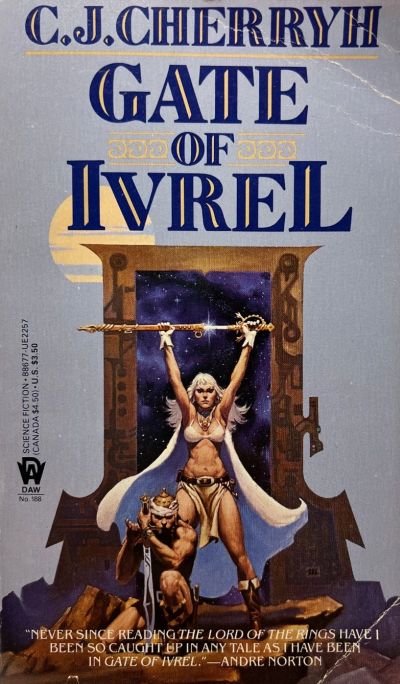
Note: Andre Norton’s two-page Introduction to this DAW printing is spoiler-free, and basically just an eloquent appreciation of the author’s literary achievement here. But though the accompanying map was made by Cherryh herself, it’s crudely-drawn, with hard-to-read place names, and hard to refer to due to its small size. And while Michael Whelan is a leading cover artist in the field of speculative fiction, his work here doesn’t reflect any actual scene in the book, and gives the wrong idea about Morgaine’s character; she doesn’t dress at all revealingly under her fur cloak, and doesn’t act like a sex object!
Author: C.J. Cherryh
Publisher: DAW, available through Amazon, only as a paperback. There is an e-book available of the whole series.
Book 1 of 4 in The Morgaine Cycle.




 ★★½
★★½ Thanks to Chris for finding this one. Albeit through a clip on a Chinese site under the name “Rescue From the Abyss”. This led to a significant diversion into movies about submarines, before eventually finding the correct, entirely submarine-free movie. No question, this is the hardest hitting film I’ve seen so far in 2026, though once you get past the action, things get more wobbly. Lily Chen (Ladouceur-Nguyen) is an operative for a shadowy government law enforcement group. She just learned about a potential promotion, though husband Jonathan is less enthusiastic and storms out. Before further discussion can occur, she gets a phone-call. The voice (Goad) informs her Jonathan is his hostage, and Lily needs to do exactly what he says.
 And this will cross Ghana off the list of countries for action heroines, in a charming and rather fascinating little glimpse into African culture. After their mother falls ill, Bibi (Mumin) and Kiki (Makafui), have to raise 20,000 cedi that day, to fund her medical treatment. I presume that’s a lot of money in local terms. After failing to do so by legitimate means, they team up with a dubious pal, Padlock (Asante), to hijack and rob a bus as it rolls through the countryside. There are four rules he tells them they must abide by. Keep to the plan; speed is key; don’t get caught; and… Well, he can’t remember the last one, but it probably doesn’t matter, does it?
 This is a nasty and grim piece of work, after which you will probably feel like taking a shower. However, I actually mean this in a (grudgingly) complimentary fashion, because it’s clear that director and co-writer Hyett was aiming for exactly that. Well done, I guess. Doesn’t mean I have to like it though, and this is not a film I have any interest in revisiting. It takes place in an unnamed part of the Balkans (though my money is on somewhere in Serbia), during the ethno-religious wars which tore apart the region in the late nineties. All manner of highly unpleasant things went on: here, it’s a brothel in which kidnapped women are forced to service militiamen.
 The phrase “blandly competent” comes to mind here. There’s not a great deal to criticize about this, from a technical standpoint. For example, the dialogue is audible, although does vary somewhat in tone, depending on the location. It’s reasonably well-shot, and knows better than to try and go beyond the restrictions of its resources. However, this lack of ambition may be its biggest problem as well, because it’s very intent on colouring strictly within the lines. Smaller-scale films need to push the envelope a bit to stand out, and this instead seems content to go the obvious route at almost every turn. Even the story’s main surprise was not much of one, and provoked little more than a shrug.
 In sports films is, actors don’t necessarily have to be able to play the game in question. But they should be able to fake it – if not necessarily at a level capable of fooling professionals, at least to get it past the casual viewer. When it comes to ball and cue games, I am certainly a casual. Unfortunately, the two players are the core of proceedings here do not look like pro players. They look considerably closer to me, down the pub, after a few pints. The major difference is, they at least do not look pleasantly surprised when they knock in a ball. But when one half of the “sports drama” equation is unconvincing, it puts a lot of weight on the other.
 Despite an impressive poster, this is a fairly humdrum action film. If it had been a Western production in the nineties, I would have described it as “straight to video.” I imagine the appropriate comparison here would be “straight to iQIYI”, the streaming service through which I saw this. It’s technically competent, make no mistake. However, there’s not very much to stick in the mind, and it feels like both the script and performances have been carried out with the bare minimum of effort. It’s the kind of thing you could have on in the background, while carrying out light household chores, and it would not impact the level of entertainment value obtained very much.
 If there’s absolutely nothing new here, it still manages to do what it does, fairly well. In the main, it’s light and fluffy, to be sure – though it has the capability to switch gears in an instant. For example, while this is by and large a Die Hard knock-off (from the “team edition” subcategory), I’ve not seen many films in that genre where a villain bludgeons a hostage to death with a hammer, because she reminded him of his mother. Just do not ask me to identify any of the players. This is another one of those films with the credits entirely in Chinese, very limited information available online, and subtitles which left a lot to be desired. Coherence, especially.
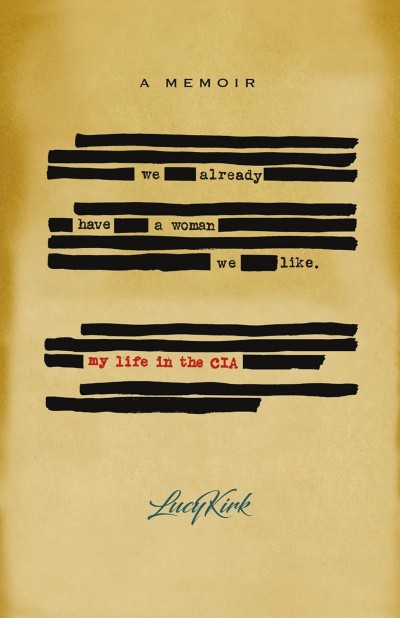 I suspect the issue here is partly my own expectations. When I read a memoir of somebody who spent more than three decades working for the Central Intelligence Agency, I was half-expecting a life somewhere between