




★½
“As dull as a 0-0 draw.”
 Football is known as “The beautiful game,” but you wouldn’t know it based on this documentary, which seems perversely intended to remove anything like that from its topic. It focuses on Olimpia Szczecin, a women’s soccer team in Poland, as they prepare for the coming season. There’s your first problem. Team sports like this are inherently about conflict: there are winners and losers, but these are not determined on the practice field, and that’s where the film spends the bulk of its time. It’s simply not very interesting, unless you have a thing for watching women amble around a park, kicking balls at each other, jumping over low hurdles or being yelled at by their coach (Baginska).
There’s simply no narrative here which can attract interest. There are any number of threads which could have been used, if the film had bothered to explore or even explain them. For example, you’re never told – I had to Google this – that these players are actually amateurs rather than pros, so there’s the potential issue of striking a balance between their day jobs and their passion. Though we never see much “passion”. The only time the film reaches any genuine enthusiasm is when we see a coaching session for young girls, about the only ones in the entire documentary, who appear to be enjoying themselves. The coach also speaks about the importance of dealing with her players’ personal problems and keeping them off the pitch. Yet we never see this happening in any meaningful way.
A football season is inherently dramatic, fortunes ebbing and flowing over the course of meaningful competitive games. Yet this peters out before the campaign begins, robbing us of that tension. The entire season is instead described in a short series of terse captions. What little footage of actual play we see, is disjointed and impossible to get excited about. For example, they reach the final of an indoor tournament, where we’re told they are wearing white shirts, while their opponents are in blue. Except, the entire film is, for no good reason, shot in black-and-white and consequently, you can’t tell which side is which.
Outside of Baginska yelling at people, there’s no sense of any of the players having personalities or lives off the pitch. Why do they play? What are their goals? [Pun not intended] The film seems supremely disinterested in… Well, anything, to be quite honest. Rather than turning up with a story to tell, or even looking to find one, it feels as if they simply showed up for eight weeks in the off-season, due to an error in scheduling, but shrugged and made their film anyway. The irony is that, certainly in the UK, the women’s game has never been bigger, thanks largely to the English team winning the 2022 European Championships. If you told me this film was made by some American dude, to prove the validity of his belief that soccer is the dullest sport on Earth, I would believe you.
Dir: Miguel Gaudêncio
Star: Natalia Baginska, Roksana Ratajczyk, Kinga Szymanska, Weronika Szymaszek
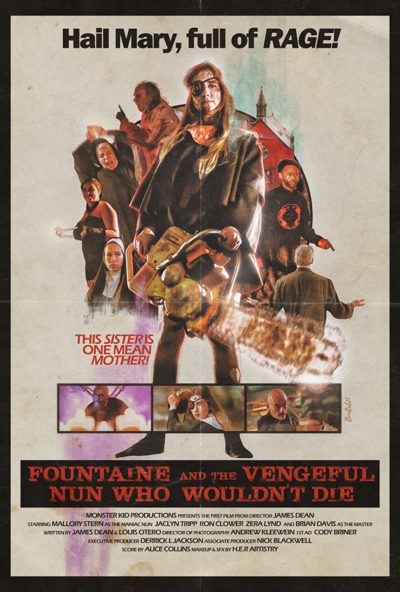 You will probably understand why the title more or less rocketed to the top of my watch-list, especially when accompanied by the poster (right). Naturally, it was almost inevitable that it could not possibly live up to either: the question was mostly, how far short it would fall. The answer is, “a fair bit, yet not irredeemably so,” even if the first half if considerably duller than I wanted. Indeed, it’s also rather confusing, in terms of what’s going on. As well as I can piece things together, Mary (Stern) is a nun who gets sent to an asylum after losing her sister, though it turns out to be less a mental-care facility than you’d expect.
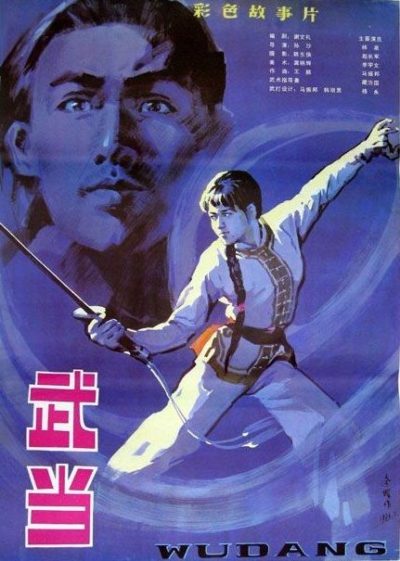 Chinese kung-fu movies took off in the early eighties, after the success of Shaolin Temple, starring an unknown teenager called Jet Li. Over the years that followed, a slew of imitators followed, with varying success. Where these largely differed from their Hong Kong counterparts, were in a more grounded approach to combat: wire-work and trampolines were avoided, in favour of players who (like Li) were martial artists first, and actors second. I believe the same is true of the heroine here, though information about Lin is hard to come by. According to the IMDb, this was her acting debut, though it’s tricky to grade her work there, thanks to the rather clunky dubbing on the print viewed for this review.
 I think it’s safe to say you’ll probably be able to decide within a few minutes, whether or not this is your cup of tea. The opening scene is set in a strip-club where the next act on the main stage is dressed as a nun. After a couple of minutes, she pulls out an unfeasibly large weapon from under her clerical garb, and guns down the mobsters present, in gory fashion. Thereafter, you can expect more of the same, along with extremely savage jabs at organized religion. Catholicism is the main target, but Judaism and Hinduism get their share of jabs: for example, Gandhi is a martial arts teacher. Or there’s a Yiddish hitman, Viper Goldstein (Lavallee), who practices the art of “Jew Jitsu”. If you just roll your eyes at that, this is likely not for you. However, if you roll your eyes and also laugh, then you, like me, may be the intended target audience.
 This dystopian future takes place after the United States of America is no longer united, having fragmented into a group of disparate regions that exist in an uneasy piece with each other. The heroine is 14-year-old Caroline, who lives in a remote part of the Appalachians, her town loosely affiliated to the People’s Republic of Virginia. She’s a scout, and one day encounters forces from the Democratic Alliance. The population of her village who escape, head towards the state capital of Warrenville, pursued by the invading army. On the way, Caroline begins to come into startling abilities which were literally injected into her as a small child.
 This begins, literally, with a bang. We first meet the heavily pregnant Maria (Docampo), carrying a rifle and preparing to leave her house. A man rises from the floor, and after a struggle for the gun, it goes off, and he drops back down. She hits the road in their pick-up truck, fearful of what she had done, and intending to head back to Naicó, the town where she was born. However, it’s not long before the people she meets on the road, seek to dissuade her from going there. It seems like everyone has a weird story about why her destination is not a good idea, from mysterious lights that abduct you, to a cult of blond people with possible Nazi connections.
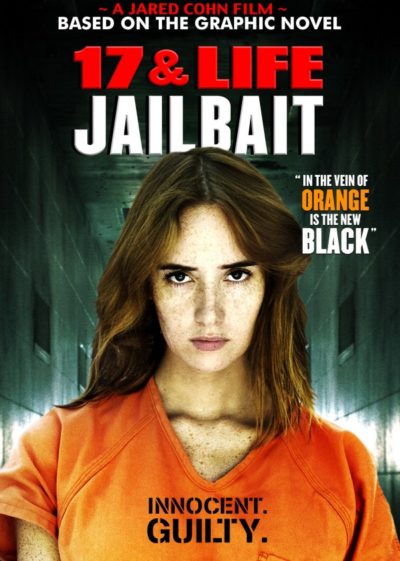 Of all the scathing reviews this has accumulated on Letterboxd.com, I think my favorite is the one which starts, “Obviously written by someone who knows absolutely nothing about the penal system.” Yes, seriously. I strongly suspect things like this were written by people who know absolutely nothing about women-in-prison films, and who inexplicably managed to overlook the title of the damn movie in their expectations. Me, I had initially overlooked this, believing it to be just a retitling of the same director’s
 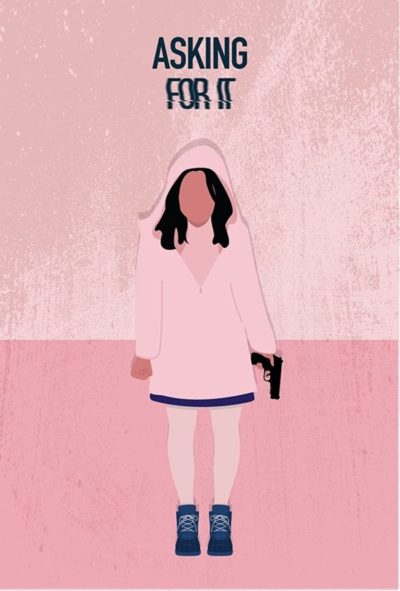 Not to be confused with the 2021 rape-revenge film of the same name (which I’ll get round to reviewing down the pipe), this is somewhat lighter in tone, though there’s a case to be made that this clashes terribly with the subject matter. Jenny (Hsu) is a journalist, working under Cheryl (Garofalo),and her work has brought her to the attention of an online stalker, who sends her increasingly disturbed and disturbing emails. When the harassment begins to move from the cyberworld into the real one, and the authorities fail even to reach the level of disinterest, Jenny teams up with room-mate Lisa (Morales), to hunt down the perpetrator and bring him to justice themselves.
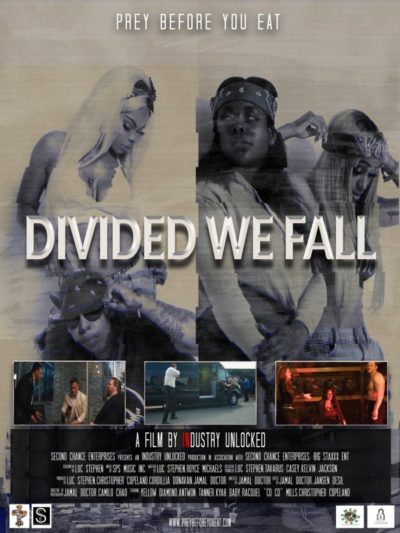 We begin with the usual disclaimer for films of this kind: middle-aged white guys like me are not the target audience. However, I think it’s fair to say that concepts like story-telling and character development are not limited to any particular race, colour or creed, so I still feel equipped to offer an opinion on these aspects. Though, actually, what felt like it worked best here was its strong sense of place. I’ve never been to the projects in Jamaica, New York (though Chris grew up elsewhere in the same borough of Queens). But the film does a good job of showing you that environment; it certainly works better than the (largely token) efforts to convince you some scenes take place in Miami, or even Moscow.
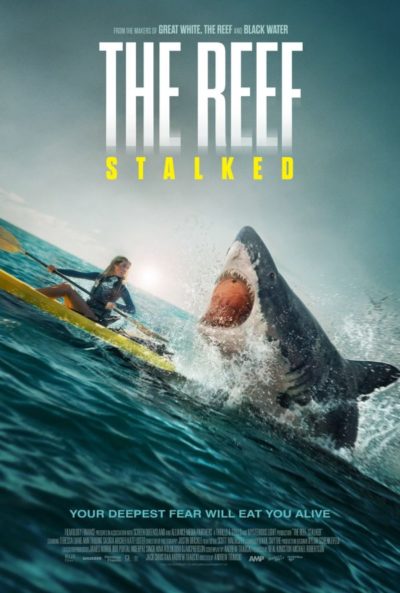 This is a sequel to Traucki’s 2010 film, The Reef, whose synopsis reads: “A sailing trip becomes a disaster for a group of friends when the boat sinks and a white shark hunts the helpless passengers.” I haven’t seen it, yet based on that, I’m not sure I need to. Replace “sailing” with “kayaking”, and you’re more or less here. Perhaps lob in a bit borrowed from