 Bruns and Olson are retired U.S. Navy officers, Olson in particular with a background in naval intelligence –and that background is drawn on heavily in the various self-published series that he and Bruns co-write. This particular 117-page novella exists only in an electronic edition; in keeping with my usual practice, I’d never have read it, but for the fact that it’s a freebie. Supposedly, it’s the fourth in a succession of “Standalone Suspenseful Short Reads.” In fact, although I read it as a standalone, it actually ties directly into The Pandora Deception, the fourth novel in the authors’ WMD Files series. (The first novel of that series is premised on the conceit that former Iraqi dictator Saddam Hussein really did have his infamous “weapons of mass destruction,” but cleverly smuggled them out of Iraq before the Americans closed in – okay, this IS fiction.) Our protagonist in this novella, Mossad agent and top-notch assassin Rachel Jaeger, is an important character in the afore-mentioned fourth novel of that series (and possibly others); and indeed, we can surmise that the reason this work is given away for free is so that it can serve as a teaser to draw readers to the series.
Actually, our heroine’s real name is Makda Moretti; “Rachel Jaeger” is her Mossad code name (jaeger means “hunter” in German, and probably also in Yiddish, which is a Germanic language; and Rachel is a name with definite Old Testament associations). Historically, going back to at least New Testament times and possibly back as far as the reign of Solomon, a certain number of blacks in East Africa have identified with the Jewish faith. Rachel was born in Ethiopia, and her mother was one of these (although her mixed race father was half Italian). But though this subculture is mentioned. the authors don’t develop it at all. Their concentration is very much on providing the character’s “origin story.”
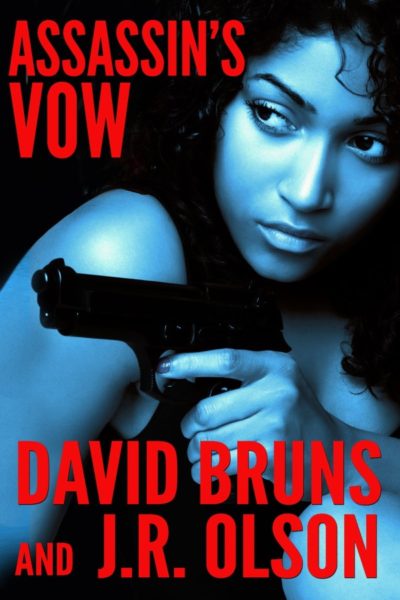 We begin en media res, on her first mission as a fledgling operative in a town on the Egyptian Sinai penninsula, where she’s supposed to provide scouting and lookout functions for a team tasked with taking out a terrorist. (But circumstances will cause her role to morph into something more demanding….) Well positioned flashbacks show us how, as a smart, physically fit and observant Tel Aviv Univ. student with a double major in economics and foreign languages, a solid background of martial arts training, and no close family (her mother had recently died, and her brother had emigrated to the U.S.) she was recruited into Mossad. (Later flashbacks show her family’s harrowing trek to Israel from danger in an unraveling Ethiopia, on which her father was killed, when she was a very small child, and a later formative experience of standing up to two bullies in order to defend another child, which shaped her penchant for defending innocents.)
Levi, the slightly older agent who recruited her, initially used the cover of a dating relationship as a medium to get close to her and check her out; this probably began as a ploy on his part, but quickly became much more serious, and the Makda-Levi relationship plays a very crucial role in the plot here. I don’t recommend reading the Amazon book description (the Goodreads database entry doesn’t have any description) because it divulges a lot of the plot, not just the premise. But suffice it to say that personal tragedy will be a shaping force in Rachel’s career. The time frame of the main tale is apparently about two years.
This is not a deep novel wrestling with moral, psychological, spiritual or political issues. There’s no real exploration of the complex roots and merits of the current Israeli vs. Arab hostility. Both Rachel’s and Levi’s role in Mossad is strictly counter-terrorism, combating and forestalling bad actors who would target and murder innocent civilians for political ends. That these people need to be stopped is a moral no-brainer, regardless of your attitudes towards Zionism or Palestinian statehood. Religion plays no role in the tale; Rachel and Levi are strictly secular and identify with Israel on the basis of peoplehood (which in her case is not exactly ethnic either, but more cultural, in a broad sense). The first time that she has to take a life (in self-defense), Rachel experiences some believable psychological distress at the enormity and finality of it, but is able to work through it and come to terms with it fairly quickly, as an action in successful and needed defense of her people; that kind of issue doesn’t arise elsewhere in the book. Despite the Amazon blurb’s overwrought reference to her “inner demons,” we don’t really meet any of the latter, our authors don’t really psycho-analyze her in depth, beyond the obvious feelings.
What it is instead is a straightforward tale of espionage action-adventure, with no real pretensions beyond offering exciting entertainment for readers who appreciate danger, suspense, physical challenges, and the satisfaction of seeing a good gal kick some bad-guy butt. :-) That’s exactly what the authors set out to deliver, and they make good on their promise admirably. This is a very well-written, fast flowing novel, with believable characters, all of them presented in life-like fashion. The prose is thoroughly serviceable, and free of bad language, with the exception of a couple of s-words in one place. (I appreciated that restraint, which I regard as a hallmark of good, tasteful writing.) There are a variety of locales here –Rome, France and Tunisia, in addition to Israel, the Sinai and East Africa, as already mentioned– and while they’re not necessarily realized with a deep sense of place (remember, this is a 117-page novella!), all of the physical settings are described vividly enough that we can easily visualize them.
Inside knowledge of espionage trade-craft and the inner workings of an intelligence agency is incorporated seamlessly into the narrative, giving it a solid feeling of verisimilitude. Our authors refrain from depicting explicit sex, and they treat sexual matters in general with restraint. It’s mentioned that Makda and Levi began sharing her bed after they’d been dating two weeks, but it’s left at that, and the feelings between the two, in fairness, are much more intense than the short time span suggests. (Normally I’m skeptical of insta-love scenarios in fiction, especially in a modern setting, but it carried complete credibility here.)
One scene had both Rachel and the target of one of her hits naked at one point, because she was posing as a prostitute in order to carry out her mission, but there’s no gratuitous physical description and no sexual activity takes place. (It’s a disgusting scene only because of the repugnant nature of the target’s exploitative and misogynistic attitudes, but he’s meant to be disgusting.) As an action adventure yarn with a government-sanctioned assassin for a main character, it’s going to feature lethal violence directly described, but there’s restraint here too; there’s no wallowing in gore for its own sake, and neither the authors nor Rachel are sadistic. (She’ll deliver certain death to her marks –who inspire no particular pity!– with consummate efficiency, but she”ll deliver it quickly and cleanly.)
My high rating reflects the degree of skill with which the authors deliver on the conventions of their genre, as well as my enjoyment of the tale (I’d easily have read it in one sitting if my time had allowed!). The only negative I felt is that Rachel’s character arc here doesn’t leave her, emotionally, in as good a place at the end as her friends would want her to be. (And by the time you finish the book, if you read it, you’ll probably also count yourself among her friends. :-) ) To be fair, however, that’s because it’s not a complete arc; the authors have at least one more adventure for her, in a full-length novel that will probably allow for much more progress in her personal life journey. Sadly, I don’t plan to witness it; at the age of 70 and with a gargantuan TBR, I don’t choose to get sucked into the welter of Bruns’ and Olsen’s various series, so I read this as a stand-alone. But I wish our heroine well; and can unhesitatingly recommend at least this start of her saga to all fans of espionage thrillers and action heroines!
Author: David Bruns and J. R. Olson
Publisher: Reef Points Media; available through Amazon, currently only as an electronic book.
A version of this review previously appeared on Goodreads.




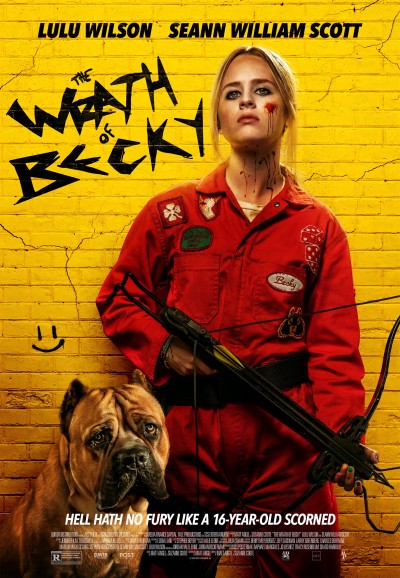 Don’t mess with someone else’s dog. This is a good rule of thumb in most cases, but especially so when the owner is an unhinged teenage psychopath, with the both the talent and desire to inflict carnage in retribution. The last time we saw Becky (Wilson), she had disposed of a gang of neo-Nazis who had invaded her house in search of a key, and killed her father in the process. Now, a couple of years later, she is a waitress in a diner, and renting a room from Elena (Burse). Three more individuals with, um, alternative political opinions enter the diner. This is not going to end well.
 Somebody
 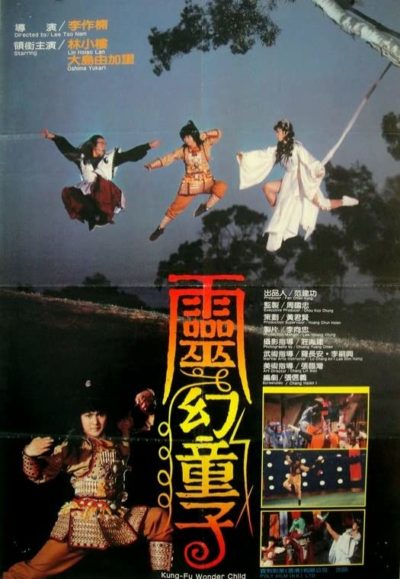 You may have noticed that I’ve been on a bit of a spree with these Taiwanese fantasy-fu flicks of late. However, I think I’m feeling a bit sated with them at this point, and the law of diminishing returns seems to be setting in. There are only so many unconvincing male impersonators, bad effects (both optical and practical) and almost illegible and/or illiterate subtitles a man can take, and I think I’ve reached my capacity in almost of these categories. Fortunately, my queue of such things seems to be nearing an end, with just a couple more to go. Still, after this delirious experience, I feel in need of a week or two’s break from the madness.
 Yeah, if the above line of subtitled dialogue makes sense, this film then ups the ante, with white subs on a frequently white background, and which frequently appear to be making a bid to escape from the bottom of the picture. It’s safe to say that a decent presentation of this, perhaps with a print which doesn’t look like it was left in someone’s pocket when their suit went to the cleaners, might merit a half-star more. A few more fight sequences would help too: the ones there are, don’t lack in quality. There’s just a bit too much farcical comedy for my taste.
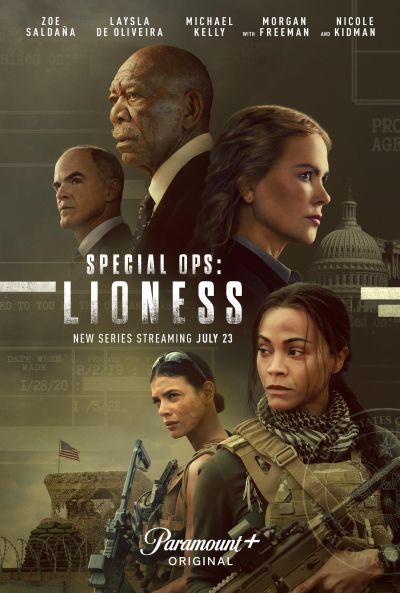 If 2023 has been underwhelming on the theatrical front (to put it mildly), the various streaming services have certainly had no shortage of entries to keep us occupied here. This one comes to us from Paramount+, and stars Saldaña – already known around these parts, most likely for
  Not to be confused with
 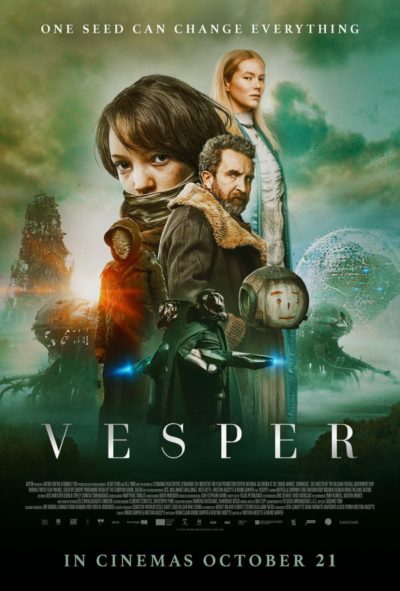 As the above suggests, I was getting a strong manga influence, in particular from the works of Hayao Miyazaki: it feels like the script could have been something he’d have written on a gloomy Wednesday in January. Feisty teenage heroine? Check? Ecological message? Check. For this takes place after some kind of change in the world, which has left the bulk of the population clinging on to existence by their grubby fingernails, in a world now owned by bizarre flora. Vesper (Chapman) is one such, tending to her paralyzed father (Brake) whose consciousness has been transferred into a drone. She trades with her uncle, Jonas (Marsan), swapping blood for the seeds they need to survive.
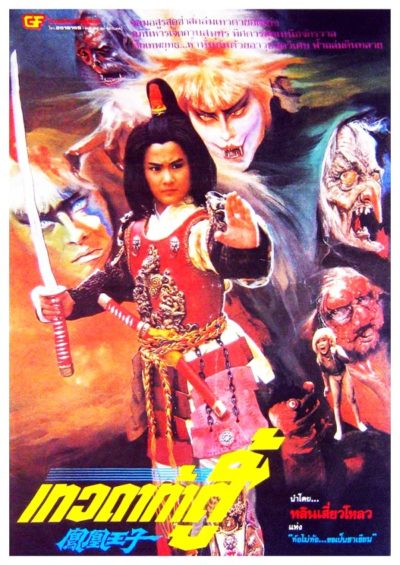 I am going to be entirely upfront, and state that any factual statements regarding the plot here will be entirely cribbed from other sources. Because, on my own, I have close to no clue as to the details of what was going. I got that some girl dressed as a guy, Little Flying Dragon (Lin, inevitably) was trying to protect Golden Boy (Chan) from a bunch of very strangely dressed weirdos with even more bizarre powers. They want Golden Boy for some nefarious purpose on behalf of an evil sorcerer type, who laughs maniacally. A lot. Everyone involved wears wigs which look like they were bought in bulk from Hair Metal R Us. There’s an acid pit, into which Golden Boy’s father is unceremoniously dropped. His mother is called “Evil Lady” in the subtitles, though she isn’t really. At one point, there’s a song whose lyrics according to the subs go, “Little Flying Dragon, Little Flying Dragon, change all the time, power breads everything.”
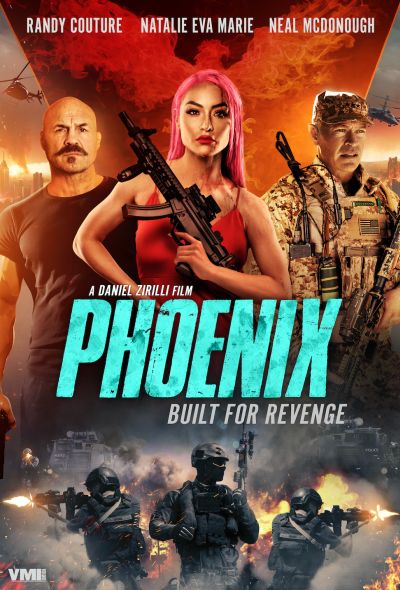 Much though I love the streaming service, even I have to admit that “Tubi Originals” are a bit of a mixed bag, to put it mildly. For every