
★★½
“More ambitious than kung fu”
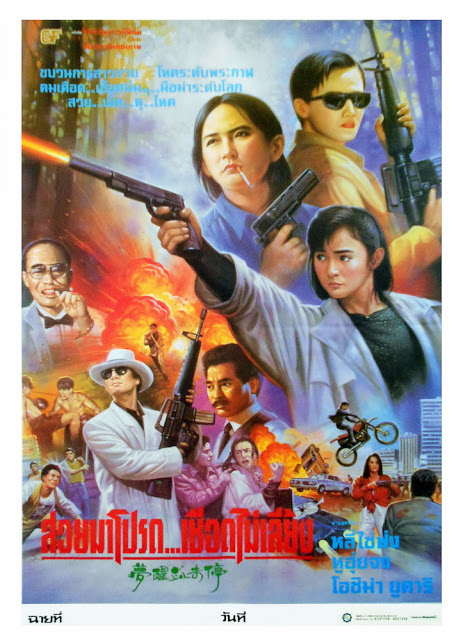
Tian Si Si (Yim) is a spoiled rich girl, whose doting daddy pays kung fu fighters to give the illusion that she can beat them up. Despite his desire to wed her off in an arranged marriage to Yang Fan (Tak), Si Si runs off to meet her idol, Qing Ge (Chen), a true master of the martial arts, whom she knows only through the fictional tales of derring-do, told by her maid. Susequently, Si Si becomes the target first of con-men, then is sold to a brother, and when they realize who she is, becomes the centre of a scheme to force her into marriage, so her husband can inherit her father’s fortune. Throughout it all, Yang is about the only loyal friend, though when she meets her idol, she discovers that, while if he isn’t as depicted, he still has a courageous streak of his own.
This is clearly intended as a light and frothy confection, not to be taken seriously – witness the gambling contest between Qing Ge and his rival, which has much more in common with a modern game-show than anything from the period. However, the plot is actually smartly written, with enough angles and schemes to keep your head spinning, as you try to figure out who actually wants to help our heroine, and who is against her. I’m not normally a fan of this era of martial arts, often finding the action too obviously-staged. However, this is quite well put together, and I do appreciate camerawork which lets you appreciate the performers’ skills.
Indeed, as a film in general, this would probably rate a star or so higher, and is a fun 90 minutes: my main disappointment is that the heroine is really not the kung fu girl of the title. Apart from the initial encounter with the paid opponents, her “Sloppy Blind Man’s Sword” technique is hardly used. Though there are some other strong female characters – most notably brothel owner Madame Mei (Wong Mei-Mei), who clearly has physical skills beyond what you’d expect from her job – they are largely secondary and/or subservient to the male ones, with the possible exception of courtesan Zhang Hao Er (Choh Seung-Wan), who is certainly her own woman. But overall, entertaining fluff though this is, it only barely qualifies for inclusion here, rather than in the Hall of Misleading Advertising.


Recent high-school graduate Cassie (Cobb) works at a bank alongside her mother (Quinlan), bickering about the usual things, such as whether to go to college or not. This mundance existence is suddenly interrupted by a robbery: Cassie is stunned to realize the raiders are actually some of her school friends. When they realize this, the girls are forced to take her along, and she discovers the cause of the crime – the father of one (Thomson) has been kidnapped while on business in Mexico. Meanwhile, Mom is tracking down her kidnapped daughter, FBI agent Mendoza (Blasi) is also on the hunt, and one of the girl gang has her own plans for the ill-gotten gains, which doesn’t involve any ransom.
This movie acquired some notoriety last year when a clip of a villain’s death went viral as “Worst death scene ever”, even though it had been edited and had extra audio added for “humourous” effect. Certainly, there’s plenty to mock in this 1974 Turkish revenge flick, which plays like someone heard second-hand descriptions of Thriller: A Cruel Picture and decided the world needed a PG remake. However, while aspects of the execution are without a question shoddy and laughable, it has an interesting story, briskly told, and with a good central character.
Great concept: Lilith, Adam’s first wife, condemned to immortality, is now an amnesiac in a minimum-wage job. But when a demon threatens to unleash a plague of biblical proportions on the Earth, she has to be shown her true nature and convinced to hunt down the enemy. Unfortunately, almost every aspect, from exposition through characters to the action and CGI-heavy effects, are awful. Not just bad:
After some hi-tech computer chips go missing, government agents Samantha (Woronov) and Mark (Johnson) are assigned to go undercover at the electronics plant. But also investigating is Angel Harmony (porn star Chambers), with whom Samatha has crossed swords before, and #1 agent one of a group called The Protectors, “international vigilantes, outlaws in the service of peace and freedom” as the introductory title card calls them. Eventually teaming up, they discover the missing chips were only the tip of an iceberg created by a thoroughly-mad scientist (Jesse), who is planning to use high-pitched sound and his army of androids (which have, charitably, been given sex drives!) to take over the world and… Oh, y’know: the usual mad scientist stuff, I guess.
I don’t watch many silent films: it’s such an entirely different experience, obviously, much less driven by dialogue and more by gestures, leading to a style that can look extremely over-theatrical to the modern viewer. My efforts to enjoy the likes of Nosferatu, for example, have usually ended in my providing an accompaniment of snoring, to be honest. This was much better. Despite a running time of over two hours, this 1916 DeMille epic successfully held my interest, as it told the story of Joan of Arc. The framing device uses the then-contemporary World War I, and an English soldier (Reid) finds Joan’s sword in the trenches, the night before a dangerous mission [Interesting how the English are the enemy in the back-story, but the good guys “now” – at the time of release, America was still several months from entering the war, on the British side]. He then experiences a flashback vision, taking him to medieval France, where he is an English soldier saved by Joan (Farrar) in her milkmaid days. We follow her for the story you know, becoming the inspiration for the French army to defeat the English, before her capture, trial for heresy and – I trust I’m not spoiling this – burning at the stake.
This was also released in a hardcore version as Black Lolita, but I’m not sure if that was 3D or not. Certainly, the DVD delivers about the worst such attempt I’ve ever seen. It’s in color, but also attempts the red/green method (glasses very early, and the only thing to be said for them is, they stop you seeing the film, which on the whole, is probably no bad thing. Lolita (Love) decides to team up with an air-stewardess and a yoga instructress to take down the local Mr. Big, who goes by the name Buddha – even though about all he shares with the Enlightened One is being Asian, since he’s neither fat nor pacifist.
This can only be described as a mess, albeit a crappily entertaining one, with a leading lady in Phillips, who almost made it to the Olympics, being described as “the next Mary-Lou (Retton)”, before trying her hand in low-budget action. She plays an international-level gymnast and martial-arts expert, whose parents are, unknown to her, involved in a plot involving the launch codes for Ukrainian missiles. The mother is killed by villainous Brit, Carla Davis (Douglas – apparently Jenny Agutter was unavailable. Or, more likely, too expensive), who wants to get her claws on the codes for some reason. Hey, she’s a villain: what more does she need? She captures Dad (Henriksen), but not before he has given his daugher the first in a series of clues which will lead her and investigative journalist Rex Beechum (Thomerson), apparently with an unlimited expense account, around the globe from Rome to Kuala Lumpur to Hong Kong and Athens, bumping into various unexpected siblings along the way.
“I’m a Barbie girl, in a Nazi world…” That’s an equally appropriate summary here, because the heroine in this flick, set in occupied Norway during World War II, was the lead singer of Aqua, famous (or notorious, if you prefer) for a certain catchy pop ditty. She plays – and I know you’ll find this a stretch – a singer, who works in a nightclub, which caters for high-ranking Nazi officers, while she simultaneously works with the local resistance and beds SS Major Kruger (Otto). The Allies are seeking plans of a local aluminium smelting plant, a key cog in the Third Reich’s war machine, so an airstrike can be called down on to it. Local businessman Tor Lindblom (Saheim) partners with Kruger to profit from the industrial operation, and play both sides, until their pet auditor is replaced by one rather less amenable to their embezzlement.
Reiko (Ike) is leader of the Athens Gang, a low-level all-girl gang, who specialize in car thefts and rolling naive salarymen with the lure of hot sex. They’re part of a hierarchy, which includes a male gang under whom they loosely operate, who are in turn on the fringes of a Yakuza group. There’s also a motor-cycle gang and its leader (Taki) who don’t obey anyone, and that independence is really what Reiko wants, even though her group is obliged to follow certain rules, such as not getting attached to any man. Things are disrupted by the return of former leader Jun (Kagawa) from reform school: will Reiko be able to hold on to her position? It’s just one of a large number of plot threads here: you also get the blackmail of a pop star; a hitman agreeing to one last mission; a gangster estranged from his wife and daughter; sex on motorcycles for no apparent reason; a journalist with a nose for scandal; and, of course Reiko failing to follow her own rule about no attachments.