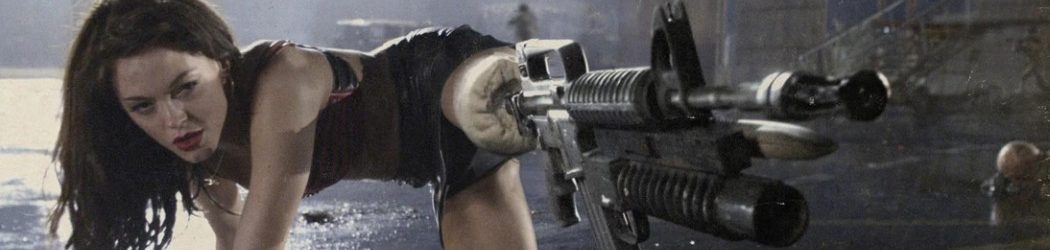

The Machine

★★★½
“Rise of the Robots”

the machineA little way in the future, a cold war between China and the West is beginning to heat up. In an underground base, Vincent McCarthy (Stephens) is doing research into cybernetic implants that can help injured soldiers lead productive lives. He’s also working on a fully self-aware android. His boss, Thompson (Lawson) likes this because of the potential military uses; McCarthy is actually doing it as a potential way of helping his mentally-disabled daughter. He gets a new assistant, Ava (Lotz), whose radical politics are viewed with suspicion by Thompson, yet there’s no denying her knowledge, and McCarthy also uses Ava as the template for his android’s persona. When she is killed by a Chinese agent, McCarthy activates the android, called “Machine”. and Thompson sees his chance to shape into a prototype for a new generation of artificial soldiers., super-strong, lightning fast and unburdened by that pesky morality thing. He blackmails McCarthy into removing Machine’s conscience, only to find she has entered into an electronic alliance with the soldiers that received implants, who are now working as guards on the base.

The start of this rang bells. I think I made an effort to watch this before, and gave up for some reason, likely related to it taking a while to get anywhere beyond its obvious low-budget limitations, i.e. early on, it forgets the need to show, don’t tell and is frankly, too chatty. However, once Ava turns into Machine, it becomes a good deal more interesting. It remains somewhat derivative in certain aspects, though it’s hard for any low-budget SF film ever to be entirely original: Species and Blade Runner would appear the most obvious inspirations, asking what it means to be human, yet taking the form of a very non-human life-form. Chuck in some Frankenstein, a bit of 2001, and it seems to have some Eve of Destruction in there as well, through the “military experiment gone rogue” angle. However, it’s most effective when going its own way, whether in storyline or style: there’s one stunning sequence where Machine isn’t doing much beyond walking, and is literally glowing from within. Beautifully executed, it shows what imagination and ingenuity can do, even on limited resources.

The movie’s other strength is Lotz who, as the picture above shows, genuinely looks like she could kick your ass if she wanted to, a refreshing change from some of the wispier action-heroines I’ve seen recently. [I’m looking at you, The Lady Assassin…] I may have to start watching Arrow, on which she plays Black Canary: her background as a dancer serves her well, and she also projects a wide-eyed innocence which appears appropriate to her “newborn” status. But the latter might be as much for show, since it’s coupled with a steadily escalating awareness that the things Thompson wants her to do, might be morally ambiguous, at the very least. More intelligent than the average genre entry (if perhaps not as smart as it thinks), Caradog and his crew demonstrate a clear talent for making a little go a long way. I look forward to seeing what he does in future – and Lotz is likely also a name on which to keep an eye, as well.

Dir: Caradog W. James
Star: Caity Lotz, Toby Stephens, Denis Lawson, Pooneh Hajimohammadi

Cyborg 2

★★★
“The film that launched a thousand lips…”

cyborg2Before there was Salt, before there was Mrs. Smith, before there was even Lara Croft, there was Cash Reese. For Angelina Jolie got her start as a grown-up actress in this 1993 sequel to a Jean-Claude Van Damme action film. She plays a cyborg pumped full of liquid explosives by her creators, Pinwheel Robotics, with the aim of being dispatched to assassinate the board of their Japanese rivals, Kobayashi Electronics. However, Cash is busted out from their complex by employee Colton Ricks (Koteas) along with a mysterious virtual guide known as “Mercy” (Palance). Unwilling to let their investment go, Pinwheel unleash psychotic bounty-hunter, Danny Bench (Drago) to track her down, before the pair can escape to Mombasa, a free zone for independent cyborgs.

“After I saw it, I went home and got sick,” said Jolie. Really? Damn, she must have hurled like Regan MacNeil after watching The Cradle of Life then, for this isn’t all that bad. Sure, it’s cheap, and rips off Blade Runner shamelessly in its visual style. However, it benefits immeasurably from an above average cast, who are all good for their roles. While Jolie’s lack of acting experience is certainly apparent, this doesn’t work against her character, an artificial person who is getting to experience the real world for the first time. Koteas is decent as the rugged hero – even though Cash is obviously stronger, quicker and probably smarter than he is. This does make the film’s finale somewhat dumb: in it, Ricks takes on Bench in a fight to the death, in order to win money for their passage to Mombasa, even though the rest of the film strongly suggests it’s Cash who would have a better chance of beating the hunter.

However, we must not forget the supporting cast who certainly help carry this, in particular Palance. His is mostly a voice performance, his lips appearing on video screens along the way to direct and assist Cash and Ricks, and brings an understated gravitas to proceedings they really don’t deserve. At the other end of the performance spectrum, yet equally fun to watch, is Drago, chewing scenery in memorable fashion. And we mustn’t forget Karen Sheperd as Chen, another hunter trailing Cash, leading to some good action there too. The script was originally intended as a standalone film called Glass Shadow [the name of the bio-explosive], which may explain why there’s no apparent connection to the original movie – as the not necessarily entirely accurate sleeve shown suggests, it was released this way in some territories. That isn’t necessarily a bad thing, and purely for opening the door to Jon Voight’s little girl, and the much bigger, (mostly) better things to come, definitely is deserving of a certain regard.

Dir: Michael Schroeder
Star: Elias Koteas, Angelina Jolie, Jack Palance, Billy Drago

Cut Off

★★
“Can only dream of being a competent movie.”

cutoffRich-bitch heiress Patricia Burton finds her easy life yanked out from under her, after her millionaire father stops her allowance and requires her to get a job. Rather than anything legal, she opts, along with dumb boyfriend Pauly (Nicholas) and his friendly drug dealer, opt to rob a check-cashing store. That goes badly wrong, and they’re forced to hijack an ambulance which is transporting a stabbing victim to hospital. That doesn’t exactly solve their problems, as the local cops are on their trail after the drug dealer is arrested, whole the patient in the back (Kurupt) also turns out to have gang ties, and so is none too keen to meet the police either. How will Patricia handle the multiple threats?

The makers must have called in a lot of chips here, since the supporting cast is impressive and well above average in terms of star power. Patricia’s parents are portrayed by McDowell and Faye Dunaway, while also in the cast are Anne Archer, James Russo and Clint Howard. However, these fail miserably to cover up the flaws in the script, which is full of massive plot-holes. Apparently, when you hijack a vehicle in Tucson (hey, local interest to this Arizona resident!), for the first few hours, the authorities will only send a single patrol car, containing two vanilla officers, to keep an eye on you. And if you’re in a siege situation, you can just wander out the back, because the police won’t bother to cover it. I will admit, these inconsistencies are addressed with a final twist. On the other hand, that simply replaces it with a far worse, cop-out, which I’ll avoid spoiling, except to say I was warned against it by my English teacher when I was seven. This is, however, probably the only GWG film which explicitly nods for inspiration to The Wizard of Oz.

It’s a difficult role for Brooks, especially given her lack of experience, because the film starts off by making Patricia borderline repellent, and she has to spend the rest of the film pulling the audience back from this initial dislike. There are a number of flashbacks, which explore her relationship with her father, and make it clear that her brattishness and delinquency are largely cries for his attention. However, this may be a case of ‘too little, too late,’ and while you can admire the strength of personality she is shown as developing over the course of the proceedings depicted here, it’s a quality which also has its impact undercut by the final twist. The influence of Quentin Tarantino is clearly present in an excess of mind-numbingly meaningless dialogue, and if I remain a sucker for an action heroine with a British accent, that isn’t enough to salvage what is closer to an ill-conceived mess.

Dir: Gino Cabanas + Dick Fisher
Star: Amanda Brooks, Thomas Ian Nicholas, Kurupt, Malcolm McDowell

1632, by Eric Flint

Literary rating: ★★★★½
Kick-butt quotient: ☆☆☆☆½

1632Veteran science-fiction writer Eric Flint, the author of this opening book in his Ring of Fire series, self-identifies with the political Left; but his is an old- fashioned, Jeffersonian sort of populist liberalism, which embraces democracy, human rights, religious freedom (as opposed to “freedom from religion”), personal moral responsibility, retributive justice, and widespread gun ownership. When the small town of Grantville, West Virginia is transported, through a super-advanced alien race’s meddling with the fabric of space-time, to Germany during the Thirty Years War, the residents are willing to fight for these principles, in the midst of a maelstrom of rampant evil and oppression; and the reader is soon caught up in cheering them on!

As one might expect, there’s a lot of graphic violence here –the real Thirty Years War was no Sunday school picnic either– but Flint’s characters (at least, the good guys and gals) employ violence only as an instrument of moral order, not in opposition to it. The premise here is really original, and it’s worked out in believable detail that brings it vividly to life; there’s a good balance between action and the quieter aspects of life that build our understanding of the characters and their relationships; the pacing is brisk, and the characters are well-rounded and thoroughly life-like. (Grantville’s local UMW leader, Mike Stearnes, is nominally the protagonist, but there’s really no one “main” hero or heroine; Flint follows a number of characters who play important roles.) Well-researched actual history is incorporated seamlessly into the narrative (I learned some fascinating stuff I didn’t know before, and I majored in history!).

For readers who follow this site, one of the main attractions here are three gun-toting ladies (all of them major characters) who earn the stars above for the kick-butt quotient. High school cheerleader Julie Sims becomes the ace sharpshooter for Grantville’s thrown-together army. (She was seriously training to qualify for the U.S. Olympic team in shooting events before the time-travel incident –and my guess is that she’d have not only qualified, but brought home the gold medal.) Sexually-abused camp follower Gretchen Richter, rescued by the Americans, becomes a force to be reckoned with when she learns to use a pistol. And while a young Jewish lady named Rebecca actually isn’t a very good shot, she doesn’t need to be when she’s packing a sawed-off shotgun. If you like your fictional heroines strong, tough, gutsy, and not a bit bothered by using lethal force, you’ll appreciate these gals. (The only ones who don’t are the bad guys –and their opinion doesn’t matter much once they’re pushing up daisies!)

Note: There are a few instances of unmarried sex here, but nothing explicit; the only sex scene that’s dealt with at length takes place on a couple’s wedding night and isn’t treated in a salacious way. There is quite a bit of bad language, which often includes profanity (Flint confuses this several times with “blasphemy;” but there actually isn’t any of the latter) or the f-word.

Author: Eric Flint
Publisher: Baen Books, available through Amazon in all formats.

A version of this review previously appeared on Goodreads.
Duelist

★★★
“A triumph of style over content”

DuelistposterNamsoon (Ha) is a hard as nails detective in medieval Korea. While working undercover at a market on a counterfeiting case, she encounters a masked man (Kang), and battles him before he vanishes, though not before she manages to cut away a fragment of his mask revealing his ‘Sad Eyes’ – the name by which he is known for the rest of the film. What is his tie to the forged money? And why has be been seen going into the house of a powerful government Minister Song (Song)? Namsoon and her mentor, Ahn (Ahn) investigate, though the closer they get to the truth, the more perilous things become, not least because she begins to fall for Sad Eyes, especially after infiltrating Song’s mansion as a courtesan – a task for which she is singularly unsuited. After a public incident, while Ahn has to fire Namsoon from the police force, this is merely a ruse, allowing her to go after the final piece of evidence they need to raid Song’s mansion and bring down his operation.

Rarely have I seen a more beautifully-shot film. Truly, this picture is as pretty as a… er, picture. The cinematography is top-notch, offering a sumptuous feast of visuals that mixes styles and techniques to great effect, and freeing the movie from bothering with banal chores like dialogue for extended periods. Unfortunately, neither the story nor the characters are a match for the look and feel, leaving the viewer largely to admire the film, rather than being engaged by or liking it. As I recall, the director’s previous film, Nowhere to Hide, had much the same issue, pitting two (male, there) adversaries against each other, in a rain-drenched landscape that was emotionally distant – but, boy, did it look good. Here, the action is extremely stylized, resembling a modern dance routine more than a fight in some cases, or even, as one character puts it, “It was like they were making love under the moonlight.” I also sense there are creative anachronisms at work: did they even have cops, never mind lady ones, at this time? However, the biggest weakness is likely the sudden way Namsoon falls for Sad Eyes; she doesn’t seem at all like the kind of person who would do that, and since this supposed relationship is at the film’s emotional heart, it’s a flaw that may explain why this feels so uninvolving.

Under other circumstances, this could well be a fatal flaw, yet there’s still enough for your enjoyment in the eye candy department to make this worth watching, even at a fairly long 111 minutes. One senses that Lee is much more interested in the technical aspects of cinema, rather than the emotional one of connecting with the audience. I can appreciate that side, certainly, yet for a film to be truly successful, there needs to be some yin to go along with the yang, or what results will seems frustratingly incomplete.

Dir: Lee Myung-se
Star: Ha Ji-won, Kang Dong-won, Ahn Sung-ki, Song Young-chang

Warrioress

★★★
“Cecily, Warrior Princess”

warrioriessThis is one I’ve been aware of since as far back as 2010, but it seemed to have been lost in post-production hell, so I was surprised to see this had finally got a release, coming out on DVD in its home territory of the UK last May. It’s one of those films where you need to know, going in, that this is not a slick Hollywood blockbuster with massive production values, and instead is clearly a work of love for those involved, doing their best with limited resources. In fact, I can’t really do better in setting those expectations than another review, which said the film was, “Best described as ‘Xena filmed on a Doctor Who-circa-1980 budget by way of a Robin of Sherwood LARPing weekend'”. I can’t really improve much on that, though would perhaps add, “Set on Steampunk Sunday at your local Renaissance Festival.”

The story is triggered by a prophecy, which sees Boudiccu (Fey) first win custody of a pair of legendary weapons, then journey through a post-apocalyptic landscape, where humanity has largely reverted to tribal savagery. However, the crypto-fascist Falonex clan still appear to have a handle on some old-school technology and appear to be massing to establish their dominance. On the way to the prophesied location, where she will face another warrioress in a battle which will hopefully lead to a champion rising who can defeat the Falonex, Boudiccu is joined by White Arrow (Simpson), who is seeking revenge on those who killed her family. Or something. They have to fend off attacks, share flashback sequences and, eventually, have a twist revealed in their relationship that should come as absolutely no surprise to anyone paying attention.

What works? Simple: the action, led by Fay. She’s a tiny thing – 4’9″! – yet it’s entirely convincing, because the style of her fights don’t show her using strength and power to beat her opponents (which would be implausible), they instead emphasize skill, quickness and agility, which she has in spades. Credit, too, for Boyask, who consciously avoids the rapid-fire style of editing, knowing that the best thing he can do with a talent like Fay, is point the camera in her direction, then let her get on with it. [Sometimes, knowing not to do anything is more important than trying to do it] There’s a battle, not long after Boudiccu leaves her village, in which she takes on half-a-dozen other women, which is just glorious: it’s probably the best action heroine sequence ever to come out of the UK. But therein lies a problem, in that nothing during the hour thereafter is as great: good, sure, sometimes very good, but the final battle in particular feels like a letdown.

What doesn’t work? Sadly, way too much of the stuff between the fights, which feels like a slapdash grabbing of elements lifted from elsewhere, lobbed into a storyline which might just about have passed muster on a wet Sunday at my college D&D society. The efforts at generating any kind of broad, post-apocalyptic landscape are feeble, particularly the Falonex, who are represented by a ropey CGI backdrop and the interior of a single tent, which does not succeed in making them the kind of global threat they are supposed to be, especially since their scenes are play largely for laughs. But what’s really missing from the dialogue and performances, is any sense of intensity. They’re purely functional, intended to get the story from A to B (where A and B are almost certainly fight scenes). It’s clear from the action scenes, everyone involved had a passion for what they were doing there. Unfortunately, that passion is absent from everywhere else, and weakens the overall product to an extent that many will be unable to look past the flaws, and appreciate the positive attributes to be found here.

Dir: Ross Boyask
Star: Cecily Fay, Joelle Simpson, Christian Howard, Merrilees Fay Harris

88

★★★
“Not entirely forgettable.”

88More by accident than design, this is the third film I’ve seen in the past couple of weeks which features amnesia as a plot-device. It’s a bit of a scripting minefield, since it’s easy to become a crutch for the writer, with the amnesia being “cured” at the moments necessary to the plot. You need a lot of discipline to avoid this: Memento is likely the platinum standard for this being done well, and to be honest, most other efforts come up short in comparison. This is no different, with an absolutely key piece of data being withheld from the audience [and the lead character] until dramatically convenient at the end – though it doesn’t exactly take Nostradamus to figure it out in advance. Gwen (Isabelle) find herself eating in a diner, with absolutely no memory of how she got there. Checking her purse, she finds a gun, and accidentally shoots a waitress. Fleeing the scene, she also discovers a key to a motel room, #88. Going there, she finds more questions than answers. What was her relationship to local mobster, Cyrus (Lloyd)? Did her really kill her boyfriend, Aster? Who is Ty (Doiron), the cheerful killer who is helping her? And why does everyone keep acting as if she’s a stone-cold killer?

This opens with a caption explaining the concept of the “fugue state”, which Wikipedia tells me is “characterized by reversible amnesia for personal identity, including the memories, personality, and other identifying characteristics of individuality… and is sometimes accompanied by the establishment of a new identity.” I note that the section there on this disorder in popular culture, is rather longer than the list of real-life incidents, since it’s pretty much an open invitation to scriptwriters, to sculpt as they see fit. The key question is how interesting the story would be without the conceit. Here, I give it a qualified passing grade, since both Gwen and Cyrus are interesting characters, the former particularly when she’s in bad-girl mode, and just not giving  damn [the same can be said about Isabelle’s most well-known performance, as a teenage werewolf in the wonderful Ginger Snaps] It’s also fun to see Lloyd, better known for his mad scientist in Back to the Future, playing a sleazy scumball, But I can’t help thinking the fractured timeline doesn’t actually add all that much to proceedings, and is only made necessary by that single point of data mentioned above. It could have been played as a straightforward revenge flick, without the psychological trappings, and been little or no less effective.

The style here is a mix of the effective and the irritating. The soundtrack seems particularly intrusive, as if the director simply set her iTunes collection on random and let it play, and the shootout at the bowling alley ends with the characters skipping merrily away across the lanes, which as someone who has tried to walk down one knows, is wildly unrealistic [a over-energetic bowl had led to my wedding ring following the ball, and I can state confidently, it’s the only location where the physics of a Tom and Jerry cartoon is actually a good approximation to real life!] But even if you work out where this is going, the underlying story is a solid one, and Isabelle’s performance does a good enough job of compelling attention, to make for a passable 90 minutes of entertainment.

Dir: April Mullen
Star: Katharine Isabelle, Christopher Lloyd, Tim Doiron, Michael Ironside

All Souls: A Gatehouse Thriller, by Karin T. Kaufman

Literary rating: ★★★★
Kick-butt quotient: ☆☆☆½

allsoulsFull disclosure at the outset: Karin Kaufman is a Goodreads friend of mine, and I was one of ten people to claim a free review e-copy of this book. Through much of my reading, I was ready to give it a solid three stars, and the super-strong ending commanded a fourth.

The premise here is that humanity is secretly menaced by a worldwide society of thrill killers, who make the notorious Thugees look like philanthropists, and who are recruited from all walks of normal life, into which they blend anonymously. (Their Gatehouse adversaries call them “Sacks,” short for “Sacks of sh*t”.) By Gatehouse estimates, the society has well over a million members, and has been around for at least 100 years. Organized in hierarchical ranks (members of each rank supposedly don’t cooperate very closely, and hate the other ranks –but they take orders from the higher ranks, and want to advance into them), it has a culture of strange behaviors, like the members taking bizarre secret names and tattooing them on their bodies.

Yet it has apparently no belief system or ideology except conscious embrace of evil and chaotic destruction for its own sake; Sacks apparently have no agenda beyond picking off as many individual innocents as they can without being exposed. The U.S. government –and possibly other governments, but our setting is the U.S.– knows about them and preserves their secrecy. But it combats them with an unofficial arm, the Gatehouse organization, which commands a small army of “hunters” who periodically assassinate individual identified Sacks (as opposed to, say, dealing with them through law enforcement and the court system) at the direction of contacts called “porters.”

Our action-heroine protagonist here is Gatehouse assassin Jane Piper, who’s very competent at what she does, and very motivated –her only sister was butchered by a Sack. She’s as lethal a woman as you’ll ever meet in fiction –but at the same time,one of the most compassionate (the two qualities aren’t incompatible), a decent person who’s kept her humanity and moral compass in a blast furnace of trial. I never had any trouble liking her, nor any doubt of her butt-kicking capabilities.

Early on, Jane reflects that if she stood up and shouted all of the above information in public, nobody would believe her anyway. Apparently, she thinks that the general populace might find this premise far-fetched. Readers might have the same difficulty. The idea is definitely original, but it’s rather hard to suspend disbelief here. While many people do embrace very evil agendas, including the killing of the innocent, hardly any do so while openly and consciously telling themselves that they’re doing so. The vast majority of them have to have some ideological belief system that justifies the evil by telling them that in reality it’s “good,” or for a greater good. I may be naive, but I don’t think Sack recruitment on the basis of “embrace homicidal evil just because it’s fun” would gain as many adherents as they have here. And while I see how Sacks have an interest in keeping their activities secret, I don’t buy the explanation that the government tacitly agrees to cooperate in letting them do so, lest they unleash an even greater blood bath if they’re forced into the open. Credibility is also strained by some individual characters’ motivations. Granted, action-heroine fiction writers often do stretch strict credibility a bit in their premises, and sometimes the tone is sufficiently tongue-in-cheek that the reader doesn’t take such lapses very seriously. Here, though, the tone is pretty serious.

It’s all the more a credit to Kaufman’s ability as a writer, and the strength of this book, that she took that kind of premise and made a four-star book out of it. Her command of language is impeccable –professional, literate, with the kind of painstaking craftsmanship that makes the flow of words seem easy. A Colorado native, she sets her tale in her home state, and the neighboring parts of New Mexico and Wyoming; she’s obviously at home on the ground, with real locations and a sense of place. The plotting is very taut in terms of time, compressed into just seven days –Oct. 27-Nov. 2, All Souls Day. Jane’s a first-person narrator for all but the first chapter, and hers is the perfect voice for the tale. She and the other major characters are all well-drawn. “Gripping” doesn’t begin to describe this book; it grabs you and pulls you along from the starting gate, and I’d have read it in one sitting if I could have.

That’s not to say it’s all action; but the waiting intervals in between are as tense as harp strings. When action comes, it comes quick, realistic, and bloody, with a high body count by the time you get to the last page; Kaufman knows her guns, and she writes action scenes clearly and credibly. Jane’s colleagues tend to be as combat-skilled as she is; and some of their adversaries are extremely deadly and crafty as well. (Generally speaking, in real life I have a problem with governments violating their own laws by sponsoring programs for extrajudicial killing. But I don’t hold operatives like Jane and Nathan responsible for acting in the situational context they’re in. They don’t make the policy; all they can do is protect the innocent and take care to kill only the guilty.) And Kaufman’s plot is a roller-coaster of surprises.

Ultimately, though, this is more than a novel of slam-bang action. It becomes a serious exploration of the possibilities of moral conversion, from great evil to willing embrace of good; of guilt and atonement; of the limits of forgiveness –in short, the kinds of serious moral questions that occupy the great literature of the Western tradition; underneath the smell of gun smoke and blood, we’re in the same realm here that Hawthorne and Dostoevsky, Undset and Graham Greene have visited before. Since this is a series opener, it’ll be interesting to see where Karin takes this theme in future books. And I’ll find out; because I definitely want to follow the series!

Note: there’s not only no sex here, but no romantic sub-plot. Gatehouse doesn’t encourage its operatives to marry, and doesn’t allow them to stay in the organization if they conceive a child. (If Jane ever decides that she wants a man in her life, I think that she deserves a good one, and that she’d be a great wife; but for now, she’s content to be alone, and doesn’t obsess about men and sex.) There is a fair amount of bad language, including some use of the f-word.

Author: Karin T. Kaufman
Publisher: Amazon Digital Services, available through Amazon, only for Kindle or as an audio book at this time.

A version of this review previously appeared on Goodreads.

Girl’s Blood

★★★
“All over the bloody place.”

girls blood2I’m very confused, at to who is the target audience here. It’s part earnest drama about serious social issues, including gender identity and spousal abuse. But it also depicts a hardcore underground fight-club, “Girl’s Blood” in which women battle it out for the gratification of spectators. However, don’t expect a Japanese version of Raze, for while the fights are well-staged [Sakamoto has a good track record, most recently having done 009-1: The End of the Beginning], it has all the class of WWE’s Divas division and amateur night at your local strip-club, combined. For it panders shamelessly to every sexist stereotype imaginable, from sexy nurse through sexy schoolgirl to sexy idol singer. And don’t even get me started on the mud wrestling, filmed with such prurient camerawork, I was genuinely embarrassed for the participants. Then there’s copious and lengthy lesbian sex scenes, which appear to have strayed in from another genre altogether, albeit filmed with a good deal more style and bigger budgets than usual for such fare.

The central character is Satsuki (Haga), the club’s best fighter, but who is estranged from her family and refuses to change with the other girls. Her position as top dog is challenged by the arrival of Chinatsu (Tada), well-versed in MMA techniques. After the two have become close, personal friends, if you know what I mean, and I think you do, it turns out that she’s working without the knowledge of her abusive husband (Hideo) , a karate master who is unimpressed by the unsanctioned nature of these bouts. He abducts Chinatsu and brainwashes her back into submission; worse, still, he threatens to have Girl’s Blood closed down. There’s only one way to settle things: that old chestnut of a school-vs-school battle, in which his top three students will face off against Satsuki two of her colleagues: if they win, Girl’s Blood becomes official, but if they lose, they will have to disband forever [because, apparently, this is how sanctioning martial-arts works in Japan]. You will be unsurprised to hear this contest all comes down to the final match, which sees Satsuki facing off against Chinatsu.

I watched the Director’s Cut version which runs 128 minutes, and wonder if this is perhaps part of the problem; maybe the regular edition has a better consistency of tone or genre. Personally, I dug the action (and, fortunately, there’s no shortage), was disinterested in the drama, and gave severe consideration to fast-forwarding through the soft-core porn, while giving thanks under my breath that my wife was out. Not that she minds: however, the stream of sarcastic comments which would surely have resulted, might well have sunk what chance the film had of any serious evaluation. I’d be hard-pushed to argue with her in this case. While this could truly be described as a film with something for everyone, there are equally significant elements which will be of no interest – or even actively off-putting – for just about anybody. If the creators had made their minds up what they wanted this to be, the end result would likely have been stronger.

Dir: Koichi Sakamoto
Star: Yuria Haga, Asami Tada, Ayame Misaki, Sakaki Hideo
a.k.a. Aka X Pinku


Clash

There used to be a review of Vietnamese movie Clash here, along with the movie’s trailer. However, in what can only be described as a bit of a dick move, Johnny Tri Nguyen, one of the film’s stars, submitted a takedown notice for the trailer. Yes, the trailer: footage specifically created and intended for promotional purposes. We emailed him politely asking how we could resolve this amicably. That was over a week ago. Not even the courtesy of a reply.

So, as a small protest at Nguyen’s high-handed and counter-productive actions, we’re pulling all reviews of films in which he appears from the site. I’m sorry to the rest of the cast and crew – particularly the action heroines whose presence is why the films were reviewed here to begin with. But if he’s going to behave this way, and act to shut down legitimate and reasonable coverage of his films. I’m happy to oblige.

Dir: Le Thanh Son
Star: Ngo Thanh Van, Johnny Tri Nguyen, Hoang Phuc, Lam Minh Thang
a.k.a. Bẫy Rồng