




★★★½
“Flight of fancy.”
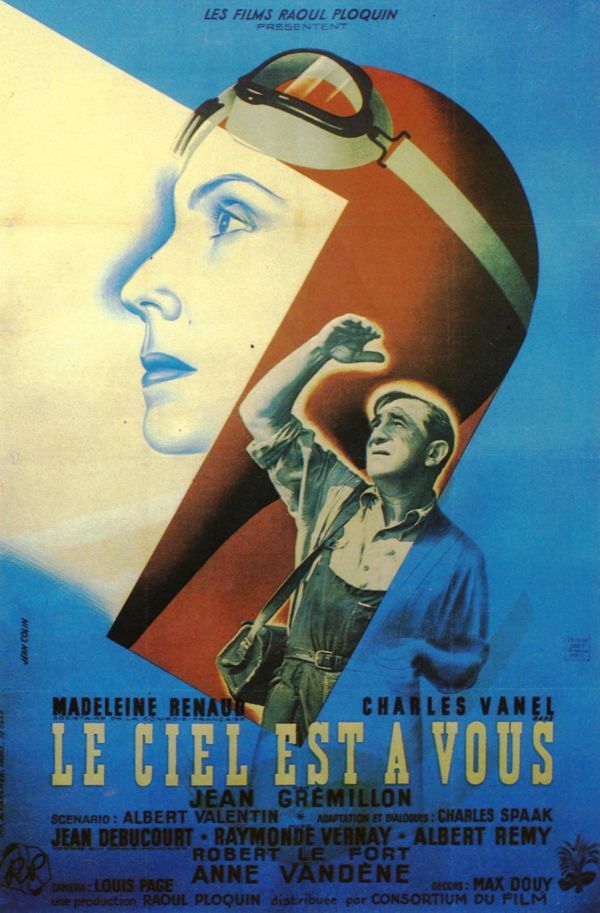 Made during World War II under the Vichy regime which controlled the South of France, it’s tempting to read the story as a metaphor for France’s struggle to be free. It begins with the Gauthier family having to relocate their family garage business, to make way for an airfield (strictly recreational, mind). This, along with a visit by famed aviatrix Lucienne Ivry (Vandène), rekindles a love of flight Pierre (Vanel) has had since his days as a mechanic in World War I. At first, his wife Thérèse (Renaud) is dubious, but after she experiences the joy of soaring through the air, her passion soon exceeds his. She flies, he mechanics, and they prepare a bid, out of their garage, to set a record for long-distance flying by a woman – even as Ivry prepares a much higher profile and better funded attempt on the same mark.
Oddly, it’s a film which reminded me most of two anime. Firstly, the work of Hayao Miyazaki, which has consistently demonstrated a love of flight – most obviously, Porco Rosso. Yet here, it’s odd that a film so much about aviation, is literally grounded. The only shots of planes in motion are taken from the earth, and Thérèse’s record-breaking flight is entirely off-screen. In this, it feels more like The Wings of Honneamise. This was a movie about an alternate-world race into space – yet it was a great deal more concerned about the human aspects than the actual end result. Similarly, this is as much about the love Thérèse and Pierre have for each other. It does come with a note of caution about how shared obsessions can cause tunnel-vision; they even sell their daughter’s beloved piano to fund their project.
Given the era, it’s remarkably forward-thinking. Lucienne and Thérèse are portrayed as easily the most competent aviators, with the men pottering around in their flying machines by comparison. Yet Thérèse is also the glue that holds the Gauthier family together; when she moves to the big city to take on management of a car dealership, their home life suffers considerably. I’d have liked to have seen a better case made for what the appeal of flying is; you’re left to deduce it second-hand, from the reactions of those who have experienced it. Regardless, the appealing central characters here help ensure the viewer is slowly drawn in to proceedings, through a low-key process of familiarity. There’s something particularly genuine about their relationship, and how they’re prepared to sacrifice so much for each other’s dreams. If you’re not holding your breath as Thérèse’s attempt unfolds into disconcerting silence, and even Pierre’s steadfast confidence begins to waver, you’ve clearly not noticed the ominous and foreboding processions of orphans through the town’s streets…
Dir: Jean Grémillon
Star: Madeleine Renaud, Charles Vanel, Raymonde Vernay, Anne Vandène
a.k.a. Le ciel est à vous (The Sky is Yours)




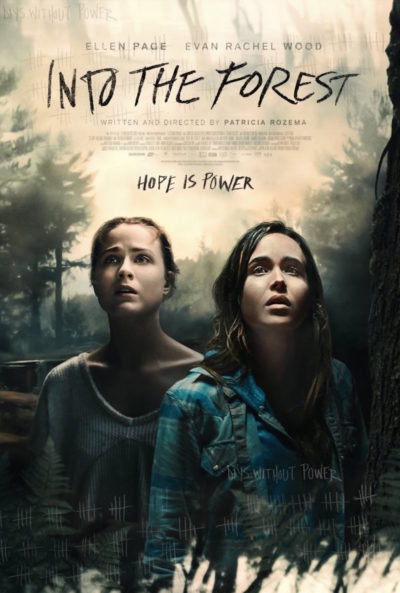 Nell (Page) and Eva (Wood) are sisters, living in a house deep in the woods with their father (Rennie). Nell is studying for her SATs, Evan is working towards a dance audition, until all plans are interrupted by a catastrophic power outage which leaves the entire country without electricity. Fortunately, they are almost self-sufficient, capable of living off the land as far as food and heat is concerned, even if the lack of power and very limited fuel forces some significant changes in lifestyle: Eva is reduced to practicing her dance routine to the relentless tick of a metronome, for instance. But when the women are thrown entirely onto their own resources, life becomes tougher, and various hard questions have to be answered, about whether to stay in their remote, apparently fairly safe location, or follow the reports suggesting that the Eastern seaboard may slowly be getting back to normal.

 On the other hand, if the plot has more than some similarities, the tone and approach are different here. There’s much more in the way of social commentary here, with the disparate personas of the two young women. [Indeed, so disparate, you have to question how the heck they ever ended up sharing a house] Jamie (Vega) is serious-minded, the kind of person who labels her food in the fridge, and seeking to pursue an academic career, but desperately needs funds to cover tuition at her chosen college. Dee (Grammer) is a party girl, whose days are filled with going to the gym and tanning, while her nights are filled with tequila and casual sex.