




★★★½
“All in, all out!”
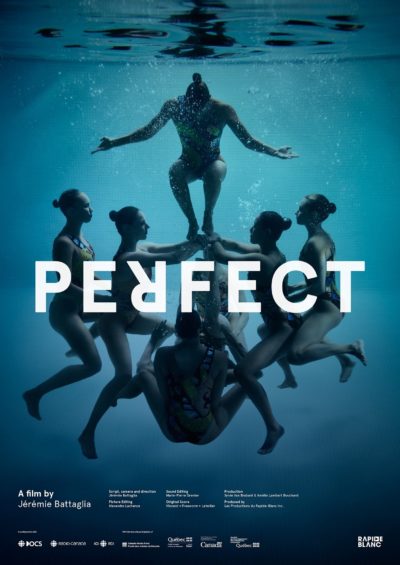 When I reviewed Russian fencing film On the Edge, I said, “I just need to find a synchronized swimming movie.” While this is a documentary, with all the positives and negatives of that genre, this fits the bill until Hollywood produces something more narrative. It follows the efforts of the Canadian team to get into the 2016 Rio Olympics. While normally, they’d be in as Pan-American champions, hosts Brazil got the spot reserved for the Americas. This forces Canada to go through the qualification tournament, battling their nemeses, Spain and Italy. The doc covers the arrival of new Chinese coach Meng Chen, efforts to get the most from her swimmers, and when this initially falls short, a radical re-invention of the team’s routine.
You may be wondering what one of the most mocked Olympic sports is doing on the site. But beneath the fixed grins, penguin walks and stripper make-up, lies one of the most intense, demanding and gruelling sports, for men or women. To quote one team member, it’s like “running an Olympic-level 400-metre sprint while holding your breath”. She’s not wrong. The most memorable sequence here is when a series of team members list the injuries suffered for their sport. Broken bones. Torn muscles. And concussions. So many concussions, an inevitable result of rapidly-moving limbs in close proximity to skulls. I wrote elsewhere about the sport, now called “artistic swimming”; read that if you want the full case for why it belongs here.
Alternatively, just watch the film, because you’ll likely leave giving the athletes the respect they deserve. It’s the result of throwaway lines like one saying she spends 7-12 hours a day in the pool. Or the relentless pressure of Chen, pushing to unlock their potential. Or team captain Morin succumbing to an eating disorder, this sport being as much about how you look as how you perform. However, I’d have liked to have seen more technical background, rather than another scene of Chen yelling at the team. Even simple things, like explaining they aren’t allowed to touch the bottom of the pool, would have enhanced the footage of them throwing team-mates into the air. Though there are still some staggeringly beautiful shots, using reflections, tilted cameras, etc. it is a shame they couldn’t use the performance music – presumably for rights reasons.
Interestingly, and perhaps pointedly, the team realizes its greatest results, after Chen adopts a more collaborative approach with them, and brings in external help. They even get an acting coach, to help improve their ability to convey emotions through movement. It’s nice too, to get a bit of insight into the aspiring Olympians, such as Holzner, for whom this has been an ambition since she was eight. We see the scrapbook she made when she was young (to help cope with a concussion!), and it helps foster an understanding of why people are willing to put themselves through this kind of ordeal. It all ends a bit messily: we don’t even see their final routine. But the journey is the thing here, not the destination, and you should be left with a new appreciation for the sport and its participants.
Dir: Jérémie Battaglia
Star: Claudia Holzner, Marie-Lou Morin, Meng Chen, Karine Thomas
 I was pleasantly surprised when this random kung-fu film found Tubi (under the Silver Fox title) turned out to be by the creator of
  This is another one in the apparently endless series of low-budget urban movies, which focus on crime in the black community. Though this does actually have a couple of wrinkles which make it stand out, if not quite enough to make it a success for a wider audience outside its community. Columbus, Ohio is the setting, where Princess (Godsey) is struggling to make ends meet. She’s relying on handouts from her dodgy brother, Dae Dae, to make rent, and also wants to get her best friend away from her pimp. Opportunity comes knocking, in the shape of an Uber driver, Omar (Campbell), who brings her on board in his business, which he tells her has almost unlimited upside and growth potential.
 ★★½
★★½ After the success of Bloody Mama, producer Roger Corman wanted to follow up with another film depicting lawlessness in the Depression. He found his source material in Sister of the Road, supposedly the autobiography of a thirties drifter called Boxcar Bertha. No such one person actually existed: it was assembled by the author, Dr. Ben L. Reitman, from multiple characters he met while helping women in trouble in Chicago (a fictionalized version of the doctor may appear in the movie). Corman hired the then almost unknown Martin Scorsese, who was directing his first commercial film; its predecessor, Who’s That Knocking at My Door, grossed only $16,085. Scorsese was given a schedule of 24 days and a budget of $600,000.
 ★½
★½ I never considered myself to be afraid of heights. I respect them, sure. But I am capable of going up the ladder to change that annoying smoke alarm battery without a safety net. This film though, literally gave me sweaty palms. It’s about climber Becky Connor (Currey) who lost her husband Dan (Gooding) in a rockface accident a year before, and has spiralled down into alcoholism and depression since. Her father (Morgan) gets her best friend Shiloh Hunter (Gardner) to intervene, and she convinces Becky the best thing is to get back on horse, with a climb of a two thousand feet tall, abandoned TV mast.
 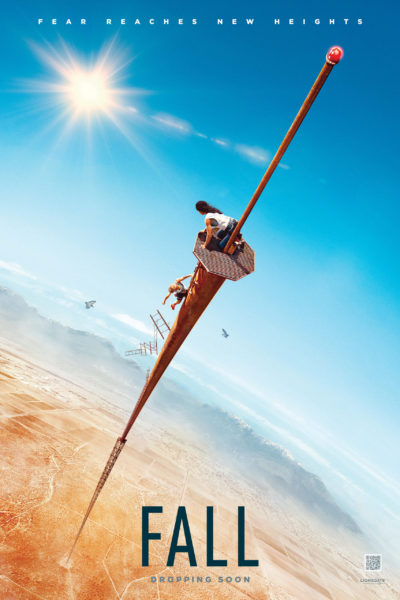 The journey up is where the moist hands started. I don’t care how nice the views might be, I’m afraid it’s going to be a no from me, dawg. Adding to the fraught tension, is the focus by Mann on the decaying structure: rust, missing bolts and general creakiness. It’s like Final Destination: you know something is inevitably going to go terribly wrong, it’s just a question of when, and the specifics. It duly does, leaving the pair stranded near the top, on a platform about the size of our dining table, with no route down or way to call for help. The rest of the film is the struggle of Becky and Hunter (she uses her last name, or her social media identity of “Danger Deb”) to find a way to do one or the other.
 I did not originally expect to be reviewing this here. I watched it because of the technical elements, which I’ll get to in a bit. However, by the end, it does qualify – though you certainly wouldn’t think so from how things begin. It gets underway with Lili (Puig) waiting for a date arranged over the Internet with Eduardo (Alcantara). He shows up late, very apologetic after having been mugged, and having had his phone taken, but is utterly charming, and the chemistry with Lili is immediate. They end up back at his place for dinner. But as he’s cooking on the kitchen, the tone of the evening changes, when she hears his supposedly stolen phone going off in his jacket…
 I am contractually obliged to appreciate at least somewhat, any film made here in Arizona. This certainly fits the bill, having been shot at places like the Pioneer Living History Museum, Sitgreaves National Forest and Winters Film Group Studio. However, it is a fairly basic tale of two-pronged revenge, with significant pacing issues. The proceedings only come to life in the last 20 minutes – and barely that. Initially, matters are more than a tad confusing, as we jump about in time and space without apparent notification. But the basic principal is eventually established.
 Ah, the things I watch for you people. Safe to say, this probably hit new heights of “I am not the target demographic”, but it’s hard to argue it is outside the remit of the site. To the film’s credit, this is not as bad as I feared it might be. If I had an eight-year-old daughter – such a shame this turned up about 25 years too late! – there would be far worse things to have inflicted on me. Not that I’ll exactly be chasing down any of the other