




Author: Jim McLennan
High Kickers
★½
“Desperately in need of more kick.”
 Hanging on the wall of the training gym in this film, is a banner on which is written in large letters: “WTF”. I imagine this is probably supposed to stand for “World Taekwondo Federation”, but it’s an unfortunate acronym for any organization. Says quite a bit that this is perhaps the most memorable thing, in what is not far from a Chinese knock-off of one of the more forgettable American martial-arts flicks of the 80’s, Best of the Best. Lingling (Huang) shows up one day at a failing taekwondo school run by Zhao Yumin (Liu), and asks to be trained for the national championships, even though she’s never fought before. Zhao sets her an impossible challenge, but when Lingling succeeds, is forced to take her on. As the rest of the film unfolds, we discover why the gym is failing – a former pupil died in a previous championship bout against the cockily brutal Gao Zhi (Cheng) – and also the reason for LingLing’s sudden interest in martial arts. If you’ve seen Best, you’ll probably be there already.
To give you some idea of how generally lame this is, the “impossible challenge” set for the heroine is… to go to a railway station and buy a ticket. We’re given no idea of why this is supposedly such a feat, because we don’t get to see any of it. Maybe it’s surrounded by a pit of crocodiles or something. Huang is also pretty unconvincing, with arms like twigs: before her climactic battle, we get to see her in one bout, which she wins with a gimmick move, so the viewer is never given any reason to feel that she has a realistic chance against Gao. That’s especially the case, after the only martial arts worthy of note, which is when he comes to the gym and basically demolishes an entire platoon of trainees.
The rest of the time is little more than a parade of martial-arts clichés, with Xie far too over-fond of the training montage as a cinematic device. Admittedly, my school of thought says “once” is about the limit, and you’d better have a good reason for doing it that often. Still, it’s in line with the other aspects: the characters are uninteresting, performances nothing special and, with the sole exception noted above, the fight sequences do little to generate excitement or interest. I note that the film is conveniently missing from Gordon Liu’s filmography on the IMDb: if I were in his shoes, I’d probably hope it stays that way.
Dir: Xie Yi
Star: Eva Huang, Gordon Liu, Mark Cheng, Daniel Chan
Kite trailer + clips
The adaptation of the infamous manga and anime was mentioned just a few days ago, in our 2014 preview, but we now have more info, in the shape of the first trailer, and four clips. Per the synopsis, it’s the story of “Sawa (India Eisley), a young woman living in a failed state after the financial collapse, where a corrupt security force profits on the trafficking of young women. When Sawa’s policeman father is killed, she vows to track the murderer down with the help of his ex-partner, Karl Aker (Samuel L. Jackson).”
Killer Women promo
 Based (loosely, according to some reports) on the Argentinian series Mujeres Asesinas, the series Killer Women follows the life of Molly Parker, a recently divorced woman, former beauty queen, and a daughter of a sheriff. She rises to the top ranks of one of the most elite and male-dominant law enforcement establishments, the Texas Rangers. Parker is played by Tricia Helfer, best know for playing Cylon “Number 6” in the reworked version of Battlestar Galactica. The executive producers include Sofia Vergara, who was one of the (not many) better things about Machete Kills, and Martin Campbell, the director of Goldeneye.
It’s an eight-week series, apparently designed as a mid-season replacement for the cancelled Lucky 7. One review said of the new show, that it will not “wear anyone out with ruminations on America’s historic notion of gender-appropriate employment. As the title declares with pride, the show has a lot in common with old-style drive-in second features at drive-ins.” Sounds perfectly acceptable to me: we’ve set the DVR. Killer Women airs on ABC at 10pm on Tuesday night. Here’s the promo.
Foxy Brown
★★★★
“…and I’ve got a black belt in bar-stools!”

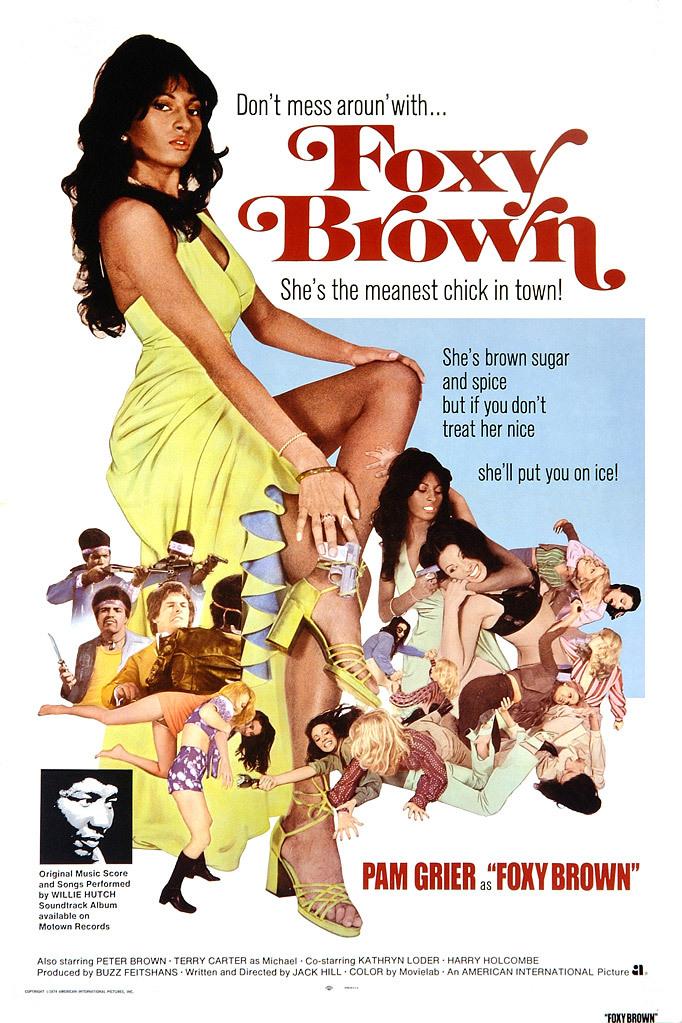 Brown (Grier) has a drug-dealing brother Link (Fargas), who works for a mob run by Steve Elias (Brown) and Katherine Wall (Loder). He tells them where to find Foxy’s boyfriend, a former undercover cop, a betrayal which leads to the latter’s death. Understandably peeved, Foxy works her way in to the gang responsible through their modelling agency, a prostitution front used to keep happy the judges and politicians who protect them. But when her presence is discovered, she’s shot up with heroin and sent off to the ranch where they package the smack. Does that stop her? Hell, no.
Following on from the success of Coffy, director Hill teamed up again with Grier – this was originally intended to be a sequel, under the original title Burn, Coffee, Burn! but AIP decided to make a new character instead, albeit with more or less the same script. There’s no shortage of grindhouse material, with neither the nudity nor the violence being soft-pedalled: interestingly, given this, the heroine doesn’t actually kill either villain, though you could certainly argue Elias, in particular, suffers a fate worse than death. The plot and characters have stood the test of time well, even the scummy Link, who has a pretty compelling explanation for his life of crime: “I’m a black man, and I don’t know how to sing, and I don’t know how to dance, and I don’t know how to preach to no congregation. I’m too small to be a football hero, and too ugly to be elected mayor.”
It’s an improvement on Coffy in a number of ways, with Grier more self-assured, and Hill apparently having a better handle on things as well. While it has been criticized for race-baiting – there are literally no good Caucasians – I’m as white as they come and it feels more like an attack on established power. The supporting cast also deserve credit, with Brown and Loder appropriately sleazy, Sid Haig being Sid Haig, and Juanita Brown deserving mention as another prostitute. Lots of moments here to treasure, including a spectacular death by propeller, Foxy hiding a gun in her afro (!), and a lesbian barroom brawl that’s glorious, which leads to the line at the top of the review. Among the dykes there, are Stephanie and Jeannie, stuntwomen from the famous Epper clan. with the latter a mentor to Zoë Bell.
But this is Grier’s show, and she carries it magnificently, even if at times it feels more like she is modelling the Foxy Brown fall collection, rather than engaging on a roaring rampage of revenge. [Some things about the seventies are likely best left there: the fashions would be one of them!] That’s a minor complaint, as what we have here is an iconic heroine, who has rarely been matched in the 40 years since, for her combination of heart and brain, courage and empathy, all wrapped up in one seriously kick-ass package.
Dir: Jack Hill
Star: Pam Grier, Peter Brown, Antonio Fargas, Kathryn Loder
2014 in Action Heroine Films
The IMDb lists over seven thousand films with a production date of 2014. Which ones look most likely to be of interest to girls with guns fans?
Raze (January 10)
We’ve been drooling not-so quietly over this one for quite some time – more than two years, in fact, since the first promo came out in November 2011, then through the trailer in March this year. And why? Because of the presence of Zoë Bell, who may finally get the chance to kick ass here, after being shamefully wasted in Django Unchained. The story concerns women abducted and forced to battle each other in an underground fight club, with their families being threatened as motivation. Bell was also one of the producers, so if this isn’t the hard-hitting actioner it needs to be, she can take herself outside for a stern talking-to. This will be a “limited” release, so keep your fingers crossed it’s somewhere near you, though I believe it’s also coming out through on-demand services.
Divergent (May 21)
Based on a popular series of young adult books by Veronica Roth, which has been compared to The Hunger Games, both being trilogies set in a dystopian future, with a young heroine. Certainly, the trailer (above) has a similar vibe, and contains enough action to establish its credentials here – it also gets a bonus point for including Maggie Q in a supporting role. So confident are the studio of this film’s success, that they are already working on versions of the other two books for March 2015 and 2016, so this series could become a staple of these previews. The writer of Jane Got a Gun (about which, more in a moment), Brian Duffield, has been hired for the second installment.
Maleficent (May 30)
Angelina Jolie is the nearest thing we have to a legitimate GWG superstar, and is perhaps the only actress who can open an action film on her name alone, as she did in Salt. This is, obviously, somewhat different, being more or less a re-telling of Sleeping Beauty, from the point of view of villainess Maleficent, who wasn’t always an evil witch. Per the synopsis, “When an invading army threatens the harmony of the land. Maleficent rises to be the land’s fiercest protector, but she ultimately suffers a ruthless betrayal – an act that begins to turn her pure heart to stone. Bent on revenge, Maleficent faces an epic battle with the invading king’s successor.” So, in other words, it’s Jolie being her usual BAMF self. Only, in this case, the last two letters stand for “magical female.”
Lucy (August 8)
Few directors have been more committed to the cause of action heroines than Luc Besson, going all the way back to Nikita, an icon of the genre, and just the first of a number of times he has gone to our well. This SF pic looks set to be another example. When Scarlet Johansson was cast as the lead in April, the Hollywood Reporter said the plot “centers on a woman forced to become a drug mule. But the drug instead goes into her system, transforming her into an ass-kicking machine. She can absorb knowledge instantaneously, is able to move objects with her mind and can’t feel pain and other discomforts.” Johansson, of course, was also the nearest thing The Avengers could give us to an action heroine, in her role as Black Widow, which could prove to be a nice warm-up. Heard very little else about this to date, so looking forward to a trailer soon – or even a poster.
 Jane Got a Gun (August 29)
This achieved early notoriety, when original director Lynne Ramsay failed to show up for the first day of shooting, and ended up parting company with the production, taking the cinematographer and Jude Law, who had been scheduled to play the leader of the gang, with her. A lawsuit has followed, alleging the director was drunk and waved a gun around on set – claims Ramsay has denied (maybe she was just channeling the spirit of Werner Herzog?). A new director has been found, but will the film survive? Oh, yeah: the plot. Jane Hammond is a married to one of the worst baddies in town. When her husband turns against his own gang, and returns home barely alive with eight bullets in his back, Jane decides to grab a gun and take matters into her own hands.
Resident Evil 6 (September 12)
The series just won’t quit, and it’s the overseas market you can thank. While the latest installment, Retribution, barely scraped past the original’s US gross, despite a decade of ticket inflation, it took more than three times as much as the first outside of North America, 82.4% of its total box-office coming from foreign parts. As yet, information on the sixth is scant, to the point that it doesn’t even have an official subtitle (“Rebirth” has been reported), but it seems to be the last one – at least for Milla and director/husband Paul W.S. Anderson, though a subsequent reboot would not surprise me. Anderson said, “In terms of returning characters and themes, I do see [it] coming full circle, and circling back to the original characters and themes that were featured in the very first film,” and also returning to the hive where it all began too.
The Hunger Games: Mockingjay – Part 1 (November 21)
Say what you like, the series is easily the biggest action-heroine box-office hit of all time: Catching Fire is still in theaters, but is already past $750 million worldwide, and may end up surpassing the original. It’s also critically preferred, at 90% fresh on Rotten Tomatoes, compared to 84% for the first part. So could we be looking here at the first ever billion-dollar action heroine movie? It’s not impossible, though more likely to be Mockingjay 2, if it follows the Harry Potter pattern, where the final movie enjoyed almost a 50% boost in receipts. Something similar would get into the top 10 all-time (currently #10 is Pirates of the Caribbean 2, at $1,066 million). Quite a remarkable feat, and a complete destruction of the argument that heroines can’t drive an action franchise.
Barely Lethal (TBA)
 “A 16-year-old international assassin yearning for a “normal” adolescence fakes her own death and enrolls as a senior in a suburban high school. She quickly learns that being popular can be more painful than getting water-boarded.” I’m not sure who came up with that synopsis, but they likely deserve some first-hand experience of waterboarding. Cute title, even if it does feel rather too close to the lacklustre school plot from Kick-Ass 2. Chris will probably be up for this, since she thoroughly enjoyed director Kyle Newman’s Fanboys. Hailee Steinfeld plays the hit-teenager, Megan, and Jessica Alba is former employer Victoria Knox, who smells a rat and heads in pursuit. Samuel L. Jackson and Sophie Turner (Sansa Stark from Game of Thrones) are also involved.
Crouching Dragon Hidden Tiger II — The Green Destiny (TBA)
Not a film I ever expected to see sequelized, but it was officially announced in May that filming would start next March. It’s based on another book in the same series on which the original was based, and will have Michelle Yeoh returning – if not under the direction of Ang Lee, I think Yuen Wo-Ping will do. Donnie Yen will also star, with Zhang Yi Yi reported in August as being “in talks” to appear in flashbacks. Given the brilliance of its predecessor, it’s got big shoes to fill, but still… Yeoh and Yen, with Yuen directing? We’ll be there. Some sources list this as 2015, but IMDb currently says next year, so we’ll include it here – while reserving the right to copy/paste this paragraph into next year’s preview!
Kite (TBA)
Based on the anime of the same name, the official synopsis says this “Kite is a character-driven action film that charts the story of Sawa (India Eisley), a young woman living in a failed state after the financial collapse, where a corrupt security force profits on the trafficking of young women. When Sawa’s policeman father is killed, she vows to track the murderer down with the help of his ex-partner, Karl Aker (Samuel L. Jackson).” Hmm. Seems to skip a couple of what would seem fairly pertinent details from the anime – but if you’ve ever seen the uncut version, you’ll know why it wouldn’t be directly filmable. Co-star Callan McAuliffe said, “It’s been toned down a tiny bit, but it is still exceedingly violent and there is a lot of the original material in there. It’s definitely not something that young children should watch.” Original director David R. Ellis died, but shooting completed in September under replacement Ralph Ziman.
 Honorable mentions:
- Veronica Mars (March 14) – The TV series about a young detective, played by Kristen Bell, was turned into a movie after a record-shattering Kickstarter project which hit its $2 million goal in eleven hours. I’ve never actually watched the show, but still – that’s kinda impressive. Am kinda intrigued now, given critical reaction such as “Alias in its attitude, Raymond Chandler in its writing and The O.C. in its class-consciousness.” Unfortunately, it’s not on Netflix, so it’ll have to wait!
- Jupiter Ascending (18 July) – “In a universe where humans are near the bottom of the evolutionary ladder, a young destitute human woman is targeted for assassination by the Queen of the Universe because her very existence threatens to end the Queen’s reign.” It’s by the Wachowski brot… er, siblings. Once upon a time, that would have been all you’d have needed to say to get us into a frenzy, but that was before… Well, just about everything they’ve done, to varying degrees, since the original Matrix. So, we’ll restrain our enthusiasm on this one for a bit.
- Sin City: A Dame to Kill For (August 22) – We re-watched the original a little while ago, and it has stood the test of time very well, remaining one of the best graphic novel to film adaptations. The most obvious section of interest was The Big Fat Kill, which saw Clive Owen team up with the ferocious and protective hookers of Old Town, including Rosario Dawson and Devon Aoki. Dawson returns for this sequel, but Aoki is too busy being pregnant, so the role of “little Miho” is being played by Jamie Chung, whom you’ll know as Amber from Sucker Punch.
Alley Cat
★★
“Never quite sinking to tedium, yet never rising to reach interesting.”
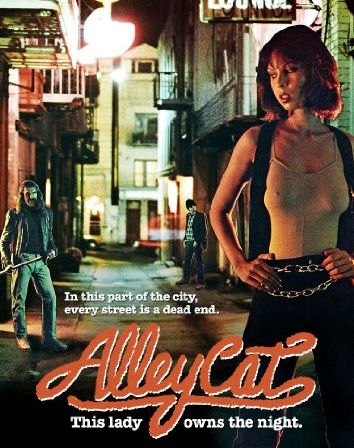 Another review compared this to Savage Streets and Vigilante, from the same era, and I can certainly see the similarities. Black belt Billie Clark (Mani) finds herself hamstrung by the ineffectual legal system, after she stops a rape – and, indeed, ends up going to jail, which is more than can be said for the attackers. With the help of a sympathetic cop (Torti), who’s also her boyfriend, she works her way up the chain to the sleazeball at the top, Krug (Wayne), presumably named after the villain of another grindhouse classic, The Last House on the Left. But it’s a climb not without its personal cost.
It seemed an almost cursed work, going through a lengthy hiatus mid-shoot, with one director for each chunk, and a third who then fiddled with the movie post-production. The results are about as uneven as you’d expect, but are hampered mostly by the characters involved being bland and forgettable. For someone who has gone through quite a lot, Billie is pretty damn phlegmatic about it all, rarely even bothering to get angry, though does believe cleanliness is next to vengefulness, going by her multiple shower scenes. Mind you, this lack of colour is line with Krug, who is not particularly scary himself, and is hardly a criminal mastermind in charge of an evil empire, his gang consisting of about three guys, with the combined IQ of a Pomeranian.
The supposed martial-arts expertise of the heroine leaves a little to be desired, too. If you’re going to make a point out of someone being a black belt, you need to be able to deliver at least convincing fakery in this department, but there are few moments when Mani (or even her obvious stunt-double) reach the necessary level of semi-competence. The fact that she’s still capable of beating up the bad guys, simply makes them look even more woeful. They’d have been better off letting her hang on to the gun, instead of using that instead to trigger the whole “women in prison” subthread, which feels like it comes from an entirely different movie, rather than just a different director. I couldn’t quite muster the loathing to turn it off: it’s the kind of film that just sits there, occupying 90 minutes of your life.
Dir: Victor Ordoñez, Edward Victor, Al Valletta
Star: Karin Mani, Robert Torti, Michael Wayne, Jon Greene
War Goddess
★★★
“Should have paid more attention in history class.”
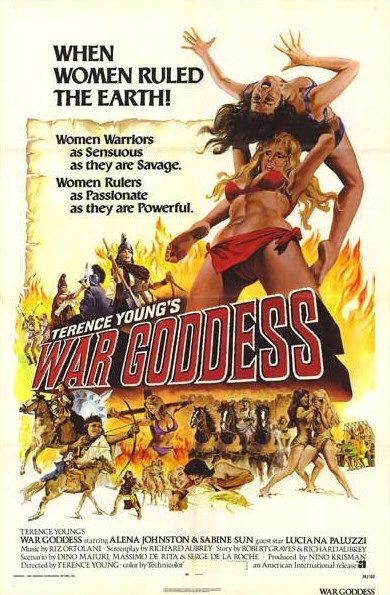 The Amazons are a tribe of women, who have seceded from the rest of the world, and set up a state purely composed of their own sex. For reproductive purposes, there’s an annual get-together with men – preceded by exercises to prevent any feelings except for abhorrence – and every four years, contests (javelin throwing, running, archery, etc.) to choose the queen. Which is where we come in, with blonde Antiope (Johnston) defeating brunette Oreitheia (Sun). The new ruler believes the tribe have gone soft, and also wants a return to a more egalitarian society; this doesn’t sit well with Oreitheia, or a lot of the other high Amazons, and a coup d’etat is soon being planned. Meanwhile, the annual Bonkapalooza poses problems of its own, as Antiope finds herself with feelings for Greek king Theseus (Infanti), who in turn feels guilty about having inadvertently sent the tribe into a Scythian ambush.
I don’t think I’ve often been so confused by a film’s approach, but this is so uneven in tone, I had to watch twice to get any kind of handle on it. For example, it starts with a jokey set of captions about how this maybe didn’t really happen, then swings in to the competition to be queen, peaking in seriousness with Antiope’s “pipe bomb” speech post-inauguration, which is radical to the point of almost revolutionary. But before you know it, you’re back to sub-Benny Hill antics involving bawdy comedy, or interpretive dance. This roller-coaster ride has Antiope apparently going from conception to birth in what feels like three days, without ever passing through pregnancy. It ends in a massive disappointment, which sees Antiope transformed from a warrior queen into little more than a simpering underling to Theseus, concerned that she might have to ask him for money to buy new sandals. Guess the sex war is over, guys – and we won. Woo-hoo!
Not to say there isn’t plenty here to enjoy, because it’s clear a lot of work went into this, and there’s no shortage of spectacle. Okay, some of it was work you might not have minded. According to Raw Panic, “Director Terence Young and colleagues reviewed 14,000 photographs and conducted “Miss Amazon” contests in Trieste, Paris, Hamburg, Munich, Rome and Nice to come up with the 100 women who are the Amazons.” Hey, it’s a dirty job, but someone’s got to do it… Those selected, “then endured a six-week training regimen that included riding, calisthenics and running from early in the morning until lights out. They did mostly their own stunts too; several girls had broken legs and one lost a finger under a chariot wheel.” If the results are somewhat uneven – some still look unsure about which end of a sword is which – most of the featured actresses are competent enough. Young is probably best known for his role in kick-starting the 007 franchise, directing both Dr. No and From Russia With Love – I was certainly reminded of the classic “gypsy camp catfight” sequence from the latter by a couple of moments here.
Yeah, if there are two scenes you’ll remember, it’s the brawls between Antiope and Oreitheia. The first is to decide who wears the crown, and involves the pre-fight application of “holy oil,” one suspects more for aesthetic than ecclesiastical considerations. The second is when Oreitheia’s midnight assassination attempt is uncovered, and appears to exist in two versions: one bikini-clad, the other entirely nude, depending on the market. You can catch a glimpse of the former in the trailer below; the less-encumbered, NSFW version can be seen in the Italian promo. Go ahead. We’ll wait for you here. :) There. Wasn’t that fun? Credit is due to both Johnston and Sun, who take on material that often strays to questionable or even laughable, with a straight-faced intensity which is rather more than it deserves. It’s a shame that some of the others involved, on the other side of the camera, weren’t apparently willing to take this as seriously.
Dir: Terence Young
Star: Alena Johnston, Angelo Infanti, Sabine Sun, Rosanna Yanni
a.k.a. Le guerriere dal seno nudo
a.k.a. The Amazons
Devil Hunters
★★½
“When Sibelle Hu asks ‘Mind if I smoke?’ she may not mean what you think…”
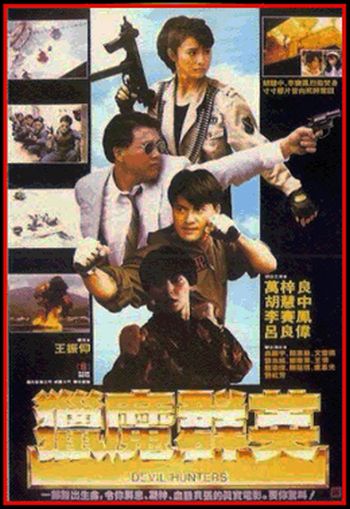 Bonus half-star for the final scene, which has the three leads leap out a window, as a giant explosion goes off behind them. Rather too giant, as a mistake in the amount of gunpowder used, apparently led to both Hu and Lee suffering third-degree burns. You can see it below: the part of the roman candle in the middle, is played by the former. :( Which may explain why the film abruptly ends there, over a montage of apparent newspaper clippings, and the heartfelt well-wishes of the director to his injured stars. Such sacrifice can only be admired.
Though, as with Michelle Yeoh’s accident on The Stunt Woman, you can’t help wishing it had been made in the service of a better movie. Particularly early on, this seems nothing more than a set of random action scenes spliced together, without rhyme, reason or a plot to connect them. Eventually, it turns out that there is virtually a queue of people, all with reasons for a grudge against gangster boss Hon San (Wong Wai), who appears to be the “devil” of the title. Among these are cop Inspector Tong (Hu); Hon San’s underling, Chiu Shing (Francis Ng); Chai Sun (Lui), who seeks vengeance for the death of his father; and finally, an enigmatic young woman Abby (Lee). By the time of the fiery finale, alliances are formed, the true villain revealed, and a great deal of butt kicked, but you’ll be hard-pushed to retain significant interest through the plethora of subplots as they unfold.
Perhaps the main problem is that, between getting these and the action in, there’s very little time for anything else, such as making us give a damn about any of the characters. Without exception, they appear to be out of the box of Hong Kong stock clichés: deceitful gangster, stoic cop, etc. and none of the plot twists will provoke much more than an “Eh.” Overall, you’re better off taking this as the “random action scenes spliced together” mentioned earlier, and having it on in the background while you do something more productive.
Dir: Chin-Ku Lu
Star: Sibelle Hu, Alex Man, Moon Lee, Raymond Lu
a.k.a. Megaforce 2, Red Force 3, Ultra Force 2
Catching Fire, by Suzanne Collins
★★★★
“Certainly better than Battle Royale 2.”

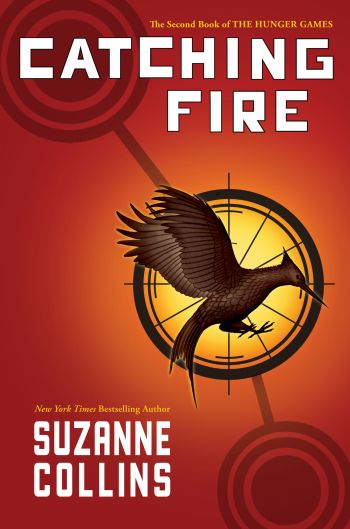 We rejoin heroine Katniss Everdeen in the second book of the trilogy, after her success in the 74th Hunger Games, where she out-lived the other contestants, in part through a fabricated love-affair with fellow District 12 tribute, Peeta. However, as well as her previous love, Gale, she now has to cope with life as a celebrity, beginning with a “Victory Tour” through the other districts. It soon becomes clear that not all is well, with her stand against the Panem government having fanned the flames of rebellion elsewhere. To demonstrate their power remains unshaken, the leaders announce the special, 75th Hunger Games will involve two previous winners from each district, meaning Peeta and Katniss are sent back in to a new, even more lethal environment, to take on other champions.
That this works better than its predecessor, is mostly due to the pacing department, which builds through a first-half of impending doom, and on to an upgraded Hunger Games, before dropping a bomb in its final paragraph. There’s more depth given to the Panem hierarchy than first time around, and the undercurrent of growing revolution is nicely depicted. The Twilight-esque love-triangle aspect, which bogged down the first book, is reined back, with Gale almost absent, though Katniss still has deal with her feelings for Peeta, whom she has sworn to protect at any cost. However, can she trust those with whom she is allied in the games, and whose motivations are less clear? It’s this angle which largely keeps you turning the pages, along with the arena, throwing one threat after another at her.
At its center is Everdeen, who remains an entirely admirable creation. She is loyal, brave and phenomenally-skilled with her bow, yet possesses enough doubts and flaws to keep her human, rather than becoming some kind of superheroine. Clearly, the first-person narrative does mean there’s not much sense of direct threat to Katniss’s survival; however, Collins has enough other cards in her hand, to leave you concerned as to what the emotional cost of that survival might be. Hopefully, the second film can capture the nuances and improve on its predecessor in the same way. For when that literary bomb was dropped on me at the end, I gave serious consideration to heading straight into the third book. Damn you, Suzanne Collins.
Author: Suzanne Collins
Publisher: Scholastic