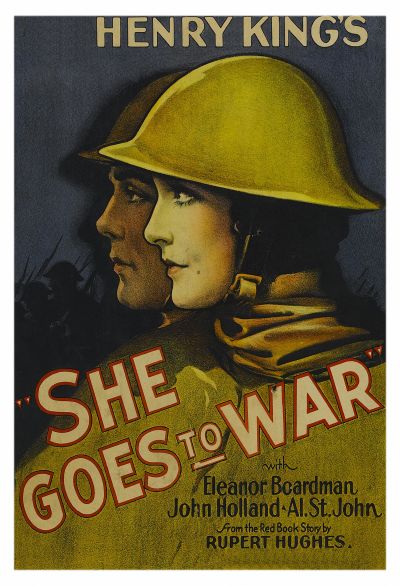
If the above doesn’t make much sense, there’s good reason for that. Things tend not to, when half of them are removed. Albeit for reasons that are largely not the makers’ fault, because this film only partially survives. Originally released in 1929 with a running-time of 87 minutes, the only version that remains is one re-released about a decade later, which has been chopped down to under fifty minutes, including new opening captions which comment on the looming second global conflict. What remains still packs quite the wallop, as an anti-war movie which doesn’t shy from the brutal nature of World War I. It’s a part-talkie, with sounds for some of the music and dialogue, and it’s very effective when used.
For example, we hear Rosie (Rubens, in one of her last roles before dying tragically young) sing a jaunty little number called “There is a Happy Place (Far, Far Away)” to cheer up the troops. A few minutes later, she sings it again to a dying soldier, as heroine Joan Morant (Boardman) watches from the shadows, and it’s utterly heart-breaking. Joan is there for reasons which have largely been lost in the edit down to the shorter version. But they seem to be related to her boyfriend, Reggie (Burns), who has gone off to war – he has a drinking problem, though whether this is a result of the conflict is similarly hard to determine. She disguises herself as a man in order to replace him after his drinking renders him unfit for active duty. This exposes her to the true horrors of trench battles, which go far beyond what she could possible have imagined.
It’s an area where the poor quality of the surviving print work for the film, because the battle re-enactments (including some impressive model work for the nineteen twenties) almost look like grainy newsreel footage. Of course, Boardman is as convincing a man as most cross-dressing soldiers are i.e. not very. You have to accept that conceit as a given, and not ask awkward questions about things like bathroom facilities. After about the half-way point, the dialogue all but stops, and things unfold thereafter accompanied only by music and some sound effects. Some sections are truly the stuff of nightmares, such as when the soldiers have to advance, only to be driven back by the enemy unleashing a tidal wave of liquid fire against them.
Seeing the men trudging back, as the entire skyline burns behind them, or (the then newly-invented) tanks driving into the same fiery hell, are images which feels like they could easily come out of 1917, or any modern war movie. The chaos of warfare is reflected in the way it’s almost impossible to tell friend from foe, in the flames and the smoke and the near-darkness. The troops advance again, coming under withering fire from a German machine-gunner. Joan shoots him in the head, after running away from a would-be rapist (!). But it’s all too much for the poor girl, and she has to be carried back to safety by the truly heroic (and non-alcoholic) Sergeant Pike (Holland), whose entire back story was another victim of the editing. It’s all frustrating, and makes it very difficult to judge, because I’m basically watching half a movie. What there is, however, packs considerably more of a punch than I expected.
Dir: Henry King Star: Eleanor Boardman, John Holland, Edmund Burns, Alma Rubens
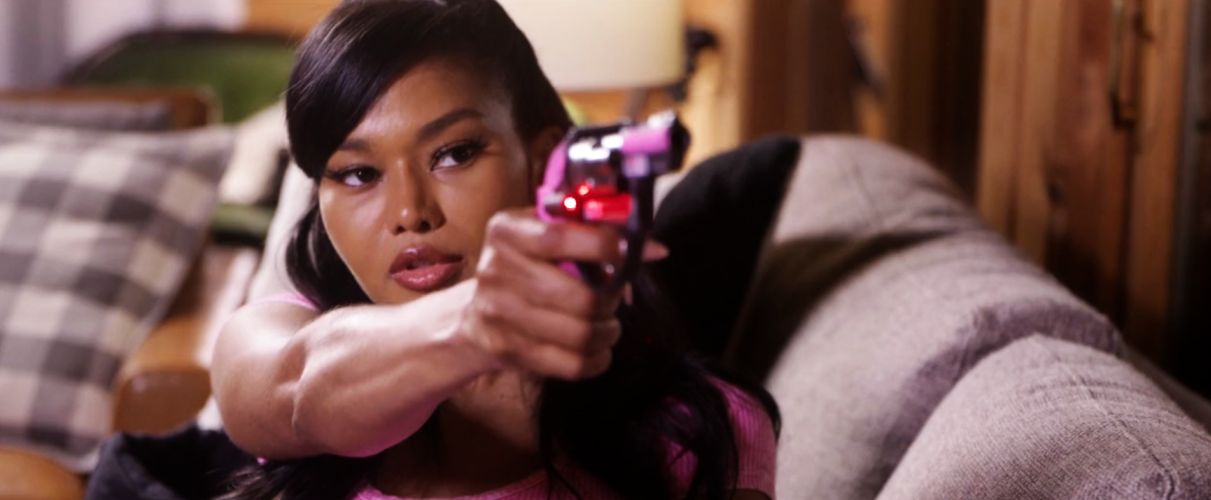
With a running time of 155 minutes, this feels like the Gone With the Wind of low-budget urban cinema. To be fair, it didn’t feel that long. To be honest, this might have been partly because it was watched in five separate chunks, over the course of about a week. However, in comparison to some entries I’ve seen, this is technically competent. Director Freddie (whose last name appears to have been abandoned) knows where to point the camera, and he has assembled a decent enough cast of actors, presumably found in the Charlotte, North Carolina area where the story unfolds. Though in this genre, “decent enough” is code for “does not generate physical pain with their performances.”
It opens with a quote from the Bible – Jeremiah 29:11, to be precise. This will become relevant, although not for another two hours or more. Instead, we are into what is probably trope #1 for the genre: the rise-and-fall story. In this case, the heroine is Nia (Evans), whom we first meet in prison. New inmate Sheba (Abell) realizes that Nia used to be her idol, when Nia was on the outside and called ‘Baddie Bedina’. Her reputation had her dead or on the run. In reality, she’s been inside for a decade, with ten more to serve, and tells her life story to Sheba. This begins with her as a young girl, struggling to take care of her disabled father, a situation which eventually forces her into prostitution.
However, she’s good enough at that to become one of the top escorts in the city, the #1 girl at the agency for whom she works, the subtly-named “Harlots”. One of her most regular and richest customers is businessman JP (Tillman), who falls for Baddie. She discovers his business is crime, and saves his life (top) when his enemies attack them at his house. After he goes to prison, for assaulting a slumlord, she takes over and expands the territory under their control – with surprising ease, it has to be said). However, this comes at a price, and the eventual reprisals force Baddie on the run. She hides out in a remote cabin which her father built with his friend Arthur (Massey).
Trouble follows: unsurprisingly, because she blabs her location to the head of Harlots, after about 30 seconds of chit-chat. Considering they didn’t exactly part on good company, this is incredibly dumb of her. However, she has an ally because Harold is… No, I can’t even. Let’s just say, I did not see his identity coming, and that Bible verse becomes increasingly relevant. It’s certainly unique among GWG films: whether it’s good or not is likely a sharp matter of both personal opinion, and religious conviction. Nia speaks about taking the consequences for her actions, yet there’s a (literal) get out of jail free card here. Credit to Freddie for taking a different route – I just can’t say it’s one that worked for me.
Dir: Freddie Star: August Evans, Torri J. Tillman, Carlos Massey, Destiny Abell
I don’t think I’ve ever seen an Italian kung-fu movie before. To be fair, the bulk of the lifting in that department is done by Chinese actress Yaxi Liu, who was a stunt double in the live-action Mulan. She plays Xiao Mei – yes, this leads to amusing confusion about Xiao and “Ciao!” – who comes to Rome in search of her vanished sister, Yun. The triad folk who brought her from China expect Mei to work as a prostitute, and soon discover that will not be happening, in impressively violent fashion. She flees, and finds an unexpected ally in Marcello (Borello), whose restaurant owning father knew Yun, and who has similarly vanished.
Meanwhile, behind the scenes is growing antagonism between Wang (Shanshan), who runs the local triad group, and Annibale (Giallini), in charge of the traditional organized crime in the area. Mei’s actions, attacking members of both gangs, are not helping, and things only escalate further when she and Marcello discover what happened to their missing relatives. You can probably work out the rest for yourself, providing the count of kung-fu movies seen previously is greater than about three. Just be prepared for it to take its time getting there. This runs a hundred and thirty-nine minutes, and I found that the main problem. While the basic story is solid, there’s a bunch of stuff on the edges that could be discarded, such as Wang’s rapper son.
There are really only four genuine action scenes in this, and given the duration, that spreads them perilously thin. However, all four are really good, to the point you will certainly wish it had more. There’s Mei’s escape from migrant processing (which has a lovely sequence of kitchen-fu); a battle against two of Annibale’s minions; her frontal assault on the restaurant which serves as a front for Wang’s activities; and, finally, her one-on-one fight with Wang himself. The last named felt like it should have been the climax: instead, it takes place when there is still thirty minutes left on the clock, leaving a long, slow march to the end-credits. I’ve not seen such an over-extended ending to a movie since Return of the King.
That said, I never particularly felt the film was boring: there’s stuff here’s that superfluous, yet is still adequately interesting. This counts as a well-done gender reversal: typically it would be the male who shows up, looking for his sister, and is helped by a waitress. It helps that both Liu and Borello are left to act in their native tongues, communicating largely through Google Translate (!). This avoid the awkward “acting in a second language” which would otherwise have been necessary. I also enjoyed the backdrop of the Eternal City, filmed in a way which emphasizes its grandeur and history. I didn’t feel like my time – and it used up a lot of it – was wasted. Had Mainetti found reason to throw in a few more fights, this could have been a classic, rather than a well-rounded throwaway.
Dir: Gabriele Mainetti Star: Enrico Borello, Yaxi Liu, Marco Giallini, Chunyu Shanshan
a.k.a. Kung Fu in Rome
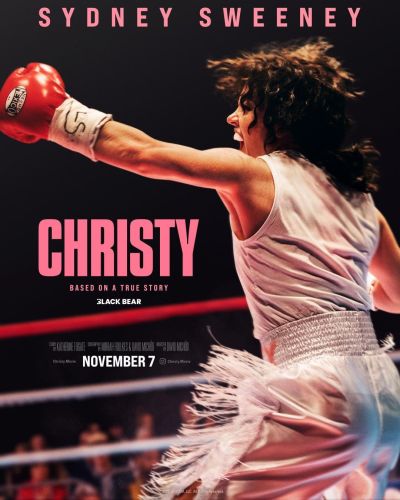
This was an interesting litmus test for your online bubble. It came out in the immediate wake of controversy over a commercial featuring the lead actress, promoted with the slogan, “Sydney Sweeney Has Great Jeans.” This prompted criticisms this was promoting eugenics, and Sweeney’s refusal to apologize, led to a lot of “Bye-bye career!” gloating when Christy subsequently bombed, with one of the worst returns for a wide opening ever. [Not least from Ruby Rose] However, the subsequent huge success of The Housemaid proved otherwise. The reality is, this is not a very good entry in a genre which is not currently in favour. A far bigger budget and star in The Rock, couldn’t stop The Smashing Machine from tanking equally hard.
What you get is basically a three-course meal of cliches, combining the very best i.e. worst of sports movies, domestic abuse porn and lesbian empowerment. It seems to be happy to change the facts to suit the narrative. For example, when aspiring boxer Christy (Sweeney) is shows as winning her first pro fight in about thirty seconds of screen time by knockout; the reality was a humdrum six-round draw. When easily-checked elements are made up, it makes me sceptical of co-writer Mirrah Foulkes, when she said, “It was important to us to try and stick as close to historical accuracy as we could.” It leaves me suspicious of… Well, basically everything else the film has to say, about anything and anyone.
It’s a shame, because both leads are very good. Sweeney gained thirty pounds, trained for three and a half months to play the boxer, and refused to use a stunt double. She is thoroughly believable in the role, and whoever was responsible for the boxing scenes knows their stuff. Foster, as her abusive manager/husband Jim Martin, is also compellingly unpleasant, his arc going from tough love coach to stabbing and shooting Christy, rather than letting her leave. That, at least, is based in fact. Though is it wrong my first reaction, on watching her getting beaten up by someone 25 years older, was “Guess she can’t have been that good a boxer”? [Answer: yes, very wrong, I know]
The problems are more the film’s persistent reliance on tropes we’ve seen far too often: if there’s one montage to stirring music here, it feels like there are a dozen. If you’ve seen any movie about the sweet science since Rocky, you have basically seen this. And at a running time of 135 minutes, there’s a lot of space to be filled in between the boxing matches. These become less significant, the deeper we get into proceedings, the film teetering precariously on the edge of abuse porn, before Christy eventually escapes the horrors of her relationship. I’m glad she did, make no mistake, and I hope she’s now living her best life – the film is kinda vague on this point. But I can’t say this provided any information I wouldn’t have got from her Wikipedia article.
Dir: David Michôd Star: Sydney Sweeney, Ben Foster, Merritt Wever, Katy O’Brian
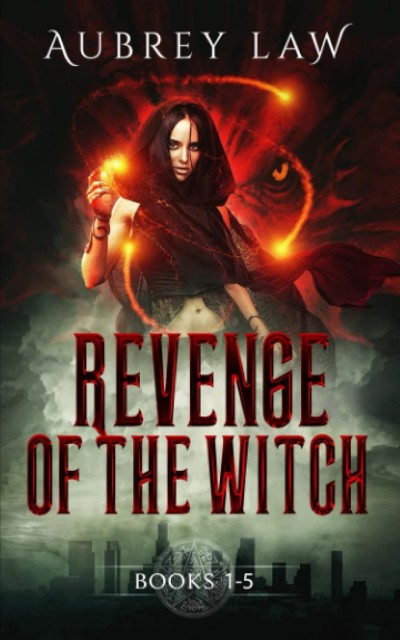
I previously reviewed the first volume in the series, Demon Hunter. and mentioned there I’d picked up a discounted collection of the first five volumes in the series. Well, here we are, having now read Demon Slayer, Demon Destroyer, Demon Punisher and Blood Moon. You may be noticing a theme there. To quickly recap, it’s the story of Annis, a Black Witch who in the Middle Ages was hanged for sorcery and spend several centuries in the fiery pits of hell. She has managed to escape, and is now out of revenge on… well, just about everyone she considers her enemy – which is just about everyone. But in particular, her mother Amelia, the even more powerful witch, who killed Annis’s father.
Annis is currently occupying the body of a young woman who had the misfortune to be in the wrong place at the wrong time. Despite her moral darkness, Annis is feeling increasingly guilty about it, having previously believed that she only killed those who deserved it. Is this the start of a genuine morality developing in our anti-heroine? We’ll find out over the course of these books, climaxing in the Blood Moon, when the Earth is in perpetual darkness and under the control of the much-hated vampires (as well as a lot of other monsters, some spectacularly large). Will Annis make the sacrifice necessary to bring light back to the world?
The additional four volumes improve over the original one, simply by Annis having a genuine character arc. Though I’m not convinced this is entirely a good thing. One of the series’s appeal was having a lead who driven almost entirely by hate of various flavours. That’s certainly a novel choice (pun not intended), but over the course of the narrative here, Annis does seem to develop genuine emotions towards other people. This does not always end well, to put it mildly, but at the end she’s closer to a conventional heroine, albeit with a a massive, industrial-strength dark side. Which is less unique, to the point I likely won’t bother with the remaining two books in the series.
However, this provides no shortage of action, Annis going up against a slew of creatures from the small (goblins) to the very, very large Leviathan. The battle against Amelia was a little underwhelming: I expected it to be a knock-down, drag-out magical slugfest, but it was over in only a few pages. However, there are plenty of other battles, against angels, vampires, bounty hunters, high priests and even Satan himself – whom we discover has a certain connection to Annis. Much as in the first part, I’d be hard-pushed to call this great literature, yet I was amused enough that I went through the approaching seven hundred pages quicker than I expected. Sometimes, a fast-food snack is really all you want to eat.
Author: Aubrey Law Publisher: Independently published available through Amazon, both as a paperback and an e-book Book 1-5 of 7 in the Revenge of the Witch series.
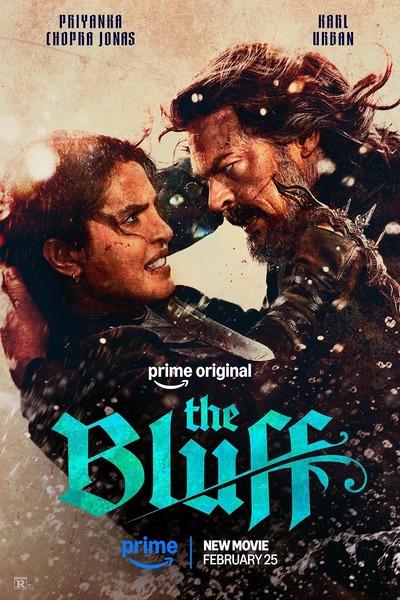
Are women pirates in vogue again? It’s safe to say that the startling failure of Cutthroat Island holed that subgenre of action heroine movies below the water. That was over thirty years ago now, and this may well be the first time Hollywood has returned to it since. [I found an indie film about Irish pirate Grainne Uaile which wrapped shooting in February 2014, and still hasn’t received a release] Though even here, there isn’t much high seas action here. Outside of the opening scene, where Captain Connor (Urban) boards a ship run by Captain Bodden (Córdova) and finds gold stamped with Connor’s hallmark, this takes place almost entirely on land, specifically the island of Cayman Brac.
Connor heads there, that being where Bodden’s ship came from, in search of the rest of the gold. This was taken from him years previously by then piratical associate Bloody Mary (Chopra Jonas) , who stabbed Connor in the chest and left him for dead. She is now Mrs. Ercell Bodden, having abandoned the nautical life, and started a family. The arrival of her ex-lover upends her domestic bliss, and forces her back into the violent way of life. It’s all kinda like The Long Kiss Goodnight, without the amnesia thing. She has to protect her crippled son Isaac and rather flighty sister-in-law Lizzie (Oakley-Green), while figuring out how to rescue her husband from Connor’s clutches.
The two leads are probably the best things about thus. Chopra Jonas has been ramping up her action chops since her co-starring role in Citadel – also an Amazon product – and does a good job throughout. Urban makes for a great villain, despite being solidly into his mid-fifties. He still commands a fine screen presence, almost thirty years after playing Julius Caesar on Xena. However, the other elements aren’t quite as impressive – or, at least, not consistently so. Flowers doesn’t have a lot of directorial experience, especially in the action genre, and sometimes that shows. There are some good sequences, such as where Ercell fends off buccaneers in her own home. But others, such as a battle in a cave complex, come over as dark and muddled.
The same lack of consistency hampers the rest of the film. For every cool moment – such as the discovery that there are caimans on Cayman Brac – there are elements that don’t work, like Ercell’s relationship with Lizzie. Another issue is that since the days of Cutthroat Island, the genre has been redefined by the Pirates of the Caribbean franchise. Any pirate movie will inevitably be compared to it, and any hero(ine) to Jack Sparrow. It’s an awkward situation, and it feels as if The Bluff is torn between pandering to this, and being its own thing. Whatever Cutthroat‘s issues – and they were numerous – that wasn’t one. But if this can prove the viability of female pirates again, it’ll have been worth the effort.
Dir: Frank E. Flowers Star: Priyanka Chopra Jonas, Karl Urban, Safia Oakley-Green, Ismael Cruz Córdova
Less than eleven months after Wuornos was convicted on her first murder charge, this TV movie was broadcast on CBS. If you’re at all familiar with the facts of the case, this won’t have much to offer. It does go a little bit deeper into the police procedural, in the shape of Capt. Steve Binegar (Grimm) and investigator Bruce Munster (James). Interesting that it does depict the FBI’s indifference to the case, the investigation basically being left up to the local cops. This gives credence to an article I read, which quoted an unnamed profiler with the bureau as saying there was no such things as a female serial killer. However, said local law enforcement comes up largely smelling of roses.
I’ve a feeling this may be because some members of the police were actively involved in the production, a fact which caused them some trouble due to the conflict of interest. There were, according to The Selling of a Serial Killer, re-assignments as a result, though nothing more formal appears to have happened. This may also have been based on the story Wuornos’s girlfriend Tyria Moore sold, though I’ve not been able to confirm this. The main problem is simply that a TV movie is a profoundly inappropriate medium in which to tell the story of a serial killer prostitute. Particularly one who was a lesbian, though you would be hard-pushed to work that out here. Aileen/”Lee (Smart) and Tyria (Overall) seem much more like room-mates than lovers.
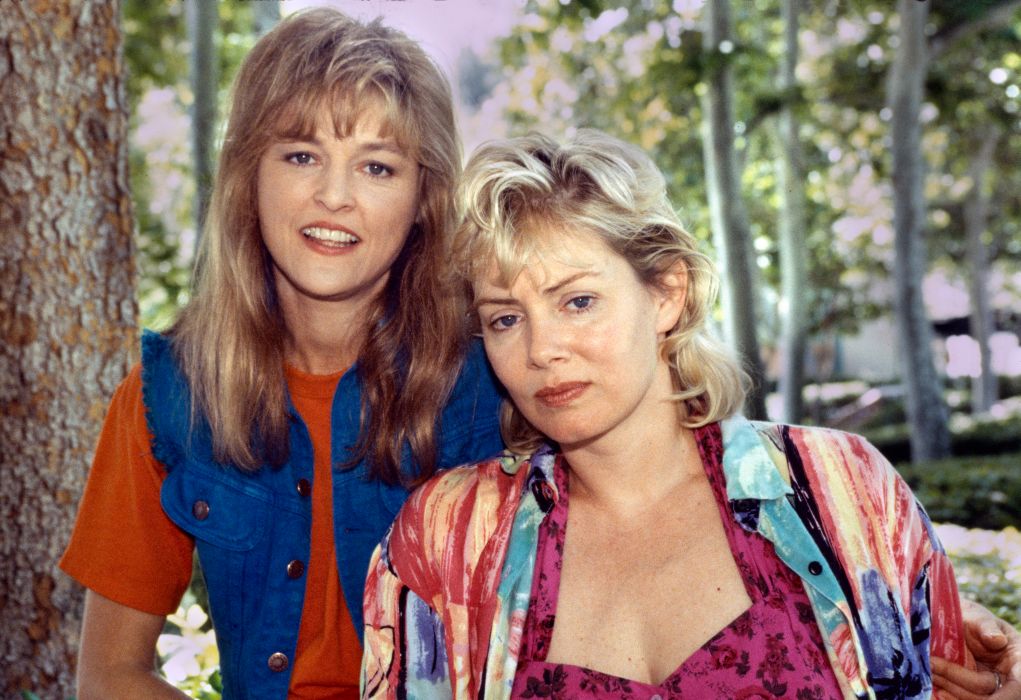
The limitations of the form mean that we don’t really get to see much of… anything, to be honest. The formative influence of Wuornos’s appalling childhood is only seen in a couple of murky flashbacks. The killings themselves come nowhere near the description of them by the authorities as brutal. The closest we get to the grubbiness required for an authentic portrayal is probably the chaste shower scene in which Aileen examines her wounds, behind which we get entirely inappropriate sexy sax music. Though let’s face it: as the picture above proves, Smart and Overall are both far too conventionally pretty, despite being somewhat uglified up. I did laugh at how even the witness sketch impressions of the pair were prettier than the ones actually used by the police.
As long as you’re fine with an obviously watered-down idea of the story, this isn’t terrible. The actors generally do a good job: I’m not familiar with Smart, but there are points when she is able to capture the body language and mannerisms of the real Wuornos effectively, and her performance does balance between making Aileen sympathetic and demonizing her. I also liked James, an actor I know more from villainous roles such as his replicant in Blade Runner. Seeing him here as a smart detective certainly felt against type. But the whole endeavour feels like a jar of “hot” supermarket salsa. You expect to get something spicy, only to find it has relentlessly toned down for mass-market consumption.
Dir: Peter Levin Star: Jean Smart, Park Overall, Tim Grimm, Brion James
I am quietly co-opting the title of the recent Netflix documentary, for a more general piece on the topic of Aileen Wuornos – arguably the first, and certainly the most infamous, female serial killers. Firstly, I do have some qualms about including her here. After all, she’s certainly not what you’d call an “action heroine”. But a girl with a gun? Definitely. Representing the dark side of that trope, absolutely. But that doesn’t, and shouldn’t, mean people like her shouldn’t be covered here. Especially when, as with Wuornos, they have inspired any number of cinematic works, ranging from the straight-laced documentary to the luridly sensational. Both directions have their own merits.
With that out of the way: was Wuornos, as is often claimed, “the first female serial killer”? That’s largely a matter of definition. There were certainly earlier women who killed indiscriminately, some in much greater numbers than Wuornos’s seven confirmed victims. The most famous would be Countess Elizabeth Báthory – herself the inspiration for many movies – who was accused of killing as many as 600 in 17th-century Hungary. But, in general, multiple murderers seem to have had different motivations depending on gender. Women are more likely to kill for profit; men for sexual gratification.
History precedes her
Indeed, the modern era killer with the highest possible number of victims is a woman – probably one you’ve never heard of. Mariam Soulakiotis, known as ‘Mother Rasputin’, was the abbess of a Greek monastery. She would typically lure wealthy women to the convent, torture them until they donated their fortunes, then kill the “donor”. She also had a scam involving a cure for TB, which inflated her numbers dramatically, albeit through negligent homicide. During her trial, figures of 27 murders and 150 negligent homicides were given, though some suggest the true total for which she bore responsibility was over five hundred. That figure would surpass the tally even of the likes of Pedro Lopez, the “Monster of the Andes”, often regarded as the most prolific serial killer.
Here are a selection of other women, generally regarded as having killed considerably more than Wuornos’s seven victims – and mostly had cool nicknames bestowed upon them in the media. I’ve not included medical personnel like Jane Toppan, because that would be a whole other list.
35 victims: Vera Renczi, Romania, “the Black Widow” – poisoned two husbands, multiple lovers, and her son with arsenic during the 1920s. But her existence is unconfirmed, and she may be an urban legend.
17 victims: Irina Gaidamachuk, Russia, “Satan in a Skirt” – pretended to be a social worker to gain access to the homes of elderly women, kill them with an axe or hammer, then rob them (pictured, right).
16 victims: Juana Barraza, Mexico, “La Mataviejitas (the little old lady killer)” – A former pro wrestler known as “The Silent Lady”; like Gaidamachuk, she targetted old women, bludgeoning or strangling them during robberies.
14 victims: Belle Guinness, USA – enticed men to visit her rural property through personal ads. Her crimes were only discovered after her supposed death in a fire, though her fate is unconfirmed.
14 victims, Sararat Rangsiwuthaporn, Thailand, “Am Cyanide” – Borrowed money to feed an online gambling addiction, then poisoned those to whom she was in debt.
13 victims, Tamara Samsonova, Russia, “the Granny Ripper” – Started killing at age 56. Murdered, dismembered, and in some accounts cannibalized, people in her flat.
12 victims, Enriqueta Martí, Spain, “the Vampire of Barcelona” – Self-proclaimed witch that abducted, prostituted, murdered and made potions with the bodies of small children. That’s enough Wikipedia for me.
11 victims, Nannie Doss, USA, “the Giggling Granny” – Confessed to killing four of her husbands, her mother, her sister, her grandson, and her mother-in-law by arsenic poisoning.
11 victims, Marie Alexandrine Becker, Belgium, “the Belgian Borgia” – Poisoned wealthy clients in order to supplement her income while working as a seamstress.
10 victims, Jeanne Weber, France – Strangled ten children, mostly while babysitting them, though also including her own. In the most unsurprising verdict ever, found not guilty by reason of insanity.
Damaged people damage people
If you ever want proof of the above, Aileen Wuornos’s early life would be it. She came from a broken home, her mother filing for divorce from her father shortly before giving birth to her daughter at the age of sixteen. When Aileen was three, her mother abandoned her, and she was taken care of by her grandparents. Who were both alcoholics. Aileen accused her grandfather of molesting her, and by the age of 11, she was sexually active, exchanging her favors for cigarettes and drugs. She became pregnant at 14, and was thrown out her grandparent’s house shortly after giving birth, living rough in woods and turning tricks to survive.
Her life from there through the late eighties, was an all-you-can-eat buffet of more or less petty crime (theft, check forgery, robbery) and suicide attempts. There was also a bizarre marriage at age 20 to the 69-year-old president of a Florida yacht club. This proved short-lived – likely mercifully for everyone – being annulled after nine weeks. In 1986, she met motel maid Tyria Moore in Daytona Beach, and the pair moved in together. But in November 1989, Wuornos killed her first victim, 51-year-old store owner Richard Mallory. She later claimed this was in self-defense, after Mallory attacked her. There may have been some truth in this, because he had been convicted of attempted rape, albeit back in 1957.
However, it’s stretching credulity to accept this also applied to all of the six other men she shot dead, between May and November the following year. Naturally, such a spree did not go unseen, with an increasing media frenzy, especially after a witness reported it was two women she had seen abandoning a victim’s car. Fingerprint evidence – obviously, her dabs were on file in Florida due to her criminal record – helped the net tighten on Wuornos. After the arrest Moore, who had fled to her family home in Pennsylvania, agreed to turn state’s evidence against her lover, in exchange for immunity from prosecution.
In January 1992, she went on trial for the murder of Mallory. After a two-week trial, she was found guilty and sentenced to death. Wuornos subsequently pleaded “no contest” (effectively guilty) or guilty to five other murders, with one left uncharged because the body was never found. She also received the death sentence for those killings. Her attitude and explanation changed dramatically over the years. At some points she stoically maintained the self-defense claim. But at other times, she admitted her guilt, saying in court, “I am as guilty as can be. I want the world to know I killed these men, as cold as ice. I’ve hated humans for a long time. I am a serial killer. I killed them in cold blood, real nasty.”
The wheels of justice ground slowly, as they tend to do in these cases. It was more than a decade after receiving her first death sentence, that Aileen Wuornos was executed, in October 2002. It had taken so long, the state of Florida had switch from the electric chair to lethal injection as the preferred cause of death. Anyone hoping for closure from her final words would likely have been more confused than anything: “Yes, I would just like to say I’m sailing with the rock, and I’ll be back, like Independence Day, with Jesus. June 6, like the movie. Big mother ship and all, I’ll be back, I’ll be back.” To date she has not, in fact, come back.
However, approaching a quarter century since her execution, the ghost of Wuornos still haunts society in a variety of ways, remaining a topic of dark fascination. There have been books, there have been TV investigations, and even an operatic adaptation of her life. There have, naturally, been movies, at all levels. The best-known is 2003’s Monster, which won Charlize Theron an Academy Award for her depiction of the killer. But we also have seen the more lurid Aileen Wuornos: American Boogeywoman. Below, we’ll cover the first fictional retelling of Aileen’s story; a documentary which came out not long after her death; and as evidence of the ongoing interest in Wuornos, a Netflix film about her, released just last October.
Overkill: The Aileen Wuornos Story
★★
“Undercooked and overdressed.”
Less than eleven months after Wuornos was convicted on her first murder charge, this TV movie was broadcast on CBS. If you’re at all familiar with the facts of the case, this won’t have much to offer. It does go a little bit deeper into the police procedural, in the shape of Capt. Steve Binegar (Grimm) and investigator Bruce Munster (James). Interesting that it does depict the FBI’s indifference to the case, the investigation basically being left up to the local cops. This gives credence to an article I read, which quoted an unnamed profiler with the bureau as saying there was no such things as a female serial killer. However, said local law enforcement comes up largely smelling of roses.
I’ve a feeling this may be because some members of the police were actively involved in the production, a fact which caused them some trouble due to the conflict of interest. There were, according to The Selling of a Serial Killer, re-assignments as a result, though nothing more formal appears to have happened. This may also have been based on the story Wuornos’s girlfriend Tyria Moore sold, though I’ve not been able to confirm this. The main problem is simply that a TV movie is a profoundly inappropriate medium in which to tell the story of a serial killer prostitute. Particularly one who was a lesbian, though you would be hard-pushed to work that out here. Aileen/”Lee (Smart) and Tyria (Overall) seem much more like room-mates than lovers.
The limitations of the form mean that we don’t really get to see much of… anything, to be honest. The formative influence of Wuornos’s appalling childhood is only seen in a couple of murky flashbacks. The killings themselves come nowhere near the description of them by the authorities as brutal. The closest we get to the grubbiness required for an authentic portrayal is probably the chaste shower scene in which Aileen examines her wounds, behind which we get entirely inappropriate sexy sax music. Though let’s face it: as the picture above proves, Smart and Overall are both far too conventionally pretty, despite being somewhat uglified up. I did laugh at how even the witness sketch impressions of the pair were prettier than the ones actually used by the police.
As long as you’re fine with an obviously watered-down idea of the story, this isn’t terrible. The actors generally do a good job: I’m not familiar with Smart, but there are points when she is able to capture the body language and mannerisms of the real Wuornos effectively, and her performance does balance between making Aileen sympathetic and demonizing her. I also liked James, an actor I know more from villainous roles such as his replicant in Blade Runner. Seeing him here as a smart detective certainly felt against type. But the whole endeavour feels like a jar of “hot” supermarket salsa. You expect to get something spicy, only to find it has relentlessly toned down for mass-market consumption.
Dir: Peter Levin Star: Jean Smart, Park Overall, Tim Grimm, Brion James
Aileen: Life and Death of a Serial Killer
★★★★
“Lethally blonde.”
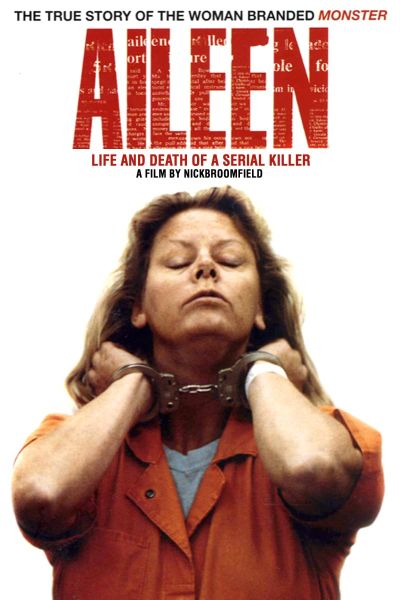
This is Broomfield’s second documentary around the topic of Aileen Wuornos, having previously made Aileen Wuornos: The Selling of a Serial Killer. It’s a glorious doc – one of my all-time favorites – but is more tangential, being about those around Wuornos, seeking to exploit her situation for their own personal gain. He thought he was done with the topic, but he was called as a defense witness during Aileen’s final appeal against the multiple death sentences, largely because among those exploiters was her lawyer at the time, Steve Glazer. But around appearing in the witness box, Broomfield decided to make a second documentary, this time focusing on the woman at the centre of proceedings, all the way up to her execution by lethal injection in October 2002.
What I love about Broomfield’s work is, he goes where the story leads him. Some documentarians – and I’m looking at you, Michael Moore – go into production with An Agenda (caps used advisedly). They then craft the end product towards that agenda. To me, that’s less a documentary than propaganda. Broomfield seems to have a much more open mind, and the results sometimes end up going in unexpected directions. Here, it’s clear that he has sympathy for Wuornos, but doesn’t pull any punches about her personality and mental state. He presents footage both of her claiming self-defense and absolutely confessing to having committed cold-blooded murder. The scary thing is, Wuornos appeared to me to be highly credible in each, contradictory situation. Maybe I’m just easily fooled. Sobering.
Certainly, there is evidence of Aileen’s anger issues. During his final interview, we see how she can go from calm discussion to volcanic ferocity in short order, for little or no reason, and storming out while flipping Broomfield the bird. If there had been a firearm to hand during this outburst… Yeah, watching this, the idea of her killing seven in less than a year definitely seemed possible. Rage and easy access to guns is a dangerous combination. But as the film proceeds, it appears Wuornos’s mental situation deteriorates into frequent surges of paranoia, claiming mind-control weapons are being used on her, and that the cops knew who she was after the first murder, and let her continue killing so they could exploit things in the media.
Should someone so clearly ill in the head be executed? Political considerations – it being an election year, with the governor wanting to appear strong on crime – appear to have overridden any judicial concerns. A cursory mental exam pronounced her fit to die, and the sentence was duly carried out. On that day, Broomfield was interviewed by the media (a classic case of the snake eating its own tail). He said, “Here was somebody who is has obviously lost her mind, has totally lost touch with reality. We’re executing a person who’s mad, and I don’t really know what kind of message that gives.” As someone not averse to the death penalty, this documentary certainly made me pause for thought, and that alone proves its quality.
Dir: Nick Broomfield and Joan Churchill
Aileen: Queen of the Serial Killers
★★
“More of a propamentary.”
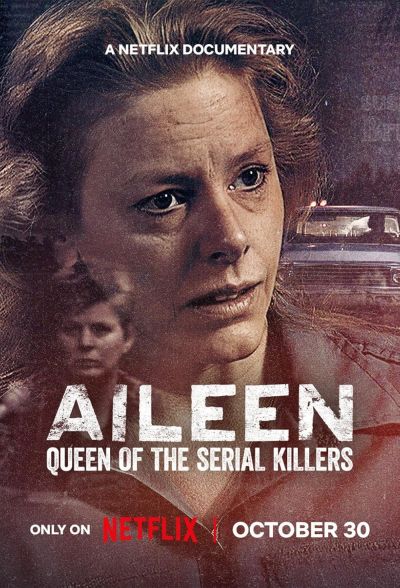
This would likely have benefited had I not watched Life and Death the previous night, because any comparison does not work in this documentary’s favour. Titled on the print just Aileen, forgetting that awkward serial killing thing, this is less balanced, and skews heavily towards Wuornos as victim – of the legal system, her clients and life in general. “Actually, she was made, and that’s chilling,” said co-director Turner, apparently opting to ignore the concept of free will. The bias is apparent, in the way the film concentrates heavily on Wuornos’s first murder, that of Richard Mallory. While that is the only one where there was a full trial, it’s also the only one where I think there’s credible evidence to support her claim of self-defense. The film barely mentions the other six victims.
I won’t argue that prosecutors did everything they could to obtain a conviction. That would be… their job? The footage of a reporter quizzing lead prosecutor John Tanner about Mallory’s sexual assault conviction in the fifties, just made me wonder, how the heck Wuornos’s team didn’t pick up on this? Checking the background of the victim for something like that seems like Defense Lawyering 1.0.1. In general, though, Turner and Cunningham are largely re-treading the same ground as Nick Broomfield: indeed, some footage here appears to be repurposed from his films, or at least comes from the same sources. I was a little surprised how this largely glossed over Wuornos’s upbringing, which I’d have to consider a huge factor in her issues.
The new stuff is mostly from Australian film-maker Jasmine Hurst, who corresponded long-distance with Wuornos for year, and interviewed her in 1997. I felt she was the whole endeavour’s weakest aspect. Her adoration for the killer is wildly improper from that start, Hurst drooling over Wuornos: “She’s like the trifecta. Gay, female, sex worker. And killing white men.” Hey, it is the Netflix trifecta, anyway. Later on, Hurst delivers this doozy of a statement: “It didn’t matter to me at all if none of the men had raped her. Those men may not have raped her in the moment, but they are icons of previous rapists that she didn’t fight against.” That the makers saw fit to leave that comment in the movie, says a lot about their agenda.
For, make no mistake, an agenda is what we have here, and what differentiates it most sharply from Broomfield’s work. Turner and Cunningham aren’t seekers after truth. They are convinced they know it, and want to drag the viewer to agree. That’s why we get comments on Reddit about the film like, “I feel so dumb for falling for the Aileen is evil stuff. This doc changed my mind completely.” More than one thing can be true, y’know. Yes, she did not receive a fair trial. Yes, she had a rough life. But she was also evil, and an incredibly angry sociopath. Not that you’d know it from the footage here, almost all showing Wuornos at her most serene.
This is Broomfield’s second documentary around the topic of Aileen Wuornos, having previously made Aileen Wuornos: The Selling of a Serial Killer. It’s a glorious doc – one of my all-time favorites – but is more tangential, being about those around Wuornos, seeking to exploit her situation for their own personal gain. He thought he was done with the topic, but he was called as a defense witness during Aileen’s final appeal against the multiple death sentences, largely because among those exploiters was her lawyer at the time, Steve Glazer. But around appearing in the witness box, Broomfield decided to make a second documentary, this time focusing on the woman at the centre of proceedings, all the way up to her execution by lethal injection in October 2002.
What I love about Broomfield’s work is, he goes where the story leads him. Some documentarians – and I’m looking at you, Michael Moore – go into production with An Agenda (caps used advisedly). They then craft the end product towards that agenda. To me, that’s less a documentary than propaganda. Broomfield seems to have a much more open mind, and the results sometimes end up going in unexpected directions. Here, it’s clear that he has sympathy for Wuornos, but doesn’t pull any punches about her personality and mental state. He presents footage both of her claiming self-defense and absolutely confessing to having committed cold-blooded murder. The scary thing is, Wuornos appeared to me to be highly credible in each, contradictory situation. Maybe I’m just easily fooled. Sobering.
Certainly, there is evidence of Aileen’s anger issues. During his final interview, we see how she can go from calm discussion to volcanic ferocity in short order, for little or no reason, and storming out while flipping Broomfield the bird. If there had been a firearm to hand during this outburst… Yeah, watching this, the idea of her killing seven in less than a year definitely seemed possible. Rage and easy access to guns is a dangerous combination. But as the film proceeds, it appears Wuornos’s mental situation deteriorates into frequent surges of paranoia, claiming mind-control weapons are being used on her, and that the cops knew who she was after the first murder, and let her continue killing so they could exploit things in the media.
Should someone so clearly ill in the head be executed? Political considerations – it being an election year, with the governor wanting to appear strong on crime – appear to have overridden any judicial concerns. A cursory mental exam pronounced her fit to die, and the sentence was duly carried out. On that day, Broomfield was interviewed by the media (a classic case of the snake eating its own tail). He said, “Here was somebody who is has obviously lost her mind, has totally lost touch with reality. We’re executing a person who’s mad, and I don’t really know what kind of message that gives.” As someone not averse to the death penalty, this documentary certainly made me pause for thought, and that alone proves its quality.




 . Albeit for reasons that are largely not the makers’ fault, because this film only partially survives. Originally released in 1929 with a running-time of 87 minutes, the only version that remains is one re-released about a decade later, which has been chopped down to under fifty minutes, including new opening captions which comment on the looming second global conflict. What remains still packs quite the wallop, as an anti-war movie which doesn’t shy from the brutal nature of World War I. It’s a part-talkie, with sounds for some of the music and dialogue, and it’s very effective when used.
 ★★½
★★½ I don’t think I’ve ever seen an Italian kung-fu movie before. To be fair, the bulk of the lifting in that department is done by Chinese actress Yaxi Liu, who was a stunt double in the live-action
  This was an interesting litmus test for your online bubble. It came out in the immediate wake of controversy over a commercial featuring the lead actress, promoted with the slogan, “Sydney Sweeney Has Great Jeans.” This prompted criticisms this was promoting eugenics, and Sweeney’s refusal to apologize, led to a lot of “Bye-bye career!” gloating when Christy subsequently bombed, with one of the
  I previously reviewed the first volume in the series,
  Are women pirates in vogue again? It’s safe to say that the startling failure of
  ★★
★★ I am quietly co-opting the title of the recent Netflix documentary, for a more general piece on the topic of Aileen Wuornos – arguably the first, and certainly the most infamous, female serial killers. Firstly, I do have some qualms about including her here. After all, she’s certainly not what you’d call an “action heroine”. But a girl with a gun? Definitely. Representing the dark side of that trope, absolutely. But that doesn’t, and shouldn’t, mean people like her shouldn’t be covered here. Especially when, as with Wuornos, they have inspired any number of cinematic works, ranging from the straight-laced documentary to the luridly sensational. Both directions have their own merits.
 Here are a selection of other women, generally regarded as having killed considerably more than Wuornos’s seven victims – and mostly had cool nicknames bestowed upon them in the media. I’ve not included medical personnel like Jane Toppan, because that would be a whole other list.
 However, it’s stretching credulity to accept this also applied to all of the six other men she shot dead, between May and November the following year. Naturally, such a spree did not go unseen, with an increasing media frenzy, especially after a witness reported it was two women she had seen abandoning a victim’s car. Fingerprint evidence – obviously, her dabs were on file in Florida due to her criminal record – helped the net tighten on Wuornos. After the arrest Moore, who had fled to her family home in Pennsylvania, agreed to turn state’s evidence against her lover, in exchange for immunity from prosecution.
  This is Broomfield’s second documentary around the topic of Aileen Wuornos, having previously made Aileen Wuornos: The Selling of a Serial Killer. It’s a glorious doc – one of my all-time favorites – but is more tangential, being about those around Wuornos, seeking to exploit her situation for their own personal gain. He thought he was done with the topic, but he was called as a defense witness during Aileen’s final appeal against the multiple death sentences, largely because among those exploiters was her lawyer at the time, Steve Glazer. But around appearing in the witness box, Broomfield decided to make a second documentary, this time focusing on the woman at the centre of proceedings, all the way up to her execution by lethal injection in October 2002.
 What I love about Broomfield’s work is, he goes where the story leads him. Some documentarians – and I’m looking at
  This would likely have benefited had I not watched Life and Death the previous night, because any comparison does not work in this documentary’s favour. Titled on the print just Aileen, forgetting that awkward serial killing thing, this is less balanced, and skews heavily towards Wuornos as victim – of the legal system, her clients and life in general. “Actually, she was made, and that’s chilling,”