



★★
“Puts the ‘no’ in Enola.”
 Complete ranking of Enolas
- Enola Gay
- Enola Holmes
- That’s it.
I’m probably not the only one who spent much of the film humming OMD’s classic Enola Gay to themselves – released 40 years ago this month, coincidentally. And, sadly, it remains my favourite Enola, by quite some distance. This was more annoying than anything else, though I’ve never been on the Millie Bobby Brown hype-train. I didn’t think much of Stranger Things, and her performance in Godzilla: King of the Monsters, interfered with what I want to see i.e. monsters fighting. Here, I found her more irritating than engaging, though in her defense, she wasn’t helped by some poor directorial choices.
This get off on the wrong foot at the very start, Enola (Brown), Sherlock Holmes’ sixteen-year-old sister, breaking the fourth wall and addressing the audience, something she does frequently. Director Bradbeer used this technique in TV series Fleabag, but I’m not a fan: it takes me out of proceedings, reminding me I’m watching a film. What follows is less a convincing evocation of 1900 England, than contemporary America playing girl power dress-up, with “nasty women” blowing things up as they seek to defeat the evil patriarchy. One of these is Enola’s mother (Bonham-Carter), whose vanishing without warning starts things off, causing Enola to begin searching for her, based on coded clues left behind. It escapes me quite why the missing parent couldn’t simply write, “Dear Enola, Gone off to be a suffragette. Love, Mum.”
Not that it matters, because Enola rapidly abandons this quest entirely, in favour of a case involving the young, attractive and entirely personality-free aristocrat, Viscount Tewkesbury (Partridge), whose vote is crucial to get a reform bull passed, expanding the ability to vote [in reality, no such change took place until almost twenty years later – but hey, why let facts stop you from twisting history for your political points?]. On his trail is a mysterious and ill-intentioned man (Gorman), with whom Enola crosses paths. She also has to fend off attempts by her other brother, Mycroft, to have her consigned to a very Handmaid’s Tale-looking boarding school. This is intended to have Enola brainwashed into being the quiet and submissive woman society expects.
The politics on view here are cringeworthy, particularly from Mrs. Holmes, who speaks almost entirely in feminist fortune-cookies, such as “Don’t be thrown off course by other people. Especially men.” It’s one of those cases where merely leading by example isn’t enough: you have to virtue-signal your morality by announcing it, explicitly and repeatedly, which I find immensely off-putting. Hence, we get gobbets of political sermonizing, such as Sherlock (Cavill) being told, by a black, female martial-arts teacher – something I’m fairly sure wasn’t common enough in the Victorian era to pass without comment: “You don’t know what it is to be without power. Politics doesn’t interest you… because you have no interest in changing a world that suits you so well.” You go, sister!
Speaking of which, the portrayal of the great detective is no more accurate than the other element. “Sherlock Holmes always works alone!” proclaims Inspector Lestrade. Uh, I guess the creators never heard of Dr. Watson, an intrinsic character, from the very first Conan Doyle story? You just never get any sense of keen intellect from Cavill’s performance. Guess they didn’t want to overshadow Enola and her Big Brain. Yet, under all these flaws, is a decent movie, trying to get out. The look of things is lovely, and some of the action sequences are well-handled, even if a slip of a girl like Enola hardly seems equipped to trade blows with grown men.
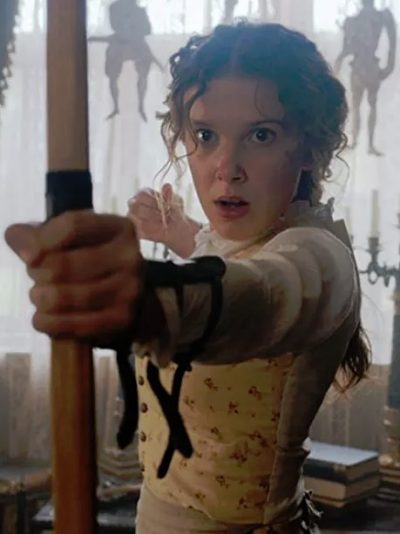
Maybe they could have made more use of her archery skills (above), which are set-up, then entirely forgotten. Like so much else, that gets lost in the rush to cram an “uplifting” message into the movie, rather than letting one flow organically from it.
Dir: Harry Bradbeer
Star: Millie Bobby Brown, Louis Partridge, Henry Cavill, Burn Gorman
 There’a a good film in here. Actually, there may be as many as three good films in here. But the way in which they are melded together, manages to rob a good chunk of the power and impact from all of them. We begin by following Mathilde H (Bercot), a war journalist clearly modelled
  I previously reviewed the ninth volume in the Wardstone Chronicles series,
  For one reason or another, in the last few years Great Britain has become the place to go for medium-budget action thrillers. Examples include the Pierce Brosnan-Milla Jovovich-actioner
 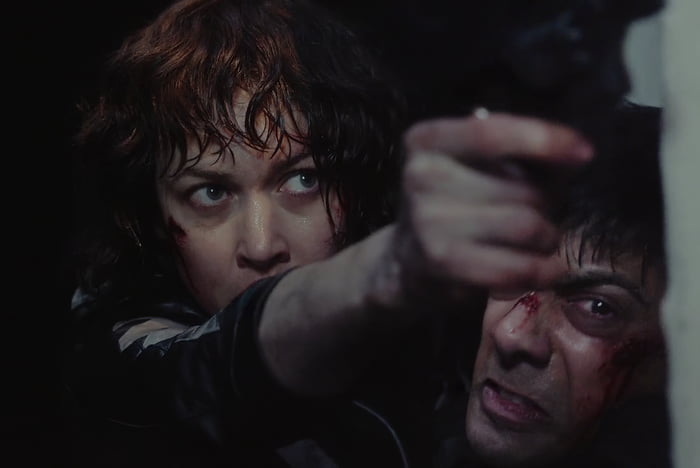 If Kurylenko’s character never reveals her name, at least some backstory is given as to why she is such a badass fighter. She used to be an Ukrainian soldier, part of a special forces battalion in Syria. After the death of her brother, she deserted and went to ground, taking menial jobs like this one. So for once we’ve got an explanation, as to why a smaller woman can take on big men who are professional killers. The fact that she is not just throwing them over her shoulder to the wall – like, let’s say, Angelina Jolie in
 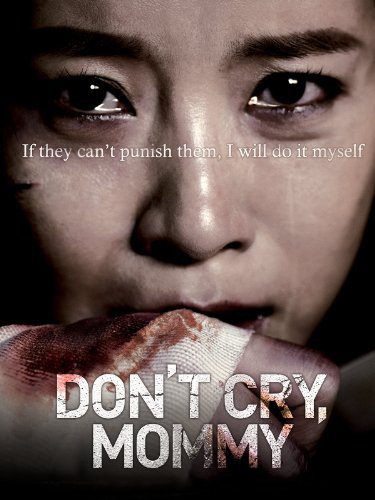 I say that, since this Korean film appears to have been at least a partial inspiration for not one, but two Bollywood films which were recently reviewed here:
  This is certainly something of a novelty and/or a gimmick. But it’s none the less reasonably effective for it. Templeton – who is a woman, despite her first name, given to her after the character of Christopher Robin in the Winnie The Pooh books – suffered from polio as a young child. This left her with a badly damaged right leg; despite this, she pursued an acting career, and became a regular on soap The Young and the Restless for eight years. While I’ve seen a few disabled action heroes – Daredevil was blind – as far as disabled action heroines go, it’s basically her and Imperator Furiosa from Mad Max. And Charlize Theron wasn’t genuinely short an arm, so advantage Templeten. Though, sadly, she appears to have passed away in 2011.
 This is a painfully lazy knock-off of a certain, well-known action film, in which terrorists take hostages in a multi-storey building over the festive season. This action is as cover for their actual goal, which is the robbery of a well-secured vault. But one of the inhabitants evades the initial surge, and begins to run interference. They get help and moral support over the airwaves by someone on the outside, and use the air-ducts in the building to avoid detection. Yeah. It’s like that, and you’ll probably understand why my eyes were rolling when we get the line, “Ho-ho-ho, motherfucker.” Now, there’s no doubt the makers openly acknowledge their inspiration. But pleading guilty doesn’t get you out of the crime. At least other, similarly inspired movies, e.g.
  It has been twenty years since
  I reviewed the
 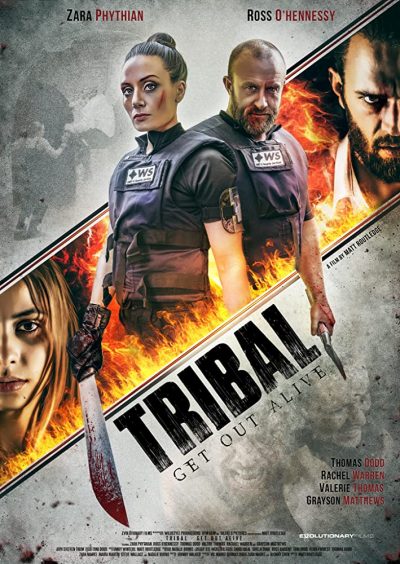 The IMDb omits the colon from the title, making rather less sense. Though it’s not inappropriate, because sense is likely not this film’s strongest suit. Indeed, I’d be hard-pushed to call it a “good” film. It is, however, consistently entertaining, and a fine piece of B-movie making. Ex-soldiers Caitlin (Phythian) and Brad (O’Hennessy) are bailiffs… Wait, is that a thing outside the UK? Just in case it’s not, let me quickly explain: they are not quite cops, but are still legal officials who can, for example, impose evictions or collect debts.