 ★★★★
★★★★
“Smack my bitch up.”
 There are some films which I like, and where if you don’t agree with me, you are an idiot – such as Shaun of the Dead. However, there are movies where I can see, understand and accept why people dislike them, even if I may strongly disagree. Bitch Slap would be one of the latter. Looking at the the IMDb ballot results, the top number of voters have given it one out of ten. However, the next-most have given it 10/10. Between them, those two extremes represent more than 40% of the total votes. Much the same thing – albeit to a somewhat less rabidly-partisan degree – happened here in GwG Towers.
 Chris has a certain firmness of opinion. When she has made up her mind about something, it’s pretty hard to get her to change it. She will purse her lips, fold her arms and stick to her guns. You could argue whether this strong will is a character quality or a flaw, but it certainly led to her early exit from Bitch Slap. Here’s an approximate timeline of the comments from the seat on the couch next to me:
- 5 minutes: “Would you rather watch this alone?”
- 5:30 minutes: “Are you sure you wouldn’t rather watch this alone?
- 10 minutes: “Is this a porno?”
- 20 minutes: “Could this get any more stereotypical?”
It was not long after this – I think it was when the lesbian canoodling started – she suddenly remembered she had a vitally-important task to perform elsewhere. Judging by the sounds emanating from our office, that task appeared to involve Facebook poker.
Of course, to me, complaining about the film being stereotypical is missing the point. It’s supposed to be a frothy melange of cliches, thrown into the cinematic melting-pot and the heat turned up to ‘High’. The opening credit sequence, with its clips of “bad girls” such as Tura Satana and Christina Lindberg, gives you some idea of what to expect, and it hardly pauses thereafter, growing increasingly more breathlessly frenetic. Not often have I seen a movie suffering from a more chronic case of Attention Deficit Hyperactivity Diso… Ooh, look! Shiny, pretty things!
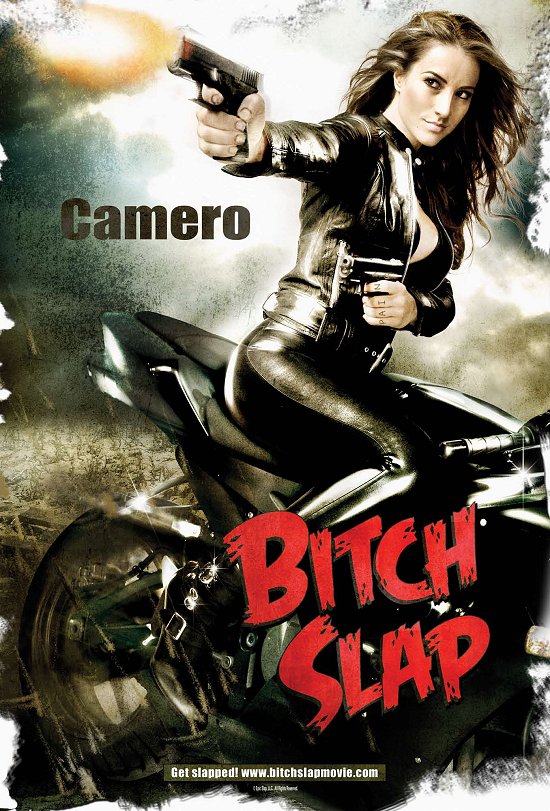
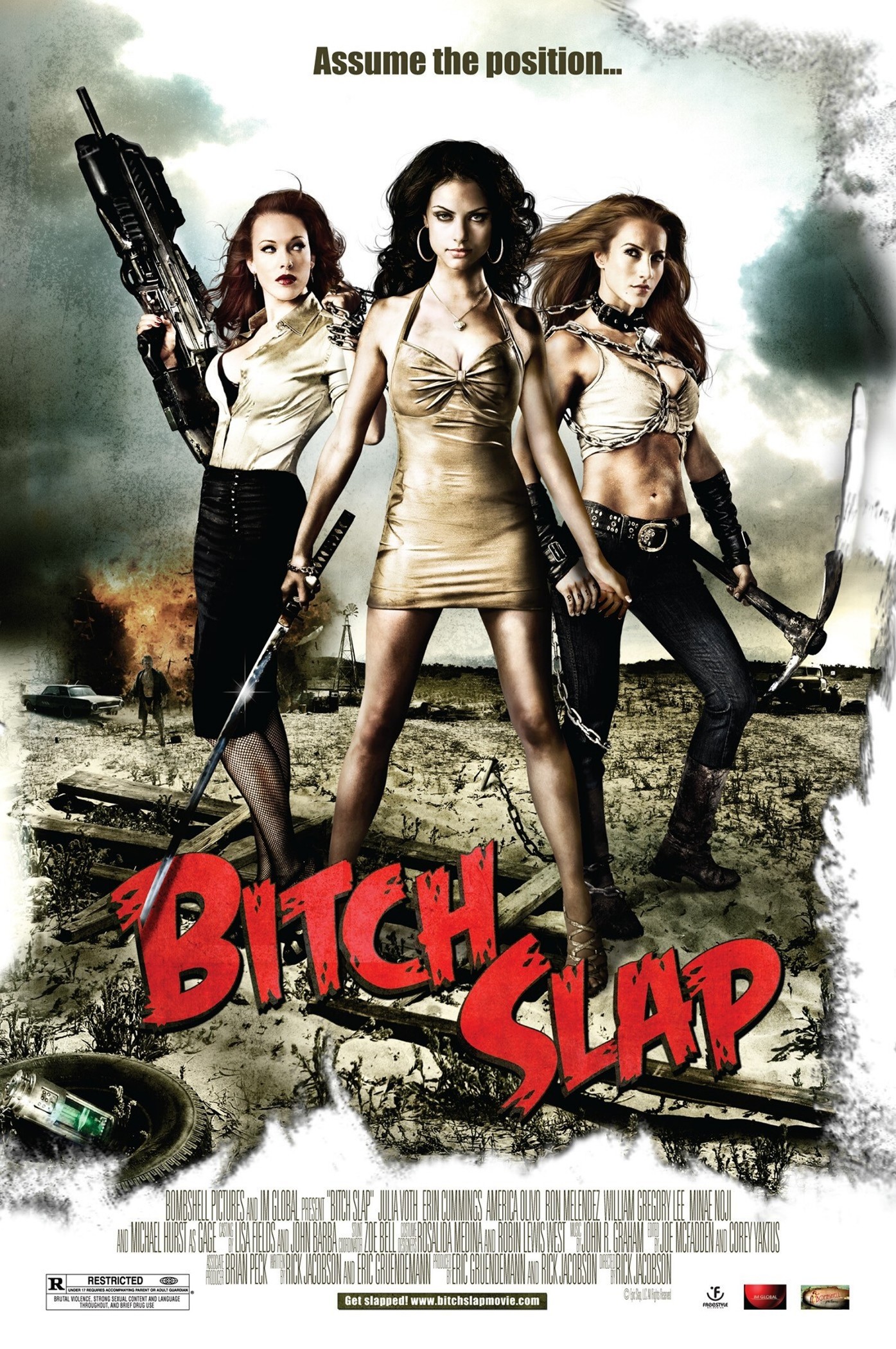
Speaking of which, it centers on three women, with about as divergent personalities as it’s possible to imagine. There’s Hel (Cummings), a con-artist with a secret identity; the psychotic Camero (Olivio), who starts off the movie insane, yet somehow manages to get even more loopy as things progress; and, finally, Trixie (Voth), the “innocent” one, whom you’re not quite sure about. The heroic trio end up out in the desert, with Gage (Hurst) tied up in their trunk, seeking… Well, part of the plot revolves around that issue, so I’ll leave that out of the summary. From there, the story of how they reached that point is told in flashback, and event also unfold moving forward, as they try to locate their obscure object of desire before the infamous, deadly “Pinky” shows up.
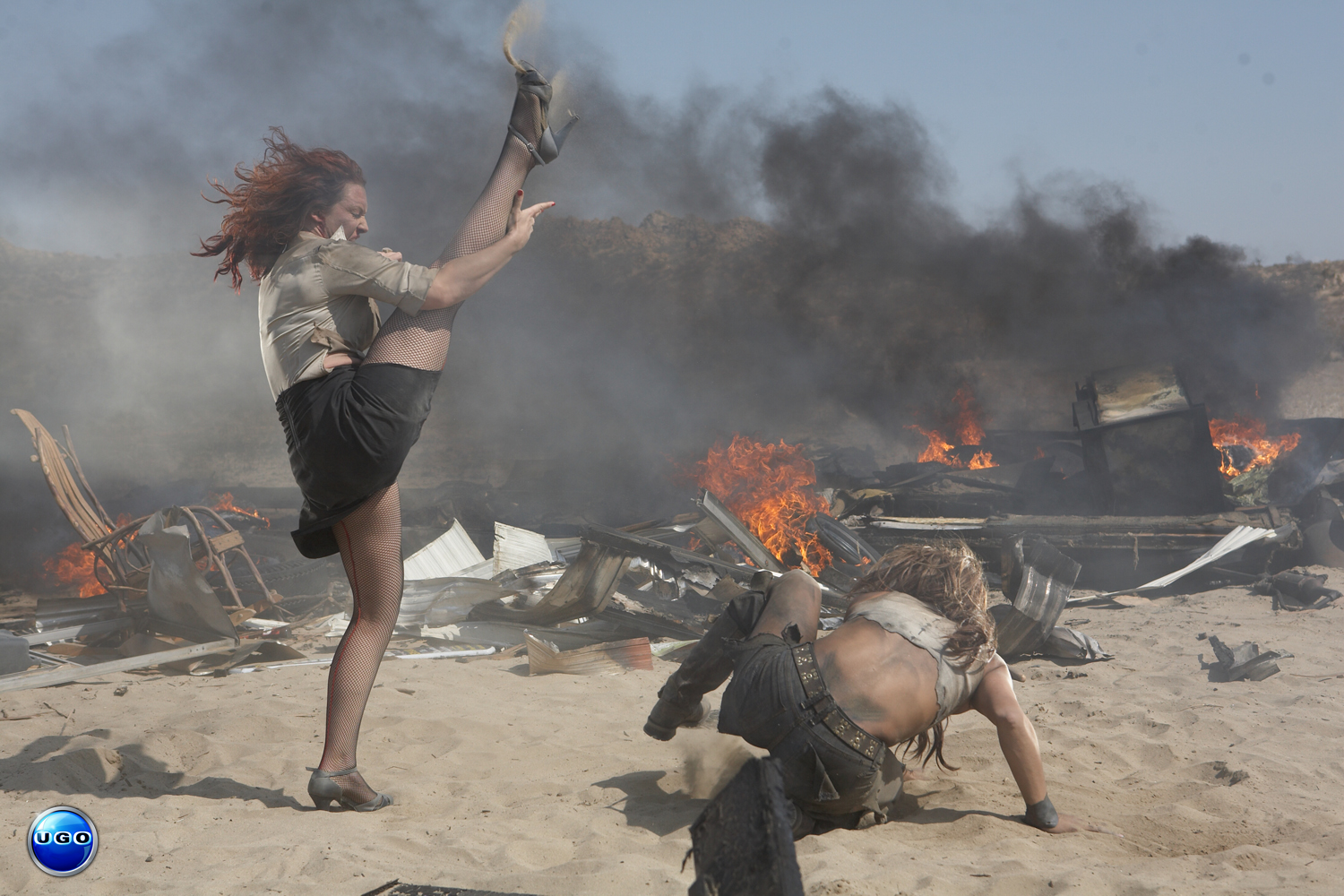
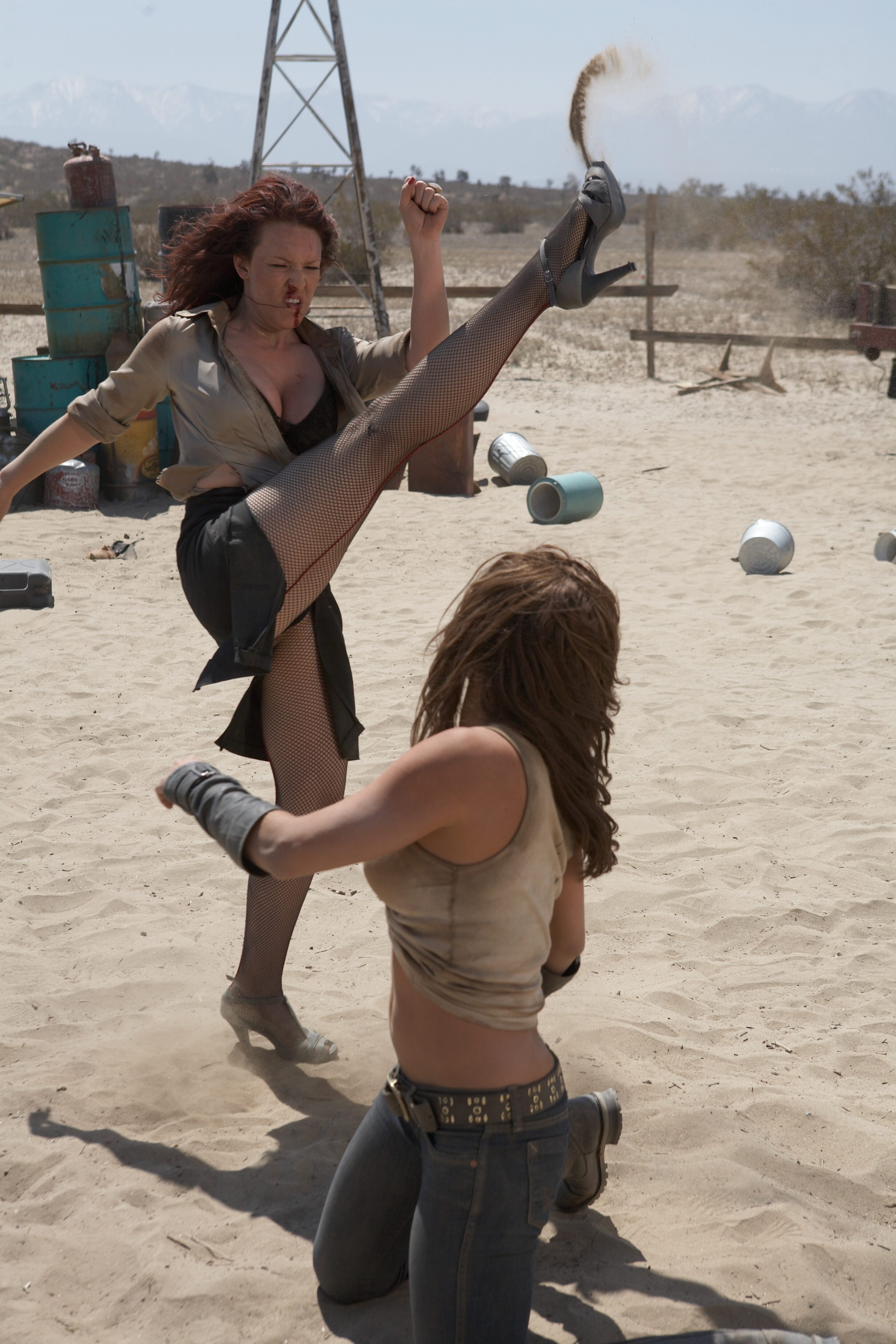
Of course, it’s not as simple as that. Others are after the same prize, such as Hot Wire and his GoGo Yubari clone (Japanese, schoolgirl, killer yo-yo), Kinki (Minae Noji). There’s also a good deal of tension, sexual and otherwise, between the three heroines: are any of them quite what they seem? I imagine my usage of the phrase “secret identity” above might have given some of the game away there. It hardly counts as a spoiler either, to say that it all ends (eventually) in a brawl between Camaro and Hel, in the middle of a desolate wasteland, which has become steadily more wasted and bullet-ridden over the course of the movie.
The Laydeez of Bitch Slap
Director Jacobson certainly has a solid pedigree in the action-heroine world, at least at the televisual end of the spectrum. His resume includes episodes of La Femme Nikita, Cleopatra 2525, Xena: Warrior Princess and She Spies, a good number of which have a similarly self-parodying approach to their subject matter as seen here. However, while the excess is somewhat greater, this only really extends to some potty-mouth lines and digital blood. Despite all the tension and canoodling mentioned earlier, Cummings shows a lot more skin for Jaconson as the hero’s wife in Spartacus: Blood and Sand. If you’re going for camp excess, as appears to be the case, you need to be a good deal more…well, excessive.
 The main weak link is the leads, who don’t have the chops – physical or acting – to pull this off. I to wonder whether it might have been a good deal better if stunt co-ordinator Zoe Bell, Lucy Lawless and Renee O’Connor had been the stars of the film, rather than merely cameos. They have all previously shown the necessary combination of martial ability and screen presence necessary for the parts here. Not that the actresses here are “bad”: however, when you’re spitting out Satana-esque lines like, “Ram this in your clambake, bitch cake!” you’d better have the F-sized volume of charismatic fire-power to pull them off, and they fall short of the level needed for this to achieve classic status (Olivo probably comes closest to the necessary level of conviction, spitting our her dialogue with a perpetual sneer).
Having got those criticisms out of the way, the rest of the film is very solid entertainment – providing, as noted above, you can get your brain lined-up with what it’s trying to do (and if you can’t, which is understandable, it’s basically unsalvageable). Alcohol will probably help the neurons go in the correct direction, as will an encyclopaedic knowledge of pop culture, and tolerance for trash at an industrial concentration. The litmus test is probably the slow-motion water-fight which breaks out among the three laydeez early on: if you greet that with a smirk of guilty pleasure (as charged, m’lud), rather than, oh, bailing for the Facebook poker lobby, you’ll probably be fine.
Jacobsen also does a good job with the visual style, providing a perfect match for the lurid, frenetic approach of the script and character. There’s a lot of green screen work, which lends proceeding a hyperreal feeling, and the pace means that there’s hardly a dull moment. Not sure the storyline makes a great deal of sense, I admit, and it feels as overstuffed as a giant bean burrito (you know the kind, the ones you regret buying about one-third of the way through, but just can’t stop yourself from finishing). The fractured plotline has been compared to Tarantino, but personally, there’s a good deal less annoying self-indulgence than Quentin usually inflicts on the audience: for example, Camero doesn’t bring things to a grinding halt, just to witter on about comic-books.
All told, it’s refreshing to see something which is so avowedly politically-incorrect, and proud of it. The film is at its best when wallowing in the gutter, unashamedly down and dirty, and with a broad grin upon its face – credit to all those involved for having the guts not give a damn about the nay-sayers and one-voters. It’s not going to trouble the more-evolved areas of your brain very much, and will tug on the heartstrings even less, but for the times when you don’t want anything more than the cinematic equivalent of a one-night stand, this will certainly do the job perfectly well. Certainly the most full-on, and arguably the best, of the genre to come out of Hollywood in the past five years.
Dir: Rick Jacobson
Star: Julia Voth, America Olivo, Erin Cummings, Michael Hurst




 After making an undeniable impact strapped to a car bonnet in the second-half of Grindhouse, Zo…Hang on, let me find the right key on the keyboard… Ah, there we are… Zoë gets to do some actual ‘acting’, rather than playing a stuntwoman called Zoë Bell [Way to go, Tarantino!] Thios started as a web-based series of ten episodes, but is now available on DVD, which is how we watched it. Bell plays Eve, an assassin whose personality radically changes after she is stabbed in the head. She starts to see one of her victims – a young girl – and as a result, decides to go after those who ordered the death. Needless to say, her manager and handler Graham (Poth) is not impressed by this sudden burst of morality, and neither are those who have now become her target, including up-and-coming gangster boss Jake Abel, who sends his minions out to take care of her before she takes care of him.
 Ward (whom we’ll watch in anything, as payment for the enjoyment Tremors has given us) plays John McWhirter, a hard-bitten journalist with a fondness for the bottle, who is still trying to put behind him an incident when he was a young radical, that led to his friends being sent to jail for long terms, while John escaped doing time. He’s looking into the murder of an industrialist by Palestinian terrorists, when said friends show up, asking him to hide a woman (Ticotin) from the authorities for a few days, describing her as an activist in Shining Path, a Peruvian rebel group. Turns out she’s not who she seems, and it also turns out John had more to do with his friends’ arrests, thirty years ago, than it initially appeared. With enemies in the FBI, led by Robert Lecker (Plummer), an ally in the CIA, and a female assassin (Miller, right) out to tidy up all the loose ends, McWhirter has to decide whether to do what’s right, what’s easy, or what’s best for himself – and those might be three mutually exclusive options.
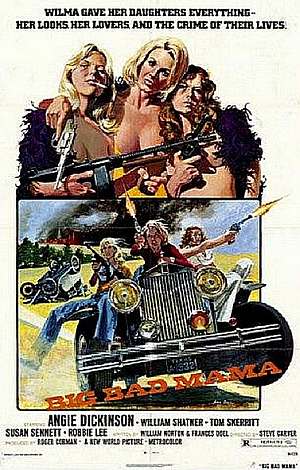 With B-movie entrepreneur Roger Corman getting honoured at the Oscars earlier this month, it seems appropriate to pop on one of his classic productions, starring Dickinson, who was just about to become a star in one of the first shows with a female law-enforcement lead, Police Woman. The truth is, however, that this doesn’t have much more to offer beyond Dickinson: while she holds the film together with her steely resolve, and proves that sexy doesn’t stop at 40, the rest of it offers nothing as substantial. It’s a basic enough plot: she plays Wilma McClatchie, a single mom bringing up her two teenage daughters in Depression-era rural America. They fall into a life of crime, in part because they happen to be trying to cash a fraudulent check in a bank when it gets robbed by Fred Diller (Skerritt). They also team up with gentleman con-artist William Baxter (Shatner), but things go awry when they pull of their last big heist, kidnapping the daughter of a millionaire.
 This feels more like a mid-season episode of Alias than anything else, and not much more than a filler episode at that. I say this, because so little effort is put into developing the characters, it’s as if the makers reckon everything had already been established in the previous seven installments. And since there
  ★½
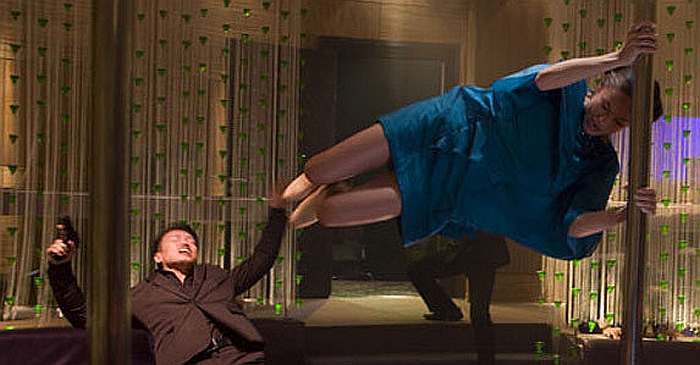
★½ I usually have no problem going on about GWG movies at some length. Hell, I even managed 750 words on DOA: Dead or Alive, and for that one, I had to re-read my review to remember what it was about. But when I got to the end of Street Fighter: The Legend of Chun-Li, my first thought was, “What the hell am I going to write about this?” It seemed likely the only way I’d get to 750 words, would be by repeating the title one hundred and twenty-five times. For the film is ill-conceived, poorly cast, badly written and directed by the man who managed to make Jet Li look bad, not once but twice, in Romeo Must Die and Cradle 2 the Grave.
 And I believed Street Fighter II was a fighting game. Silly me. It’s far too talky: all mouth and no trousers, to borrow a good ol’ British phrase. The fights themselves, choreographed by Dion Lam, aren’t bad, though the welding of some of the Street Fighter moves into the game doesn’t work – Chun-Li’s Spinning Bird Kick, for example, just looks silly. But otherwise, they aren’t awful; there’s a nice brawl in a bathroom between our heroine and Bison’s henchwomen. However, particularly in the first hour, there just aren’t enough of them, and what should be a fast-paced slugfest becomes bogged down as Chun-Li meanders her way, with a somewhat concerned expression, around the slums of Bangkok [which actually look surprisingly liveable. You want real slums, try Mumbai].
















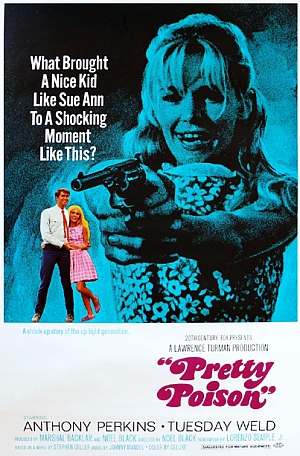 I was expecting more a quirky comedy than a dark thriller from this 1968 film, and only bothered with it because I’m a fan of Perkins (Edge of Sanity is a beautifully-lurid retelling of the Dr. Jekyll story, with the trash quotient cranked up to 11). Imagine my surprise when… Well, let’s start at the beginning, shall we? Juvenile arsonist Dennis Pitt (Perkins) is finally released back into the community as “cured”, though his fondness for fantastic invention appears unchanged. For a while he works at a chemical in the small town of Winslow without apparent issue. But trouble looms in the pretty, 17-year old shape of Sue Ann Stepanek (Weld), even though she appears to be squeaky-clean – an honor-roll student, majorette, etc. To entice her, Pitt spins a tale of being a secret agent, investigating a plan to poison the water supply. Sue Ann seems to swallow it, hook, line and sinker, but after one of their ‘sabotage mission’ goes wrong, it’s apparent that Sue Ann has her boyfriend
 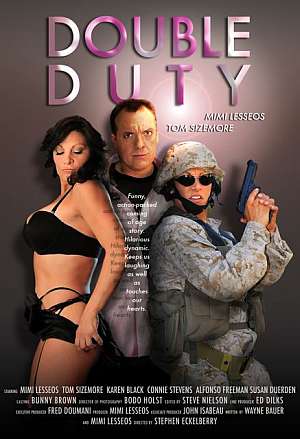 After 20 years in the Marines, MJ (Lesseos) returns to civilian life, but finds it somewhat hard to adapt to life as a civilian. Her old college friend Sophie (Duerden) helps her adjust – somewhat – and introduces her to Craig (Sizemore), a designer who is perhaps rather more feminine than MJ. Sophie is working on a charity auction, not realizing her assistant Carl (Freeman) is planning to steal the top item, a Faberge egg. Meanwhile, hypnosis has given MJ the ability to get in touch with her inner woman – but the problem is, every time someone snaps their fingers, she switches between her two personas. There is that of the rough, tough and gruff Marine, and then there’s the other, a giggling girlie for whom breaking a nail would pose a deep, personal crisis. Which will win out when the chips are down?
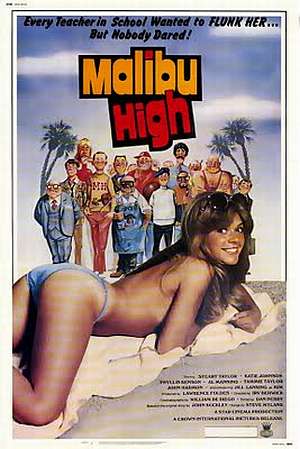 This one popped out of nowhere, on a box-set of discs called Drive-In Cult Classics: most of these were unremarkable double-feature fillers, and this started off looking the same way, Kim (Lansing) is fed up with life: she’s still in high-school at age 18, is about to flunk it, has no money, just lost her boyfriend (Taylor), her father hung himself and her mom’s a total bitch. Finally, she opts to use her natural resources (if you know what I mean, and I think you do) to resolve these issues – though when her mother suggested Kim get a job, I’m not sure she meant as a whore working in the back of a VW van for the ultra-sleazy Tony (Mann). Her ‘popularity’ there lets her move up to work for the slightly-less sleazy Lance (Howard). Which is where the film takes an abrupt right turn, as she discovers a taste for killing – not least on her former pimp – and starts work as, to use one of the movie’s alternate titles, a high-school hit girl.
 Film-makers really need to let the sixties go, especially when it comes to mining TV schedules and turning them into movies. The Mod Squad, Thunderbirds, Wild Wild West: the remainder bins in Walmart are littered with the DVD corpses of failed attempts. While it’d be a massive stretch to call this incoherent mess anything like a success, it does have some merits, not least in the casting of Fiennes and Thurman as John Steed and Emma Peel. If undeniably different to Patrick McNee and , it still works, despite the unfortunate efforts to shoehorn in a romantic relationship between the pair; one of the things that made the original series work was the