 ★★★★½
★★★★½
“First Form at Mallory Towers”
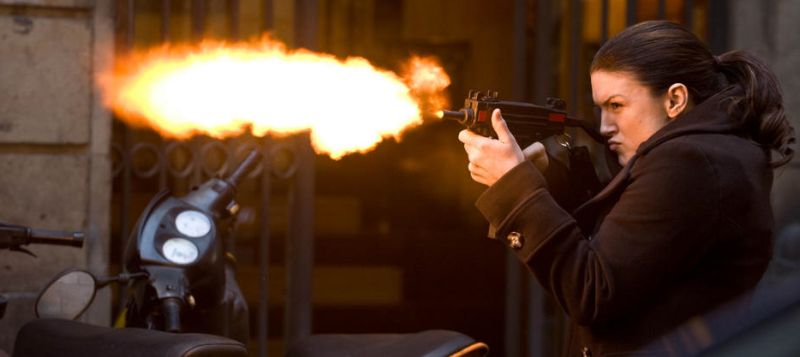
 Soderbergh has never shied away from using unconventional cast members in his movies. Bubble was made entirely with non-professional actors, and when he wanted someone to play a high-class call-girl for The Girlfriend Experience, he went with renowned adult actress, Sasha Grey. Continuing this trend, Haywire revolves around MMA star Carano, which I guess means Soderbergh’s recent leading ladies could, in real life, kick your ass or lick your ass. Ok, I’ll stop. Here, Carano plays Mallory Kane – I keep wanting to type Mallory Knox – an employee of a shady private contracting firm with links to the government, who do the dirty jobs for which the feds want plausible deniability.
 We first meet her in a diner, where Aaron (Tatum) meets her. It’s clear there’s some tension, with Aaron having been ordered to bring her in. After a brief, brutal brawl, she knocks him out and escapes, in a car belonging to startled patron Scott (Angarano). There she reveals what led up to that day: an operation in Barcelona, supposedly to rescue a hostage, followed by another in Dublin, which turned out to be an attempt to tidy up the loose ends from Barcelona, The plan is to frame Kane for multiple murders and portray her as a rogue operative. Kane needs to get to her boss, Kenneth (McGregor), and expose the truth before she’s gunned down.
It’s a deliberately-vague plot, with the characters speaking in clipped obscurisms, that leave the audience to piece things together. Don’t worry, it all becomes clear by the end, but it is probably fair to say that you have to pay a bit more attention than is usual for this kind of Hollywood thriller, between the fractured timeline and doubtful loyalties of most characters. It’s economical, at a tight 91 minutes (about 22 minutes shorter than the average Jason Bourne movie to date), and much like Carano, there’s not much fat on its bones: every scene serves a distinct purpose, which is definitely the way I like my movies.
I find it hard to criticize Carano’s acting, because it’s not clear how much acting is involved. Mallory Kane does not just possess physical prowess, but one who is also extremely comfortable with using it, and has a quiet confidence in her abilities. Any similarity to Carano is clearly not coincidental, and there isn’t much more required of her, in terms of emotion or depth. Unlike most action heroines there is no “personal” agenda e.g. Sarah Connor in T2, Ellen Ripley in Aliens, or The Bride in Kill Bill, it’s simply a case that her enemies are out to get her. In that aspect, Knox is not a particularly-“feminine” character. Just as Salt was originally envisaged as a male role, it’s easy to imagine someone like Jason Statham playing this part; hardly any plot changes would be needed.
 And then there’s the ass-kicking, of various kinds. It’s good, Carano demonstrating a no-nonsense style that’s highly-effective. Perhaps too effective, in fact, since it seems that hardly any of the fights last longer than about 30 seconds – even the hotel bedroom one, which is certainly one of the roughest male/female brawls seen this side of Terminator 3, feels like it ends, just about when it should be getting going. While it’s nice to be left wanting more, rather than less, it’s still not quite the all-you-can-eat buffet of action I wanted. There also is no real sense of escalation; her final battle isn’t particularly different from the one which opens the film, in the diner; it has another location, and that’s about it, there’s no indication her adversary is any more of a challenge.
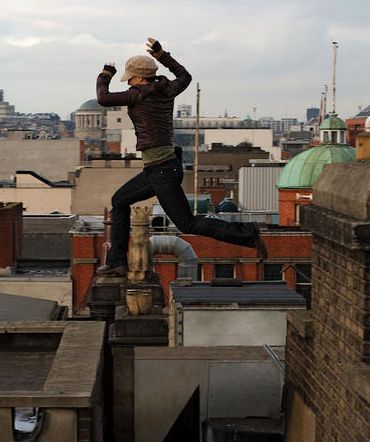
While the battles are well crafted – I note that the fight co-ordinator was J.J. Perry, who worked on Sunland Heat back in 2005 – perhaps my favorite scene was not actually one of them, but an extended scene where Mallory has to shake off her pursuers in Dublin. It is adequately extended, contains a number of twists and turns over its length, and showcases Carano’s physical prowess in more than just brutality, as she glides through and over buildings. I also enjoyed a snowy car-chase, which ends in a way which, I’m prepared to bet, you haven’t seen in a movie before. One senses Soderbergh and writer Lem Dobbs enjoyed playing with the usual expectations of the genre.
It’s certainly shot in typical Soderbergh style. He throws all manner of styles in there, from black-and-white through hand-held to the heavy use of colour filters. Mostly, these flourishes enhance the film, rather than distracting from it, and a billion nods of approval are due for avoiding the rapid-cut style of editing, which is the bane of modern action cinema (except for the rare cases where it’s done properly). Still, there’s no question it’s obvious who made it, to the point that I actually laughed when a shot of Kenneth appeared in sepia – having seen Traffic, I knew, before it was explained, that he had to be in Mexico.
All told, if not quite an all-time classic, this is more than acceptable, upper-tier work. Carano is by no means out of her depth, despite a heavyweight supporting cast including the likes of Michael Douglas and Antonio Banderas, and has an understated charisma which works in her favour. I don’t know if her future plans involving returning to the octagon, or sticking with the acting, but if it’s the latter, she’d certainly be a welcome addition to the (fairly short) roster of credible action-heroines from which Hollywood can draw.
Dir: Steven Soderbergh
Star: Gina Carano, Ewan McGregor, Channing Tatum, Michael Angarano




 Mercenary Frank Ryan (Thompson) is hired by a shadowy private entiry to go to a Mediterranean dictatorship, and bust out the leader (José Ferrer) of the rebels, so he can lead a revolt against current leader Michael Bartos (Oliver Reed). The only way to get in, is for Ryan to become a “faggot” fashion designer, along with a team of special-ops trained supermodels – or perhaps that should be, supermodel trained special-ops ladies, since they’re mostly bailed out of Turkish prisons, federal detention facilities, or otherwise have dubious pasts. After putting on their fashion show, and gaining Bartos’s trust, the team hit the road and head cross-country to the remote jail where the leader is being sequestered.
 The films put out starring WWE wrestlers are a bit of a mixed bag: some are mindlessly entertaining, while others are near unwatchable. And much the same goes for their Diva’s division: some are actually good wrestlers, others are clearly chosen for their looks. Stratus does probably fall into the former category, but this doesn’t do her adequate justice, and top-billing is probably a bit of a stretch – she’s held hostage more than she kicks ass. She plays Jules, one of three bounty-hunters, who pick up a guy that suggests a deal: let him go, and he’ll point them to a wanted man with a $100,000 reward. They accept, but when taking the guy in, get a call from mob boss Hal Lambino (Rafla) who offers them one million dollars if they deliver the bail-jumper to him instead. Needless to say, the transaction doesn’t go smoothly.
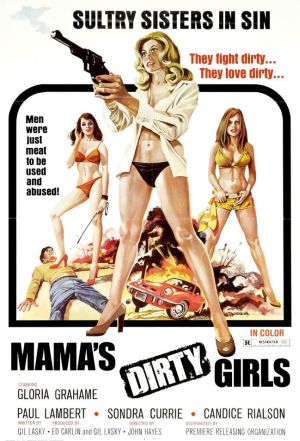 While the title suggests something inspired by Corman’s Big Bad Mama, this is a contemporary tale which, in some ways, is actually closer to Faster Pussycat. It has a great deal more nudity, right from the opening scene in which Becky (Rialson) stares into a mirror, and puts on her bikini-top… very… slowly… However, the titular Mama (Grahame) is nowhere near the level of Varla, and the movie feels more like a pale imitation, despite the additional breasts.
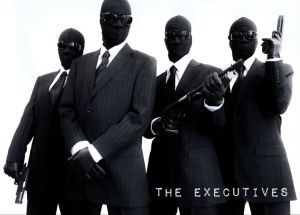
 A series of bank raids has local police baffled: ‘The Executives’ specialize in slick, swift in and outs, never over-reaching themselves. They’re also very well-dressed, which might actually be a clue, since these four robbers are women, under veteran criminal Fox (Evans). But all is not well in this gang of thieves, with some seeking a bigger score. Matters come to a head when they find a cop (Lombardi) nosing around their headquarters, and a tracking device attached to their van – all signs point to an informant within the gang, Is someone seeking to take over from Fox? Or is Fox herself tired of her accomplices? Let the accusations – and the bullets – fly.
 All told, however, these are small quibbles, and the bottom line is: we enjoyed it. Someone should give Blinky enough money for a proper movie – but I suspect, Notarile will likely keep on making films, whether anyone does or not! I’ll be looking out for them.
 And winner of ‘Least Accurate Movie Tag-line of 2011’ goes to this one, by a country mile. “Sucker Punch on steroids”? Well, let me tell you something. I know Sucker Punch. And Warriors, you’re no Sucker Punch. The drugs reference is fitting, though I’m thinking less steroids, and more likely an overdose of Vicodin. Everything about this, from martial-arts fights staged at the speed of a reluctant glacier, through lighting of scenes that’s so poor as often to be non-existent and obvious digital gunfire [as seen in an extended scrap-yard gun-battle, without any glass being shattered at all], to a painful, sludgecore metal soundtrack presumably made by some mate of the producers, combine into a deeply uninteresting viewing experience.
 In many ways, this is wretched beyond belief, crippled by near non-existent production values and likely only to appeal to those who live in the urban culture depicted. And yet… For every moment of wince-inducing idiocy [Agustin appears to be a big fan of Benny Hill, using speeded-up footage for “humourous” effect more than once], there were moments of surreal charm. For instance, “Captions for the Hispanic-impaired,” or the really terrible fight scene which breaks the fourth wall, turning into a “making of” segment which (and I can attest to this) accurately depicts the hell of being a microbudget moviemaker. Or that the large family of children belonging to one of the Angels includes a bearded midget. “He just showed up one day. Hey, he buys groceries, it’s cool” is her casual explanation.
 S’funny what you stumble across on Netflix, at the end of a long chain of “See also…” recommendations came this, which according to the
  The shortest match of the night – lasting exactly one minute – was a bit unfortunate, as Shayna Baszler actually broke the arm of her opponent, Samantha Anderson. She was applying a submission hold on the arm, but it seemed that Baszler fell forward, resulting in the pressure being made much worse, and resulting in a clean break of her humerus. Ouch. The opening contest [on the DVD – there was an amateur fight not included for some reason] was the only one that lasted longer than one five minute round, with Marissa Inhofer beating Kirsty Bushnell. As well as being the brother of another MMA figher [Nick Inhofer was on The Ultimate Fighter 3] Inhofer was a roller-derby girl, and seemed to have brought a large contingent of her team-mates with her.
 If you’re going to use a cover like this, you’d better live up to it, even if we can forgive the heels as artistic license. And while not a complete lie, this takes far too long to deliver, and comes up short of expectations. Holly (Kosaka) is a nightclub singer, separated from her husband, who got custody of their daughter due to a DUI Holly got, with the daughter in the car. On arrival at his house to pick up their child for a scheduled visit, she finds him missing – and a gun in the basement, along with a case of drugs. She calls the police, but ends up getting arrested after the police find her husband’s body, and her fingers on the murder weapon, which has mysteriously moved from the basement to the scene of the crime. The drugs have also vanished; while held in jail over the weekend, Holly gets a visit from their owner, who busts her out and insists she return with him and his thugs to the house to show her where they are. Can she escape their grasp, rescue her daughter and find out who the real murderer was?
 The Asylum studio are infamous for producing ‘mockbusters’ – straight to DVD look-alikes of big-budget movies, designed to benefit from their publicity budgets. These have included their own versions of Sherlock Holmes and War of the Worlds, but they do make their own original works, including cheesy delights such as Mega Python vs. Gatoroid, starring 80’s popsters Tiffany and Debbie Gibson. They come in for a lot of flak as a result – some justified, some not, for this is neither mockbuster nor cheesy, and is surprisingly solid, if you want a straightforward Western tale of revenge. Selina Stevens (Mears) has to watch as her husband and two young sons are killed by Lee Horn (Mead) and his gang; she is brutally raped and left for dead, beginning a decline into alcoholic despair. Having reached bottom, she meets bounty-hunter Frank Allison (Van Dyke), and asks him to teach her how to shoot – conveniently, just as Horn’s crew start to make their way back to town. The townsfolk’s repeated affirmations that they feel safer with Frank around, might have been a bit premature.