
★★
“The eighties called. They want their movie back.”
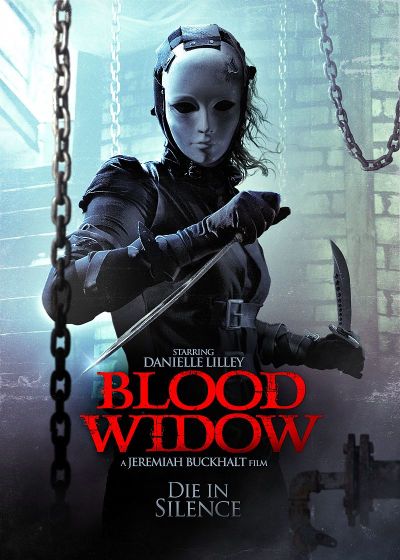 In the slasher genre of horror, the perpetrators seem almost exclusively male: Michael Myers, Jason Vorhees, Freddy Krueger, etc. Women can play an important role, and we’ve covered some of them here before – but it’s much more often as the “final girl”, than the one wielding the machete. However, it’s often forgotten that, in the original Friday the 13th movie, the killer was not Jason, but his mother, so there is some precedent for the female antagonist. See also Nurse 3D, American Horror Story: Coven or perhaps best of all, SexyKiller, whose heroine manages both to be the killer and the final girl.
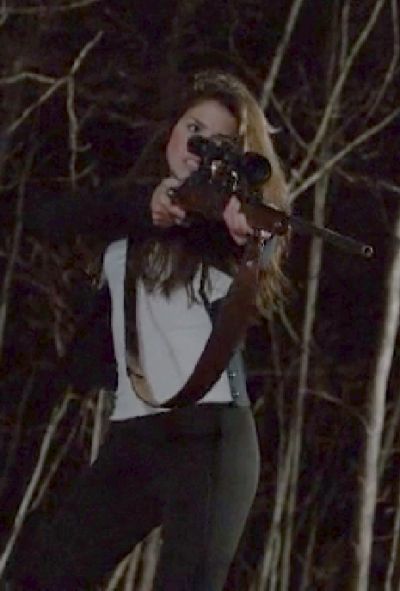
It was in the hopes of getting something novel along those lines that I went into this, only to be severely disappointed by a product which is very little more than a standard slasher. A group of photogenic, but vacuous and tremendously uninteresting, teens head out to a remote house to par-tay, only to break into the spooky dwelling on the next door property, engage in petty vandalism, drug-taking and other anti-social behaviour, for which they naturally pay a heavy price. About the only difference is, the mad, masked killer dispatching them with extreme prejudice is a woman, a former resident of the boarding school next door, who was tormented into psychosis. It’s an idea not without potential: the look of the maniac-ette is very stylish (even if the mask seems a Halloween knock-off), and the actress portraying her (Henry) does a good job, particularly considering her face is rarely if ever seen, coming over as menacing in just about every one of her scenes.
But beyond that, none of the potential is utilized, In fact, the gender of the killer is entirely irrelevant to proceedings, and the final scene seems more appropriate for a male psycho – it left me wondering if perhaps that was the original plan. Really, for a first-time feature, as this is for the director, I’d have tried to push the envelope much more, instead of apparently being content to tread the same ground as we’ve seen a million times before. Maybe this would have passed muster thirty years ago? Now, not so much, with viewers far more cynically self-aware, and wanting more than an uninteresting rehash of its predecessors. Save the gender of the assailant, there’s nothing new or of note here; it isn’t enough, when it’s little more than an afterthought, and everything else we get, has been done a lot better elsewhere.
Dir: Jeremiah Buckhalt
Star: Danielle Lilley, Brandon Kyle Peters, Christopher de Padua, Gabrielle Ann Henry
 While twice as long as the first series, at 12 episodes rather than six, I can’t say it’s actually any better. Indeed, I think the dilution of the main element which was so much fun the first time round – the relationship between the two, disparate hitwomen, Roxie (Osment) and Veronica (Chriqui) – leaves this season less entertaining. Yes, it’s bigger and more exotic: but it feels spread thinner, to the detriment of the core aspects. The story takes up shortly after the events of the first series, with V+R in the Caribbean, waiting to get their share of the money from Eileen (Missi Pyle) and Mother (Gershon). But instead, an assassination squad is sent to get them, kicking off a reunion with Veronica’s “parents”, a deranged killer who thinks Roxie is his dead wife, a rogue CIA operative who sends Frank Barnes (Arquette) after Mother, and so on. It builds to a climax where Veronica, previously injected with a lethal nanobot virus that’s about to go off, takes part in an underground death match at a cockfighting arena, to prove her love for the deranged killer. I shit you not.
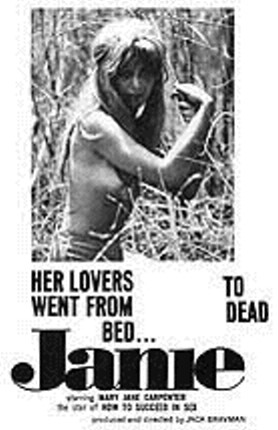 This grindhouse obscurity manages to rise above the limitations of its budget, and proves an effectively nasty piece of work. The titular teenage “heroine” (Carpenter) is on the way to see her older lover, but embarks as well on a killing spree that first includes a classmate and the guy who picks them up, then a householder (Michael Findlay) whose swimming pool Janie hijacks, before moving onto a predatory lesbian and finally her lover’s girlfriend (Roberta Findlay), whom she strangles with a belt. This is all told in flashback as she tells the story to her disbelieving bedmate – though the corpse he discovers in the bath-tub rapidly changes his mind. Oh, and did I forget to mention, for extra sleaze points, he is also Janie’s daddy? Damn. All of her exploits are accompanied by narration from what could be seen as an ancestor of Dexter’s “dark passenger”, exhorting Janie to further murderous acts, in a placid and matter-of-fact tone that is actually all the more chilling for its calmness.
 It’s hard to be critical of a film for being cheap, when the movie is not only aware of its own cheapness, but wears this on its sleeve like a badge of honour. “So what if I’m made entirely by amateurs with their pocket-money,” it seems to be saying. “We didn’t care, so why the hell should you?” I could list all the flaws here – crappy sound, low-quality video, acting your local amateur dramatic group would reject, awful use of stock classical music that would make Gustav Holst spin in his grave – but its response would simply be “…and your point is?” In the interests of space, let’s largely take those aspects as thoroughly read, and get on with the rest of our review. The setting is Chicago, and far from Armageddon having hit, it looks pretty much like the city we know – trains run in the background, for example. There is some introductory guff, which is hardly convincing, and nor is there anything particular “Prehistoric” about the leading ladies here, beyond a bit of fur trim.
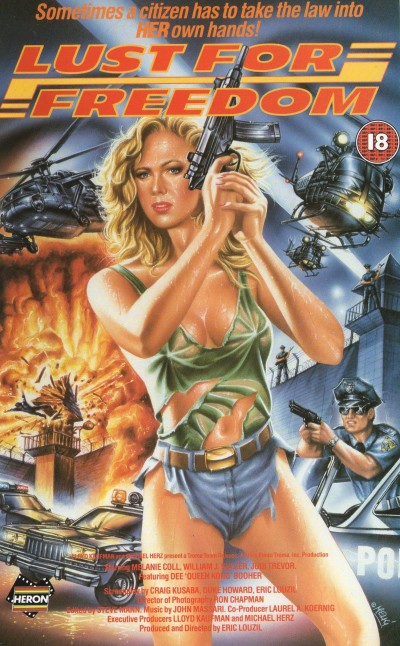 Undercover cop Gillian Kaites (Coll) needs a break from the force after an operation goes wrong, with her boyfriend and fellow cop being gunned down in front of her. She goes on a road-trip, but has the misfortune to go through a town where the local cops are in league with the prison to arrest fetching young ladies on fabricated charges. They can then be shipped off to jail and… Well, the script is kinda vague on the specific purpose behind this, clearly quite significant, operation involving a large number of people and no small effort. Let’s give them the benefit of the doubt, and presume the ends, whatever they may be, justify the means. Gillian ends up framed for drug possession, and has to survive against brutal guards, brutal fellow prisoners and matron Mrs. Puskar (Trevor) – in the interests of sustaining suspense, I will avoid revealing whether or not she is brutal. Eventually, the brutality on display becomes too much, and she leads the inmates in a revolt against their cruel captors. In other words: women in prison plot 3A.
 Currently running on