
Guns & Lipstick

★½
“V.I. Warshitski.”

gunslipstickI’m not saying this was a film made, The Producers-style, as a tax write-off. But if a movie was made for that purpose, it would probably look as slapdash and amateurish as this. I’ll just give you one example. Near the end, the heroine is seen by a corrupt cop and he gives chase. It starts in broad daylight, up in the mountains. One cut later, it’s the middle of the night and they’re by the docks. WTF? Whether the makers didn’t notice, or didn’t care, neither says much about the quality of the product. Then again, the entire concept of a cougarish, blonde PI with a smart mouth was clearly ripped off wholesale – minus the shoe obsession – from Sara Paretsky’s V.I. Warshawski, filmed four years before this came out in 1991.

Kirkland plays private detective Danielle Roberts, a former cop who was kicked off the force for having an affair with her boss. She has a job protecting Rose, a stripper who thinks someone is out to kill her – with good reason, because Rose turns up dead. As, in short order, do a lot of other people who cross Roberts’ path, and due to this she comes under the suspicions of her former colleagues. Turns out there Rose had come into possession of a jewel that an awful lot of people want to get their hands on, for one reason or another. These include crime boss Mr. Song (Hong), cop with a grudge Dimaggio (Forster), Rose’s brother, Andy (Lurie) and an albino, who can’t have been a “real” albino, because he doesn’t have pink eyes [Source: my numerical analysis professor at university was an albino] It’s a complete mess of a storyline, with little or no effort made to provide credible motivation, and the romance between Danielle and Andy is more creepy than anything, since Kirkland is literally double his age.

Things escalate to a ludicrous and entirely incoherent shoot-out at a ranch, where the bad guys prove they are literally incapable of shooting the broad side of a horse, before the time-challenged car-chase mentioned above. A potentially interesting B-movie cast, which also includes Wings Hauser for no readily apparent reason, is entirely wasted on this turgid mess of a script. Kirkland has been decent enough in other things, and gives it her best shot, but is woefully miscast here. Everyone involved with this should be very, very ashamed.

Dir: Jenö Hodi
Star: Sally Kirkland, Robert Forster, Evan Lurie, James Hong

She Mob

★★½
“Lethal weapons.”

She-MobReally, from the poster, I was expecting something utterly unwatchable, so on that basis, this rating should be considered something of a triumph. Oh, make no mistake, there are aspects of this that are truly dreadful. But it’s rare to find a film which so obviously does not give a damn about what the audience might want, and goes so relentlessly on its own way. After a rough week for your humble reviewer – I’ll get to Super Gun Lady and, worse still, Guns & Lipstick, over the next few days – I’m inclined to look upon this with more favour. It does at least alternate elements of some interest with its mediocrity; for instance, there can’t be many thrillers of the era, even soft-core ones like this, which have only a single male speaking role.

The focus is a group of four women, apparently recently escaped from prison, under the leadership of Big Shim (Castle), whose picture can be found in the dictionary beside “diesel dyke.” When two of the group become hungry for male company, Shim dials out to gigolo Tony (Clyde), but when he arrives and tells them he is now the toy-boy of rich businesswoman Brenda McClain (Castle), Shim decides to “kidnap” him for ransom. Because of their ‘delicate’ relationship, McClain won’t go the police, so turns instead to private detective Sweetie East (Duval). She plays the part of her employer when it’s time to drop off the ransom, but hides a transmitter in along with the cash, and follows its signal back to the gang’s lair. This being 1968, the whole transmitter concept has to be explained in detail, I guess in case any of the audience hasn’t seen Goldfinger.

There’s a fair bit here of note, albeit not always in a good way. Firstly, having the same actress play both Shim and McClain is a striking choice, especially since this was apparently Castle’s one and only movie [though I suspect assumed names were heavily used here; there isn’t even a formal director’s credit!]. Admittedly, neither of her performances are exactly subtle, though that’s in line with the incredibly-pointed bra she wears, which would be rejected by mid-90’s Madonna as excessive, and with which she stabs Tony at one stage in proceedings. Then there’s “Sweetie,” an obvious knock-off of Honey West, though the budget here doesn’t stretch to an ocelot. And the rest of Shim’s gang are little less memorable, from Twig, the simple-minded go-go dancer, to Baby, Shim’s lover, whose main purpose is to remind us how far breast implants have come over the past 45 years.

The main downside here are the lengthy, frequent interludes where nothing much is happening. Mostly, these are what could best be called “scenes of a sexual nature,” though they are so completely unerotic they begin to feel like Dadaist sketch comedy. For instance, the film opens with Brenda taking a bath, yelling shrilly and repeatedly for Tony to join her. When he eventually does, they slosh around in the tub for a few minutes while the single camera watches with a complete lack of passion. Still, it’s a film that you will certainly remember, and is a pleasure to write about, offering no shortage of aspects worthy of comment. Though that may partly be my subconscious trying to put off having to write a review of Super Gun Lady.

Dir: Harry Wuest
Star: Marni Castle, Adam Clyde, Monique Duval, Twig

The Dalton Girls

★★★½
“How the West was wo(ma)n.”

dalton-girls-os1“Oh, you can’t trust a man, ‘cos a man will lie,
But a gun stays beside you till the day you die.
A man is a cheater, with his triflin’ ways,
But a gun’s always faithful, ‘cos a gun never strays.”
   — Holly Dalton (Merry Anders)

The above comes from a rather strange musical number, injected into the middle of this B-Western for no particular purpose. It’s sung by Holly, the leader of the titular gang, consisting of four sisters: the older pair Holly and Columbine (Edwards), are forced on the lam after a sleazy funeral director tries to force himself on Holly, resulting in his encounter with the business end of a spade. Six years later, they have been joined by younger siblings Rose (Davis) and Marigold (Sue George). and are raiding stage coaches around the West.

Things are derailed when one of their targets is carrying W.T. “Illinois” Grey (Russell), a gambler on his way to the Colorado boom town of Dry Creek. Columbine falls for him, and casually suggests Dry Creek as the location for the gang’s next raid. They raid the bank, and get away with $6,000 – which was supposed to go to Grey, and he is shot in the process. He trails them to Tombstone where, rather than tell the sheriff, he blackmails the gang to get the money back, and Holly decides to get revenge by raiding the high-stakes poker game where he is wagering the cash.

It’s a wonderfully grey film, morally speaking: unlike many Westerns of the era (1957), it isn’t black-hatted villains metaphorically twirling their wax moustaches, as they go up against square-jawed good guys in their white hats. Here, there isn’t anyone whom you could truly place at either end of the moral spectrum. The Daltons, Holly in particular, are victims of their family reputation – the film opens with their brothers being hunted by a posse, and gunned down in the desert. [The funeral director who assaults her is displaying the corpses for a 25-cent admission fee, which appears based on the fate of the real Dalton Gang].

On the other hand, Grey is certainly no hero either, a pragmatist whose main focus is looking out for #1. Naturally, crime can’t be allowed to pay, and the ending reflects that. However, the journey is a surprisingly forward-thinking one, with only the doomed Grey-Columbine romance counting as an expected element. There is probably one sister too many, since they do blur together, and absolutely nothing like the tagline on the poster happens [“snared them in their love traps at night”? Really?], though that may not be a bad thing. Apart from the fact that the outlaws are women, the story doesn’t have much new to offer. However, considering the era, that alone is still borderline radical, and plays a good two decades ahead of its time, if not more.

Dir: Reginald Le Borg
Star: Merry Anders, John Russell, Penny Edwards, Lisa Davis

Loves Her Gun


“A cautionary tale. And you’re cautioned not to watch this movie.”

lovehergunPerhaps surprisingly, given the nature of this page, I’m not inherently averse to the idea of gun control. I lived in Britain until I was in my thirties, which seems to work fairly well without the whole “right to bear arms” thing. It probably made sense in 1776, but certainly wouldn’t be high on my to-do list if I was writing the constitution now. However, I now live in a country with 300 million guns or so, and I’m pragmatic enough to accept that the genie is out of the bottle here: any attempt to impose it at this point, would only impact law-abiding citizen and weaken their ability to defend themselves against criminals who would still have their weapons. Gun control works – but only if you already have it. Anyway, I mention all this to establish that I’m not averse to a movie which makes a well-reasoned argument against guns. Unfortunately, this is about as far from well-reasoned as imaginable. The facile scaremongering here leaves this mild-mannered Brit, who has touched a gun once in his life, with a strong wish for the makers of this, some day, to find themselves in need of some well-armed help.

Walking back to her Brooklyn apartment, Allie (Dunn) is the victim of a swift but brutal mugging. It’s the last straw for her, and she bails out of the city the next day, hitching a ride to Texas with a touring rock band and its “charismatic” leader, Clark (Barrero). She stays in his house, and gets a job working alongside local landscaper Sarah (Bisagni), but it unable to shake the PTSD caused by the attack. Sarah introduces Allie to the joy of firearms, eventually leading to her purchasing her own weapon for personal defense. However, the presence of the gun turns Allie into a raging Charles Bronson, as we see when she charges into a local domestic dispute, all a-firearmy. From here, it’s painfully if illogically obvious where this is going to end up. Oh, look: Allie getting her hands on a gun turns out to be A Bad Idea, in an incident a third-grade English teacher would mark down as poorly considered. This is my unsurprised face.

The end credits proudly proclaim that the dialogue was largely improvised, which might be okay, if it didn’t seem they also made the story up as they went along too. There are a number of interesting ways this could have gone. Unfortunately, the film chooses none of them, preferring to drive a path through Austin’s hipster scene, populated by “wacky” people, apparently expelled from Portland for being too smug and self-centred. Marslett seems more interested in them than his lead and her story – Dunn is actually not bad in the role, her character at least not leaving me with violent urges. So, we get lengthy, pointless scenes of a tubing trip down the river, or a party where people write their hopes and dreams on pieces of paper, stuff them into a Yoda piñata and sets fire to it. Very deep. Perhaps worst of all, Clark’s band, The Karate Kids, perform behind mannequins posed into the crane-kick move from the film. Was that idea improvised as well? Because I can’t think of any other explanation for it being such complete shit. Hang on: turns out it’s the director’s band. Explains a lot

So much of the running-time here is completely wasted on these self-indulgent excuses for film-making, of interest only to Marslett and his cronies in Austin’s scene. The net result, is that Allie’s transformation from scaredy-cat into vengeful vigilante is so fast as to be utterly implausible. They needed to establish the more problematic side of her personality earlier, rather than making it seem as if purchasing a gun immediately causes psychosis since that’s what guns do. There’s a brief spell, where Allie is taken shooting by Sarah, that does catch fire, capturing something of the awe-inspiring power firing a gun can create, but it’s soon forgotten – because we have to go to the Yoda party! Even to a neutral in the debate like myself, this is a facile and simplistic approach to a subject which deserves a far more complex exploration, from people who aren’t fascinated by an aimless, slacker lifestyle that’s entirely uninteresting or noteworthy.

Dir: Geoff Marslett
Star: Trieste Kelly Dunn, Francisco Barreiro, Melissa Hideko Bisagni, Ashley Rae Spillers

Queen of Swords

qos1★★★
“Leather, whips and lace – gotta love the type.”

In 1817, a young Spanish aristocrat, Tessa Alvarado (Santiago), returns to Spanish California after the death of her father and finds her home in ruins, her father’s manservant reduced to stealing. The town where she was born is run by militaristic governor Colonel Luis Ramirez Montoya (Pelka), who abuses his power, resulting in the miscarriage of justice and the poor living conditions of his subjects. Upset about the state of her birthplace and the murder of her father, Tessa’s path is revealed to her in a mysterious dream where her father comes to her and talks of his murder, his hidden gold, and of his “Avenging Angel”. She will take up arms to protect the people from the town’s governor and to avenge her father’s death. Tessa will do this in disguise behind a mask, becoming that “Avenging Angel”, The Queen of Swords.

Synopsis shamelessly cribbed from Wikipedia, but why re-invent the wheel? That seems to have been the approach taken by the makers here anyway, for their show which ran a single season from October 2000 through June 2001. The obvious, if unacknowledged, inspiration here is Zorro, in which another member of Spanish nobility, adopts a secret identity in order to defend the downtrodden populace from corrupt officials, etc. etc. Indeed, so close were the similarities that Sony sued Fireworks Entertainment, the producers of Queen of Swords, asserting that there was a breach of their rights. The resulting decision was murky: the court initially ruled the character was in the public domain, but later vacated that decision, and the suit was settled out of court, but it’s certainly possible the legal wrangling contributed to the decision to pull the plug on the show, after only eight episodes had aired.

qos2Certainly, in terms of quality, it’s by no means a disaster, and I enjoyed this more than other, recent shows which were yanked as fast, e.g. Killer Women or the Charlie’s Angels reboot. Of course, the central premise requires quite some suspension of disbelief: the concept that putting a little lacy mask on somehow transforms Alvarado and renders her completely unrecognizable by anyone, is nonsense. It’s not as if the town is full of similar-looking women, and she doesn’t even bother to change her voice. Still, if Superman can put on a pair of glasses to the same end, I guess we shouldn’t pick on Queen of Swords. What does work, is the interesting range of characters. Montoya is a bastard, always out for himself, but he’s quite a clever bastard with it, aided by captain of the guard Marcus Grisham (Lemke). On Santiago’s side, she assisted by her gypsy maid – who, like all gypsies, has psychic powers (I think it’s genetic) – and also by the local doctor, Robert Helm (Wingfield), who also has secrets of his own. These are all well-rounded characters whose interaction is fun to watch.

The action work is a bit of a mixed bag. Santiago was found at an open casting call, and underwent two months of training under swordmaster Anthony De Longis, who also plays Tessa’s fencing tutor in the opening episode. However, portraying the character required cobbling together a patchwork of Santiago with stunt doubles and other replacements, including Natalia Guijarro Brasseur, Roberta Brown, Gaëlle Cohen, Mary Gallien, Mary Jose, and even the occasional male for particularly difficult stunts. Again to quote Wikipedia, this “is exemplified in the Queen’s run up the hill away from the soldiers in Death to the Queen. Mary Gallien started the run, Roberta Brown performed the medium shot duel with swords on the hill, Tessie Santiago performed the spoken parts and was in the close-up, and Natalia Brasseur fell off the cliff.” The results are hardly seamless, and fall more into the category of competent than anything else, with the occasional moment that either impresses, or is painfully obvious in the doubling.

The shows did have some decent guest stars. Among the most memorable was perhaps Bo Derek, who played retired pirate captain (!)  Mary Rose, who is intent on seeing her son escapes a murder charge. She could, at least, do her own horsework, being quite an accomplished ride. David Carradine also appears, getting to wield a sword some years before doing so in Kill Bill, and Sung-Hi Lee plays another action heroine in a later episode, The Dragon, where she plays a member from a temple of Japanese warrior-priests, whose master (Burt Kwouk – not Japanese either!) is killed, and seeks vengeance on the Queen after being told by Montoya she was behind the attack. Elsa Pataky also has a regular role, playing the wife of a local landowner, who is having an affair with Grisham. Other guests in the series include Simon MacCorkindale and Ralf Moeller. Oddly, given the setting, there’s a high percentage of British actors in both the regular and guest cast, led by Pelka who, despite his accent, was actually born in Yorkshire – his exotic name is Polish, rather than Hispanic…

A few random other thoughts: I grew to despise the theme song, which sounds like a low-rent version of something by the Gypsy Kings. But the lack of over-riding romantic entanglement works in the film’s favour. While there’s a sense Tessa and Dr. Helm have an attraction, unlike certain shows I could mention, the storylines never gets bogged down in this ‘shipper drivel. I reached the end with a feeling of sadness that the show never quite did well enough to merit further season. If far from original, and not even the first female version of Zorro [which would be Zorro’s Black Whip], it was generally entertaining, with performances that were better than I expected. Even now, the legal status of Zorro remains undecided, and until that is resolved, I doubt anyone will head down the distaff version path again. Episode 1 is on YouTube.

Star: Tessie Santiago, Valentine Pelka, Anthony Lemke, Peter Wingfield

Savaged

★★★
“The Crow-ette”

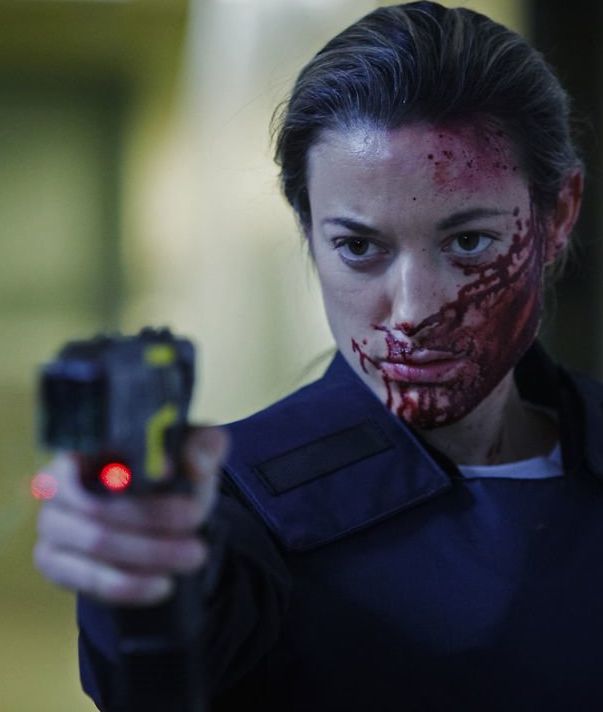
savagedZoe (Adrienne) is driving across country to meet her long-distance boyfriend, Dane (Samuel), when she has the misfortune to stumble into a pack of four rednecks, engaged in their favourite pastime of hunting the local Indians. When they stab one to death right in front of her, it’s clear things are going to end badly for her: and they do, as she is raped, brutalized and left near-dead in a shallow grave. But a conveniently-passing shaman finds her; though his efforts to save her are unsuccessful, the spirit of a dead chief enters Zoe. For, it turns out, he was killed by the ancestors of these same rednecks, and he sees in Zoe the chance to extract his long-awaited and brutal revenge. However, there’s a time-limit involved: since she’s still technically dead, decomposition is setting in…

There are a couple of interesting wrinkles here, first that Zoe is deaf. This disability doesn’t play much part in proceedings, which is actually kinda cool: it’s just another aspect of her character. What is rather more relevant, is that Dane is black, so when he heads out in search of her, and crossed the path of the rednecks, it soon becomes very apparent that it isn’t just native Americans they dislike. All of which simply adds impetus to your enthusiasm for them to get their comeuppance, and that certainly happens. The “revenge” part of this rape-revenge flick starts with the possessed Zoe in a bar, yanking someone’s intestines out like they were tickets from an arcade game, and impressively, somehow manages to escalate from there. She gets to wield a variety of traditional weapons, such as a bow & arrow or spear, on the way to the slightly-less traditional tomahawk vs. chainsaw finale.

This only comes close to working if you don’t think about it too much: ideally, at all. Otherwise, you’ll be left wondering about questions like why the shaman didn’t do the sensible thing and call 911; too often, the supernatural aspects are used as an alternative for plot logic. Have to say, though, Adrienne is very good as Zoe, though in some ways, it’s a shame she has to be possessed by a male ghost to get her revenge. I’d have been perfectly happy for her to be intestine-yanking on her own terms, and Dane could also be excised from the plot entirely. Still, the further this heads into excess e.g. point-blank target practice, the more entertaining it is, and the practical effects are more than good enough to counter some distinctly ropey CGI work. As the title of this piece suggests, more than one review has compared this to The Crow – and that’s a reasonable parallel, considering its similar mix of soft-core spirituality and hard-core violence.

Dir: Michael S. Ojeda
Star: Amanda Adrienne, Tom Ardavany, Ronnie Gene Blevins, Marc Anthony Samuel

Maidentrip

★★
“A two-year round-the-world voyage. Filmed, apparently, in real time.”

MaidenTrip-posterWhat were you doing when you were 14? Going to school. Hanging out with friends. Being highly irritated by your parents. That’s probably fairly close. I’m quite sure the answer isn’t “spending two years sailing around the world by yourself.” Which would be Laura Dekker’s answer. The film chronicles her single-handed sailing expedition, as well as the path of her life which led her to the epic voyage, and the battle against the Dutch government, who considered the trip dangerous, and wanted to remove Laura from parental custody as a result.  [That aspect reminded me of Ready to Fly, where the women ski-jumpers also had to go to court as part of their battle for acceptance]

The bulk, however, is about the trip itself, with the on-board footage all filmed by Dekker herself, for obvious reasons connected to the word “single-handed” – fortunately, my fears of sub-Blair Witch shakycam proved unfounded. The main problem is the almost complete lack of any drama here. Maybe there’s more if you are a sailing enthusiast, but about as exciting as it gets, is a bit of rough weather and a bird that takes refuge on the deck. The only narrative tension is Laura’s decision to switch from sailing under the Dutch flag to that of the country where she was born (on a boat), New Zealand. I appreciate that you can’t manufacture drama where none happened, but this seems less like the taxing and potentially lethal endeavour it would seem to be, and more like a jaunt around a village pond on a slightly-overcast Saturday afternoon. One bit of ocean blends into another, and perhaps the most interesting parts are during Dekker’s sometimes lengthy stopovers en route, where she explores the local landscape.

Dekker herself generally comes over as remarkably mature for her age – 14 when she started, 16 by the time she completed the circumnavigation – albeit occasionally a bit bratty. That’s perhaps exacerbated by her basically fending for herself for two years, though if you’ve raised a teenage girl, you’ll know that’s pretty much par for the course, and any self-centredness is backed by an ability to handle whatever the world throws at her, well in excess of that possessed by a normal adolescent. However, nor is there much sense of character development, and you don’t get any sense the Laura you see at the end was changed in any significant way by her experience. The film definitely needs to dig deeper into what makes Dekker tick, and the apparent failure to do so, leaves it as not much more than a shallow, if pretty, travelogue. The heroine deserves a bit better.

Dir: Jillian Schlesinger
Star: Laura Dekker

The Female Bunch

★★★
“Manson Family Values.”

female_bunch_poster_01Despite a title which seems to be echoing a certain Sam Peckinpah film, this is a Western only in location, being set firmly in the present day. Las Vegas waitress Sandy (Renet) tries to kill herself after being dumped yet again, and a friend introduces her to the gang of women led by Grace (Bishop), who occupy a ranch in the desert near the Mexican border, take no shit from any man and ride across the border to a town to blow off steam when necessary. This also lets Grace pick up drugs which she both sells and uses. The only rule is no men on the ranch, except for Monti (Chaney), a former stuntman devoted to Grace. When that gets broken, the man responsible is branded on the forehead as a warning, which sets in motion a train of events that end where the film begins – with Sandy and another man, driving through the desert, trying to escape from the pursuing banshees.

There’s an aura of Faster, Pussycat here, with a roaming gang of women, outside the law and terrorising anyone unfortunate enough to cross their path – here, the most obvious victim (except for the branded guy) is a poor Mexican who sets up house on the trail they use to cross the border. However, it’s the opposite sex – and the treatment thereof – which ultimately leads to their downfall. Certainly, I can see echoes of Varla in Grace, though Bishop is a mere fraction of Tura Satana, and that’s probably the film’s main weakness – as the axle round which the wheel turns, she doesn’t have the presence to make for a believable “queen bee,” to whom others gravitate. However, it’s undeniable she’s a dark anti-hero, with the film not stinting at all from depicting her intravenous drug use, and it’s refreshing to see a film with such a flawed character at its focus.

Some bits of trivia worth noting. This was subsequently released in some territories on a double-bill with Ted V. Mikel’s vaguely similarly themed, but vastly inferior, The Doll Squad. Lon Chaney Jr’s last film before he died, and his voice is incredibly raspy – perhaps a relic of his battle with throat cancer. Though Adamson denies it, many sources say that some footage for this was apparently shot at the Spahn Ranch, later to be home to the Manson family, while they carried out the Tate-LaBianca murders – the movie was released the same month authorities raided the ranch. I’m sure any similarity to this story, of a gang held together by its charismatic leader, until it disintegrates in a killing spree – not to mention the guy with a cross etched into his forehead! – is purely coincidental. But it’s decidedly spooky, none the less.

Dir: Al Adamson
Star: Jenifer Bishop, Nesa Renet, Lon Chaney Jr., Geoffrey Land

Asian School Girls

★★
“This is at least better than Transmorphers.”

asianschoolI have a lot of time for The Asylum. I met head honcho David Michael Latt back in 2002, when Sharknado was not even a twinkle in his eye, and have been following the studio’s rise to pop-culture icon ever since. They’re best known for their “mockbusters”, designed to cash in on bigger-budget title – including the sublimely-titled Snakes on a Train, which didn’t really have much in common with Samuel L. Jackson’s opus – and also cheesy monster movies, typically involving over-sized or over-aggressive species. This doesn’t fall into either category, and to be honest, isn’t one of their more successful efforts. While obviously not intended to be taken entirely seriously, based simply on a title which had me looking over my shoulder before clicking it on Netflx, it isn’t self-aware enough to succeed as a knowing parody. Nor is it competent enough to stand on its own merits.

The heroines are four – yes – Asian school girls, whose illicit evening out in a nightclub is derailed when they are drugged and raped. After the police are unable to take any action, one of them subsequently commits suicide, and the other three decide to locate and take revenge on the perpetrators, working their way up the chain of supply. Naturally, this requires them to go undercover at a strip-club. It’s not long before the dead bodies are piling up, and the police, led by a dogged detective (Johnson) with a personal interest in the case, are closing in on the perpetrators. Nor is the douche who runs the market in unconscious jailbait happy at their actions, and kidnaps the trio, locking them up in a basement cage where they will be perpetually on-call to service his customers.

There are a couple of directions this could have taken, but the unwillingness to commit to a specific mode of operation – parody or serious? – leaves it coming off as half-hearted and a pale imitation of genuine Japanese imports like Hard Revenge Milly. One moment it’s acknowledging its silliness e.g. the strip-club MC’s dead-pan announcement that as well as Asian School Girl night, it’s also Plushies and Furries, the next, it has a rape scene that is genuinely unpleasant. It’s clear they aren’t “real” school girls – Scarlet is more tattooed and pierced than your typical merchant seaman – but Aotaki, as the fiery Hannah, is the only one to deliver a performance that makes you believe, yes, they could be capable of slicing off dicks. The rest of the cast lack the necessary intensity to sell the concept, and while I can look past the obvious flaws in plot logic, this certainly falls into the category of a film which fails to live up to its poster.

Dir: Lawrence Silverstein
Star: Sam Aotaki, Catherine Kim, Minnie Scarlet, Andray Johnson

300: Rise of an Empire

★★★★
“Faster than Greece-d lightning.”

300riseaI’m going out on a limb here, and predicting that Eva Green is going to be the next great action heroine. She seems very taken by strong female characters, from Morgan Le Fay in Camelot, through Vanessa Ives in Penny Dreadful, and we recently noted her contribution to the marketing for Sin City 2. But this was unexpected. We watched it, purely because we saw and enjoyed the original film, and didn’t expect this one to come anywhere near qualifying for the site. I mean, we were aware of Artemisia – almost a decade ago, Brian wrote a piece for the site, detailing why she’d be a good subject for a movie. However, we were expecting this to be an entirely macho film, likely bordering on the homoerotic, as mercilessly parodied in Meet the Spartans. We certainly didn’t expect her to be so pivotal to this sequel.

Well, technically, it’s neither sequel nor prequel to 300; it’s more of a companion piece, depicting events elsewhere around the same time, and focusing on the naval battle between the Persian forces, nominally under Xerxes (Santo), and the Greek ones of Themistocles (Stapleton). In an earlier encounter, Themistocles killed Darius, Xerxes’s father, which sent Xerxes off the deep end – carefully shepherded there by Artemisia (Green). She is a Greek citizen whose family was slaughtered by their soldiers when she was young, with her being subject to years of horrific abuse. Left for dead, she was rescued by Persians, switched sides and rose through the ranks, now seeing in Xerxes a chance to extract retribution on her former nation. Unlike Xerxes, who was portrayed in the original as Caligula with muscles, Artemisia is smart and resourceful, not making the mistake of under-estimating the Greeks in general, and Themistocles in particular. Indeed, as far as we are concerned, she was much more interesting than the hero, particularly in terms of back-story. She also kicks serious ass, both with a bow and her pair of swords.

As far as general film-making goes, this seems to have built on Spartacus, in much the same way that Spartacus built on the original 300. Indeed, there’s a fairly explicit nod to it, in the casting of Peter Mensah as Artemisia’s trainer, a similar role to the one he played in Spartacus. This means lots of slow-motion and buckets of digital gore, which seems to hit the camera lens more often than it hits anywhere else. It also perhaps means playing faster and looser with history: neither Darius’s death nor Artemisia’s fate are as depicted in the movie. But, hey, when facts conflict with drama, it makes cinematic sense for the former to give way. If what you have here occasionally topples over into video-game style, it rarely looks less than lovely, and if Artemisia wasn’t enough, we get a bonus action heroine at the end, as Queen Gorgo (Headey), leads the Spartan reinforcements into action. Now, will someone please give Green a full-on starring role in which she can kick butt, and tell me where I go to sign up?

Dir: Noam Murro
Star: Sullivan Stapleton, Eva Green, Rodrigo Santoro, Lena Headey