




★★★
“Artificial, more than intelligent.”
 Julia (Monroe) is a petty thief, who is abducted from her house and wakes to find herself, along with other random low-lives, prisoner in a mysterious facility. All of them have an electronic implant in their neck, which gathers data as they are put through a series of tests. Using her thieving skills, Julia leads a breakout attempt, which is brutally foiled by the facility’s automated defense system, a robot called Aries. But the attempt brings her to the attention of Alex (Skrein), the man running the project. He’s a tech innovator, who has been working on a super-AI, called Tau (voiced by Oldman), and using the data gathered from his kidnapped subjects to make it smarter. Julia’s brain makes her particularly suitable, and with time running out before he has to present Tau to its backers, he sets her to work. But Julia begins building a relationship with Tau, with the aim of using its naivety to turn the AI against its cruel creator.
I was expecting something perhaps a little more like Cube based on the trailer and the early going, with more of Julia and the other prisoners going through the tests. However, that aspect is disposed of relatively early. This is possibly wise, since the whole “kidnapping for experimental purposes” angle doesn’t make much sense, with Alex clearly not short of money or smarts (he comes across as an evil cross between Mark Zuckerberg and Elon Musk – some may consider the word “evil” there to be redundant!). Why not come up with a method of research which doesn’t require the death of the test subject? Anyway, with the resulting blood mopped up off the floor by a squad of semi-autonomous mini-drones, it then becomes a three-hander, between her, Alex and Tau, as they fence for psychological, and occasionally physical, dominance inside the confines of Alex’s fabulous house.
This looks lovely (the director’s background and previous work has mostly been in the art department), and occasionally has moments of effectiveness: Tau’s love of music is endearing, and his voracious desire, fed by Julia, to learn about the outside world is almost childlike. I also liked Julia’s feisty physical presence; this transfers well across from her previous “final girl” roles, such as in It Follows, especially during her confrontations with Aries. But the script frequently veers off to far more obvious beats. The self-destruct system is particularly blatant in its foreshadowing. and if I’ve learned anything from this kind of movies, it’s that biometric sensors on doors are a bad idea. If you ever see one in a movie, you know they inevitably lead to someone losing the necessary body part e.g. an eyeball in Demolition Man.
The script likely would have benefited from ramping up the pulp quotient along similar lines, since it isn’t quite smart enough to succeed on brains alone. When it takes a more visceral and less cerebral route, such as the first escape attempt, it’s notably more effective than when it tries to be clever.
Dir: Federico D’Alessandro
Star: Maika Monroe, Ed Skrein, Gary Oldman (voice)
 I will confess to a little post-read confusion here. Amazon calls this Volume 2 in the author’s Rogue Galaxy series – but I could find no information, there or elsewhere, regarding Volume 1. I suspect Amazon and Goodreads are wrong, and this is actually the first entry, as stated in the Dominion Rising collection. It certainly
  This compendium gathers together the first three (shortish) parts of Green’s Shadows of the Void series. In this, humanity has to face a malevolent alien species, the Shadows, which capture their victims, then take their shape in order to lure in more people. In these books, the threat is known but being largely kept under wraps, which is why it comes as a surprise to Jas Harrington. She’s the security officer on board a private exploration ship, sent out by the Polestar corporation to find new worlds to exploit. They find what appears to be a prime target, yet Harrington can’t shake the feeling something is wrong with the planet. Over-ruled by the ship’s captain, it turns out she was right – but by that point, the captain and almost all the officers have been replaced by their doppelgängers.
 This dates back to 2006, and was somewhat groundbreaking at the time, due to the very high volume of digital effects and CGI background work – it came out was three years before Avatar, as a yardstick. The key word here, however, is “volume”. For the effects make up for in quantity what they largely lack in quality, although you have to be impressed at the sheer ambition on view, especially when you don’t have a fraction of the resources which were available to James Cameron. More problematically, also missing is the skill necessary to handle a narrative, where there is simultaneously too much and not enough going on. The former is apparent in entire universe building which has to be accomplished in hard to digest expository chunks, and the latter makes itself known, courtesy of long stretches which are as devoid of interesting features as the Arizona landscapes in which they were shot.
 The Hyde Project was a secret government experiment to create artificially-enhanced super-soldiers. Due to difficulty controlling their aggressive tendencies, it shut up shop, but not before 13 of them escaped. They are now being hunted down by a pair of MI-6 agents, Damion Crow (Kyle Hotz) and Lina Petrov (Jensen). Connected to this, somehow, is Iris Black (Newberry). She’s a put-upon barista, with a cheating boyfriend, sleazy boss, alleged stalker – and an increasing body-count of the people around her, the corpses being tagged with religious symbols, in line with the work of an active serial killer. This quickly brings her to the attention of the FBI, in particular Agent Fry (Osborne) and her partner, who have been hunting the killer. They’re not exactly prepared for what they will discover.
 This initially seemed like a borderline entry, which I kept reading purely for entertainment. It’s about an exploratory star-ship, the Gemini, out on the very edge of known space, which comes across a giant barge, packed with nuclear waste and populated by a race of rat-humanoids, the Raetuumak. The Gemini is an appropriate name for the craft, as it’s effectively two separate ships, each with their own captain and very different approaches. Maggie Antwa, commander of Gemini Right, is a cautious scientist who abhors violence in any form, and was compelled to take on this mission after being involved in a environmentalist rebellion against the ruling Empire. Over in Gemini Left, on the other hand, Skip Sutridge is a square-jawed believer in shooting first and asking questions… well, never, to be honest. He has been sent to the fringes, probably to try and keep him out of trouble.
 Three millennia previously, the Terrans landed on the planet of Ogun, and took it over. The native Iliri, though in many ways superior to the new arrivals in both mental and physical ability, ended up subjugated. They are now very definitely second-class citizens, only remembering vague legends of their once-proud past. One such is Salryc Luxx, a rare pure-bred Iliri who is a private in the army. Despite the fierce prejudice against “her kind”, she gets a try-out for the Black Blades, the military’s elite special forces. Which, it turns out, is a haven for Iliri and their supporters. Sal becomes the first woman in the unit, and her talents – including the ability to shape shift – quickly become an essential part of the team, allowing her to become one of their top covert assassins. However, her presence also causes significant static, not least her relationship with the Black Blades’ commanding officer, Blaec.
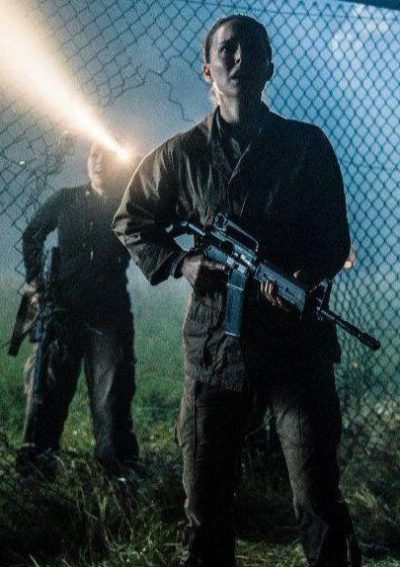 12 months after apparently vanishing while on a covert mission, the husband of former soldier Lena (Portman) suddenly shows up, unable to remember what happened, and suffering massive organ failure. The couple are quarantined by the government, and Lena learns of “Area X” in Florida. An apparent meteor strike has led to a “shimmer” which is gradually expanding in size: all expeditions into the area have vanished without trace, until Lena’s husband showed up. Lena joins another such expedition, led by Dr. Ventress (Leigh), hoping to reach the lighthouse which marks the apparent focus of the event, and discover something which can help her husband.
 I’m unsure who the woman is on the DVD sleeve. I can only presume it’s Lady Not-Appearing-In-This-Film. For what we have instead seems to be a real labour of love for British stunt-woman Cecily Fay. Though calling her a mere stunt-woman would be selling her short: she also wrote, directed, starred in, edited and scored this feature, plus did the fight choreography and sound re-recording, while sewing every sequin on the costumes herself. Okay, the last might be a bit of a stretch, but since she is also credited as the costume designer… perhaps not. Hell, even Robert Rodriguez doesn’t have such a large collection of hats, and this overwhelming multi-tasking might help explain why it took close to five years between the start of filming and its eventual release. The main problem is that Fay’s talents, while considerable, are not equally spread.
 More positively, we have Fay’s acting and directorial talents. The former isn’t much of a surprise, as I enjoyed her performance in
  ★★★½
★★★½