
Mind Raider by S.M. Blooding & P.K. Tyler

Literary rating: ★★
Kick-butt quotient: ☆☆

I’m not sure if the problems here are a result of there being two authors credited on this story. It could certainly explain them. For rather than providing a single coherent vision, this feels like both its universe and characters are being pulled in too many different directions. It’s overstuffed with ideas and, instead of them being developed fully, scurries from one to the next, as if the writers were competing to have the final word. This comes to an end in a rather ludicrous finale. There, the entire plot takes a right turn, with the biological weapon which has formed much of the early focus all but discarded.
The heroine is Keva Duste, an “engineered human,” who was originally pod-grown for use as a super soldier. However, she proved able to over-ride her programming so was discarded after refusing an order. And by “discarded”, I mean tossed into space. From there, she was fortuitously rescued, and began a new life as an agent working for the Syndicate. This is one of a number of murky groups, including the Elite and the Families, who are waging a proxy war for power around the network of planets and space stations which are the setting here. None of them seem to have the population’s interests at heart.

She’s sent undercover to an Elite planet, to find out information about the bio-weapon mentioned, which will shortly be tested on an unsuspecting batch of subjects. However, troubled by an increasing moral compass, she goes off-mission and also rescues Dothylian, the new wife of the not very nice Elite (to put it mildly) on whom Keva is spying. This causes problems all its own, partly because of Dot not being fit for the harsh world of the “Black”, where Keva operates. And partly due to the increasingly self-aware AI she brings with her, which has an agenda of its own.

I found it all kinda annoying. Ideas and concepts like the “slip drive” are hurled at the reader, without adequate explanation, and the focus bounces around, to diminishing effect. There is some a bit of decent tension built up when Keva is on the Elite planet, because her undercover identity is that of a dead woman. Anyone who knows that will be understandably surprised to see the corpse walking around, so it’s a very risky situation. For a genetically-engineered super-soldier though, especially one with a permanent connection to a high-powered AI in her head, she doesn’t seem to make much use of her talents. There’s rather more of Keva moping around her spaceship, and unresolved sexual tension with Captain Hale.

From reading interviews with the authors, it appears one wrote and the other edited, so my theory about competing pages doesn’t seem to be valid (much though it’d explain the deficiencies). I’ll split the blame here, with perhaps a little more going to the editor, Tyler. She should perhaps have spotted and corrected the structural issues that rendered this more chore than pleasure at about the half-way point, and turned into a real slog in the final stretch.

Authors: S.M. Blooding & P.K. Tyler
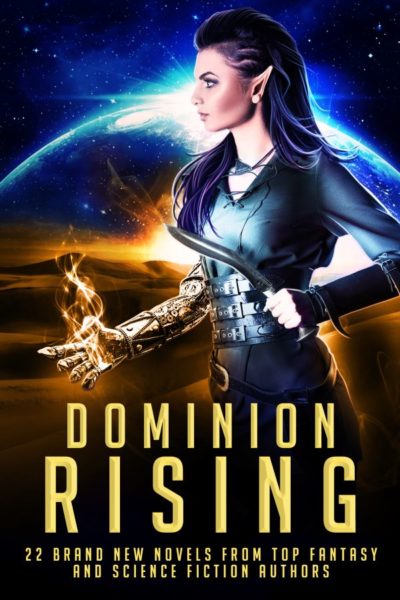
Publisher: Macmillan, available through Amazon as an e-book only. It also forms part of the Dominion Rising collection for Kindle.

What Happened to Monday

★★★½
“Seven Noomis for the price of one!”

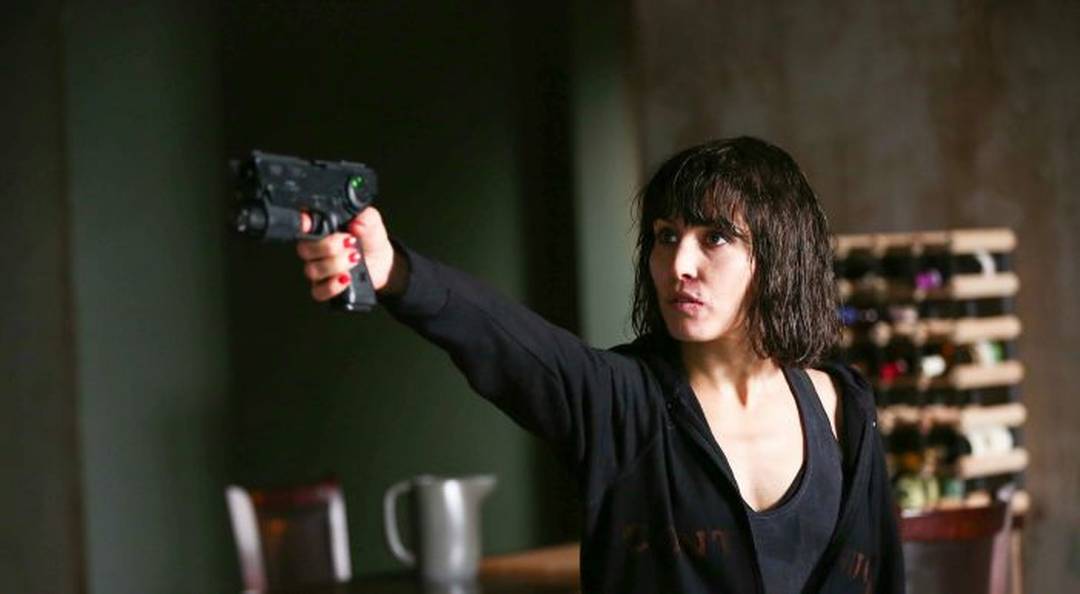
In the future, overpopulation becomes such a problem that strict limits are placed on children per family. You are only allowed one, with any others being taken by the authorities and put into “cryosleep”, so they will no longer consume resources until the situation has been addressed. After a woman secretly gives birth to septuplets, their grandfather, Terrence Settman (Dafoe), brings them up, rigidly schooling their actions so they remain under the radar. Each gets to go out on the day of the week corresponding to their name e.g. Monday on Monday, etc. On their return, they share with their siblings the events of the day, so the illusion can be sustained. 30 years later, with their grandfather gone, the seven women have evaded capture, though tensions between the different personalities are growing. Then, one evening, Monday simply doesn’t come back. The following day, neither does Tuesday. The remaining sisters have to try and figure out what’s going on, without exposing themselves.

There are strong hints of Orphan Black here, the TV series in which Tatiana Maslany played multiple clones, with distinct personalities, who end up working together to uncover a conspiracy. That ran for five seasons, truly flogging a dead horse into the ground, and the concept works a good deal better at the two hours for which this runs. Though even here, the third quarter does somewhat run out of steam. The main pleasure is the seven different versions of Rapace – and, indeed, the seven mini versions seen in flashblack, played by Read. Watching them bickering around the dinner table is a marvel on both technical and acting levels. Despite limited screen time, Rapace imbues them with distinguishing characteristics that mean you can tell the players without a scorecard. Though, again, the third quarter gets rather murky in this area, especially when two versions start rolling around, brawling with each other.

Wirkola is best known for Hansel and Gretel: Witch Hunters (a film which, like the Resident Evil series, performed much better overseas), and has a similarly stylish grasp of the action here. Though not all the seven sisters are action-oriented, some of them most definitely are. The highlights are a chase through the streets of the city, and a misguided attempt by the authorities to storm the apartment where the sisters are embedded. It does not go well. These sequences likely work rather better than the plot. As well as my doubts a subterfuge like this could be sustained for three decades, despite Settman’s undeniable commitment to it, I must confess I’m with Nicolette Cayman (Glenn Close), head of the Child Allocation Bureau. She points out the grandfather’s actions are thoroughly selfish: he feels that rules for the necessary good of all, should only apply to other people, not his descendants. The story likely also needs a better antagonist: someone against whom the Noomis can directly battle. Cayman is largely absent and operating at just too much of a distance to qualify.

There’s still more than enough here to appreciate, with a well-crafted dystopian world which seems not implausible – see China’s “one child policy,” for instance. But it’s really Rapace’s show, and the actress builds on the intensity shown in the Millennium Trilogy. She seems to have both a fondness and a talent for action: Noomi likely has as good a claim to being the current Queen of European Action Heroines as anyone.

Dir: Tommy Wirkola
Star: Noomi Rapace, Clara Read, Marwan Kenzari, Willem Dafoe

Tag

★★★★
“Virtually game for anything.”

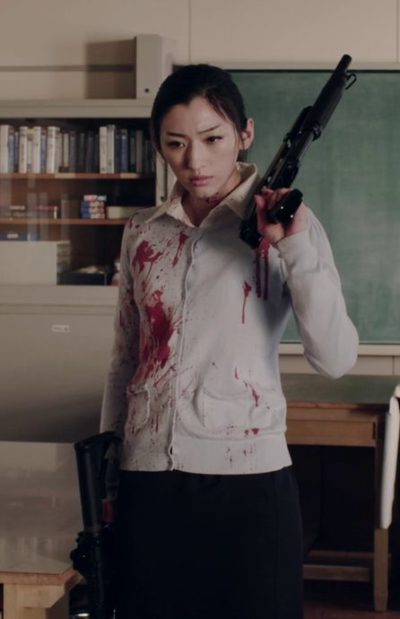
A bus full of Japanese schoolgirls includes the quiet, poetry-writing Mitsuko (Triendl), who drops her pen. Bending down to pick it up, she thus survives the lethal gust of wind which neatly bisects, not only the bus, but the rest of her classmates. Ok, film: safe to say, you have acquired our attention. [Not for the first time the director has managed this: the opening scene of his Suicide Circle is one we still vividly remember, 15 years later]
What follows is an extremely hyper-violent gallop through a series of scenarios, with Mitsuko and her friends becoming the target for assaults by everyone from teachers to bridesmaids. Can she figure out what the hell is going on, with matters not helped by her apparent amnesia, with no memory of everything prior to the bus? And, more importantly, is the film going to be able to deliver any kind of rational explanation for this?

The further this went on, the less convinced this would be possible. However, I have to say, it ends up making far more sense than I expected. It even explains things as disparate as the fairly lecherous costume choices (the schoolgirls’ skirts are more like broad belts, and frequently fly up in anything more than a light breeze) as well as the extremely drone-heavy cinematography. On reaching the end, I immediately wanted to watch this all over again, armed with the provided explanation, and see what other clues I had missed.

There’s a lot to admire here: it plays almost like a cross between Sucker Punch and Run Lola Run, combining the slick visuals and “anything can happen” mentality of the former (and has been similarly condemned), with the latter’s… Well, mostly its running. Seriously, Triendl (who is Austrian-born, hence her non-Japanese surname) racks up as many miles in this 85 minutes as an entire series of Doctor Who companions. But not just her, because even more confusingly, her character is played by multiple different actresses across the various scenarios.

Interestingly, until the very end, there are almost no men in the movie at all, save the pig-headed bridegroom, to who our heroine will be wed. Perhaps that’s a clue in itself to the nature of the multi-verses around which Mitsuko finds herself bouncing. It’s fascinating to watch everything unravel, and the lead actresses do very well, in a role or roles that could have been little more than a place-holder. Watch the emotions flickering across Triendl’s face, for instance, as she tries the virtually impossible task of explaining to one of her friends what she has gone through.

There’s no denying the strongly feminist subtext here, providing you can look past the chauvinist trappings and arterial spray. Sono is both embracing and critiquing the exploitation world in which he has largely operated, although does so with a light enough touch, you can simply enjoy it as a blood-drenched action film, rather than having to worry about its philosophy. And the less you know about it going in, perhaps the better.

Dir: Sion Sono
Star: Reina Triendl, Mariko Shinoda, Erina Mano, Yuki Sakurai

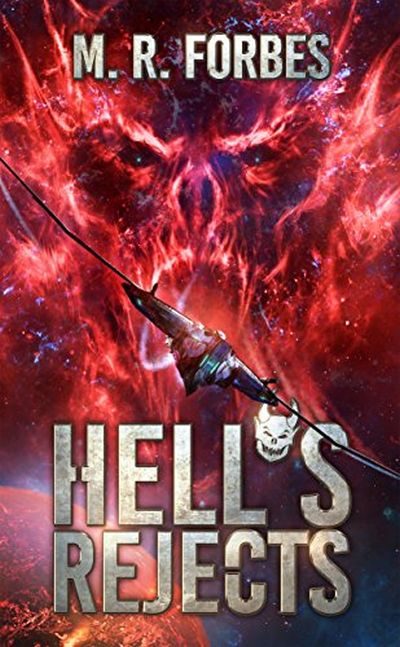
Hell’s Rejects by M.R. Forbes

Literary rating: ★★★½
Kick-butt quotient: ☆☆☆☆
“I am going to die, surrounded by the biggest idiots in the galaxy.”

The heroine in this enjoyable slice of space opera is Lieutenant Abigail Cage. She’s a “breaker” – effectively, a hacker – although one who is highly trained in combat. Her latest mission is to enter a rebel compound and recover a laptop, but the job goes awry, and she finds herself framed for treason after a cache of weapons goes mission, and sent to Hell. No, literally: that’s the name of the planet, and it’s an entirely apt one.
Once imprisoned there, two competing forces come into play. One has interest in using Cage as the guinea-pig for a program to unleash an army of superhumans. The other is Captain Olus Mann, who needs her for quite a different task. Because the rebels have stolen two cutting-edge spaceships, the Fire and the Brimstone, which could tip the balance of the ongoing conflict. Someone needs to find and retrieve them. That someone is Cage, together with a motley crew of other convicts, liberated by Capt. Mann from Hell.

The first in the “Chaos of the Covenant”  series, it strikes a decent enough balance between telling a self-contained tale and luring you in to the next volume. As the tagline at the top – not an actual quote from the book! – suggests, it falls somewhere between, and owes a big debt to, both Guardians of the Galaxy and Suicide Squad. With a side order of La Femme Nikita. There’s a big sprawling universe out there, and Cage has to try and wrangle her motley crew of species through a task which rarely seems less than an impossible assignment.

Fortunately, if a little conveniently, Mann has a very discerning eye for personnel, and put together a good team as backup, out of the pieces to hand in the prison. For instance, one is an incredible pilot, another a wiz with machinery, etc. Cage, meanwhile, can keep them all in line, both through her force of personality and with force if necessary. She’s desperate to complete the mission, win her freedom and return to her daughter – who doesn’t even know Mom is in prison, let alone has been broken out in order to chase a stolen spaceship across the galaxy.

Meanwhile, there’s also the side-effects of the experimental injection she received while in Hell. If only apparently half of what she could have received, the effects are impressive, effectively rendering her near-bulletproof. [She can still be shot, it just… doesn’t appear to have any real effect] This could have ended up being a real “Mary Sue,” in the sense of a heroine who is utterly unstoppable. Except those responsible want to track Cage down, and send Trin after the heroine. She is another woman who has gone through both halves of the process, making her a particularly tenacious adversary. This leads to the final epic battle, in a series of what must be said, are largely epic battles.

Yeah, if you’re fond of large-scale destruction, this book certainly delivers. The carnage begins with the scene where the two spaceships are stolen, that escalates into the demolition of an entire spaceport: like many sequences, it seems written with one eye on a cinematic adaptation. Refreshingly free of romantic distractions, this does an excellent job of setting up its universe and populating it with interesting characters, each of whom have their own, interlocking agendas. Indeed, it may perhaps be slightly overstuffed with ideas, species and technology. Better too much invention than too little though, and it’s a series I can see myself picking up subsequent volumes down the road.

Author: M.R. Forbes
Publisher: CreateSpace Independent Publishing, available through Amazon, both as an ebook and a paperback.

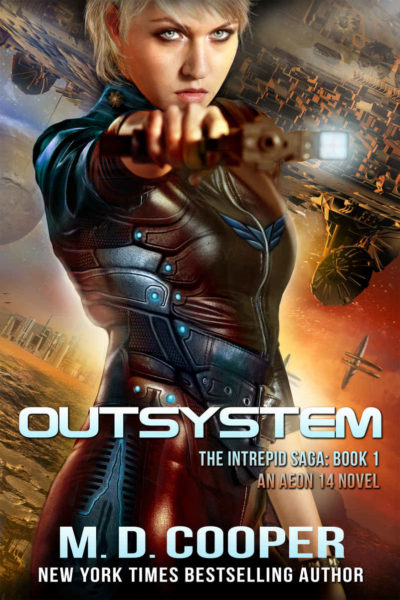
Outsystem by M. D. Cooper

Literary rating: ★★½
Kick-butt quotient: ☆☆☆

This is certainly “hard” SF, by which I mean a story driven by (and to a large extent, more interested in) scientific advancements. In tits 42nd-century future, humanity has expanded to fill the entire solar system, and is now reaching out with colony ships to nearby stars. One such ship, the Intrepid, is being assembled at the Mars Outer Shipyards, one of the massive ring-like complexes which surround the planet. But not everyone wants the project to succeed. Major Tanis Richards, who will be one of the colonists, is first tasked with ensuring the project’s security. The scope of her job becomes apparent quickly, as immediately on arrival, she has to fend off a terrorist attack, trying to set off a nuke on the Intrepid. It’s just the first of a number of sabotage attempts.

There is a lot of tech here, to the extent that the book includes multiple appendices, devoted to explanations of it. Everyone is interfaced to networks, each other and their own AIs – Tanis’s is called Angela – and medical advances mean age is now little more than a number. I found it a bit much, as if technology had become a gigantic, all-encompassing “Mary Sue” of unstoppable power. Whatever the problem… Well, there’s an app for that. The reality, as we’ve seen, is that new technology tends to create as many new problems as it solves: you don’t get much sense of that here. The issues are more old fashioned than that: terrorism is now corporate-sponsored, rather than state-sponsored.

The storyline also tends to get bogged down at times, in an alphabet soup of organizational structure. It seems as if the Major spends as much time in meetings, as actively hunting down the bad guys: it almost turns her into the world’s first bureaucratic action heroine. There are frustratingly incomplete hints at her past, with an incident which caused her to be tagged “The Butcher of Toro“. Though it’s suggested this is an unfair sobriquet, the incident – whatever it was – appears to have played a significant role in her decision to apply to become a colonist. Such an important piece of character motivation likely should not be swathed in such mystery, though it’s possible the details are revealed in one of the later volumes in this three-book arc.

Re-reading the above, this all seems highly negative, more so than it deserves – though I note Cooper recently released an expanded version of this and its sequel, which does suggest he was perhaps not satisfied with the first version. Still, despite flaws, such as a supporting cast who could have used more fleshing out (particularly Joe, the uninteresting romantic interest), I found the pages turned at a a solid rate, and the action sequences generally hit the spot. The version I read included the first couple of chapters of part two, A Path in the Darkness, and it possesses a good enough premise to make me consider going forward. Less is likely more, and the smaller-scale setting of the Intrepid is perhaps a better fit for Cooper’s voice, which isn’t strong enough to populate the entire solar system here.

Author: M.D. Cooper
Publisher: The Wooden Pen Press, available through Amazon, in both printed and e-book versions.

Girl of Fire, by Norma Hinkens

Literary rating: ★★★
Kick-butt quotient: ☆½

You might be forgiven for expecting something Hunger Games-like, given Katniss was referred to frequently as the “girl on fire,” only one letter different from the title here. That really isn’t the case at all: though both are, broadly speaking, science-fiction, instead of an urban dystopia, this is sprawling space opera. The heroine, 17-year-old Trattora, lives on Cwelt, a fringe planet largely overlooked and bypassed by the rest of the galaxy. She’s a chieftain’s daughter there, but was adopted, and is clearly different from the rest of her people; she yearns to find the truth about her ancestry.

Her chance comes in the form of a trade-ship, captained by the untrustworthy Sarth. For it’s discovered that Cwelt is a source for dargonite, a mineral now in high demand for its use in cloaking technology. Before this can be announced, the planet comes under threat from the raiding Maulers, and Trattora strikes an uneasy bargain with the visiting captain, to sell dargonite in order to buy ships which can defend Cwelt. However, after an apparent double-cross, Trattora steals Sarth’s ship from under her nose, and strikes out on her own, to take care of business – and also locate her biological parents.

The latter thread doesn’t occupy much of this, the first volume in a trilogy called ‘The Expulsion Project’. That title is explained at the beginning: proceedings open with her parents on Mhakerta, sending Trattora into space, in a last-ditch effort to escape the clutches of an all-powerful AI who has taken over their planet. The only thing Trattora has left as a link with her parents is a bracelet – when she finds a similar item belonging to Velkan, an indentured serf in Serth’s crew, she realizes there are apparently others like her. But this book is more concerned with her attempting to sell the valuable minerals, and adapting to life in a universe very different from the one to which she is used.

The cover is rather misleading, since as soon as Trattora gets off the surface of Cwelt, she more or less abandons the “barbarian chic” aesthetic, as far as I can tell. Probably wise: carrying a spear around would likely attract undue attention in any space-faring civilization. Indeed, she largely avoids violence, hence the low kick-butt quotient. She still qualifies here, due to what would probably be described on her resume as “a pro-active approach to problem-solving, demonstrated ability at adapting to new situations, and proven leadership skills.” She’s certainly brave, prepared to risk everything to save her adopted home planet, loyal to her friends, and resourceful – all-round, she has the qualities of a good heroine.

I’m less convinced with the writing when it comes to the universe building, beginning with planet names which feel like the author made them up by pulling tiles from a Scrabble bag. You don’t get much sense of a structured universe, despite the apparently overwhelming presence of “The Syndicate”, a group whose power is vaguely ineffectual, except when necessary to the plot. This is where the “space opera” label becomes something of a double-edged sword. While I appreciated the brisk pace, Trattora and her pals whizzing from one incident to the next, the idea of a teenage girl hijacking a spaceship on her first trip off-world, from its far more world-wise captain, with most of the crew supporting her, was only one of a number of moments which stretched my credulity. It was just far too easy.

This probably falls into the category of a fun read rather than a good one, and is thoroughly disposable fluff. While there’s nothing wrong with that per se, this likely panders a little too much in the direction of the young adult audience, to be entirely acceptable for anyone who has grown out of that group.

Author: Norma Hinkens
Publisher: Dunecadia Publishing, available through Amazon in both printed and e-book versions.

The Last Girl, by Joe Hart

Literary rating: ★★★
Kick-butt quotient: ☆☆☆

There are elements here which reminded me of Children of Men, though this is set further down the road, when civilization has decayed a good deal further. The issue here is slightly different: specifically, a lack of female children, which has triggered a rapid collapse into anarchy for the United States. 25 years later, the National Obstetric Alliance (NOA) seek far and wide for young girls, who are brought to their compound in the Pacific Northwest, to be held until the age of 21 when… Well, their fate gets a bit murky. Approaching that point is Zoey, who has known almost no other life. But after she’s subjected to a harrowing bout of psychological torture in a sensory-deprivation chamber called “the box”, her whole attitude changes, and she’s prepared to go to any lengths to escape, and take the other women with her.

It’s clear the exact moment and paragraph at which Zoey changes: “A searing desire for vengeance sweeps through her, turning her blood molten hot within her veins and with it the will to exact revenge on those responsible, to destroy what should be obliterated. To reap justice.” Before that, she has been somewhat cowed. A little rebellious, but in small ways, such as reading forbidden literature (The Count of Monte Cristo, perhaps a little too obvious a choice!). Afterward? She becomes a single-minded zealot, intent on the destruction of NOA and those who run it – and all the more interesting for it. But that’s a mission which will open up not only NOA’s darkest secrets, it will also expose how far Zoey is prepared to go in her mission.

As well as Children, there are definitely echoes of A Handmaid’s Tale, with one gender largely reduced to breeding chattel in a theocratic dictatorship [the concept of women as property, is hinted at briefly here with the “Fae Trade”, and appears to be explored further in later volumes]. I’m always down for a good dystopia, and despite the pieces being somewhat familiar, Hart has put them together in an interesting and effective manner, particularly in the second half when Zoey discovers the outside world, and realizes not everyone is like the NOA. My qualms are mostly with the plotting of the first half: if these young women really were the last hope of mankind, wouldn’t they be treated rather better? As in, propped up on couches and fed grapes, rather than kept in conditions resembling a Japanese women-in-prison film.

Still, I can understand why Hart opted for another approach. It would have made for a more ambivalent story-line, rather than NOA and its operatives being the obvious villains of the piece they need to be, and might have robbed Zoey of her moral drive to action. The interesting question – albeit one left unaddressed here – would be whether her lying and putting others in danger, never mind the actual killing, are justified; does the noble end justify her means? Though you could perhaps argue, jeopardizing the future of humanity for your own freedom, is selfish in the extreme. Zoey’s transition certainly makes for one of the more dramatic arcs I’ve read, although her easy adeptness with weapons is somewhat implausible.

Despite these weaknesses, which may seem quite significant, it must be said they didn’t stop me from enjoying the tale as it was told, and there’s still a decent amount to commend this. It’s a nicely self-contained story, yet leaves the door open enough to leave me genuinely interested in reading more. The romantic angles are kept secondary, and there’s a plausibility about the way in which society has fallen apart, that makes this border on disturbing. When the world ends, it may not be with a bang, so much as the sound of us tearing each other apart.

Author: Joe Hart
Publisher: Thomas & Mercer, available through Amazon in both printed and e-book versions.

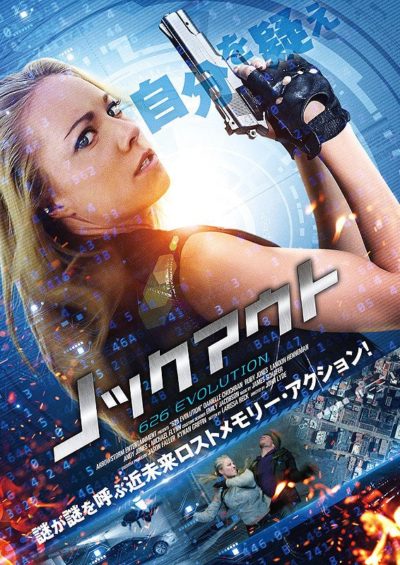
Survivor (2014)

★★★
“The post-apocalyptic horse whisperer.”

Arrowstorm Entertainment appear to have quietly become a minor creator of action heroine flicks. We’ve previously written about several entries in their Mythica series, and also Cyborg X, but seem to have missed this one. As in Mythica, the “name” star here is Hercules himself, Sorbo, who plays Captain Hunter. He’s in charge of one of seven interstellar ships, dispatched from Earth after the conditions for life here became increasingly precarious. Having spent four decades in space, they pick up a message, but when attempting to reach its source, go through a wormhole and their shuttle craft disintegrates. Hunter and his crew are scattered across the surface; with the captain having a broken leg, it’s up to his most highly-trained recruit, Kate Mitra (Chuchran) to rescue him.

Which would be fine, if that’s what it was. The first half of the film, in particular the section which has Mitra battling her way across the unforgiving landscape, and against the creatures (both humanoid and… not so much) who inhabit the planet, is actually pretty good. Chuchran looks thoroughly convincing, possessing actual muscle tone; the production makes good use of the Utah landscapes; and the lack of dialogue here may well work to the movie’s benefit. It’s undeniably a distraction how evolution on this alien solar system managed to produce something looking exactly like a horse. This is explained… but I have to say, the reason is something I had strongly suspected before it was delivered, and had been hoping I was wide of the mark.

Sadly, I wasn’t, and the film’s second half is considerably weaker. This stops focusing on its main strength – the heroine – and doesn’t live up to the poster tag-lines which use both the words “only survivor” and “alone”. She turns out to be neither, and the plot disintegrates into some kind of squabble between the tribes of local inhabitants, along with a couple of (somewhat convincing) monsters. Combine this with the explanation mentioned above, and my interest evaporated – in the same way the oceans back on Earth apparently had, according to Kate’s opening voice-over. Rather than going in an original direction, as had been the case earlier on, the influences become painfully obvious, and this film does not benefit in any such comparison.

From the technical point of view, this isn’t too bad, especially considering the budget was so low, a significant fraction came through Kickstarter. It mixes CGI and practical effects to generally decent effect; the odd shot looks ropey, and some of the “mutants” are a little Halloween-esque, but I’m gradually learning that comes with the Arrowstorm territory. There is just a strong sense of unfulfilled potential; in Chuchran, they had someone who could have been capable of carrying the entire film on her own. To see her character largely shuffled off to the side during the latter stages was a bit of a disappointment, and I hope future projects will offer her the opportunity she appears to deserve, based on a solid showing here.

Dir: John Lyde
Star: Danielle Chuchran, Kevin Sorbo, Rocky Myers, Ruby Jones

Staff Sergeant Belinda Watt, by Tom Holzel

Literary rating: ★★
Kick-butt quotient: ☆☆☆

This self-published novel was recently donated by the author to the library where I work, a kindness that we appreciate. The author and I are both members of the Action Heroine Fans group here on Goodreads, and I was intrigued by his posts there about the book. Understanding (from experience!) the frustrations of waiting for reviews in today’s glutted book market, and being a fan of kick-butt female protagonists myself, I’d hoped to help him out with a good review, though he didn’t donate the book with any such expectation. As my rating indicates, my reaction wasn’t as positive as I’d hoped, so I would have refrained from writing a review at all; but Tom graciously indicated that he didn’t have a problem with a less than stellar review.

I’ll say at the outset that if you like to discover the plot of a novel (as opposed to the basic premise) for yourself as you read it, I would NOT advise reading the cover copy, which gives away a fair bit of the plot. Suffice it to say that our chronological setting is the year 3177. Chapter 2 begins –and Chapter 1 is just a one-page set-up; chapters here tend to be quite short, which helps the plot flow quickly– with our title character, a cook from Idaho in the Galactic Federation army (who’s recently been discovered to have extremely good natural marksmanship skills with a rifle) being acquitted by a court-martial of murder charges in the killing of her commanding officer, General Bloodworthy. The physical evidence overwhelmingly proved that General Bloodworthy had been raping her at the time. But the late General was the head of the Guardian Council, a semi-secret cabal of “right-wing” army officers who are suspected of self-serving and illegal behavior aimed at advancing and protecting their own members; and their power within the military makes them “virtually unstoppable.” Since it’s pretty plain that the Council will murder Belinda in retaliation for Bloodworthy’s death, Intelligence officer Lt. Col. Andrew Jackson Jones conceives the idea of spiriting her off-world for her own protection. (Why an Intelligence officer is serving on the Judge Advocate’s staff in the first place is only one of several unexplained problems here.) So these two characters take off for the stars, and the plot takes off along with them.

Holzel’s fictional universe has similarities to that of many other writers in the SF tradition: FTL space travel, a galaxy-spanning Federation, etc. But he puts his own original spin on this. Here, the Federation extends into several different galaxies, reachable by navigating through wormholes associated with black holes. There are, however, not very many habitable planets out there, and the few there are are populated by alien species that are all pretty much humanoid (this is explained by convergent Darwinian evolution adapting them all to similar conditions). Earth turned out to be the most technologically advanced of the lot (that, and the distances involved, might serve as a plausible explanation for the old chestnut about why, if there are alien civilizations out there, we’ve never picked up their radio waves, though Holzel doesn’t mention this). Jones and Belinda’s destination is the far-off, Jupiter-sized planet Magnus, a major source of a mineral that’s critical to FTL travel. The planet’s ultra-rapid rotation reduces its gravity around the equator to Earth-like levels, and its extremely strong magnetic field prevents electricity from being transmitted on the planet’s surface. As this discussion indicates, this novel is very much in the “hard” SF tradition. The effects of the planetary conditions on local technology are worked out in some detail, which will please fans who like that sort of thing. (Personally, I’m much more of a “soft” SF fan.)

I’m not scientifically knowledgeable enough to understand or evaluate much of Holzel’s above use of actual science, though I would say that it comes across as plausible. My interest in fiction, in this or any genre, is more in the human and literary elements of the stories. On that level, the plot is predictable, has serious logical gaps (beginning with the fact that the military even tolerates the Guardian Council to begin with, or that they would let a serving soldier simply go off planet with no orders), and IMO makes excessive use of coincidence. Some readers have found Belinda too passive; I’m not sure that criticism is entirely fair, since she grows here from a fairly naive and passive young woman to a greater maturity. But the characterizations are not well-developed, and I particularly don’t feel the romance as believable. (Jones treats Belinda with a degree of duplicity and manipulation that’s more or less treated here as just an example of how boys will be boys, but which I don’t think most women would or should accept.)

No serious Intelligence officer would confide his mission to total strangers the way Jones does twice here; and I seriously question whether it’s physically possible for one crucial plot point to have happened the way it did. The Galactic Federation’s policy of paternalistically controlling interstellar trade (to “protect” other species from the “bad” competition) and Exporting Democracy strikes me as a naive extension of the worst aspects of globalist American foreign policy extrapolated onto an inter-galactic scale, and the cavalier attitude of the characters towards mass destruction of innocent life with a tactical nuke was a really serious negative for me. There are also repeated editing issues, numerous plot points that are inadequately explained, and not much world building outside of the technological area. (A minor quibble is the unexplained variation in Belinda’s name, which seems to be random; I could understand “Bea” as a plausible nickname, but she’s also sometimes “Linda” rather than Belinda.)

On the positive side, I was interested enough in the story to finish it. There’s a certain amount of bad language (though I don’t recall any obscenity –there might be some I’ve forgotten) including religious profanity, but it’s probably within the bounds of realism for the milieu. Although there’s no explicit sex, there are sexual situations, and Belinda tends to be a frequent target of sexual harassment and rape attempts. However, this isn’t condoned, and it’s dealt with forcefully. I don’t think the “moral tendency” of the novel would be to encourage that sort of thing in any sense.

Author: Tom Holzel
Publisher: Self published, available through Amazon, both for Kindle and as a printed book.

A version of this review previously appeared on Goodreads.

Ghost in the Shell (2017)

★★★
“Majors in stunning visuals; minors in everything else.”

I really wanted to like this. Seriously, this had the potential to be thoroughly kick-ass, innovative and visually stunning, in a way never before seen in action heroine cinema. However, the end result is only somewhat kick-ass, and might have felt more innovative. if Ghost in the Shell hadn’t already been strip-mined for ideas over the past two decades, as noted over the weekend, by everyone from James Cameron to the Wachowskis. Rather than pushing the imagination envelope further, Sanders and the film’s script seems content to coast along on the original ideas, and these are no longer as cutting-edge as they need to be.

The story still concerns the Major (Johansson), here the marginal survivor of a terrorist attack, who has her brain transplanted into an entirely artificial body by the Hanka Robotics corporation. She has become the top operative of a government security group Section 9, working alongside somewhat-cyberized Batou (Asbæk) and the still entirely human Togusa, under the command of Aramaki (Kitano). Hanka becomes the target of a series of cyber-terrorist attacks, investigated by the Major, despite experiencing “glitches” of audio-visual hallucinations. The culprit is revealed to be a hacker known as Kuze (Pitt). Turns out he has more than a slight connection to the Major, being in possession of disturbing information about her origin, as well as her life before becoming a full-body cyborg.

The story has a very clever approach to the whole “whitewashing” controversy: at least initially, rather than Motoko Kusanagi, she has been reinvented by Hanka Robotics as Mira Killian, who give her a whole new set of memories, which may or may not be accurate. It’s this quest for her real identity which drives the plot, containing more than a few echoes of Robocop. And that’s an illustration of the main problem here: it feels less like anything cutting edge, than a conglomeration of elements taken from films which has gone before. That half of these stole from the animated Ghost, doesn’t help the live-action version much.

There are are some aspects which work. It looks lovely, and I can’t say I felt shortchanged by having gone to the cinema to see it: though even here, it’s like Blade Runner with less rain and more daylight. The cast are good too. Johansson has the correct deadpan approach, Asbæk is ideal for the hulking Batou and Kitano knocks it out of the park, as the most bad-ass bureaucrat you’ve ever seen [this will be absolutely no surprise if you’ve seen classic Kitano films such as Violent Cop]. However, in action, it only works in intermittent moments, such as the raid against the hacked geisha robots, or the battle against the spider-tank – the latter certainly lives up to expectations from the other versions.

The aspect which did work better than in the animation was the blurred line between humans and cyborgs, which is more striking when you have real people involved. There’s one scene, for instance, where Kuze is talking to the Major, and he simply reaches out and lifts a quarter-panel of her face off. It’s a startling image; truth be told, perhaps too startling, as I spent the rest of the scene thinking, “SCARLETT JOHANSSON IS MISSING PART OF HER HEAD!” rather than about the conversation between the two characters. I’ve also heard a number of people say this was a case where 3D genuinely improved the experience – we saw it in 2D, in deference to Chris’s motion sickness, which ended 3D viewing for us at Avatar.

At a brisk 106 minutes, it doesn’t hang around, though the story appears to shift gears at about the half-way point, and becomes more focused and driven. It’s still barely able to scratch the surface of the universe: having watched four movies, 52 TV episodes and four hour-long OVAs over the past couple of months, I was painfully aware of how much was going on that had to be utterly discarded here – yet they still found time to include a number of scenes e.g. the water fight, which felt inserted, purely as homages to the original material. Did appreciate the way languages were completely fluid: Aramaki spoke all his lines in Japanese, yet the Major was entirely in English, as if this was as much a stylistic choice as the shape of your “shell.”

Unfortunately, it looks like this will likely be one and done for the franchise, with the film being crushed at the North American box-office by – pardon me while I throw up – Baby Boss. If the makers are to recoup their investment, it will need to follow in the footsteps of Resident Evil: The Final Chapter, and perform well in overseas markets. [RE: TFC has now taken 11x as much in foreign markets as it did in the US/Canada] Action heroine fans will be hoping for better results on June 2, when Wonder Woman opens.

Dir: Rupert Sanders
Star: Scarlett Johansson, Michael Pitt, Pilou Asbæk, “Beat” Takeshi Kitano