




 ★★
★★
“Bombs away!”
Like it or not, the history of action heroines is littered with commercial failures. Cutthroat Island set the gold standard for a long time, but there have been many others, from Barb Wire through to Mulan (no – the other one…). The reasons for their failure varied: sometimes the film was at least partly to blame; sometimes, it was external factors. But last year, The Marvels took things to a new height. Not just the biggest bomb of the year. Or even the biggest bomb in girls with guns movies. While Hollywood accounting will always leave such things uncertain, The Marvels may well be the biggest loss-maker in film history. It had a production budget of $270 million, which doesn’t take into account marketing or other post-production costs, and took in only about $206 million worldwide. Take off things like the cinemas’ cut, and the loss for Disney and Co. is estimated at a staggering $237 million.
Why did The Marvels fall so hard? To be honest, discussing that is perhaps more interesting than talking about the film itself. Not that it’s terrible. There are movies where, you see three minutes and are left wondering, “What the hell were they thinking?” and whose failure was inevitable. Cats, for example: even as something of a connoisseur of bad movies, I’ve not been able to bring myself to watch more than clips. The Marvels is not on that level. Sure, it’s not very good, and we will get to that. But it’s no worse than other movies from the Marvel and DC Cinematic Universes. Line this up with Morbius, Suicide Squad and Madame Web – I’d defy someone without prior knowledge to point the finger at The Marvels as being the worst-ever bomb.
I think a whole slew of factors went into its failure, beyond the quality of the movie. As we saw recently with Furiosa: A Mad Max Saga, even good films can tank abysmally. Here, in no particular order, are the elements I think were involved:
- Superhero fatigue. After Avengers: Endgame, interest and ticket sales could only go down.
- A sequel to a film no-one wanted. Sure, Captain Marvel did well. But it was certainly helped because it came between Infinity War and Endgame. She is not anything like an iconic character.
- A run of underwhelming Marvel entries. Thor, Black Panther, Ant-Man, Guardians of the Galaxy. All made less than the preceding films in those franchises, and were less well received critically. At some point people will just stop watching.
- General downtown in cinema going. The pandemic whacked the legs out from box-office returns, and people haven’t come back. In this case, perhaps related to:
- Quick release on streaming. It was available on Disney+ less than three months after hitting cinemas. Anyone on the fence would be forgiven for thinking, “I’ll just catch it at home.”
 It’s worth mentioning a couple of reasons I don’t think had much impact. Some suggest the actors’ strike handcuffed the film, preventing the stars from doing publicity for it. Others blame a backlash against women-led movies. But neither of these seem to have affected other entries. For instance, you might have heard of this little woman-led film called Barbie? It did okay, or so I’ve heard. You don’t need to invoke conspiracy theories to explain The Marvels‘ failure. The fact it’s taken me, a devoted fan of action heroine movies, more than seven months to get round to watching it, probably tells you all you need to know.
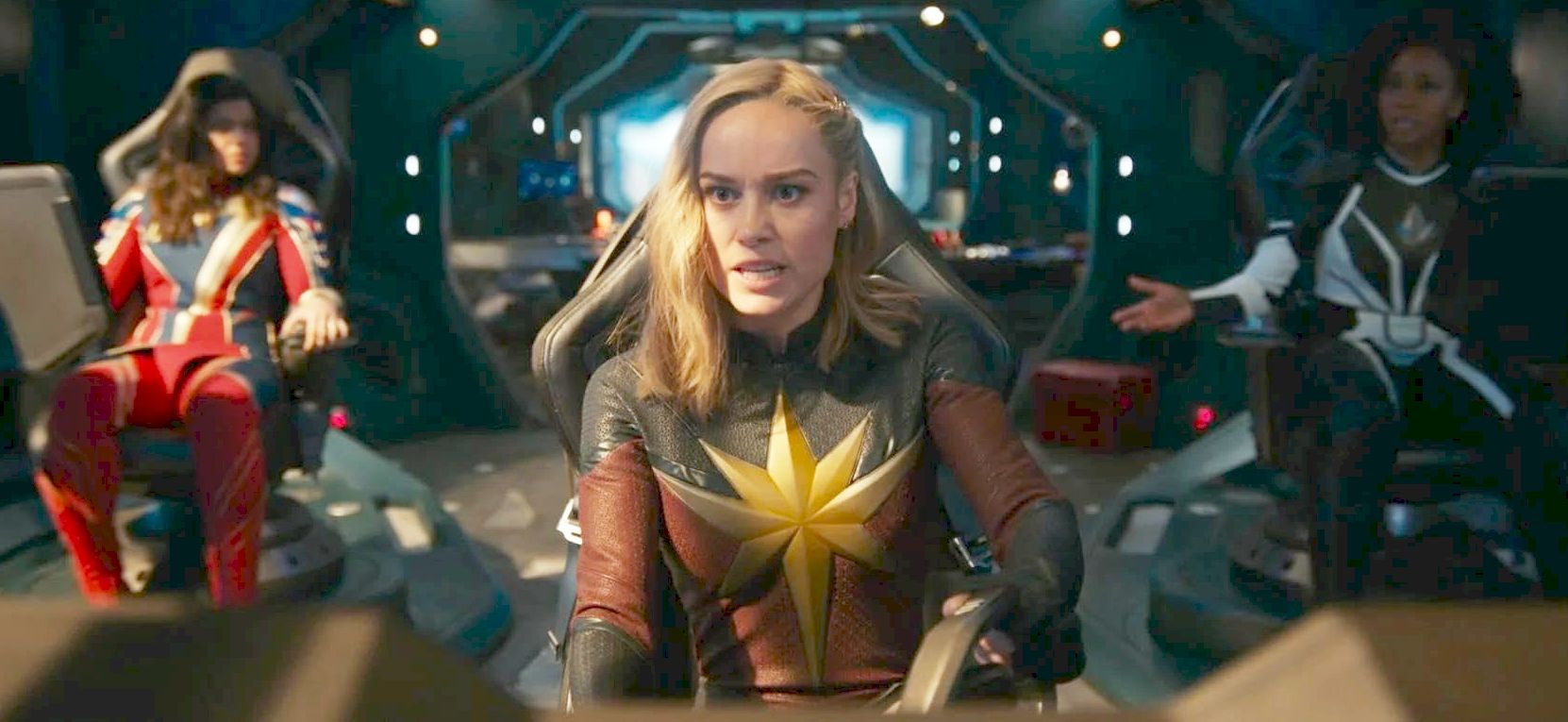
So, let’s get to the film, which sees three action heroines for the prices of one! How can you go wrong? Well… As well as Carol Danvers, a.k.a. Captain Marvel (Larson), there’s Monica Rambeau (Parris), whom I last saw as a little girl in Captain Marvel, so I guess several decades have passed since then? Like so much here, don’t expect an explanation. She apparently got superpowers after some “Hex” thing, and can manipulate electromagnetic radiation. There’s also Kamala Khan (Vellani), Ms. Marvel, who is a dedicated Captain Marvel fan-girl, but has powers courtesy of a magical bangle. However, the other bangle is in the possession of Dar-Benn (Ashton), leader of the Kree who intends to use it for malicious purposes. Because reasons, Danvers, Rambeau and Khan swap places with each other whenever they use their powers, which complicates trying to stop Dar-Benn.
I’m not prepared to swear to all of the above, since the film makes the assumption I have seen the related TV shows WandaVision and Ms. Marvel, which fill in the background of both Monica and Kamala. I have, in fact, not. This, combined with my general apathy about the MCU, left me frequently confused and/or uninterested in the finer points of whatever was going on. The lack of internal characterization present here which resulted from it, left me not caring very much about anyone – especially Khan, who seems like an annoying teenager, shoehorned in purely to appeal to other annoying teenagers. [Memo to Marvel: make movies to appeal to a minority, and only a minority will find them appealing] Rambeau isn’t much better, and Danvers just seemed like your basic, overpowered superhero.
Most of the running-time – and, at least, it’s relatively short, not much more than 90 minutes before the closing credits start – is spent bipping around the galaxy, going to places the film presumes we know, and meeting people we are supposed to recognize. I would say, the budget shows up on screen, and the action is decent, especially when the three heroines figure out how to team-up properly. But it tends to have the same problem as in Captain Marvel, where the fights frequently feel so artificial as to be lacking in impact. The only sequence which genuinely entertained me had the crew of a space-station pursued and eaten by feline-shaped extra-terrestrials, while Midnight from the musical Cats plays. It’s utterly glorious. Shame it is also so totally at odds with the po-faced approach generally taken elsewhere, which leaves little or no impression at all.
To be honest, I’d rather have five $50 million movies than one costing $270 million, and if this brings an end to the fondness for ridiculously over-priced Hollywood movies, it’s a price I’m willing to pay. It’s a shame it will, almost certainly, have a negative impact on our genre, because we’ll be forced to hear again that nobody wants to see action heroines. That’s not the case, of course. But if you spend more than a quarter-billion dollars and this underwhelming result – complete with, inexplicably, musical numbers – is all you can manage, it’s not hard to conclude something needs to change.
Dir: Nia DaCosta
Star: Brie Larson, Teyonah Parris, Iman Vellani, Zawe Ashton
 ★★★★½
★★★★½ It was a good run. There was a point, not long ago, when action heroines could do no wrong. In hindsight, the golden era may have started in 2012 when the Hunger Games franchise began, along with
  The counterpoint is experiences like this, a full-on, bombastic, in your face event that made full use of everything IMAX has in its locker, and surpassed anything I could get at home. Now, your mileage may vary. Poor Chris, in particular, found it
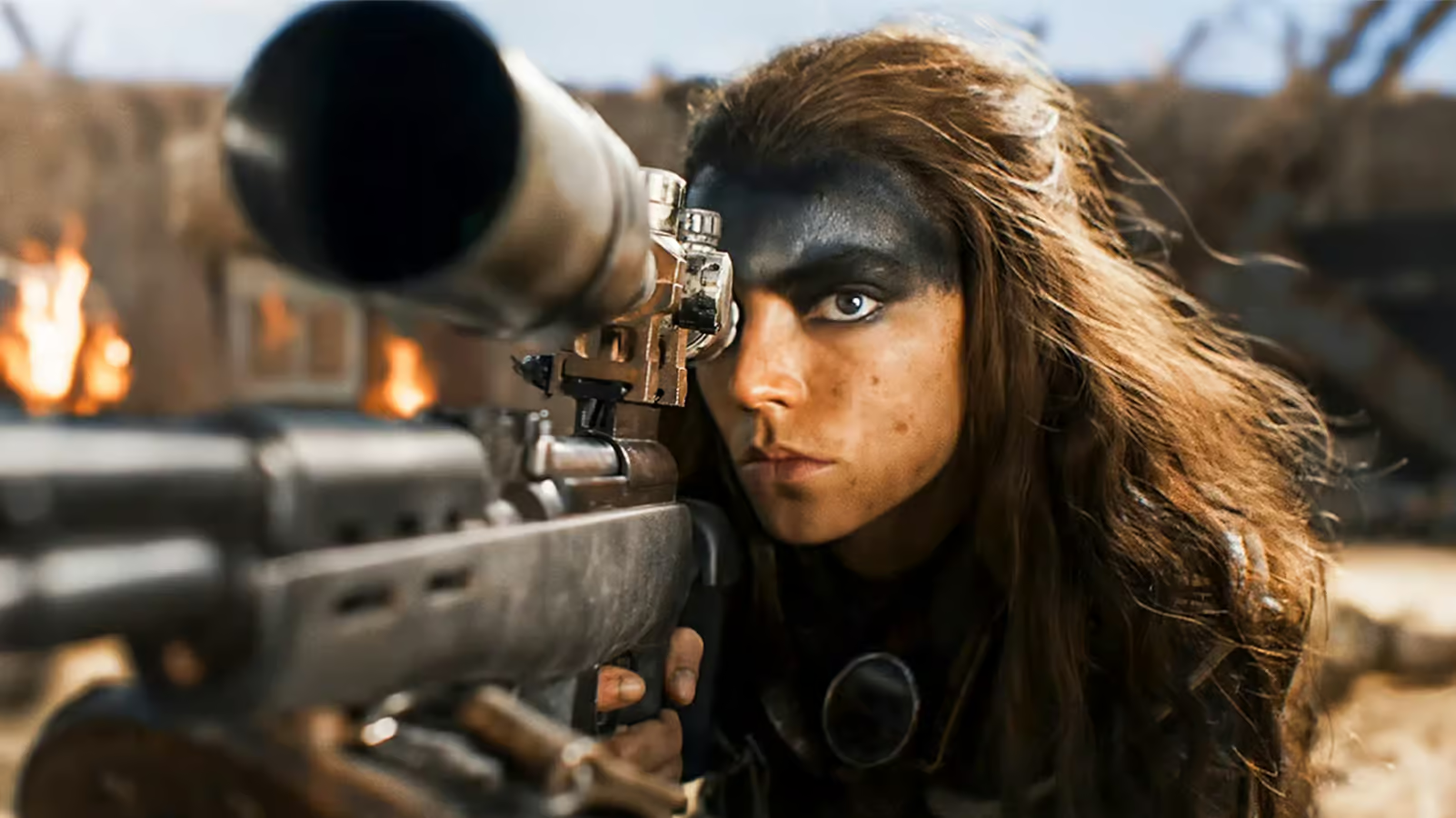
 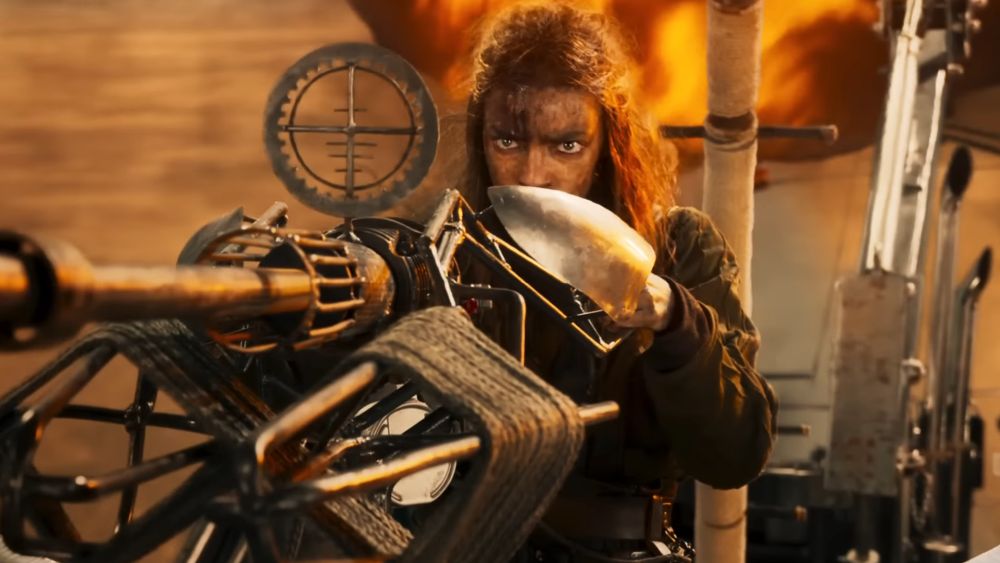 You would be hard-pushed to argue that the $168 million budget is not up on screen. I lost count of the times when I wondered whether what I was looking at really existed in the physical world, or was matte paintings and CGI. Part of me wants to peer behind the curtain and watch the behind the scenes videos. However, part of me would prefer to sustain the illusion, which was a factor in the sense of wonder that often washed over me during the screening. It’s the quest for that sense of awe which keeps me going to cinemas, even if most of the time, I end up leaving disappointed [I’m looking at you, Godzilla X Kong…]
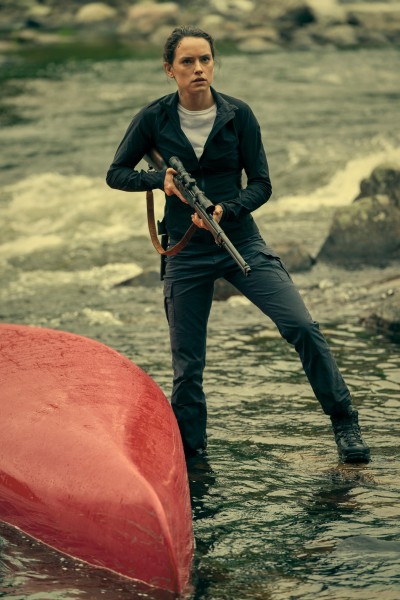 This begins with the young Helena, living deep in the woods with her mother and father, Jacob (Mendelsohn). He’s teaching her the ways of the forest, including hunting and the need to be ruthless, with the top priority expressed in the tagline above. However, things aren’t quite what they seem: it feels like it could be a century ago, yet the tranquil illusion is shattered when a lost stranger on an ATV rides up. Mom makes a break for freedom with Helena, for it seems this is actually a kidnapping which has gone on for a long time. Fast forward twenty years: Jacob is in prison, mom killed herself and Helena (Ridley) is working a dead-end job, but married to Stephen (Hedlund), and with a daughter, Marigold.
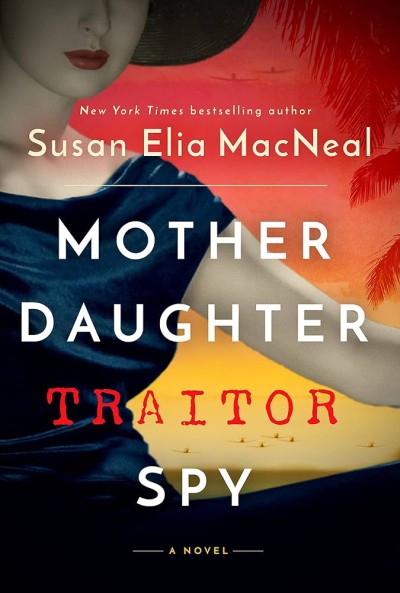 It’s often forgotten that America didn’t join World War II until almost three years after it started. In the early days, there was a strong isolationist movement, which saw the conflict as other countries’ problems, from people like aviator Charles Lindbergh and broad groups like the America First Committee. Indeed, there was a surprising amount of support for the Nazi regime: in February 1939, a rally at Madison Square Gardens drew twenty thousand people, and even after the war started in Europe, there was significant activity attempting to keep America out. It’s in this period, between the start of the war and the bombing of Pearl Harbor, that the story told here takes place.
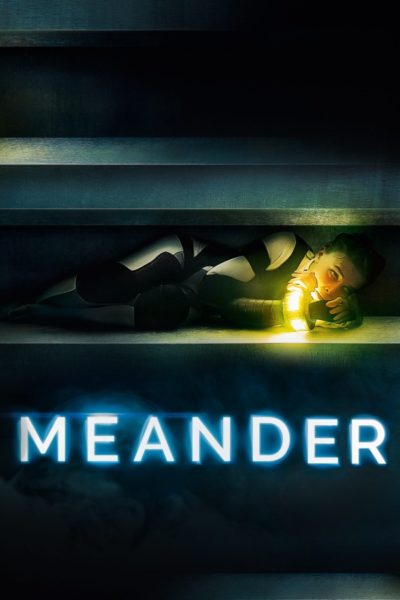 I guess, if you want to watch a woman crawling along a series of ducts for an hour and a half, this is the film for you. I’m afraid it’s just not a particular fetish I share, so the appeal of this is largely lost to me. Lisa (Weiss) lost her daughter in a tragic accident and has been plagued by guilt ever since. She wants to end it all, and to that end, is lying in the middle of the road, when she is convinced to accept a lift from passing drive, Adam (Franzén). Except, he turns out to be a roaming serial killer, who knocks her out. This is where it gets weird, since she recovers consciousness to find herself in a twisty little maze of passages, all alike.
 ★★★
★★★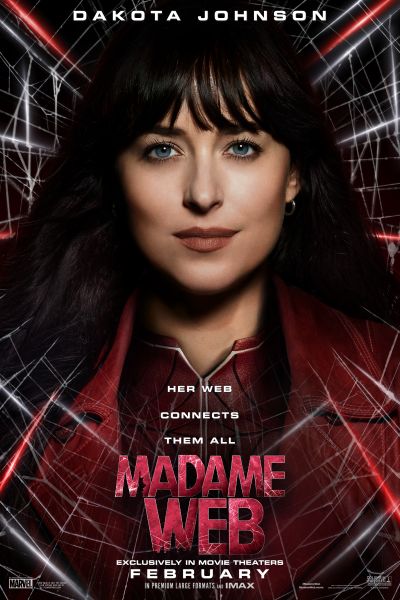 Jump forward to 2003. Cassandra “Cassy” Webb (Johnson), Constance’s daughter, is a paramedic who saves lives everyday, but is strongly averse to emotional attachment. I wondered what she does in her leisure time – but then, the same could be said about me! After being drowned, dead for three minutes, and revived, she has visions which turn out to be clairvoyant; she can glimpse the future moments before it happens. After experiencing the death of a colleague, she realizes she can act to stop her visions taking place. [What a revelation!] While on a train she foresees the death of three girls, killed by a masked man with superpowers. She tries her best to save them; no easy job as she has to improvise and out-think her pursuer constantly, while taking care of young girls who don’t necessarily follow her orders. That’s the moment you realize this movie might be made with 30-year-old moms as its target audience, which is something I have not seen before on the big screen.. Kudos for originality, I think.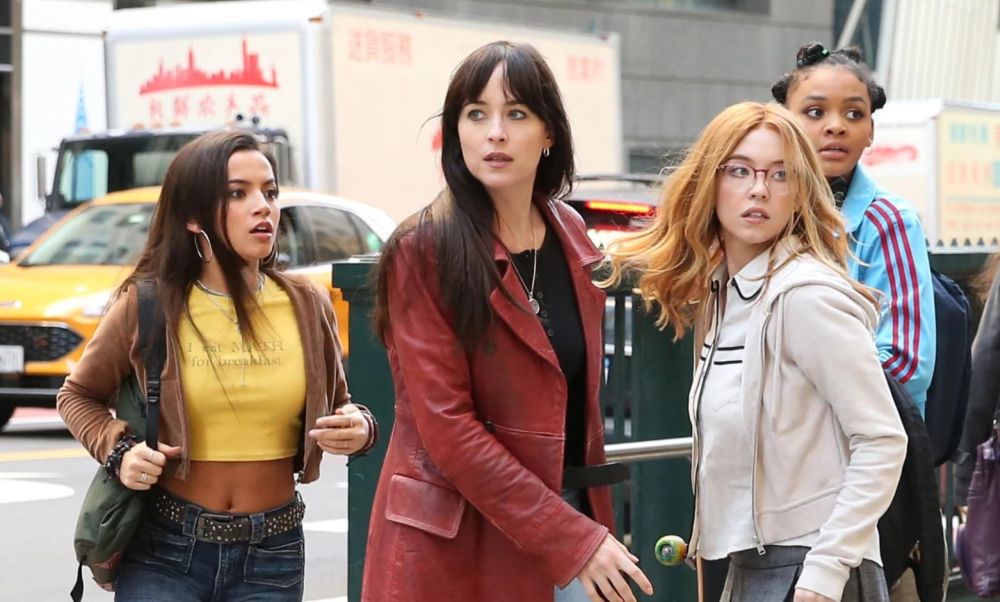
 I ask, because this film, made in Mexico City and starring mostly Mexicans, seems to be trying to take place in America. It’s not doing a good job of it. The heroine is Martha (Mazarrasa), a single mother running a shop in a border American city with the help of her two daughters, Eva (Reynaud) and Raquel. Then Eva is kidnapped by evil Mexican cartel boss, El Chacal (Guerrerio), and held by him, even after Martha pays the requested ransom. However, it turns out Mom has a hidden past, which gave her a set of special skills. With the help of sympathetic cop, Juan Cinderos (Dulzaides), she sets out to bring down his organization and retrieve her daughter.
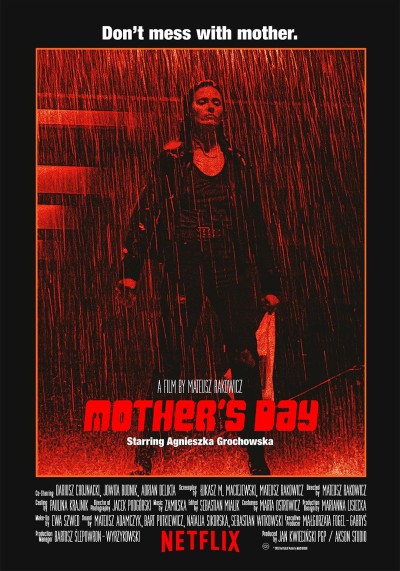 I’d be the first to admit, those issues likely extend beyond the characters in the movie, and probably extend to the script writers, because there are certainly… well, let’s just say, some novel concepts here. The heroine is Nina Nowak (Grochowska), a former Special Ops soldier, who had to fake her own death and give her son Maks up to adoption, for both their security. She’s been keeping an eye on Maks (Delikta) from afar, but after he’s abducted at the request of a gangster Nina took down, she needs to become considerably more hands-on. Rescuing Maks, however, will bring her into contact with a number of rather odd people, on both sides of the law.
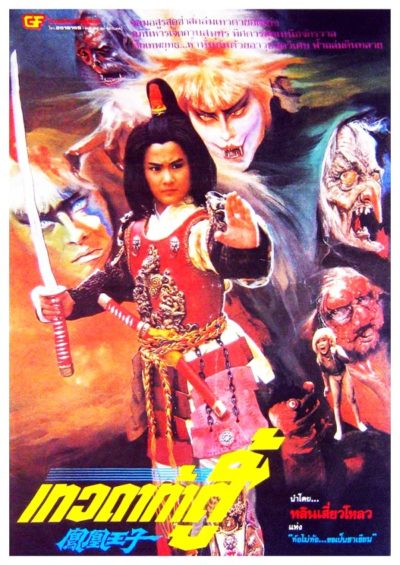 I am going to be entirely upfront, and state that any factual statements regarding the plot here will be entirely cribbed from other sources. Because, on my own, I have close to no clue as to the details of what was going. I got that some girl dressed as a guy, Little Flying Dragon (Lin, inevitably) was trying to protect Golden Boy (Chan) from a bunch of very strangely dressed weirdos with even more bizarre powers. They want Golden Boy for some nefarious purpose on behalf of an evil sorcerer type, who laughs maniacally. A lot. Everyone involved wears wigs which look like they were bought in bulk from Hair Metal R Us. There’s an acid pit, into which Golden Boy’s father is unceremoniously dropped. His mother is called “Evil Lady” in the subtitles, though she isn’t really. At one point, there’s a song whose lyrics according to the subs go, “Little Flying Dragon, Little Flying Dragon, change all the time, power breads everything.”
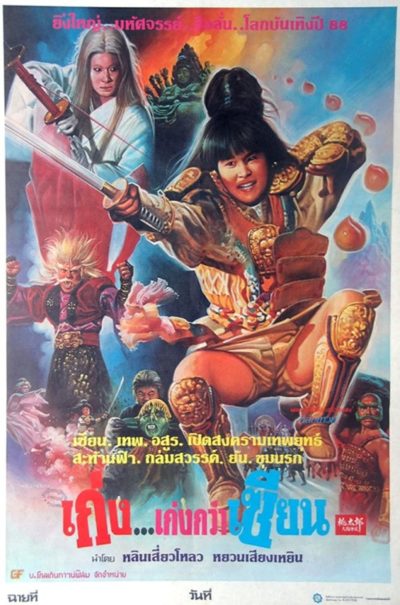 The best way to describe this, is perhaps to say that if I was nine years old, I would think it was the greatest movie I had ever seen. And I would likely be right, at the time. With the benefit of [redacted] more years, and several thousand additional movies under my belt… Not so much. Oh, it’s excessive, insanely imaginative and high energy, to be sure. However, it is also slapdash, incoherent and juvenile. Never mind appealing to nine-year-olds, it often feels like it was made by nine-year-olds. This explanation could be the most logical way to explain how the film manages to misspell its own name in the opening credits, calling itself Magic of Stell.