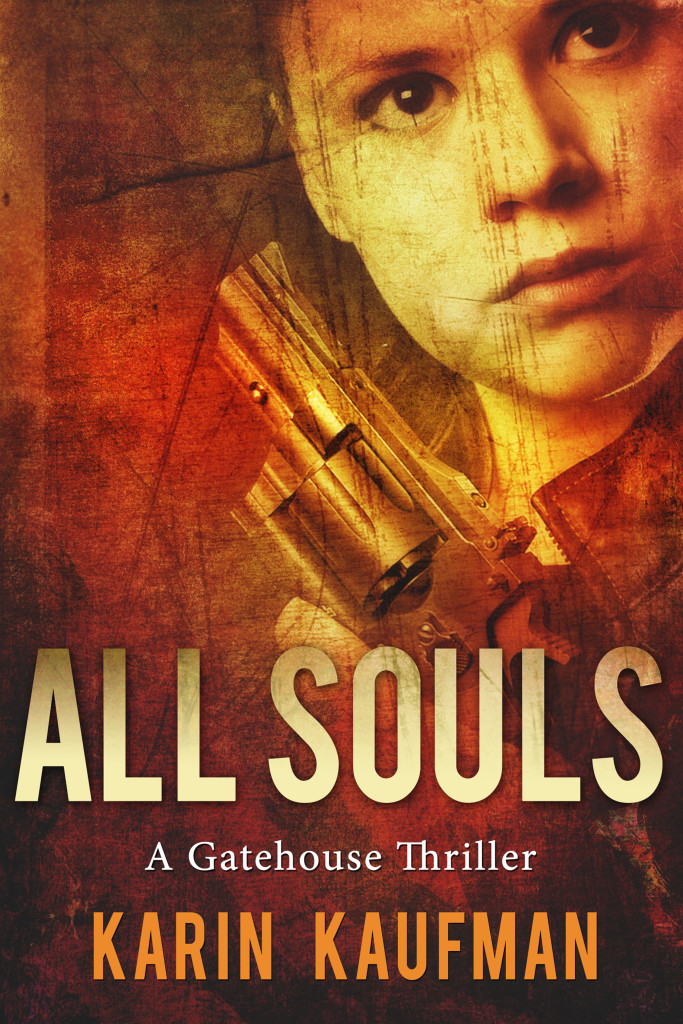

All Souls: A Gatehouse Thriller, by Karin T. Kaufman

Literary rating: ★★★★
Kick-butt quotient: ☆☆☆½

allsoulsFull disclosure at the outset: Karin Kaufman is a Goodreads friend of mine, and I was one of ten people to claim a free review e-copy of this book. Through much of my reading, I was ready to give it a solid three stars, and the super-strong ending commanded a fourth.

The premise here is that humanity is secretly menaced by a worldwide society of thrill killers, who make the notorious Thugees look like philanthropists, and who are recruited from all walks of normal life, into which they blend anonymously. (Their Gatehouse adversaries call them “Sacks,” short for “Sacks of sh*t”.) By Gatehouse estimates, the society has well over a million members, and has been around for at least 100 years. Organized in hierarchical ranks (members of each rank supposedly don’t cooperate very closely, and hate the other ranks –but they take orders from the higher ranks, and want to advance into them), it has a culture of strange behaviors, like the members taking bizarre secret names and tattooing them on their bodies.

Yet it has apparently no belief system or ideology except conscious embrace of evil and chaotic destruction for its own sake; Sacks apparently have no agenda beyond picking off as many individual innocents as they can without being exposed. The U.S. government –and possibly other governments, but our setting is the U.S.– knows about them and preserves their secrecy. But it combats them with an unofficial arm, the Gatehouse organization, which commands a small army of “hunters” who periodically assassinate individual identified Sacks (as opposed to, say, dealing with them through law enforcement and the court system) at the direction of contacts called “porters.”

Our action-heroine protagonist here is Gatehouse assassin Jane Piper, who’s very competent at what she does, and very motivated –her only sister was butchered by a Sack. She’s as lethal a woman as you’ll ever meet in fiction –but at the same time,one of the most compassionate (the two qualities aren’t incompatible), a decent person who’s kept her humanity and moral compass in a blast furnace of trial. I never had any trouble liking her, nor any doubt of her butt-kicking capabilities.

Early on, Jane reflects that if she stood up and shouted all of the above information in public, nobody would believe her anyway. Apparently, she thinks that the general populace might find this premise far-fetched. Readers might have the same difficulty. The idea is definitely original, but it’s rather hard to suspend disbelief here. While many people do embrace very evil agendas, including the killing of the innocent, hardly any do so while openly and consciously telling themselves that they’re doing so. The vast majority of them have to have some ideological belief system that justifies the evil by telling them that in reality it’s “good,” or for a greater good. I may be naive, but I don’t think Sack recruitment on the basis of “embrace homicidal evil just because it’s fun” would gain as many adherents as they have here. And while I see how Sacks have an interest in keeping their activities secret, I don’t buy the explanation that the government tacitly agrees to cooperate in letting them do so, lest they unleash an even greater blood bath if they’re forced into the open. Credibility is also strained by some individual characters’ motivations. Granted, action-heroine fiction writers often do stretch strict credibility a bit in their premises, and sometimes the tone is sufficiently tongue-in-cheek that the reader doesn’t take such lapses very seriously. Here, though, the tone is pretty serious.

It’s all the more a credit to Kaufman’s ability as a writer, and the strength of this book, that she took that kind of premise and made a four-star book out of it. Her command of language is impeccable –professional, literate, with the kind of painstaking craftsmanship that makes the flow of words seem easy. A Colorado native, she sets her tale in her home state, and the neighboring parts of New Mexico and Wyoming; she’s obviously at home on the ground, with real locations and a sense of place. The plotting is very taut in terms of time, compressed into just seven days –Oct. 27-Nov. 2, All Souls Day. Jane’s a first-person narrator for all but the first chapter, and hers is the perfect voice for the tale. She and the other major characters are all well-drawn. “Gripping” doesn’t begin to describe this book; it grabs you and pulls you along from the starting gate, and I’d have read it in one sitting if I could have.

That’s not to say it’s all action; but the waiting intervals in between are as tense as harp strings. When action comes, it comes quick, realistic, and bloody, with a high body count by the time you get to the last page; Kaufman knows her guns, and she writes action scenes clearly and credibly. Jane’s colleagues tend to be as combat-skilled as she is; and some of their adversaries are extremely deadly and crafty as well. (Generally speaking, in real life I have a problem with governments violating their own laws by sponsoring programs for extrajudicial killing. But I don’t hold operatives like Jane and Nathan responsible for acting in the situational context they’re in. They don’t make the policy; all they can do is protect the innocent and take care to kill only the guilty.) And Kaufman’s plot is a roller-coaster of surprises.

Ultimately, though, this is more than a novel of slam-bang action. It becomes a serious exploration of the possibilities of moral conversion, from great evil to willing embrace of good; of guilt and atonement; of the limits of forgiveness –in short, the kinds of serious moral questions that occupy the great literature of the Western tradition; underneath the smell of gun smoke and blood, we’re in the same realm here that Hawthorne and Dostoevsky, Undset and Graham Greene have visited before. Since this is a series opener, it’ll be interesting to see where Karin takes this theme in future books. And I’ll find out; because I definitely want to follow the series!

Note: there’s not only no sex here, but no romantic sub-plot. Gatehouse doesn’t encourage its operatives to marry, and doesn’t allow them to stay in the organization if they conceive a child. (If Jane ever decides that she wants a man in her life, I think that she deserves a good one, and that she’d be a great wife; but for now, she’s content to be alone, and doesn’t obsess about men and sex.) There is a fair amount of bad language, including some use of the f-word.

Author: Karin T. Kaufman
Publisher: Amazon Digital Services, available through Amazon, only for Kindle or as an audio book at this time.

A version of this review previously appeared on Goodreads.

Clash

There used to be a review of Vietnamese movie Clash here, along with the movie’s trailer. However, in what can only be described as a bit of a dick move, Johnny Tri Nguyen, one of the film’s stars, submitted a takedown notice for the trailer. Yes, the trailer: footage specifically created and intended for promotional purposes. We emailed him politely asking how we could resolve this amicably. That was over a week ago. Not even the courtesy of a reply.

So, as a small protest at Nguyen’s high-handed and counter-productive actions, we’re pulling all reviews of films in which he appears from the site. I’m sorry to the rest of the cast and crew – particularly the action heroines whose presence is why the films were reviewed here to begin with. But if he’s going to behave this way, and act to shut down legitimate and reasonable coverage of his films. I’m happy to oblige.

Dir: Le Thanh Son
Star: Ngo Thanh Van, Johnny Tri Nguyen, Hoang Phuc, Lam Minh Thang
a.k.a. Bẫy Rồng

Real Dangerous Job, by K. W. Jeter

Literary rating: ★★★★★
Kick-butt quotient: ☆☆☆½

kimoh2I was graciously given a free review e-copy of this second series installment by the author, with no strings attached. As in the case of the first one, I blazed through it; it’s compulsively readable, and I made every opportunity I could to log on to it. Had time permitted, I’d have read it in one sitting –it’s that compelling.

Much of the evaluation and background material in my review of Real Dangerous Girl applies to this sequel as well. Here, Jeter brings the immediate story arc begun there to a close, while leaving the future open. The themes of coming-of-age, “primitivism,” and darkness vs. light begun in the first book are also explored further here, to serious effect. Kim has to really grapple here with the significance of what she’s decided to do, and face the fact that it’s changing her into a person who’s less innocent and less gentle, and that this isn’t necessarily a good thing. But that’s set against other psychological factors of self-actualization and self-determination that aren’t wholly negative either. This isn’t the story of a good girl changing to a bad one. It’s the story of an essentially decent girl learning to balance who she is with a world that’s far from decent, with no other guides (besides a very dubious mentor) than her heart and her conscience. And this will be reflected in the real moral choices that come her way.

We get to know Kim better here, as a person as well as the fact that she’s only 17 (as an “emancipated minor” –though we already knew she was pretty young). Other supporting characters are back and developed in more depth as well –not surprisingly, Cole, Donnie, Monica, McIntire and his chief goon Michael (and more surprisingly, TV newswoman Karen Ibanez). Also, we learn that our setting is a city in upstate New York (a character comes “up from Albany,” an expression that wouldn’t apply to New York City, which is down the Hudson from there, but would to cities built in the higher ground above the river valley). Jeter has kept his moral vision and standards of literary quality here. Again, there’s no sex, and bad language is restrained. Action fans who felt that the first novel was light on violence (several people die there, but in only two parts of the book) will get more of it here, and Kim will be an active participant in more of it. Her development into someone who can both psychologically and physically handle that, as Jeter presents it over the course of the two books (rather than overnight) is believable. But again, the violence is handled tastefully, with no wallowing in gore for its own sake.

I didn’t have any issues with plot credibility here, and the pacing and developments are excellently crafted to keep a high level of suspense and tension, again building to a very powerful climax. Jeter imparts a lot of obviously well-researched information about guns and ammo, explosives, body armor and other technical equipment that adds verisimilitude without being info-dumped in in such large doses that it takes away from the movement of the story.

Kim’s a heroine I think many characters can relate to in her moral quandaries, even though they involve extreme situations most people don’t face –because, as she muses at one point, everybody, or just about everybody, at times has people who, at one level, they might like to kill, and figure the world would be better off without. The moral possibilities Jeter is using action-adventure fiction to explore are possibilities, or temptations, that confront us all.

One of the greatest strengths of these books, IMO, is the brother-sister relationship between Kim and Donnie, which is genuinely beautiful and touching (and a two-way street of caring and emotional support). As an only child, I never had a sister; but if I’d had a big sister like Kim, I think I’d have counted it an enormous blessing!

Author: K. W. Jeter
Publisher: Self-published, available through Amazon, only as a Kindle e-book at this time.

A version of this review previously appeared on Goodreads.
Killer Biker Chicks

★½
“Vanity kills.”

killerbikerchicksOh, dear. I’m sure those involved with the production and their mates loved this. To anyone on the outside… Much less so. However, the problem is not actually the concept, of an all-female biker gang, which had a long, disreputable B-movie pedigree, going back at least to the sixties, with Herschell Gordon Lewis’s She-Devils on Wheels and similar films. The women here operate under the leadership of “Mother” (Gorlano), and in something apparently inspired by Sons of Anarchy, run a garage/bar that doubles as gang HQ, from where they also deal meth to passing truckers (and midgets), while taking their tops off at random intervals – in particular Baby Doll (Roth). Possible related: there may be a strip-club that’s part of it, but the film is vague on the details of their infrastructure.  The movie starts well enough, with them out in the desert torturing a man who had done one of them an unspecified wrong, dousing him in gas and setting him on fire.

If the film had stayed here or hereabouts, things would have been significantly better. But the next time we see them, their numbers are inexplicably reduced to a level where they could have their gang meetings in a phone-box. Worst still, writer-director Redding instead chooses to dilute his material with a bunch of truly dreadful supporting characters, who range from superfluous down to the point that you will be praying for a power outage to save you. In the former category are a passing band, Glam Puss, whose van breaks down on their way to a gig, and who have to hang out at the ladies’ establishment for a couple of days. They do actually provide the only genuine laugh in the film, with their reactions to a story from Mother’s earlier years. Further down the scale, at “gratingly cliched,” are a pair of corrupt cops who spent their time hassling and shaking-down citizens, when not hanging out at a strip-club, whose owner is played by Ted V. Mikels, the infamous director of some god-awful works we’ve covered here before. That the makers think him deserving of a cameo should be seen as a warning of what to expect.

Right at the bottom of the barrel, however, are the “comedic stylings” of Rusty Meyers as Hawksmeir, an Azerbaijani tourist. Within two minutes, you’ll be left with deep appreciation for the comparative subtle understatement that was Borat – indeed, through in a Chinese store-owner who is less convincing than Mickey Rooney in Breakfast at Tiffany’s and you’ve got something which is embarrassingly unfunny at best, and quite possibly offensive [and, don’t forget, I’m someone who loves Ilsa, She-Wolf of the SS, so do not offend easily]. Almost as annoying is the soundtrack, which appears to consist largely of bands who put the director on the guest-list or something, and is rarely less than aggravatingly intrusive. These, together with random acts of motiveless (and, apparently, pointless) violence by Mother and her crew, dominate proceedings until the last quarter, where a drug deal with another biker gang, the Rebel Cocks, goes wrong, leading to the final confrontation.

Great B-movies take interesting central characters, then put them in situations that drive the storyline forward, and possess a consistent style and approach that complements the content. This merits a marginal passing grade on the first category, but fails utterly at the second, and Redding appears to use every special effect available on his camcorder, resulting in a lurid mess. A decent idea ends up chewed into pulp, then vomited out onto your screen.

Dir: Regan Redding
Star: Brenna Roth, Sara Plotkin, Sarah French, Rose Gorlano

Confine

★★½
“Home invasion, English style”

Pippa (Lowe) is an international model whose career is ended after a car accident leaves her with a disfigured face. Her confidence shattered, she retreats to the safety of her apartment, not leaving it for any reason. But her stately isolation is disrupted by the arrival of Kayleigh (Bennett), an art thief who needs a place to hide out, and takes Pippa hostage while she waits for her accomplice, Henry (Allen), to show up. But when he does, Henry is knocked out and tied up too, as Kayleigh’s hidden agenda becomes apparent: she has few, if any, moral scruples, and is using Henry just as much as she is using Pippa. But is there perhaps even more going on than it seems? Was Kayleigh’s arrival in Pippa’s apartment purely the stroke of bad luck it initially seemed?

There’s something to be said of the claustrophobia generated by a confined setting: in some ways, this reminded me of 2LDK, though the adversaries here clearly have a different kind of relationship. The inability of the heroine here to leave adds an additional level of peril to the well-worn home invasion genre, perhaps making Audrey Hepburn’s Wait Until Dark another influence, with Pippa’s disabilities (which include OCD) standing in for blindness. Tobbell and cinematographer Eben Bolter seem aware of the potential limitations of their space, using a number of visual tricks to keep things interesting, such as overhead shots. While some work, it betrays an apparent lack of confidence in their material and its ability to retain the audience’s engagement. Perhaps this is tied to their lead’s inexperience as an actress – this was Lowe’s feature debut, though her “day job” as a model certainly makes her not inappropriate for the role, and her performance is respectable enough.

confineBennett certainly has the more interesting role, with Kayleigh’s background as much a mystery as her goals: is she genuinely the Sloane Ranger robber she seems? I can’t say I was ever convinced by her character, though it is still much more developed than Henry, who exists almost solely so he can be tied up and abused (between this and Theon Greyjoy from Game of Thrones, it seems torture is a requirement for Allen’s contract). The main problem, however, is a script which consists almost entirely of contrivance: people behave in a way necessary for the script to progress, and which doesn’t make much sense on any other basis. There’s one obvious signpost pointing toward how this will end, so when this comes to pass, it provokes less shock and more of a casual shrug. Maybe it’s all just too Britishly polite for its own damn good.

Dir: Tobias Tobbell
Star: Daisy Lowe, Eliza Bennett, Alfie Allen

Rica 3: Juvenile Lullaby

★★
“Carry On Raping”

rica3The third and last installment depicting the adventures of mixed-blood juvenile delinquent Rica (Aoki), has very much run out of ideas and is playing out the string: it’s no surprise the series ended here, all but taking Aoki’s career with it. As in the previous installment, it starts off with her confined to Aiyu Reform School, but it isn’t long before she has busted out. The storyline here focuses again on her half-black friend Hanako, whose daughter has run away. Unfortunately, she has actually been abducted by a gang, who are selling her on to a Western pornographer, who will pay a high price for a Japanese virgin. Rica herself falls foul of the gang, whose leader has no tolerance for Americans or Amerasians, due to an earlier incident where his girlfriend was raped by GIs and later killed herself.

Which all might be interesting – or, at least, okay – if this were executed straight, for intensity. Unfortunately, they got a new director in, Yoshimura replacing Kô Nakahira at the helm for this one, and he appears to have had a very different vision of the project.  For some reason known only to the film-makers, large chunks of this are obviously played for comedic relief, such as the sequence where they try to gang-rape Rica, only to be knocked out, one by one, through having a winch dropped on their heads. Throw in music which appears to have strayed in from Benny Hill, and you have something that has failed dismally to make the cultural transition over time and space – and that’s not even getting into the astonishingly obvious use of blackface for Hanako. It would take a special kind of talent to pull this kind of political incorrectness off, and even speaking as a viewer who is about as far from PC as imaginable, Yoshimura comes up woefully short. If you can make me cringe with embarrassment for the heroine, you’re doing… something. Just not what I want.

There are redeeming elements, led by Aoki’s continually smouldering portrayal of the heroine, who has a chip the size of Stonehenge on her shoulder against society, and takes no shit from anyone, be it her cell-mates in reform school, street punks or pornographic film-makers. When the film is pointed in the right direction, it’s by no means terrible; it’s just unfortunate that this tone is never sustained for long, before another wacky interlude destroys any atmosphere. It’s also a shame Aoki appeared in only one other movie, 1974’s Gakusei yakuza, since she has a striking look that could have sustained a longer career. This isn’t much of an epitaph.

Dir: Kôzaburô Yoshimura
Star: Rika Aoki, Jiro Kawarazaki, Taiji Tonoyama, Kotoe Hatsui

Deep Gold

★★½
“Sea minus.”

deep goldI love reading IMDb reviews where half are “totally brilliant film-making!” [obviously by people related to the production, who have generally reviewed nothing else] and half are “worst movie ever!” More than half the votes here are either 10’s or 1’s: of course, the truth lies in the middle. This is proficient, with occasional aspirations to competence, along with some nice production values and scenery, yet founders mostly on a bad script, partly on a misguided belief that filming underwater is interesting, in and by itself. That probably hasn’t been true since Jacques-Yves Cousteau hung up his Undersea World snorkel at the start of the eighties. Maybe these sequences worked better in 3D, as originally shot?

It’s the story of two sisters, Amy (Pham) and Jess (Ong): the former is a free-diving champion, but the latter refuses to go into the sea [there are reasons for this, explained in flashback; they are, however, irrelevant. Of course, her hydrophobia is an obvious foreshadow of the movie’s climax]. Amy’s boyfriend is in the Air Force, but vanishes along with his plane, transporting a cargo of gold back to Manilla. The Air Force suspect he and Amy may have staged the disappearance to solve their financial problems, and so the sisters head for where reports indicate the aircraft went down. Which isn’t anywhere near where the search is taking place. Hmm. There, they team up with a local businesswoman (Prudent), and also travel journalist, Benny Simpson (director Gleissner pulling double-duty), only to find they are not the only people interested in recovering the golden treasure.

I’m not the only person to have reviewed this and been reminded of the work of Andy Sidaris, with which it shares a tropical location and actresses cast more for their looks than their variable thespian abilities. This does have a glossier sheen; on the other hand, if you’re hoping for any nudity, look elsewhere. I think the main problem is the old “acting in your second language” issue, which appears to be the case for most of the cast. Pham has to do most of the heavy lifting, and nails only about one line in three, with others sounding more as if they are delivered through phonetic translation. When things are in motion and SCUBA-free, the film fares rather better. The action scenes are decently staged, the pick likely being Amy getting chased around a library by a slew of thugs, though the final ship-board encounter is nicely done as well. However, embarrassing sloppiness counters this, such an abduction scene where it looks like the same henchman climbs into the car twice, once in the back and once in the front, while Amy’s hands mysteriously get bound, albeit with the sort of constraint she can literally shake off.

It works mostly as a very nice promotional piece for the local tourist board, and if you’re looking for something pleasant looking and possessing absolutely no depth, you could do a lot worse. However, the more you look at this in detail, the more you will likely find yourself going, “Hang on…”, and that’s even before a final credits sequence where the actual local mayor reveals some kinda important storyline information. It’s just another part of a plot which strains even my credulity, and leaves the movie, if not sunk, certainly holed below the waterline.

Dir: Michael Gleissner
Star: Bebe Pham, Jaymee Ong, Michael Gleissner, Laury Prudent

Rica 2: Lonely Wanderer

★★★
“Black and white and red all over…”

rica2Our mixed-blood heroine is back, albeit with a slightly-different spelling of her name, a C replacing a K. But she’s still wading through criminal shenanigans from the get-go, as she escapes from reform school and gets informed that her similarly cross-bred friend, Hanako, is in trouble. The bearer of the bad news is shot dead before she can provide details, and when Rica heads to northern Japan, her train journey leaves a trail of dead bodies, of those apparently intent in making sure she doesn’t find out the truth. Turns out Hanako was providing entertainment on a ship, which was sunk by criminals, and one of the gangs responsible, under their female boss Yukie Shimamura (Tonoyama), is obliged to tidy up the loose ends – Hanako is now confined to a mental hospital. The local police, certain members of whom have ties to the gang, are not exactly enthusiastic about investigating any of this, but there’s clearly someone (Minegishi) on Rika’s side, as she finds herself receiving assistance and protection, from a source whose motivations are initially opaque. However, as the corpses continue to pile up, how long will it be before Rica becomes another one of them?

I’m not sure if the makers are taking this one seriously or not. Some aspects, such as Rica’s train ride, have an avant-garde and almost surreal approach, told without dialogue and instead utilizing a series of deliberately jarring cuts, between Rica and close-ups of the sun-glass wearing men who are following her. It’s unusual, effective and memorable. But then, there are other moments which are so ludicrous as to be completely laughable. For example, one fist-fight between Rica and a man trailing her, ends with him pulling out a short sword and committing seppuku. Why didn’t he – and this is just a casual suggestion – stab her with the freakin’ knife. There are also several too many song and dance numbers, mostly courtesy of Rica’s transvestite sidekick, though she herself also gets to strut her stuff on the stage at one point. and there’s more than the usual amount of casual xenophobia.

Against this, there’s no doubt that she seems to kick ass with copious frequency, though the fight scenes here fall more into a category I’d label, “enthusiastically amateurish.” It’s also nice that she’s going up against a female adversary. Shimamura herself makes for an intriguing character, since she’s following in her father’s footsteps, despite severe misgivings about having to keep the promises he made. The story does build fairly nicely, wobbly through its shakier moments to a final confrontation that ties up the loose ends, yet still leaves things open for a sequel. And, what’s this sitting in my viewing pile? Part 3? Despite some undeniable misgivings about the story here, don’t mind if I do…

Dir: Kô Nakahira
Star: Rika Aoki, Ryunosuke Minegishi, Taiji Tonoyama, Mizuho Suzuki

Everly

★★★½
“In which Salma Hayek suffers from an apartment complex.”

everly6Not sure how this managed to escape attention in our 2015 preview, because it’s hard to think of a film more directly positioned in our wheel-house. This unfolds entirely in a single building, close to real time, the vast majority of it (as with 2LDK) in one apartment, where Everly (Hayek) has just been outed as betraying her boss, a ferociously vicious Japanese mobster called Taiko (Watanabe). Desperately, she calls her mother (Cepeda), begging her to take Everly’s daughter out of town, but when that route is closed, they’re forced to hide out with Everly in the apartment. It’s not much safer, for Taiko has offered a bounty to anyone in the building willing to take down his turncoat – and also some increasingly-deranged professionals. Meanwhile, we also find out more about Everly’s history, which includes four years trapped in the apartment building as a sex slave for Taiko and his cronies.

Lynch has described this as Die Hard in a room, with Hayek instead of Bruce Willis. Despite sharing a similarly “ironic” Christmas setting, it isn’t: Lynch may wish it were, but the pacing is nowhere near perfect, the script isn’t as engaging, and whatever Watanabe’s qualities are, he’s no Alan Rickman. Not to say that it’s a bad film at all, especially considering this wasn’t originally supposed to star Hayek. Back in February 2012, Kate Hudson was announced as headlining the cast, before being replaced 15 months later by Salma Hayek. One can only wonder what difference that might have made, because her replacement certainly takes the role and owns it. [Side note: she’s only a couple of months younger than me. Damn…] It’s also gleefully and gloriously R-rated, not skimping on the bad language or hyperviolence, resulting in a comic-book feel which works nicely.

However, this leads to problems with the script, right from the opening sequence in which an apparently untrained Everly takes out, with unerring accuracy, an entire room of gangsters. Given her supposed prisoner-like status, it also proves remarkably easy for her mother and daughter to join her, basically swanning into the building on the pretext of visiting someone on another floor. And, to be honest, some of those who lay siege to our heroine aren’t as amusing as Lynch and scripter Yale Hannon seem to think, with the Sadist (Igawa) in particular overstaying his welcome. On the other hand, the lack of any romantic interest is refreshing: the only vaguely sympathetic male character is a Japanese man, and he spends his entire screen-time bleeding out on the sofa. It probably needs to be more unrelenting and with a better sense of escalation: as is, the film peaks in its opening 10 minutes, when it seems killers are popping out from everywhere. However, it’s been a while since we’ve seen Hayek in an action role: between this and Bandidas, she has done a good enough job, it’s something I wish we got to enjoy more often.

Dir: Joe Lynch
Star: Salma Hayek, Hiroyuki Watanabe, Laura Cepeda, Togo Igawa

The Mini-skirt Mob

★★★
“Hell hath no fury like a blonde scorned.”

miniskirtIt’s not much of a stretch to imagine this coming out of Japan, as an early ancestor of the pinky violence genre. Though that would probably require the additional of significantly more nudity, since it proves surprisingly coy on that front, without a nipple to be found. The central character is Jeff (Hagen), a rodeo star who has just married Connie (Jackson). This does not sit well with his old flame, Shayne (McBain), who heads an all-girl gang, The Mini-skirts. Together with a group of male bikers (who include cult legend, Harry Dean Stanton), they harass the newlyweds, on and off the road, until a tragic accident leads to the death of one of the bikers. Then, the gloves come off, with Jeff and Connie besieged in their caravan by Shayne and her crew. However, they find an unlikely ally in Shayne’s sister, Edie (McCormack, who had previously been nominated for an Oscar as the tiny psychopath in The Bad Seed). While she stepped aside from Jeff when Shayne decided she was interested, Shayne is now sniffing around Edie’s current man, Lon (Jeremy Slate) and Edie has no interest in stepping aside again.

It’s an interesting set of power dynamics here: Shayne is the one who runs things here, manipulating others – Lon in particular – to do her bidding without the slightest qualm. For instance, after Lon has brawled with Jeff to the point where the latter has pulled a rifle on the gang, as far as Lon is concerned, that’s the end of the matter. But Shayne casts aspersions on his manhood, basically goading him into further action. She has also the whip-hand in her relationship with Edie, who is initially happy to follow along, clinging to her big sis’s coat-tails, until the scales fall from her eyes and she realizes how far Shayne is prepared to go in her quest for vengeance against the man who has – oh, the horror! – found love in the arms of another woman, Or, as Shayne puts it, “You need a real woman, Jeff – not a mouse.” Rodents are something of a running theme, it appears: she also tells a touching story of a visit to a zoo with Jeff, where she watched a snake hunt and swallow alive a mouse. Who said romance was dead?

It’s Jackson, using so much hair-spray she doesn’t need a motorcycle helmet, who keeps this watchable – even when the biking scenes, juvenile delinquent hi-jinks and Budweiser product placement begin to wear thin, and that doesn’t take very long. However, the siege of the caravan racks up the tension, and brings an unexpected and quite nasty death, albeit one clearly accomplished through thoroughly unconvincing stunt-doubling. That, and a finale where Connie shows an equally unexpected streak of malice, left me suitably entertained, though it would certainly be a stretch to call this anything more than throw-away drive-in fodder.

Dir: Maury Dexter
Star: Diane McBain, Ross Hagen, Sherry Jackson, Patty McCormack