




★★★½
“Brazilian whacks.”
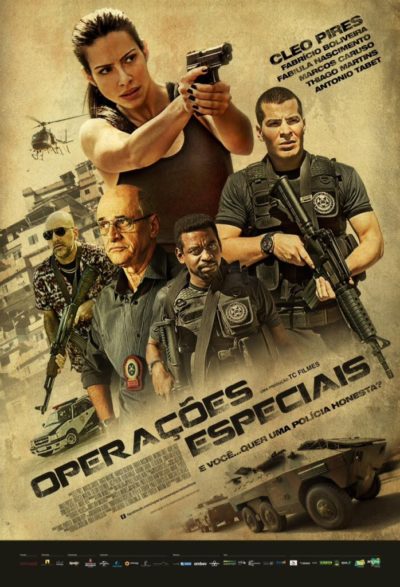 The Brazilian special police unit, known as BOPE (Batalhão de Operações Policiais Especiais) have a ferocious reputation for a hard-edged approach to its work. This is, likely, necessary for surviving the favelas (slums) of Rio in which they operate, going up against heavily-armed drug dealers. But with this also comes a “by any means necessary” approach, which has come in for criticism. They’ve been the topic of films before, most notably the incredible Elite Squad, which is an all-time classic of action cinema (and removed any chance of us attending the 2016 Olympics). It’s into this obviously macho environment, that rookie policewoman Francis (Pires) is dropped, and has to make her way.
Early on, this is a heroine who is seriously out of her depth, being a former hotel administrator, who opted to join the police after a robbery at her place of work. Quite how she ends up on the squad is a bit vague: quotas may have been involved. Anyway, they’ve just succeeded in flushing the bad guys out of Rio, but the perps have taken root in a suburb instead, so for their next mission, BOPE are sent there to supplement/replace the local cops. Initially, both residents and city government are delighted to have someone there, following an incident in which local kids were shot. But after the gang members are defeated, the squad decide to turn their attention to the resident corrupt politicians. All of a sudden, they aren’t quite so welcome any more…
I loved Francis’s character arc: far from initally being any kind of bad-ass, her reactions during the first raid and subsequent gun-battle are much closer to the “cowering in a corner” which would likely be my personal approach to coming under attack. Her courage is latent, and somewhat misdirected – early on, she’s chewed out by her commanding officer, after risking herself to drag a wounded suspect out of the line of fire, something which clearly demonstrates the attitudes of BOPE. But she gets a tip from a prisoner, which pays off, giving her the self-confidence to come out of her shell. She blossoms from there, to the point that, by the end, she has become almost indistinguishable from her colleagues in terms of that attitude.
It does share a certain, alluring crypto-fascist attitude to Elite Squad: it seems to suggest that the cops deserve greater slack, since they never have anything but the best interests of the population at heart. At least Squad was willing to admit the potential for corruption – something this largely skirts, with the main villain carefully portrayed as a former cop. It also ends abruptly, feeling more like a pilot than a fully rounded feature, with too many loose ends. It’s still a sharp piece of social observation, with some good characters; her commanding officer is a particularly delight, someone who clearly gives not a damn for the niceties of convention. However, I’m still not likely to book any holidays to Rio for a while.
Dir: Tomas Portella
Star: Cleo Pires, Fabrício Boliveira, Thiago Martins, Marcos Caruso

 This is confusing. For the IMDb
  Renowned for its influence on just about every subsequent cyberpunk entity, from The Matrix to Westworld, this also remains one of the classic anime movies, more than two decades after its release. The main problem though, is the translation of a densely-packed and heavily notated manga series by Masamune Shirow, into an 82-minute action feature. You’re left with something forced to cram the philosophical aspects into a couple of indigestible lumps – an approach certainly also adopted by the Wachowski Brothers.
 Beginning with a jokey caption stating “The producers of this movie are in no way admitting to the existence of PMS,” this is a rather uneven B-movie, which has a potentially interesting premise. Unfortunately, it then does not do enough with the concept.





 Set in the early 1950’s, this was a brief – seven episodes over two seasons – but very effective TV series, with heroines who used brains, rather than brawn, to solve crimes which the authorities are either unable or unwilling to address. The origins of the group were during World War II, when their analytical skills were put to vital use, cracking German communications, out of the then-secret Bletchley Park base. But after the war, the women returned to normal lives; Susan Gray (Martin) is now married, a mother of two, and uses her talents for nothing more taxing than crosswords. But she is intrigued by a series of serial murders, and detects an apparent pattern in them. When her attempts to through official channels are met with little more than a pat on the head and a suggestion to return to the kitchen, she contacts her colleagues from Bletchley, who begin gathering and analyzing information on their own. This makes use of the skills each has: for instance, Jean (Graham) works as a librarian, while Lucy (Rundle) has a photographic memory, and asks as the group’s computer database.