




★★★★
“String theory for beginners.”

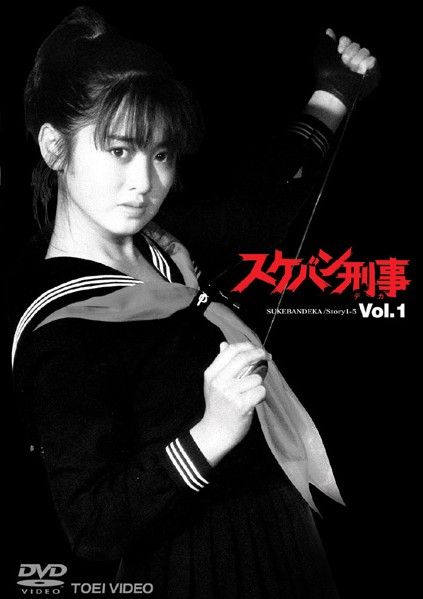 Probably the only TV series ever with a credit for “yo-yo coach” – Masaya Taki, should you be concerned about such things – I must confess to having thoroughly enjoyed this. It is, of course, a concept that’s entirely idiotic, but it’s executed with such serious intent that you can’t help but be swept along with the earnestness of the production. There are no sly winks to the cameras here: everyone, but in particular Saito as Asamiya Saki, is deadly straight-faced about their mission. And that’s absolutely the only way this kind of melodramatic soap-opera (“Who is Saki’s father?), crossed with high-school angst and not-exactly realistic martial arts should be played. A moment’s acknowledgement of Otherwise, it would collapse under its
To start by filling you in on the background that took place before the show starts, Saki’s mother was sent to death row, after being framed for murder. To save her from being executed, Saki agrees to become “Sukeban Deka”, which roughly translates as “Delinquent Girl Detective”. Under the supervision of Jin (Naka), she goes into various educational establishments over the course of the 24 episodes that follow, uncovering malfeasance by those in charge and, not infrequently, the pupils too. But what distinguishes this from 21 Jump Street, say, is Saki’s weapon of choice: a yo-yo that pops open to reveal her official badge, but can also be used to knock people out, disarm them and even, courtesy of the string, as the equivalent of a pair of handcuffs.
For instance, the opening episode takes place at St. Anna High, where poor students are being bussed in to raise the school’s academic grade – but are then being forced to sit examinations on behalf of rich students, who are the ones that make the school profitable. Some subsequent stories demonstrate surprising social awareness for 1985, covering topics like bullying, competitive pressure and corporate bribery, but there are also more outrageous or exploitable elements, such as black magic, student-teacher relationships and high-school swimsuit models. Saki, however, doesn’t care, facing them all with the same expression of grim determination. Most of the episodes in the first half take place at Takanoha-Gakuen High, Saki’s old stomping ground, where the new queen bee is Miyako Yumekoji, who doesn’t take kindly to her predecessor’s return.
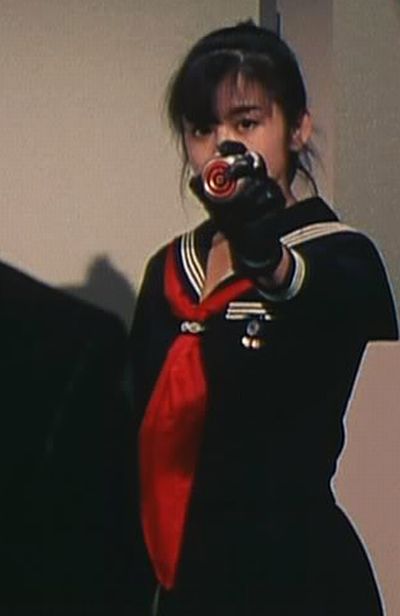 In the second half, however, the structure changes. From about #11 on, instead of individual stories, there’s an increasing emphasis on a story arc involving a trio of girls, the Mizuchi sisters – daughters of a legendary Japanese industrialist. Initially, the girls seem intent merely on taking over Takanoha-Gakuen – though have no qualms about shooting Saki when she gets in their way. She initially manages to turn them back, but they then call big sis Remi (Takahashi), back from the United States, and she becomes the Big Bad for the rest of the first season. Saki has to survive a stint in reform school, and also deal with disturbing hints dropped by the patriarch of the family, that he had a close, personal relationship with her mother. [Remember the “Who is Saki’s father?” plot thread mentioned – that’s what we have here] Our heroine succeeds in taking him down, by broadcasting a conversation he doesn’t know is being recorded, and happiness beckons for Saki – unfortunately, Remi is having none of that.
Obviously, if you’re expecting anything like Go-Go Yubari from Kill Bill, you are going to be extremely disappointed. This is a television series, likely aimed at the contemporaries of Saki, and needs to be viewed as such. However, given that limitation, it’s remarkably engrossing, and does a very good job of telling a complete story inside little more than 20 minutes, as well as developing its characters. Sure, Saito will never be confused with Rina Takeda, but she gives it all she’s got, whether engaging in yo-yobatics, or spitting out her trademark introduction (something that, sadly, is also discarded during later episodes – even if it makes sense, given the longer story arc means she doesn’t need to introduce herself) with wonderful intensity.
The passage of this delinquent Asamiya Saki: what path of ruin do I follow? Now heading into the age of decadence. If I could laugh, I’d rather laugh. However, bastards like you, who don’t think anything of making students take exams illegally in the name of money… My soul ain’t sunk that low!
It takes a special level of deadpan talent to be able to unleash a slice of ripe Cheddar like that, and sell it with enough conviction that the reaction in this viewer – not exactly the intended teenage, Japanese, girl target audience, remember – is more “You go, girl!” rather than a derisive snort. It’s an interesting contrast to later entries, which had more of a team quality about them, with multiple yo-yo wielders. Here, Saki is a lone wolf, almost on her own: she has no parental guidance and Jin is interested only in practical help, furthering the success of her mission, rather than offering any personal support. The nearest thing she has a friend is schoolmate Sanpei Nowaki (Masuda), and he spends most of the show in a state of blithe ignorance about her real purpose. But I was particularly impressed by the final episode, which manages to kill off a surprising number of major characters, and leave even the fate of Saki and Remi uncertain. Subject to contract negotiation,. I imagine.
There are certain questions that remain opaque. It’s not quite clear how Saki becomes such a mistress of the flying cylinders either, or even why such a weapon was chosen. It doesn’t appear standard for the department, as another special agent shows up in one episode, and he’s entirely yo-yo deficient. Maybe such things are explained better in the 22-volume manga series by Shinji Wada on which this is based. It’s the kind of show where you need to have a willingness to accept such things for what they are, and if you go with the flow that results from the (admittedly, fairly barking-mad) idea, everything else will seem perfectly natural. While it’ll probably be a while before I get round to the second season, it’s something to which I am looking forward.
Dir: Hideo Tanaka
Star: Yuki Saito, Koji Naka, Yasuyuki Masuda, Hitomi Takahashi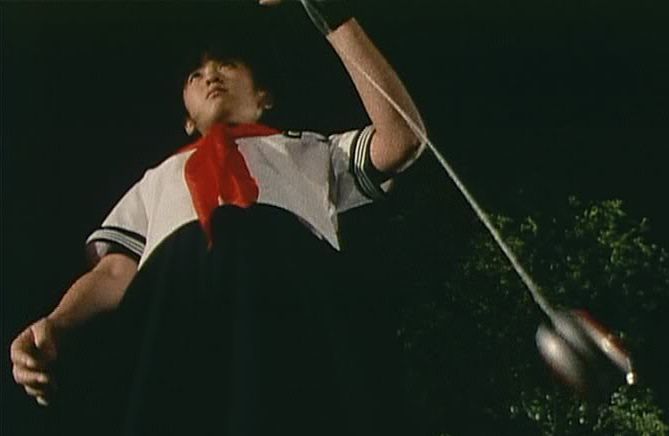


 “Cleopatra Wong is Asian Interpol’s answer to James Bond, Flint, Cleopatra Jones and Stacey.” Well, less an answer, more like a repetition of the question, since this is firmly in “cheap Asian knock-off” market, though has some charm in its first half. Wong (Lee) is an agent, assigned to investigate a flood of near-undetectable counterfeit money which is flooding the markets in Hong Kong, the Philippines and elsewhere in the far East. It’s happening in such volume, there’s potential to destabilize the entire economies of the affected countries. She takes down the Singapore branch of the operation, and then discovers the money is being transported in shipments of strawberry jam, emanating from a monastery north of Manilla. After finding them to be not exactly a social order, Wong takes pictures by flying over their compound, which shows that these nuns have some nasty habits – specifically, they’re brothers rather than sisters, and concealing automatic weapons under their vestments. Time for Cleo to assemble and lead a team of crack agent in a raid on the convent, take out the bad guys, rescue the real nuns and save the world for free-market capitalism.
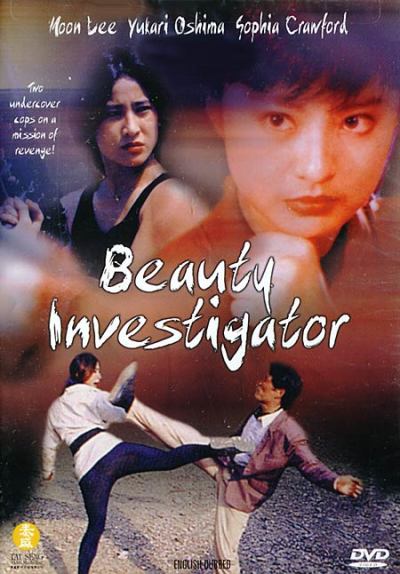 Ellen (Lee) and Grace (Kim) are police officers, who are first on to arrive when the latest victim of a serial sexual predator is found in a dumpster. After a brief diversion to catch a purse snatcher – really, how dumb must you be to do that at a murder scene? – they are sent undercover as nightclub hostesses, since that’s the profession of all the victims. While fending off both lecherous customers and employers, they stumble across an arms smuggling outfit, whose leader Bill (Tsui) has pulled a fast one over his Yakuza partners, with the help of a hired hitwoman (Oshima, whose character in the end credits is named as, I kid you not, “Japanese Jap”!). Rather than letting their superiors know, they decided to investigate themselves. Probably not the wisest of moves: as they’ll discover by the end of the movie, discretion is indeed the better part of valour…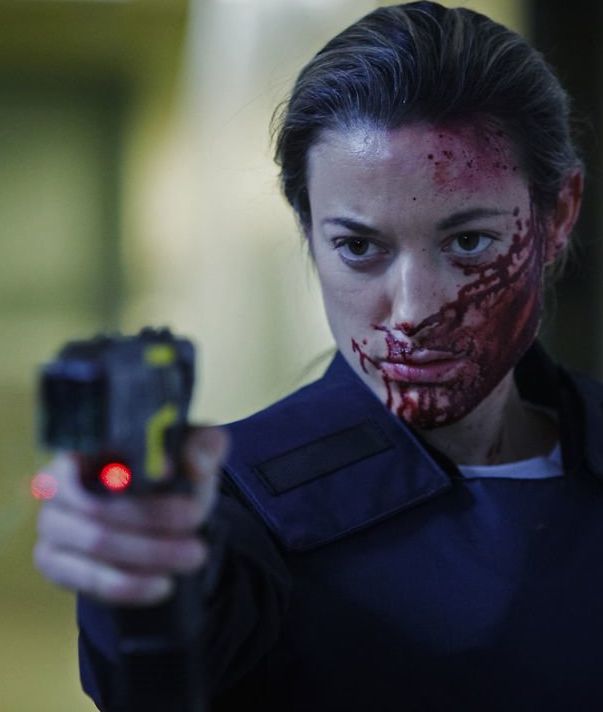
 The main mission given to Rie (Shiratori this time) is a little bit different, from her usual, straight-forward assassinations. Instead, she’s given the job of protecting a witness. Nana (Matsuda), the disgruntled mistress of an organ-trafficking ring, who has had enough and agreed to co-operate with the police. Rie is part of the protection detail, but soon finds out that the gangsters, under ever-so strange boss Kaneda (Nogami) with his transvestite tendencies, are not going to sit back and wait for Nana to take the witness stand. Oddly, the cops let Nana stay in her own apartment, perhaps figuring that’s the last place her former lover would look. but when that is unsurprisingly stormed, Rie takes the target back to the operative’s flat, where they hang out, exchanging small talk – that’s mostly Nana, of course, since Rie is about as talkative as the enormous pet fish she has in a tank, and to which she feeds goldfish.
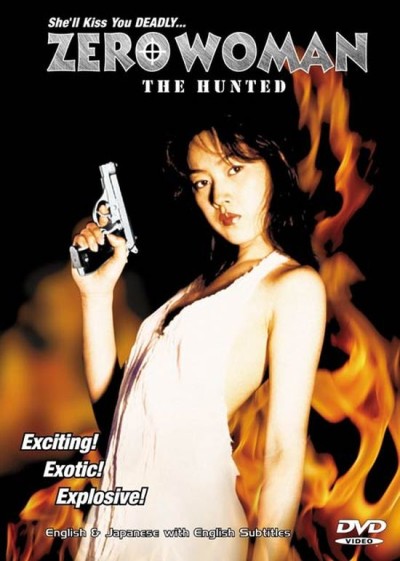 If ever I become an evil overlord, I will ensure my minions’ idea of security does not involve walking slowly in the open, towards an attacker, while firing wide of them from a range no greater than a slightly oversize dinner-table. That’s the first thing we take from this, which begins with a thoroughly implausible scene where Rei (Ono, who had been a part of 90’s J-pop group CoCo) manages to drown her target, a German industrialist, despite him being roughly twice her size, and without anyone in or around the swimming-pool noticing anything. She then climbs out, pulling a gun from who knows where, kills bodyguards who’d fail the Imperial Stormtrooper accuracy exam, and abseils down the side of the building to escape. That sets the tone for much of what follows, combining a reunion with someone from her past, a blossoming relationship with a chef, and her boss’s traditional surly reluctance to allow anything as banal as “personal happiness” to distract his #1 killer from her work.