
Last Shift

★★½
“Bit of a cop-out.”

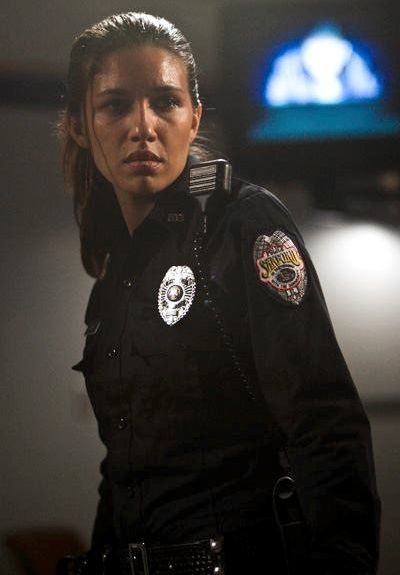
last shiftA strong start fails to be sustained, as it becomes increasingly apparent that the director here has a very limited selection of weapons in his cinematic arsenal. Jessica Loren (Harkavy) is a rookie cop, following in the footsteps of her late father. Her first assignment is the last (wo)man standing, on the final night before all duties at a police station are transferred to a new building. She’s supposed to be little more than a caretaker, waiting for the final clean-up crew to arrive, but virtually as soon as she is left alone, weirdness starts happening. She gets increasingly frantic calls from a woman who says she has been abducted, then a vagrant appears, first outside and then inside the facility. Furniture moves. Ghostly singing is heard. And that’s just the tip of the iceberg, before a conveniently-passing bystander informs Jessica that tonight marks the year to the day that a notorious cult of serial killers were caught and brought to the station, where they all committed suicide.

Despite moments that are unquestionably effective, DiBiasi uses the jump scare far too often, beyond where it becomes not just ineffective, and instead a joke. I lost count of the number of times that the heroine saw something, heard a noise that made her look in another direction, and when she turned back, whatever had been there was gone. I did like the way you were never quite sure whether what you were seeing had any objective reality – perhaps a prank by her fellow officers on a new recruit – or if it was entirely in Jessica’s head. And while she stays around well past the point at which any rational person would have legged it out of there, the backstory gives a plausible explanation, in terms of her desire to make a good first impression, and live up to her father’s legacy. However, given that, her apparent complete ignorance of (or amnesia about) previous events doesn’t make sense, especially since her father died apprehending the cult in question.

Things ramp up in the final reel, with the station under siege by other members of the cult, but I have to confess, my attention had not been adequately sustained through the middle portion. Harkavy gives her best shot, and is decent, but this performance isn’t so much acting as reacting, and given she is alone for much more of the film than you’d expect, it needs a good deal more. I couldn’t help comparing this with another take with a not dissimilar theme and location, Let Us Prey. That succeeds a great deal better, not least because it provided a solid antagonist against whom the heroine must battle, rather than an apparently endless line of ghosts and cheap (if, it must be admitted, sometimes successful) shocks, as provided here.

Dir: Anthony DiBlasi
Star: Juliana Harkavy, Joshua Mikel, Hank Stone, Mary Lankford

Sicario

★★★½
“Not sponsored by the Mexican Tourist Board.”

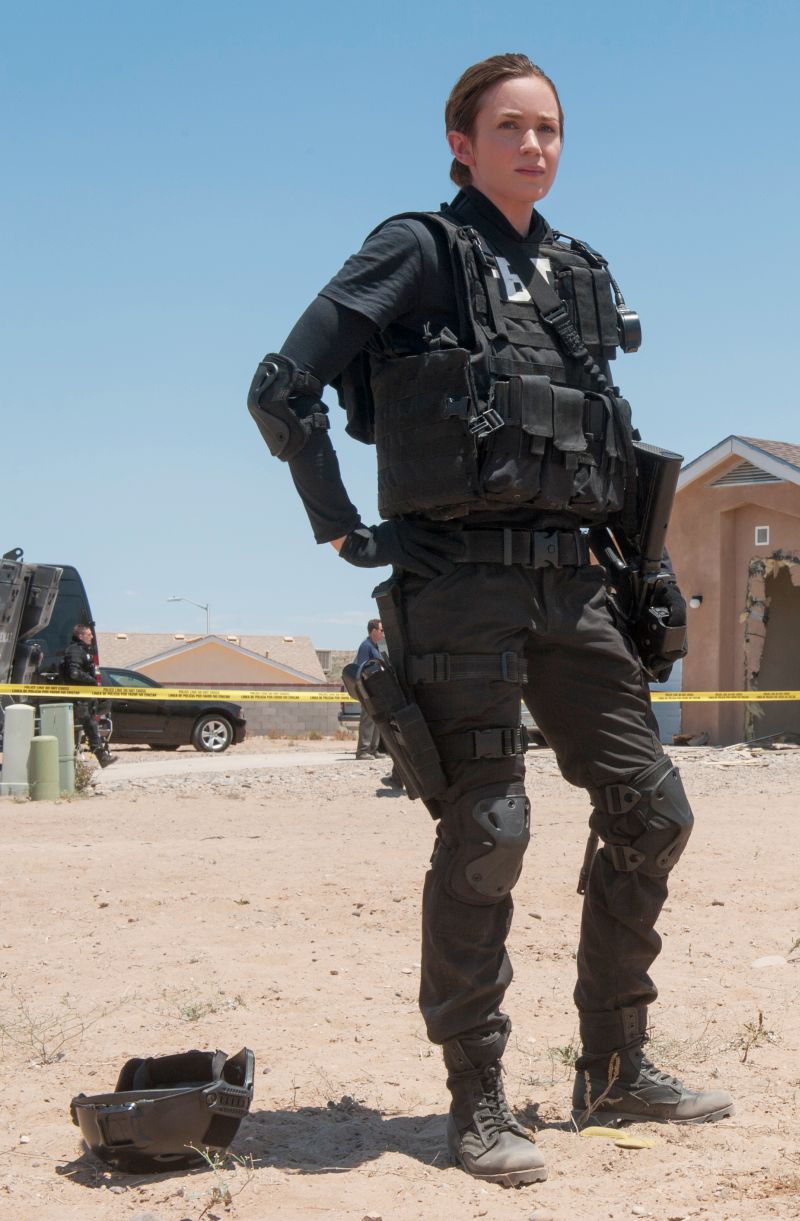
sicarioThis has no small element of local resonance, kicking off in the Phoenix suburb of Chandler (albeit filmed in New Mexico!), where an FBI raid on a house uncovers dozens of bodies in the wall and a booby-trapped basement, all the results of the Mexican cartels encroaching on the United States. In the aftermath, lead agent Kate Macer (Blunt) is invited to join a group working to take down the mobsters responsible, in particular cartel boss Fausto Alarcón. To that end, she joins a force that heads across the border to Juarez, and extradite one of his associates, and then begins a plan to prod the gang’s leader in America, Manuel Diaz, into returning to Mexico for a meeting with Alarcón. Heading the force are CIA “advisor” Matt Graver (Brolin) and the even more shady Alejandro Gillick (del Toro), who has extremely personal reasons for wanting Alarcón brought to justice. Neither have quite the same attention to… procedural detail, shall we say, as Macer, and she soon discovers her new partners will go to absolutely any ends to achieve their goals.

I’m just glad we saw this before going on holiday to Rocky Point, because between this and the documentary Cartel Land (as well as Backyard), we’ve crossed Mexico off our travel plans for the foreseeable future. Hell, Tucson is now looking a bit dubious. For it doesn’t exactly paint a glowing picture of American’s southern ally: even the cops are as likely to be gangsters as anything, and brutal violence is a casual part of everyday life. It’s a setting where, the film seems to be saying, you have to be every bit as brutal if you’re going to go against the cartels, and Macer’s high belief in “justice” is portrayed as idealistic and innocent to the point of naivety, when contrasted with the unflinching savagery of the opposition. Indeed, for much of the second half, she’s little more than a place-holder, present solely so the CIA and their assets can continue to operate with official sanction. The film becomes much more about Graver and Gillick, and the final mission sees the heroine taken out of action entirely, when her presence is no longer needed.

However, up until then, Villeneuve delivers tension by the truckload, during the opening raid, and in particular during the extradition raid to Mexico, when potential threats lurk absolutely everywhere. It had us growing very familiar with the edge of our seats for a lengthy period, and I’m feeling a bit more optimistic about the upcoming Blade Runner sequel, which Villeneuve is also directing. I’d rather have seen more of a character arc from Macer, perhaps buying further into participating in the grey-area methods of her associates, instead of becoming a bench player in what I was expecting to be her own story, and that’s why it falls short of getting unqualified approval here. However, as a grim action-thriller that pulls no punches in its depiction of the (probably unwinnable) drug war, it checks of all the necessary boxes and achieves its goals.

Dir: Denis Villeneuve
Star: Emily Blunt, Benicio del Toro, Josh Brolin, Daniel Kaluuya

Hot Pursuit

★★½
“Colombia 1, America 1.”

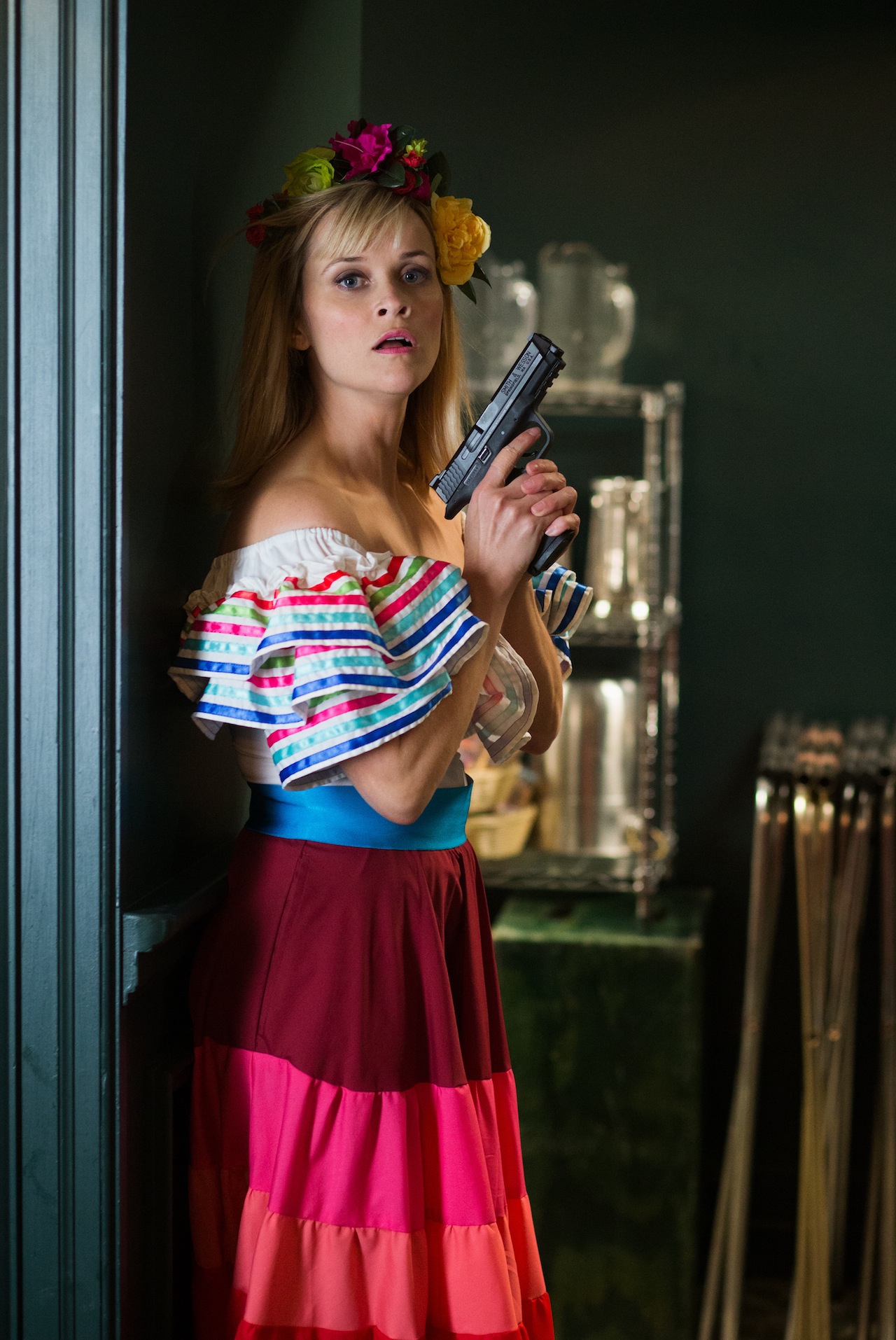
Your tolerance for this may well depend on your fondness for Modern Family, in which Vergara plays Gloria, who is much the same character: a Colombian spitfire trophy-wife. It works rather better there, as part of the broad palette of distinct individuals, and in an episode that lasts 30 minutes, including commercials. You get the sense she might not be too easy to live with, and the 85 minutes here does sometimes become more a slog than a pleasure, and we speak as big fans of Family. Here, rather than the wife of a closet magnate, Daniella Riva (Vergara) is married to the henchman of a drug lord, who gets gunned down after agreeing to testify against his employer  (Cosio), just as the straight-laced Officer Cooper (Witherspoon) arrives to escort them to court. When it becomes clear some corrupt cops are in on the action, Cooper and Riva are forced to strike out on their own, making for an unlikely odd couple, whose spiky relationship grows over the course of their unscheduled road-trip.

It’s certainly far from novel, and the whole concept is so well-worn and utterly predictable, the script might as well have grooves and be mounted on rails. This is not a film to watch if you want to be surprised, in any shape or form; it’s more like a comfy jersey, that you pull on, knowing exactly what to expect. As such, there are some moments which are genuinely amusing, such as when Cooper ends up coked-up by (literal) accident, chattering away like a highly-caffeinated dolphin. It’s not Witherspoon’s first entry here either; back in her early days, Freeway won our Seal of Approval, and more recently, we also reviewed Wild, which had her stepping out into the wilderness. This is a more obvious role, in more ways than one; like the story, Cooper is over-familiar from a hundred other comedies, and making her a woman isn’t sufficient deviation to create interest. Witherspoon certainly tries, and the effort is palpable; however, there’s only so far effort can take you, given such lazy writing.

With Vergara, the problem is almost the reverse; Riva certainly has more of an arc than Cooper, and is given some genuine motivation for her actions, rather than existing purely because the plot demands it. However, if you’ve caught one episode of Modern Family, you’ve already seen all this performance has to offer. It probably says a lot, that Vergara’s turn in Machete Kills offered a more highly-nuanced approach to acting. I’m thinking this is probably the first time Machete Kills and “highly-nuanced” have ever been used in the same sentence. The end result just about manages to skate by on the charisma of its two leads, and I can’t say we were ever bored; that hardly counts as anything even approaching a glowing recommendation, however, and you should be in a thoroughly undemanding mood before approaching this one.

Dir: Anne Fletcher
Star: Reese Witherspoon, Sofia Vergara, Robert Kazinsky, Joaquín Cosio,

Fair Cop: A Century of British Policewomen

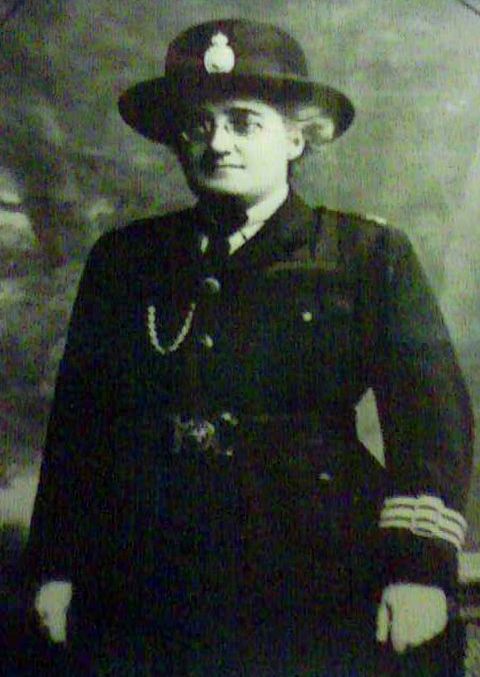
edithtmithThis month marks the 100th anniversary of the first British female police constable with the power of arrest, Edith Smith (right). The documentary below looks back at the history of women in the police force over the past hundred years, and how the role, attitudes (of both the public as well as their male colleagues) and even the uniform has changed during that time. Interesting to discover that the organized format started as the result of two effectively “vigilante” groups, who were formed to carry out volunteer patrols. One was mainly suffragettes, who were also fighting at the time for the right to work; the other, more genteel group of middle-class ladies, were the ones who obtained official sanction. At this time, the Great War was taking place, and just as World War II opened the doors to women in many areas, so did this conflict, with a large percentage of the male population being enlisted into the armed services.

Initially, women constables were tasked solely with handling children and other women – one of Smith’s main tasks was to address the prostitution problem, due to the large army presence near the town of Grantham where she was stationed. There were also restrictions which were not applied equally to men: they were forced to quit the force if they got married, it being deemed incompatible with the job. Some of these took a very long time to overcome; it wasn’t until 1994, for example, that policewomen in Northern Ireland were allowed to carry firearms for personal protection, something which had long been standard practice for men. But slowly, and not without some push-back, doors opened to other fields, from detective work through to the specialist units, and now certain areas have a majority female presence, such as the mounted police.  Now, there is no separation at all, something the film does acknowledge as not without its issues, in particular leading for a time to a horrendously primitive and uncaring approach to rape victims.

I think what I enjoyed most were the anecdotes told by the various women who had served, about their time in the police-force, and how they handled the situations in which they found themselves, which does a good job of bringing out the human side of the topic. Virtually every one of these officers comes over as resilient – likely a necessary attribute, I would imagine! – and sharp; the men interviewed largely praise the womens’ skills and abilities as equal to their own. It’s not a job I imagine is ever easy, and you’ll probably leave this film with a new-found respect for the women who take it on.

Let Us Prey

★★★★
“The devil’s in the details.”

letuspreyI’m not religious, but I do enjoy a good religious movie. Say what you like about the Bible, it has some great stories, and inspiration for a ton of others [some day, I want to see the Book of Revelations filmed by Paul Verhoeven]. This certainly falls into the latter camp, but the small cast and claustrophobic settings work for it very well. On the way to take up a new post at a police station in a small Scottish town, Rachel (McIntosh) witnesses a pedestrian being hit by a joy-riding teenager, though the victim is nowhere to be found. Taking the perp to the station, the victim (Cunningham), known only as “Six” (after his eventual cell number), is located and brought to the station: but the doctor brought in to check his wounds tries to kill him. It becomes clear that Six knows a lot more, not just about Rachel, but her new boss Sergeant MacReady (Russell), and the other inhabitants of the station, on both sides of the bars. That’s dangerous knowledge, since some of those are definitely not intended for public consumption. Rachel, whose secret involved hurt done to rather than by her, has to figure out Six’s agenda – Devil? Angel? Bit of both? – to survive the night.

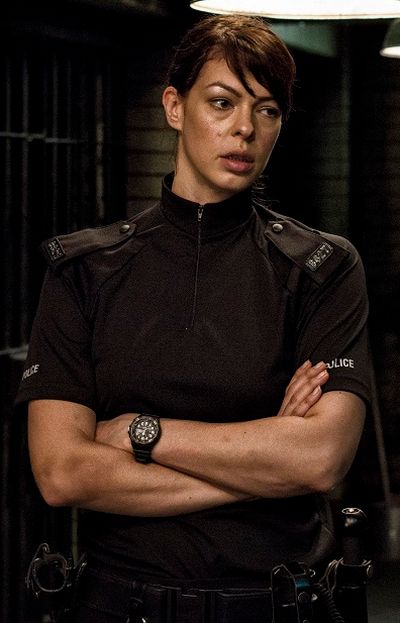
Right from the opening credits, depicting Six against a variety of ominous backgrounds, the creep factor here is severely amped up, and it keeps increasing the rest of the way – just when you think it’s reached its peak, O’Malley turns the screw another notch. It also benefit from very good performances. Cunningham has been a house-approved actor since Dog Soldiers, and exudes presence even when quite, as he is particularly in the early going, while McIntosh was striking in an equally disturbing film, The Woman, and brings much the same sense of physicality to her character here. The director has said one of the inspirations was the original Assault on Precinct 13, and I can see that; however, in a psychological sense, it felt almost like a psychological version of another John Carpenter film, The Thing, with people’s “inner monsters” bursting out to wreak havoc on those unfortunate enough to be around them. There are a couple of embarrassing mis-steps: at one point, for example, a character carefully and ostentatiously removes his glasses, only for them immediately to re-appear on his face! That kind of sloppy mistake is disappointing, and could easily have been avoided.

We also wondered why no-one makes much effort to call in external help, be that from another station or emergency service. For a while, I was thinking it was going to reveal that all the participants were dead already, which would have been a tough act to pull off. Does it end up going that way? I couldn’t possibly comment. But if they ever decided to make a sequel, we’d love to see it.  We watched this the same day as Jurassic World, and both my wife and I think this was the better movie.

Dir: Brian O’Malley
Star: Pollyanna McIntosh, Liam Cunningham, Douglas Russell

Cybergeddon

★★½
“Putting the delete in CTRL-ALT-DELETE.”

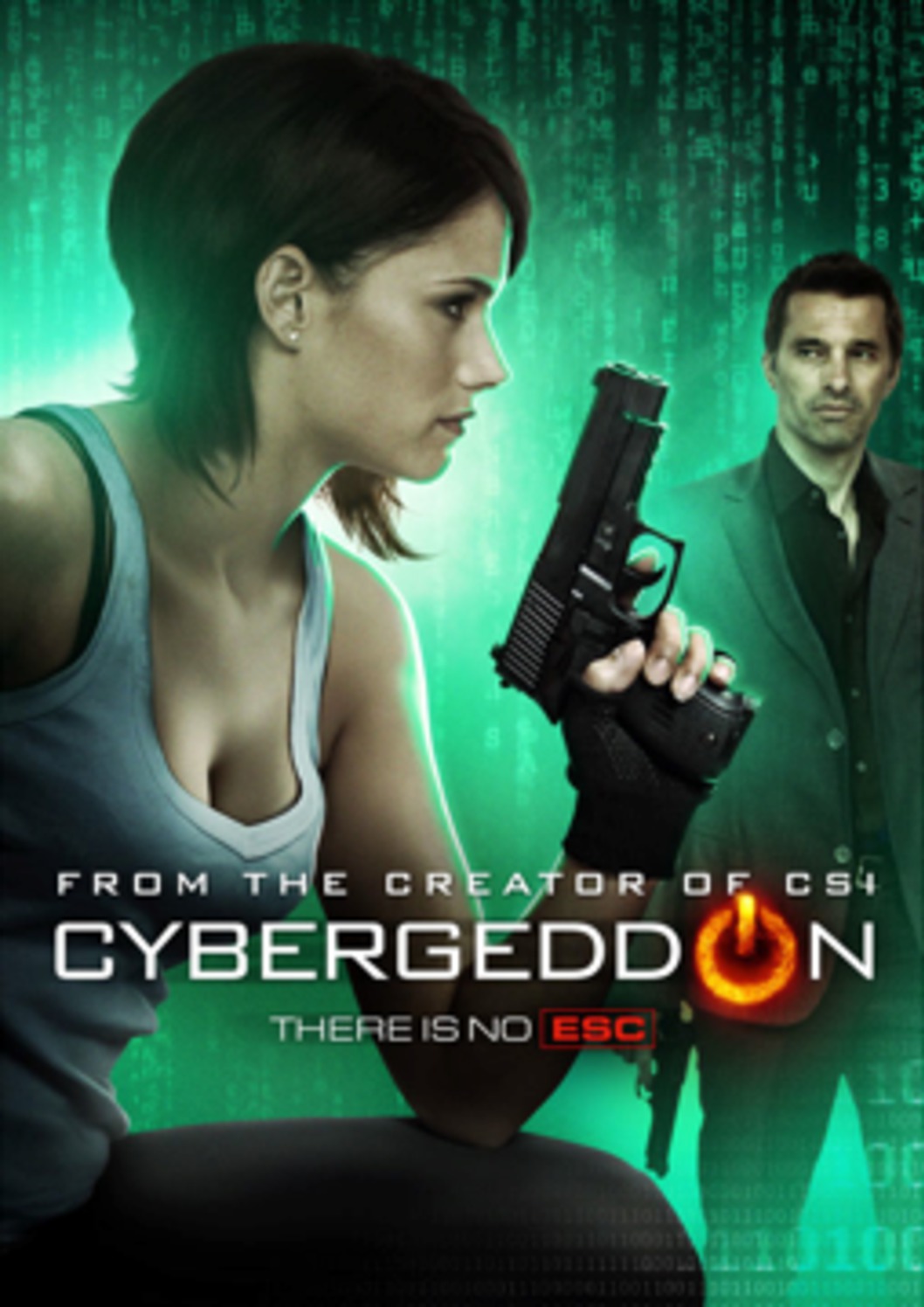
cybergeddonComputer security is part of my day-job, so I’m always amused by Hollywood’s efforts to depict it, particularly in thrillers. For the truth, which also creates the main problem with the entire “hacker” sub-genre, is that it may sound enthralling, but watching someone else type is among the most tedious things imaginable. While the effects may be very significant, the journey to get there is, frankly, dull as ditch-water. Any realistic cinematic depiction of cyberterrorism would be worse than watching paint dry. It would be more like listening to a description, of someone else playing a video-game, about watching paint dry. Here, the makers try to jazz things up by depicting cyberspace as a 3D network made up of data panels, sliding around each other like a virtual Rubik’s cube, with bad data showing red. Despite dropping buzzwords like “Stuxnet” to show the writers know what they’re talking about – or, at least, have read Wikipedia – that isn’t enough.

Yet it’s not a bad idea. The heroine is a former hacker (Peregrym) whose past was buried, to the extent she’s now a tech analyst for the government. Her name is Chloe Jocelyn – and that’s a mistake, for it immediately reminds us that there have been other federal geeks called Chloe, and this one isn’t fit to boot up the computer of that Chloe. We first see her impersonating the daughter of Russian technomobster Gustov Dobreff (Martinez) to lure him into entrapment, but that isn’t the end of the matter. For when he escapes custody, and starts his plan to bring down civilization as we know it, by hijacking a billion devices or so, he frames Chloe as revenge, by using code that was originally written in her black-hat days, thereby exposing her past. She’s blamed for the intrusions, arrested and knows that the only way to prove her innocence is to find the real culprit, with the help of former sidekick, Rabbit Rosen (Gurry). But Dobroff isn’t sitting back, and kidnaps Chloe’s mother to use as additional leverage against her.

This was originally a web series for Yahoo! and released in nine chunks of 10 minutes, which explains both the frantic pace and the strongly episodic nature. [I presume Symantec were a major sponsor, given the painfully obvious product-placement for Norton Anti-Virus, including an utterly superfluous trip to Symantec’s corporate HQ!] Despite my snark above, Chloe is actually fairly interesting, and Peregrym brings her to life well, but it’s a character which needs more development before dropping her into a scenario such as this. The story also had its share of “I’m so sure” moments: I strongly suspect federal custody is not as easy to escape as Chloe makes it seem, and I doubt they’d let a hacker keep her mobile phone either! While its brisk pace helps the flaws become too problematic in motion, and the supporting characters, particularly Rabbit, are nicely drawn, there’s nothing at all in the story which is new or unpredictable. The end result is only somewhat more fun than resetting your Gmail password.

Dir: Diego Velasco
Star: Missy Peregrym, Kick Gurry, Olivier Martinez, Manny Montana

Duelist

★★★
“A triumph of style over content”

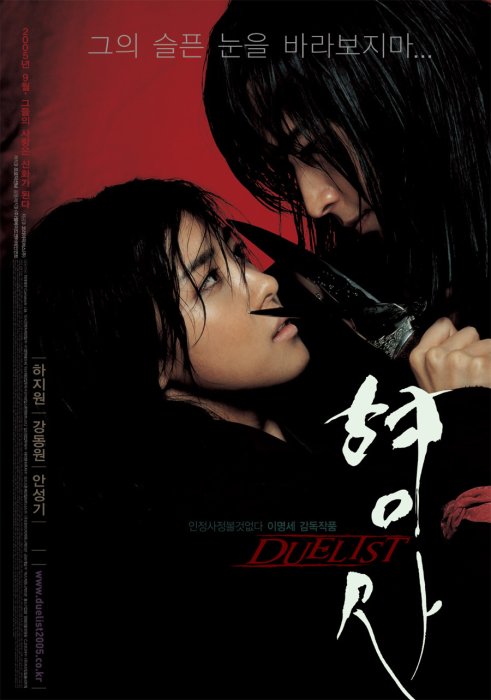
DuelistposterNamsoon (Ha) is a hard as nails detective in medieval Korea. While working undercover at a market on a counterfeiting case, she encounters a masked man (Kang), and battles him before he vanishes, though not before she manages to cut away a fragment of his mask revealing his ‘Sad Eyes’ – the name by which he is known for the rest of the film. What is his tie to the forged money? And why has be been seen going into the house of a powerful government Minister Song (Song)? Namsoon and her mentor, Ahn (Ahn) investigate, though the closer they get to the truth, the more perilous things become, not least because she begins to fall for Sad Eyes, especially after infiltrating Song’s mansion as a courtesan – a task for which she is singularly unsuited. After a public incident, while Ahn has to fire Namsoon from the police force, this is merely a ruse, allowing her to go after the final piece of evidence they need to raid Song’s mansion and bring down his operation.

Rarely have I seen a more beautifully-shot film. Truly, this picture is as pretty as a… er, picture. The cinematography is top-notch, offering a sumptuous feast of visuals that mixes styles and techniques to great effect, and freeing the movie from bothering with banal chores like dialogue for extended periods. Unfortunately, neither the story nor the characters are a match for the look and feel, leaving the viewer largely to admire the film, rather than being engaged by or liking it. As I recall, the director’s previous film, Nowhere to Hide, had much the same issue, pitting two (male, there) adversaries against each other, in a rain-drenched landscape that was emotionally distant – but, boy, did it look good. Here, the action is extremely stylized, resembling a modern dance routine more than a fight in some cases, or even, as one character puts it, “It was like they were making love under the moonlight.” I also sense there are creative anachronisms at work: did they even have cops, never mind lady ones, at this time? However, the biggest weakness is likely the sudden way Namsoon falls for Sad Eyes; she doesn’t seem at all like the kind of person who would do that, and since this supposed relationship is at the film’s emotional heart, it’s a flaw that may explain why this feels so uninvolving.

Under other circumstances, this could well be a fatal flaw, yet there’s still enough for your enjoyment in the eye candy department to make this worth watching, even at a fairly long 111 minutes. One senses that Lee is much more interested in the technical aspects of cinema, rather than the emotional one of connecting with the audience. I can appreciate that side, certainly, yet for a film to be truly successful, there needs to be some yin to go along with the yang, or what results will seems frustratingly incomplete.

Dir: Lee Myung-se
Star: Ha Ji-won, Kang Dong-won, Ahn Sung-ki, Song Young-chang

The Geneva Decision, by Seeley James

Literary rating: ★★★★½
Kick-butt quotient: ☆

genevaThis fast-paced action novel opens the author’s Pia Sabel series, about an international women’s soccer star who takes over the management of her father’s world-class security firm. My read of it flew pretty quickly; the narrative drive and suspense kept me turning pages as fast as I could. It’s easy to imagine some readers finishing it in a few days –less time if they’re able to read it nonstop, and many might want to.

Brave, principled action heroines are an enormous draw for me in fiction, and Pia Sabel is an outstanding example of the type. Seeley’s skill in bringing her to life is the key to the novel’s success; she’s an intriguing, fully round character with a complex past that shapes her. (Not all of this past is revealed here, and what is revealed is exposed gradually, sometimes in a way that can create a bit of confusion; but stay with it.) Even as a young child, her life was impacted by violence. Her adoptive father is an enormously wealthy business tycoon with a drive and determination that he’s passed on to her. She’s rich in her own right from stocks he settled on her, gifted with a tall, strong physique developed as an athlete, and highly trained as a boxer.

Not a superwoman, she isn’t without her inner demons; she also lacks experience with security and combat, despite growing up around security operatives, and she can be dangerously brash and impulsive. But she has believable strengths that counterbalance these weaknesses. (One is native smarts, which she’s used to applying in competitive situations, and an ability to read people –though she doesn’t always realize when she needs to let these skills kick in.) Above all, she’s a caring, highly ethical person who genuinely wants to help others, whether it’s with her money or with her fighting ability.

Around her, the author has created an edge-of-the-seat plot which opens with a man’s head being blown off on the second page, and keeps up the pace until the end. Piracy and money laundering are the engines that drive the action (though Seeley doesn’t dwell on the intricacies of the latter), which includes life-and-death jeopardies for our heroine, along with plenty of gun fighting and hand-to-hand combat on land and water. The violence isn’t as bloody as it could be, however –while Pia packs bullets as a last resort, her Glock, like other Sabel Security firearms, is equipped to shoot quick-acting tranquilizer darts, and one of her first acts as head of the company is to require these to be the first resort in all cases. Pia’s also not the only strong female character in an action role here; Sabel Security’s Major Jonelle Jackson and Agent Tania are also well-drawn characters whom I expect to see more of in the later books.

I’d characterize the book primarily as action-adventure, but it has elements of the mystery genre too, with a criminal mastermind whose identity is hidden through much of the book, and will take some twists and turns to reveal. (I guessed one of Seeley’s secrets early on, but not all of them.) He develops the geographical settings –Geneva, Cameroon, Lyon, Vienna– with an assurance and vividness that suggests that he’s actually been to these places; and there’s none of the awkwardness here in handling language that’s so often associated with first-time, self-published novelists. He also knows soccer, and knows about guns, high-tech communication equipment, etc. IMO, most of the plot developments and motivations stand up well to examination.

What flaws did I find in the book? First, the descriptions of action scenes were often, for me, hard to follow visually; that is, from the language used, I couldn’t always exactly picture the action in my mind without it seeming awkward (that may be because I haven’t engaged in that sort of fighting, and don’t have the experience to picture it with), or because I couldn’t get the physical layout of the setting, as in the floor plan, etc. Second, Seeley sometimes suddenly drops bits of information that Pia or other characters have known before (but we haven’t) into the mix at moments when they can be useful, in a way that sometimes makes them come across as confusing, or as a Deus ex machina, or both. It would have made the narrative smoother, IMO, to introduce these earlier, and I don’t think it would have required info-dumps to do so.

There’s also a basic credibility problem; under the circumstances, I don’t think Alan Sabel would realistically have sold her the control of his security firm, and I don’t think it’s realistic to imagine the top leadership of the firm being involved in field operations with nobody minding the store at headquarters. (Of course, the author’s purpose demands that Pia be in the field; and the premises of action heroine fiction not infrequently do strain believability a bit.) But these weren’t deal-breakers!

Pia’s a stellar action heroine for the 21st century, and I’m already a committed fan who wants to read every book she ever stars in. My recommendation doesn’t carry the weight that genre author Zoe Sharp’s does; but nevertheless, I’m proud to add my endorsement to hers.

Note: There’s no sex in the book; and though some characters do at times use profanity and obscenity in their speech, the author does exercise a degree of restraint with this.

Author: Seeley James
Publisher: Self-published, available through Amazon, both for Kindle and as a printed book.

A version of this review previously appeared on Goodreads.

Sukeban Deka: season one

★★★★
“String theory for beginners.”

sukebandeka4Probably the only TV series ever with a credit for “yo-yo coach” – Masaya Taki, should you be concerned about such things – I must confess to having thoroughly enjoyed this. It is, of course, a concept that’s entirely idiotic, but it’s executed with such serious intent that you can’t help but be swept along with the earnestness of the production. There are no sly winks to the cameras here: everyone, but in particular Saito as Asamiya Saki, is deadly straight-faced about their mission. And that’s absolutely the only way this kind of melodramatic soap-opera (“Who is Saki’s father?), crossed with high-school angst and not-exactly realistic martial arts should be played. A moment’s acknowledgement of Otherwise, it would collapse under its

To start by filling you in on the background that took place before the show starts, Saki’s mother was sent to death row, after being framed for murder. To save her from being executed, Saki agrees to become “Sukeban Deka”, which roughly translates as “Delinquent Girl Detective”. Under the supervision of Jin (Naka), she goes into various educational establishments over the course of the 24 episodes that follow, uncovering malfeasance by those in charge and, not infrequently, the pupils too. But what distinguishes this from 21 Jump Street, say, is Saki’s weapon of choice: a yo-yo that pops open to reveal her official badge, but can also be used to knock people out, disarm them and even, courtesy of the string, as the equivalent of a pair of handcuffs.

For instance, the opening episode takes place at St. Anna High, where poor students are being bussed in to raise the school’s academic grade – but are then being forced to sit examinations on behalf of rich students, who are the ones that make the school profitable. Some subsequent stories demonstrate surprising social awareness for 1985, covering topics like bullying, competitive pressure and corporate bribery, but there are also more outrageous or exploitable elements, such as black magic, student-teacher relationships and high-school swimsuit models. Saki, however, doesn’t care, facing them all with the same expression of grim determination. Most of the episodes in the first half take place at Takanoha-Gakuen High, Saki’s old stomping ground, where the new queen bee is Miyako Yumekoji, who doesn’t take kindly to her predecessor’s return.

sukebandeka2In the second half, however, the structure changes. From about #11 on, instead of individual stories, there’s an increasing emphasis on a story arc involving a trio of girls, the Mizuchi sisters – daughters of a legendary Japanese industrialist. Initially, the girls seem intent merely on taking over Takanoha-Gakuen – though have no qualms about shooting Saki when she gets in their way. She initially manages to turn them back, but they then call big sis Remi (Takahashi), back from the United States, and she becomes the Big Bad for the rest of the first season. Saki has to survive a stint in reform school, and also deal with disturbing hints dropped by the patriarch of the family, that he had a close, personal relationship with her mother. [Remember the “Who is Saki’s father?” plot thread mentioned – that’s what we have here] Our heroine succeeds in taking him down, by broadcasting a conversation he doesn’t know is being recorded, and happiness beckons for Saki – unfortunately, Remi is having none of that.

Obviously, if you’re expecting anything like Go-Go Yubari from Kill Bill, you are going to be extremely disappointed. This is a television series, likely aimed at the contemporaries of Saki, and needs to be viewed as such. However, given that limitation, it’s remarkably engrossing, and does a very good job of telling a complete story inside little more than 20 minutes, as well as developing its characters. Sure, Saito will never be confused with Rina Takeda, but she gives it all she’s got, whether engaging in yo-yobatics, or spitting out her trademark introduction (something that, sadly, is also discarded during later episodes – even if it makes sense, given the longer story arc means she doesn’t need to introduce herself) with wonderful intensity.

The passage of this delinquent Asamiya Saki: what path of ruin do I follow? Now heading into the age of decadence. If I could laugh, I’d rather laugh. However, bastards like you, who don’t think anything of making students take exams illegally in the name of money… My soul ain’t sunk that low!

It takes a special level of deadpan talent to be able to unleash a slice of ripe Cheddar like that, and sell it with enough conviction that the reaction in this viewer – not exactly the intended teenage, Japanese, girl target audience, remember – is more “You go, girl!” rather than a derisive snort. It’s an interesting contrast to later entries, which had more of a team quality about them, with multiple yo-yo wielders. Here, Saki is a lone wolf, almost on her own: she has no parental guidance and Jin is interested only in practical help, furthering the success of her mission, rather than offering any personal support. The nearest thing she has a friend is schoolmate Sanpei Nowaki (Masuda), and he spends most of the show in a state of blithe ignorance about her real purpose. But I was particularly impressed by the final episode, which manages to kill off a surprising number of major characters, and leave even the fate of Saki and Remi uncertain. Subject to contract negotiation,. I imagine.

There are certain questions that remain opaque. It’s not quite clear how Saki becomes such a mistress of the flying cylinders either, or even why such a weapon was chosen. It doesn’t appear standard for the department, as another special agent shows up in one episode, and he’s entirely yo-yo deficient. Maybe such things are explained better in the 22-volume manga series by Shinji Wada on which this is based. It’s the kind of show where you need to have a willingness to accept such things for what they are, and if you go with the flow that results from the (admittedly, fairly barking-mad) idea, everything else will seem perfectly natural. While it’ll probably be a while before I get round to the second season, it’s something to which I am looking forward.

Dir: Hideo Tanaka
Star: Yuki Saito, Koji Naka, Yasuyuki Masuda, Hitomi Takahashisukebandeka3

Undercover Girl

★★
“A kinder, gentler era. Particularly for heroines.”

AlexisUndercoverDespite a good central idea, this founders on failing to have the courage of its convictions. The heroine’s appearances are book-ended by a boyfriend (Egan) who reckons she’d be better off in an apron than a police uniform, and colleague Mike Trent (Brady), who treats her with hardly any more respect – Chris watched the end of this one with me, and her sole comment (not including various derisive snorts) was, “I would not have fared very well in the fifties…”

Christine Miller (Smith) is the young lady in question, whose father is gunned down by a mobster after spurning a payoff. Christine feels guilty about this, because her father ran up debts to put her through school, and is left with a burning desire to take vengeance on those responsible. Enter Trent, an LA detective who is trying to roll up the entire gang,  but their wary nature has led to him being unable to gather any evidence. He thinks a women, posing as a drugs buyer, might have better luck, and is convinced that with the right coaching, Christine is the right one for the job – over qualms that she might not be able to control her emotive impulses, because she’s a girl ‘n’ stuff. He sends her to bond with Liz Crow (George), a former Chicago criminal who became addicted to her own supply, and is now in rehab, seeking information which will establish a solid background for Christine’s undercover persona.

That done, she moves into a boarding house opposite a low-level connection to the gang, and starts trying to work her way up the food chain. It’s not without issues, as her target remain suspicious, and her cover  is stretched the the limit, for example, when her boyfriend happens to bump into her, calling Christine by her real name within earshot of a lurking gang member. As such, it concentrates more on attempting to craft tension than action, along with a lengthy (too long, it might be said) depiction of the relationship between Christine and Liz. But it doesn’t really work, leading instead to a lengthy climax which appears to consist mostly of people running around a building constructed entirely out of staircases, landings and doorways, shooting at each other with the accuracy of Imperial Stormtroopers. It’s just not something which has aged well, and will leave you mostly with an appreciation of how far cinematic heroines have come in the sixty-plus years since.

Dir: Joseph Pevney
Star: Alexis Smith, Scott Brady, Richard Egan, Gladys George