




★★★
“Fury woad.”
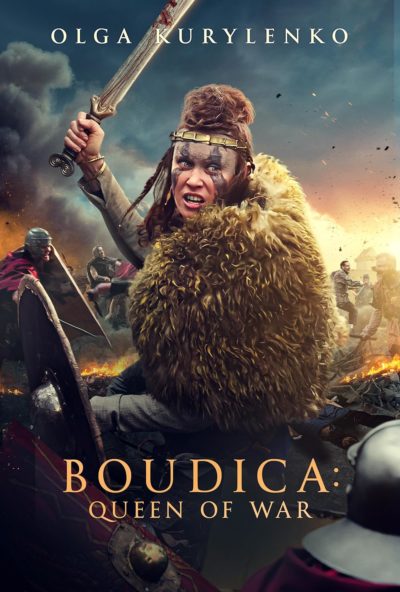 The latest take on one of Britain’s greatest historical heroines has come in for a fair bit of critical flak. But I really did not think it was all that bad. Sure, it plays fast and loose with historical accuracy (Christianity wasn’t a thing in Britain at the time). However, we’re dealing with someone about whom there is very little reliable record. Why not throw in chunks of the Arthurian mythos, if it might make for a more interesting end product? The usual basics are there. Queen of the Iceni Boudica (Kurylenko) loses her husband (Standen), and subsequently falls foul of the occupying Roman Empire. She raises an army, leads a rebellion, kicks Roman butt for a while, but eventually goes down, fighting. That’s the Cliff Notes version.
The variations are in the details, and the versions previously reviewed each take a different approach. For example, Warrior Queen (2003) leaned into the drama. This goes the other way, coming to life most in the battle sequences. It should be no surprise: Johnson is a former stuntman, who has turned to directing action films. He’s best known for excellent Scott Adkins vehicle Avengement, but here we previously reviewed his war film, Hell Hath No Fury. There isn’t the budget here for the necessary scale – the Iceni army reportedly numbered well into six figures, but when Boudica is giving her inspirational speech, it’s more like a soccer mom offering half-time motivation. Yet it makes up for this in gory intensity: this is certainly the most blood-drenched version of the story ever told.
It does take its time getting there. Initially, Boudica is not a warrior queen at all. It’s only after she gets a sword handed down from previous generations that she begins to head in that direction. She encounters a female fighter (Martin), who regards Boudica as the fulfillment of prophecy. It’s when the Roman’s take over, flogging and branding her, then doing worse to her daughters (an angle which is handled weirdly, yet not ineffectively), that Kurylenko becomes the bad-ass Brit bitch we expected from the likes of Sentinelle. She paints up her face and takes the battle to the enemy, in a way which is up-close and personal.
At least for the first few battles, the Romans won’t know what hit them, and this absolutely doesn’t soft-pedal the brutality of hand-to-hand combat. It’s a shame there’s some stuff around the periphery that doesn’t work so well, such as a mercenary called Wulfgar (Franzén), who speaks modern-sounding French – was that even a thing in 61 AD? – and appears to have the hots for Boudica. There’s also the way her sword seems almost magical, which does perhaps take away from her intrinsically heroic nature, and doesn’t add much. I think if you took the best elements of both this and Warrior Queen, you might have something close to definitive. This can provide Kurylenko and a solid eye on the action. That’s still good enough for me.
Dir: Jesse V. Johnson
Star: Olga Kurylenko, Clive Standen, Peter Franzén, Lucy Martin
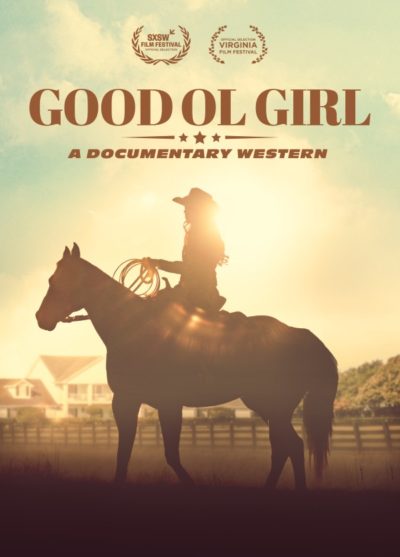 This documentary takes a look into the lives of three women in Texas, who are all operating in the male-dominated world of ranching. Some were born into it, while others came to it through choice. In particular, Mandy Dauses falls into the latter category, having left her East-coast home because she felt that Texas represented the best chance to fulfill her ambition of becoming a ranch manager. On the other hand, Sara Lemoine Knox is struggling to balance what she feels is an obligation to carry on in the family business, with her own goal of becoming a lawyer. Meanwhile, Martha Santos is looking to find work in that line, but without her own property, is finding it a challenge.
 Despite critical derision, this is actually perfectly serviceable pulp SF. Sure, it’s derivative as hell. But the critics getting all huffy about the similarities to Star Wars seem to have forgotten George Lucas only made his film, after failing to acquire the rights to Flash Gordon. This is Snyder’s equivalent to The Fifth Element, in that it’s a long-gestating SF idea, originally conceived well before he became a director. “The Dirty Dozen in space” was the high concept, although there is no denying the SW similarities, especially in the early going. I mean, young orphan on a backwater farming planet gets sucked in to galaxy-hopping adventures, joining a rebellion against an evil empire? Yeah, a little more originality would be welcome.
  Netflix describes this as “Charlie’s Angels meets Lupin, with a dash of Killing Eve.” Um. About that… While I haven’t seen Lupin, I can confidently state any similarity to the others is tangential at best. For example, the only thing this really has in connection with Charlie’s Angels, is that there’s three of them. But here, it’s more like 2.25, since the third member is largely useless. It’s almost entirely the story of Carole (Laurent) and Alex (Exarchopoulos), two thieves who work for the enigmatic Marraine (Adjani). But Carole has discovered she’s pregnant and wants out of the business. Marraine is not happy, but agrees, providing Carole does that hoariest of film clichés: One Last Job.
 I went into this braced for it to be terrible, having sat through the same film-makers’, largely irredeemable
  I should be clear, this is not to be confused with
  We’ve written about Griselda Blanco before. In particular, we reviewed telenovela La Viuda Negra, which was loosely based on her life and
  To my pleasant surprise, that’s not the case at all. Obviously, there’s a certain allure here, but it doesn’t needlessly glamourize or condemn its subject, and instead manages to do a good job of painting both sides, and depicting Griselda as a surprisingly complex character. This is particularly clear at the end, when her youngest son – named, amusingly, Michael Corleone – says of his mother, “Yes, it’s a legacy of violence. But she was a woman that had to become savage in a world that wasn’t made for her.” Then Detective Diaz, who headed the Miami task force charged with bringing her down, counters, “We have this bitch from hell who decides she wants to be meaner and more powerful than anybody else… Violence. Arrogance. Greed.
 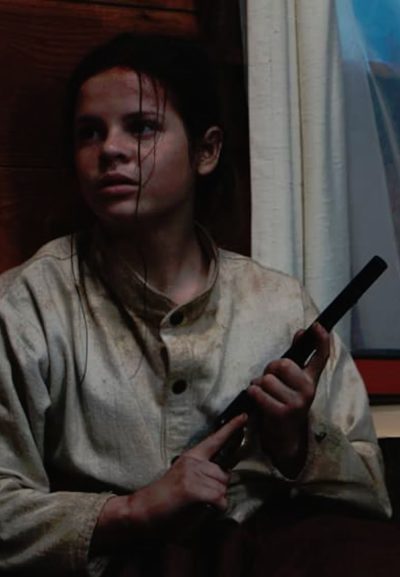 This one does take a while to reach the necessary threshold: probably only truly qualifies for the final twenty minutes or so, though it does talk a good game until that point. Also, it’s a decent enough combination of Western and home-invasion genres to that point, to pass muster. Nothing special, mind you. It just knows its limitations and is careful enough to work within them. It takes place in the Old West. whee Beth (Bernadette) and her twin children, Brian and Irene (Betsy) now live with her new husband, Robert (Krause). The trio appear to have escaped an abusive relationship, and it’s not long after a railroad surveyor pays a visit, before Irene is cheerfully telling him, she’s going to go back and kill her father some day.
 Director LaBute is best known around these parts for his ill-conceived remake of classic horror The Wicker Man, which is generally regarded as spectacularly bad, and is probably best-known for spawning memes involving Nicolas Cage and bees. So expectations going into this were… not high, shall we say. On that basis, the three-star rating is something of a pleasant surprise, though most of the credit for this should got to its star, rather than the director. Tess (Q) is a veteran of the war in Iraq, who is struggling to reconnect to her two sisters. Rose is getting married, and is nice enough that Tess is willing to attend her bachelorette party at the family cabin, deep in the country. But Beth (Foster) is a straight-up bitch.
 By coincidence, I watched this not longer after the not very good