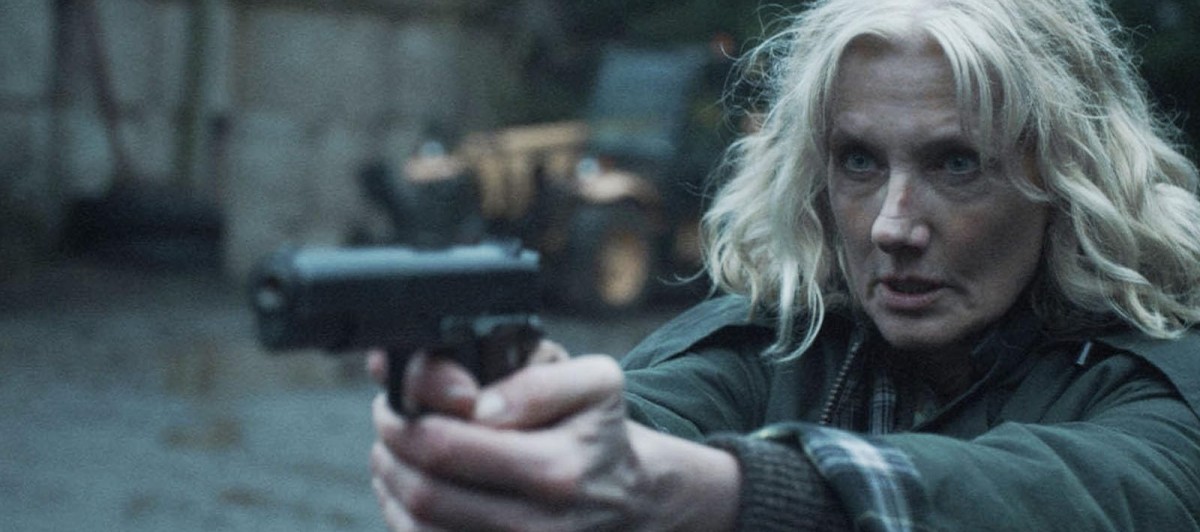
Genuinely good Tubi Original shocker! Well, that’s a bit harsh: there have have been decent ones before – such as Lowlifes, which certainly has some DNA in common. But this is likely the best I’ve yet seen, anchored by an excellent performance from Richardson. This takes place on a dark and stormy night, in a remote Scottish farmhouse. Rose (Richardson) is taking care of her disabled husband, with the help of daughter Maisy (Soverall), where there’s a frantic knocking at the door. It’s two men, Matty (Cadby) and his badly injured brother, Jack (Linpow). Their car got into a wreck nearby, and they are in desperate need of help. Naturally, they aren’t innocent passers-by.
No great surprise there, and it turns out they are fleeing from a robbery, with the intention of getting across the North Sea to Norway. However, there was a third member of the gang, who didn’t survive. He’s the son of the man who planned the heist: for obvious reasons is not happy about the situation, and ends up heading for the farm. However, that is not the biggest problem Matty and Jack face. For it turns out they aren’t the only ones keeping secrets, and they have just chosen the wrongest possible home to invade. Told you it was not dissimilar to Lowlifes. The question of who are the villains here becomes a good deal less clear, the more we know about everyone involved.
To that end, much credit to the script, also written by Linpow in an impressive feature debut. It reveals the necessary information at the right pace, and just when you think you know what’s going on, it’ll throw another twist at you. Loyalties shift from scene to scene as the characters discover more about each other, or themselves, and the situation becomes inextricably messy. You know it’s going to end in messy violence, and the film certainly doesn’t disappoint there. The cast are all solid – though in the credits, I notice the production had a “sensitivity consultant”, which is apparently a thing now. I’d like to offer my services as a crass insensitivity consultant to any movies interested. My qualifications there speak for themselves.
Where was I? Oh, yeah. It is, however, Richardson’s movie, having the toughest arc to handle as she moves from caring and compassionate mother to… Well, I guess technically she is still a caring and compassionate mother. It’s just that, well… /gestures vaguely at the screen. The film opens and closes with meaningful quotes about motherhood and the emotions it can trigger. Although what transpires between them, makes them read in radically different ways. To that end, I was getting notes of French horror flick Inside, another story of maternal instincts gone horribly wrong, or Matriarch, also set in Scotland with visitors getting more than they bargained for. Yet despite the influences, this is its own creature, powered by Richardson, and is a solid thriller to the very last shot.
Dir: Matthias Hoene Star: Joely Richardson, Neil Linpow, Sadie Soverall, Harry Cadby
a.k.a. Little Bone Lodge [A version of this review originally appeared on Film Blitz]
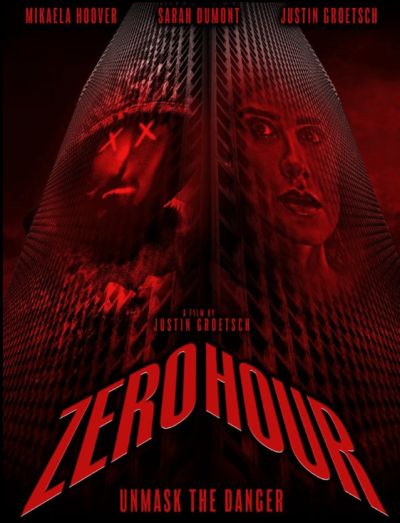
Not to be confused, in any way, with Zero Hour!, the 1957 Canadian film which was spoofed mercilessly in Airplane! This unfolds mostly over one night in a high-rise, where Ida (Hoover) is the last person left in the building, having taken over from best friend Katrina (Dumont). She finds herself being harassed by a pair of masked figures, and simultaneously receiving messages on her phone and computer from her husband, Isaac (Groetsch). Which is perhaps even more disturbing to her, because Isaac was killed in the home invasion which opens the movie. So what’s going on? Has he become a ghost in the machine? Do they have cellphones in the afterlife? Or is there a more prosaic explanation?
According to what Isaac tells her, the people hunting her through the building are also those responsible for his death. The obvious question is why, and it’s in providing the answers that the script (also by Groetsch) falls apart. After the heroine has been chased through the building, eventually ending up in a roof-top confrontation, we get the first of a number of twists, and… Put it this way: I have questions. Lots of questions. Out of respect for the film-makers, I won’t spoiler it, because this is clearly a big part of the film. However, I don’t feel it makes very much sense, because the conspiracy required would need to extend far further than the handful of people shown as involved.
While you are still going, “Hang on, what about…” there, the film lobs another twist at you, then a third as we flashback to Ida and Katrina’s earlier conversation in a bar, which brings in Allison (Durham). After the credits, there’s even another scene which could be a fourth twist, I dunno. Or it might be Groetsch simply wanting to get in another drone shot. I remember my first drone shot. It was in a movie called Berkshire County in 2014, and was amazing at the time. Now? It’s very easy to overuse them, and Groetsch does just that here. He’s clearly going for a fluid style of camera, with it always on the move. But there has to be a point to them. Here, not so much.
This barely runs an hour between opening and closing credits (or, perhaps more accurately, opening and closing drone shots). That’s likely a wise decision, considering how much of this is Ida staring at her phone – and Goetsch needs to learn how to shoot text messages. I will say, I didn’t hate Hoover, who is fairly sympathetic, and does what she can with material which feels more like a rough draft of an idea, and in great need of external critical input. According to his IMDb, Groetsch has no fewer than eleven other films in various stages of pre-production (though some haven’t been updated since 2017 or earlier). The only way to get better is to make more movies. I hope he does.
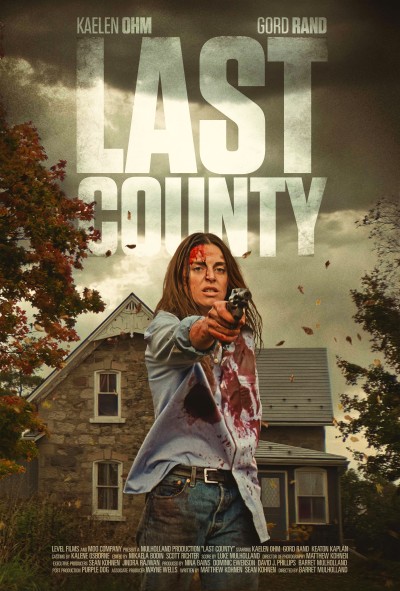
I suspect the main problem here is a story which takes too long to get going. By the time things do kick off, my interest was already on… if not quite life support, it was likely seeing a doctor regularly. While things do then perk up in the second half, it feels too late. We begin with Abby Gardner (Ohm), a recovering alcoholic and mother to a young daughter, whose marriage falls apart after a car accident with the child in the back-seat. Her husband gets custody, and Abby begs for them to come visit her. Before that can happen, her home is entered by Bennet (Rand) and his wounded partner, who have absconded with a duffel-bag full of drug money.
The good news? It’s not long before the cops start to show up, under Sheriff Bill McLean (Campbell). The bad? They are far more interested in the loot than the well-being of Abby, Bennet or anyone else who gets between them and the hold-all. After an enthusiastic bit of rake-wielding (!), Abby goes from hostage to something closer to an accomplice. It’s a decision which makes her hopes for survival, and being re-united with her daughter, significantly harder to achieve. The idea does offer an interesting (if highly cynical) twist on the usual home-invasion dynamic. Rather than fighting against the intruders, the home-owner ends up working with them, because they are now less of a threat than those supposed to protect her.
I did feel this switch in sides for Abby was a little too sudden. If she’d been given a darker past, then her siding with the drug mules would have been more credible: a fondness for booze did not cut it for me. I also never liked her very much. While it’s one thing to have a nuanced character with shades of grey (and that’s certainly the case with Abby), her maternal status was wielded like it trumped everything. Not for me, it didn’t. As a result, there were points where I almost forgot she hadn’t been part of Bennet’s crew all along. On the other side (literally), I appreciated how the cops ranged from almost honourable to entirely self-serving in their goals.
I would say things escalate towards the expected face-off, in which Abby, Bennet and Sheriff McLean stand in a triangle, pointing guns at each other. But “escalate” may suggest a little more impetus than is actually present. It does remain watchable, with Ohm and Campbell delivering the best of the performances – you can see each figuring out their next move, like chess grand-masters. The ending, however, seems a little too convenient for its own good, and while I get that everyone may under-estimate Abby, that only goes so far. Technically, it’s solid enough. I was just never particularly engaged, and the innovation present in the concept doesn’t follow through to the characters. It’s going to be forgotten as quickly as its generic title.
We return to the prolific well of Jeff Profitt, last seen here with Keisha Takes the Block. And by prolific, I mean that the IMDb lists now fewer than thirteen upcoming projects he is slated to direct. Fortunately for my backlog, most of these do not appear to be candidates for the site: I do confess some curiosity as to what Trap House Pizza is about. Anyway, both Choppa and Keisha are among the six features he directed in 2023, a number he exceeded last year. Quality is clearly subsidiary to quantity, and this has much the same problems as the last film we covered here, In particular, it’s mostly talk and not enough action.
You have three friends: Leah (Robinson), Jada (Alysha) and Shanice (Collins), all of whom are out of work and seeking a way to make money. Leah literally stumbles across a cache of weapons belonging to gun dealer Ricky (Profitt), and convinces him to let her sell his merch in the ‘hood. For the “Choppas” of the title are Kalashnikov AK-47’s, the weapon of choice for the discerning gang-banger. After the initial sale goes well, Leah gets a bigger order, and has to ask for the guns on credit. Which is a problem, first when Leah’s buyer delays paying for the weapons, and then Shanice’s boyfriend Ray discovers what she’s doing, and decides he wants in on the action. That eventually leads to the only bit of AK action this provides.
The skeleton of a decent movie is present here. It’s possible to read the above synopsis and see how it could be done in an exciting manner. For instance, tensions escalate among the group as the lure of the profits from their new, illegal, but hopefully temporary business, drags them over to the dark side, when the trio only wanted to make a living. It’s a classic tale of the slippery slope into criminality, with the net of the authorities closing inexorably around the participants. Unfortunately, the resources here do not allow for anything like that. It’s telling that the women are buying just three (3) guns at a time, and there are absolutely no cops to be found here at all.
Meanwhile, the script is strictly of the Point A to Point B variety, without real energy. The trio of lead actresses are okay: there are a few scenes where you can believe they genuinely are friends. The main problem on the performance side is Profitt himself, who is a contender for the world’s least convincing gun-runner. Used cars? Perhaps. Cellphones? Certainly. But now illegal firearms. He’s also very white, and I speak as someone whose skin colour is legally classified as “transparent.” If they’d made him an Aryan Nation type… that would have been a wrinkle. That, however, would be too much like hard work for a film which seems to be uninterested in anything except the path of least resistance to an underwhelming ending.
Dir: Jeff Profitt Star: Tuckeya Robinson, Jasmine Alysha, Chanel Collins, Jeff Profitt
I’m not sure whether this is too long or too short for its own good. Could be a little bit of both. As the tag-line for this review suggests, it bears more than a superficial resemblance to a certain other action heroine film. Faith Newford (Hall) is your everyday, upper middle-class woman: married to a loving husband, physician Bryce (Shipp), with a young daughter, and running a shoe store on the side. Let’s not trouble ourselves about the mysterious amnesia, which leaves a large chunk of her past a blank slate. The problem is, Faith – or Imani, as she was previously known when she was a special ops soldier, is not supposed to be alive at all.
A blow to the head suffered during an abduction attempt triggers the return of her old skills, albeit at the cost of sending her on the run. Turns out she was in possession of information which could prove seriously detrimental to the political ambitions of General Michelle Dupree (Mirto). It’s why Imani and the rest of her squad were supposed to have been eliminated. If dodging Dupree’s goons wasn’t enough, there is another shadowy yet powerful group, who have an interest in Imani from the other direction, intending to use what she knows against Dupree. It’s all rather too over-complex, and I suspect they’d have been better off either simplifying the plot, or making it a mini-series. Hence my opening sentence.
The makers do get some things right, not least there has clearly been a decent amount of resources put into this. It doesn’t look cheap, and they also largely avoid most cliches of black action cinema. Though, inevitably, you still get drug dealers, rap music and The Man – or, in this case, The Woman – they are more incidental, and not the focus. Hall is okay as the heroine. If no Geena Davis, she generally acquits herself adequately in most of the action scenes, at least when she’s not trying to go toe-to-toe with obviously far larger and stronger opponents. For example, Raymond ‘Supreme’ Avant Jr (Lofton), who looks like he could eat Imani for breakfast, and pick his teeth clean with her spine. Yeah, their fight was a tad cringe.
At least the cinematic amnesia wasn’t too grating. For the movie simply has someone sit the heroine down and explain the past, rather than relying on the contrivance of her remembering it when convenient. Sometimes, simple is better. However, the film isn’t good at managing all the threads in the plot carpet, and it proved too much for my poor little mind to handle. I think my brain threw up a blue screen of death somewhere in the middle, during one of the more expository sections, about who was doing what to whom and why: my interest and attention never fully recovered thereafter. I did find the ending satisfyingly bleak – there’s always someone more shadowy and powerful than you – but I’d not call this more than adequate.
Dir: Mike Ho Star: Brittany S. Hall, Demetrius Shipp Jr., Kris D. Lofton, Elyse Mirto
Sira (Cissé) is a young African woman, travelling through the fringes of the Sahara Desert in Burkina Faso, on the way to get married to Jean-Sidi (Barry). However, their caravan gets involved in an incident with Islamic terrorists, which escalates into murder, with Sira being abducted by the terrorist leader, Yéré (Minoungou). He changes his mind, raping Sira and leaving her in the desert, because she is “not worthy” to die by his weapon. She survives, and stumbles across the terrorist camp, and takes shelter nearby, sneaking in to obtain food and water. After a group of other kidnapped women show up, to be used as sex slaves, Sira begins to put a plan in motion, with help from an unexpected ally.
Lured in by the poster, I was hoping for something along the lines of Revenge, especially in the wake of early dialogue about how the heroine had been trained to take care of herself by her brothers. But this is a very different kettle of fish. I have a bunch of questions, not least over the time frame involved. Sira is living in the rocks beside the camp for the better part of a year. It’s long enough, to go from not being aware of a pregnancy, to giving birth in the same rocks. While it’s certainly a memorable image to have her blazing away with an automatic weapon, her child strapped across her back… It doesn’t make a great deal of sense.
Yéré’s terrorists don’t appear to do anything much for the great bulk of the time either, except sitting around. They do eventually go out on an attack in the final twenty minutes, but the amount of terror they generate is minimal. Indeed, everyone does their share of sitting around since nobody seems particularly bothered by Sira’s long-term absence. The police, and the authorities in general, are notable by their absence until the very end. Though this may be an accurate assessment of the local situation; I can’t say. Jean-Sidi makes a half-hearted effort to join up with Yéré’s forces. The fact he’s a Christian proves a bit of an instant red flag there, and Yéré does not take kindly to the attempt.
It’s only at the very end things crack open, with the terrorist camp proving to be unexpectedly flammable. It does offer a glimpse into a culture of which I had little experience or knowledge, and Sira is an interesting character, one whose resilience is remarkable, given the circumstances under which she has to operate. This was the first time Burkina Faso submitted a movie to the Oscars (it was filmed in Mauritania for safety reasons), and is technically decent. But for a film over two hours long, it’s in need of significantly greater narrative impetus. It has the shape of a thriller, yet definitely wants to be a drama. At least I get to cross another country off my map of world cinema.
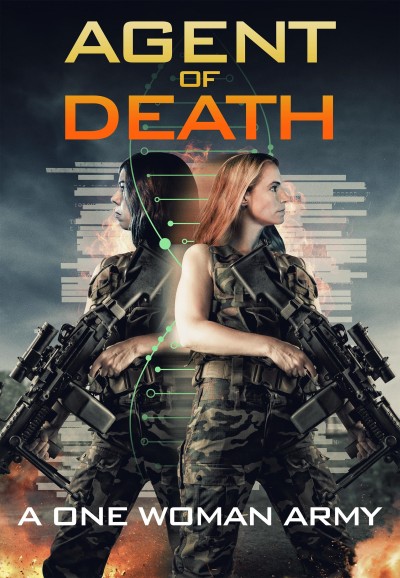
I quite liked the idea here, but the execution just wasn’t quite good enough to do justice to the concept. It feels like a matter of resources to some degree. But I also feel that a few tweaks to things would have paid significant dividends. The heroine is Tara Croydon (Fox), a CIA agent who experiences a crisis after an operation means she’s not around when her father passes away. In her depression, she signs up for a cutting-edge but rather dubious experimental project under the oversight of Hype (Medina). This involves her being given the ability to transform, physically, into one of fifteen different personas which have been implanted into her.
Once she has come to terms with this, it obviously offers a wealth of possibilities for use on missions. However, this is not entirely without a downside, not least the instability of one of the personas, Maeve (Miller). As a result, Tara is cautioned against using Maeve. She also discovers eventually that the whole operation is not as officially sanctioned as she believed, and there’s an unexpected connection to her father. The ending doesn’t exactly tie everything up, leaving the film too open-ended for my tastes. Clearly, Marder was angling for this to spawn a franchise, but since work on this apparently started in 2018 (it seems to have begun as a series called Shifter, which premiered in November 2019), I suspect everyone involved has more probably moved on to other things by now.
With regard to the resources, it tries to be considerably more global than it can manage. Tara’s first mission post-implants is to the former Soviet republic of Georgia, and this is followed up by one to central Africa. Except, in both cases, it’s painfully clear that the production likely never got outside the TMZ of Hollywood or wherever. There’s no reason things had to take place overseas: I could easily come up with domestic operations that could have used her talent just as well. The other problem is the 15 personas are only somewhat different versions of Tara. It would have been much more fun to see her occupying a broad range of shapes, skills and personalities.
It doesn’t help that the thunder has been stolen by Netflix series, In From the Cold, also about a spy with the ability to shapeshift. That came out in January 2022, while this was presumably sitting on a shelf somewhere. It leaves Agent of Death looking like a knock-off, even though that isn’t the case. Something of a pity, since this contains a decent amount of hand-to-hand action (and surprisingly little gun-play for an American show involving the CIA!), with Fox and the various actresses representing her personas, doing reasonable work. On the other hand, Fox’s acting tends to come over as wooden: for example, she’s never able to sell the death of her father adequately. While the time passed here, it’s telling that the cliffhanger ending neither excited nor annoyed me very much.
Dir: Matthew Marder Star: Alanna Fox, Hugo Medina, Samantha Grace Miller, Richard Rivera
I was rather surprised to see the name of Alexander Witt pop up as the director, at the end of the first movie in this Chilean trilogy. He has been a stalwart second-unit director in Hollywood for decades, going back to Speed in 1994. With regard to the site, he fulfilled the same role on Aeon Flux, but is best-known as the director of the second film in the Resident Evil franchise, Resident Evil: Apocalypse. That was his sole directorial credit prior to Sayen, and I must confess… I was today years old when I discovered he was Chilean. I presumed he was German, based off his name and his work on the Berlin-shot Apocalypse. But, no. Born in Chile, albeit of German descent. He returned there to take the helm, almost 20 years later – again with an action heroine story.
Sayen
★★½
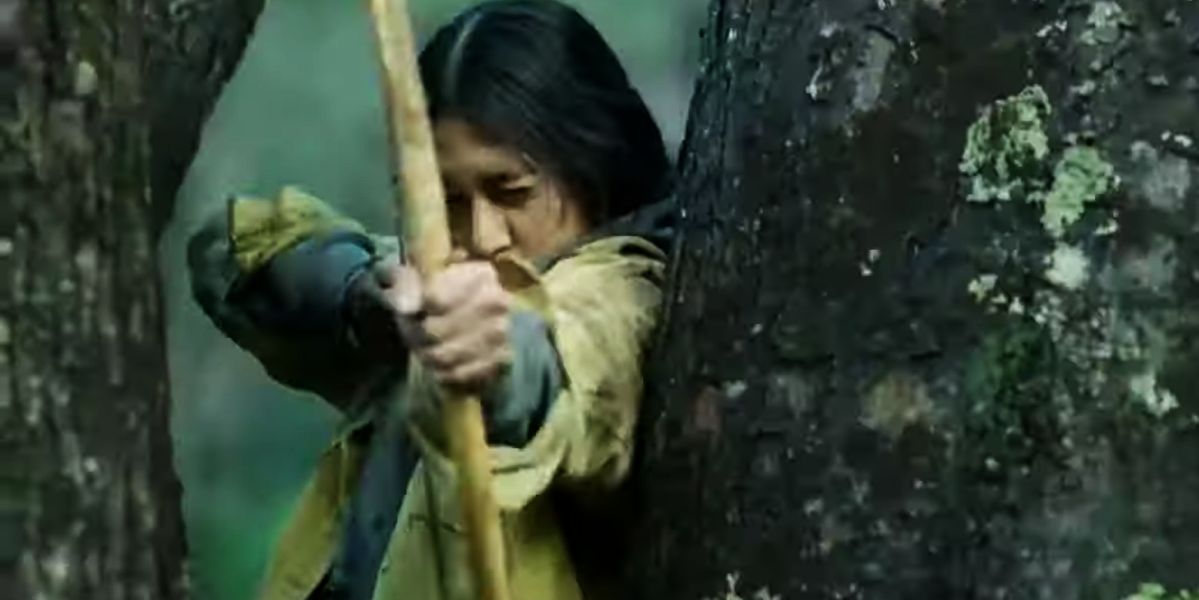
This takes place in the Araucanía region, where Sayen Coñuepan (Montenegro) has just returned to her indigenous homeland. Her grandmother is presented with an offer for her land, but a suspicious Sayen discovers it’s a front for a mining company. Things escalate, with Antonio (Piper), the junkie son of the company’s head, Máximo Torres (Arce), shooting the old woman dead. Sayen vanishes into the jungle, with Antonio and his henchmen in hot pursuit, knowing that if Sayen is allowed to go public with what she knows, it could make things very difficult for the company. However, this is very much her territory, and she has skills to make things potentially very difficult for them.
As a jumping-off point, this is… okay, I guess. It begins with a po-faced caption which informs the viewer this is going to be an Important Message Movie. The early going is a bit of a slog, leading to me coming to the conclusion, just because something is “traditional” doesn’t necessarily make it any good. Once granny is gunned down, the film shifts gears and gets more energy. However, I was expecting Sayen to go full Rambo, using the environment to her advantage. She doesn’t really, short of crafting a bow, which she uses one (1) time, and a bit of impromptu first-aid. Meanwhile, the bad guys could hardly be less subtle about their villainy, if they were given wax mustaches to twirl.
Admittedly, this may be necessary to make things clear for the international audience, who may not be up to speed on the intricacies of indigenous politics at the bottom of South America. We need black hats and white hats: keep things simple. Oh, and Chilean rap. Okay. It is interesting how Sayen doesn’t kill anyone – at least not directly. Oh, people die in her wake. Quite a few of them. However, it’s things like death through careless driving, for example. Or pointing a speedboat at a pier, then leaping off. Given the circumstances, surely no jury in the land would convict. After this lacklustre opening, while I can’t say I was keen to get to the next installment, I’m reluctant to quit any story in the middle.
Sayen: Desert Road
★★★
However, I felt the sequel works a little better. It takes place in an entirely different environment, relocating from the southern forests to the Atacama desert, one of the driest places in the world. The enemy remains Actaeon, the predatory industrial corporation headed by Torres, who have built a lithium extraction facility, after bribing their way to approval. Sayen, now with a businesslike crew-cut, is looking to find evidence of this corruption, and gets help from Qumal (Sánchez), a young woman whose father was among those who accepted the money. A SD card contains the required proof, but Acteon and their minions remain hot on Sayen’s trail, and prepared to stop her, by any means necessary.
This is at least somewhat more nuanced and less simplistic. While Torres remains the personification of evil, things are greyer elsewhere. A good example, is Qumal’s father: turns out he used the money received from Acteon to build a school for the town. There’s also one of the minions, Gasper, whose loyalties seem flexible, and who makes good points about the realities of life in the area. Sayen, though, is largely unbothered by these, though still defiantly proclaims herself not to be a murderer, despite what the authorities and media are saying about her. The desert locations provide some good opportunities for vehicular mayhem. I’d say Actaeon should probably look at revamping their driving courses, because some of their employees literally can’t steer to save themselves.
I’m still not entirely on board with Sayen’s mission: I tend not to feel eco-terrorism is better than any other flavour. However, this benefits from not needing to spend time on set-up, though does mean you really can’t watch it without having seen the first part. I was definitely surprised by a couple of twists at the end, where one character I expected to survive into the next movie, ended up dead, and one I thought was already dead, turned out to be alive. This set things up for the third installment, with Actaeon’s parent company Greencorp proving, in the corporate world, there’s always someone bigger and more morally dubious than you. Will Sayen be able to continue her battle, and also maintain her “clean hands” policy? Guess we’ll find out…
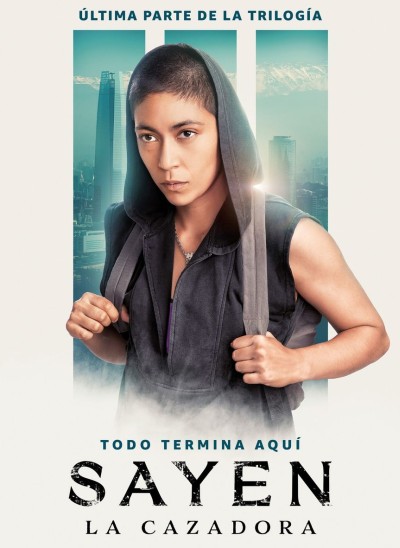
Sayen: The Huntress
★★★
There’s a further shift in setting here, the series moving to an urban location, of the Chilean capital Santiago, where Sayen has joined up with a group of activists. They are seeking evidence that Greencorp, under its CEO Fisk (Aarón Díaz), has bribed senators to vote against a bill protecting the country’s water from exploitation. There’s treachery on both sides, with a mole in Sayen’s group bringing heat on their heels, in the particularly interesting shape of female enforcer Jo (Niav Campbell – not to be confused with Neve Campbell!). On the other hand, they receive help from an unexpected source, because it’s not just eco-terrorists who have had enough of Fisk’s shenanigans…
There are some positives here, with the city landscape providing another fresh set of locations for Witt to work in action sequences, including zip-lines, base jumping and cycling. I particularly enjoyed the multiple battles between Jo and Sayen, although the director is still too inclined to go with the quick cuts, as he did in RE: Apocalypse. There’s a decent balance between the action and drama, with the high-level political intrigue working well. On the other hand, the film suddenly drops in a romantic interest for the heroine, which had me wondering where this came from. I wouldn’t worry about it. He isn’t around for long. It all ends a little too neatly, Sayen apparently able to sustain her position on the moral high ground.
All told, if you said this was a South American take on The Millennium Trilogy, I would not be inclined to disagree. In both cases, you have a young woman with a grudge against the powerful, who has the skills to make them pay for their unpunished crimes. Sayen is more hands-on than Lisbeth Salander, although the latter could take care of herself. I think the heroine here is probably less unstable: without the death of her grandmother to propel her down this path, you could easily see Sayen living a normal life, getting married, having kids and perhaps opening a legal help centre for the local residents. Instead, she ended up hunting the head of a global corporation, seeking justice for relentlessly putting the quest for profits ahead of everything else.
After a bit of a shaky start, putting the message ahead of the medium, the second and third films made for decent entertainment. They were all close to the ninety minute mark, avoiding the cinematic bloat we see too often in movies that do not need to be two-plus hours, and Witt’s experience in well-staged action is apparent. Having a heroine who won’t directly kill, but who is not averse to cracking heads if necessary, is a tricky needle to thread, and I’m not sure this is always successful. On the other hand, Sayen comes from a fresh and interesting background, and the trilogy as a whole does explore new territory. I can’t truly recommend it, but if you are interested in watching these, nor would I argue against it. You do you, gentle reader – you do you.
The easiest way to describe this is a Thai version of Wanted. You could make a case that the central character is not female. But like Wanted, there’s easily enough going on around him to qualify for this site. The similarities don’t stop there either. In both films, you have an innocent, totally unaware office worker, who is recruited into an ancient order of super assassins, just as they are going to war. Here, the rookie is Charlie (Ngamnet), an insurance salesman – sorry, he’s a sales manager, as he would no doubt correct you – who is caught up in the affairs, and eventually becomes a member, of a lethal organization known only as The Agency.
In something perhaps nicked from Naked Weapon, they recruit by using orphaned young girls, who are trained in the ways of murder for hire. They form cels, each overseen by a manager, in this case codenamed Grey Fox. The last incumbent, Keng (Semglad), drew the wrath of upper management for his unauthorized actions, and designated Charlie as his heir apparent. Which is news to Charlie, who eventually accepts and after an extended training montage, has to deal with the assassins. The most potent of these is Dina (Thangprapaporn). Though there are a number of others, of various experiences and skills, all the way down to Mina, who must be aged about eight [Yes, their names do all end in -ina, thank you for asking].
Fortunately, their enemies appear to sit back while Charlie gets up to speed, with the subplot about a stolen stone with mysterious qualities conveniently back-burnered. Instead, we watch fairly lengthy flashbacks, detailing the past of various characters. This is the movie’s main weakness, with a middle which is close to being free of action, filling in gaps that we never particularly cared about to start with. Given a running-time of almost two hours, this padding feels especially egregious. It also has a somewhat odd mix of tone, things like Charlie’s reactions to events largely being played for comedy. I guess at least it isn’t the toilet-based humour of certain Asian entries I’ve seen, and I will admit to genuine laughter on more than one occasion.
Pleased to report, the film gets back on track with a strong final act. This brings Dina back to the centre, and sees Charlie and her having to team up to take on the Agency’s #1 killer, the masked Nina (Ying Donnaporn Sukprasert). I can only presume the organization is capped at 26 killers, for alphabetical purposes. I pity the poor assassin called Wina. Anyway, the action is fairly solid, albeit somewhat prone to being over-edited. It’s largely hands-on, with swords the preferred weapon of choice, though I suspect the lead performers are actresses first, rather than martial artists. While it’s far from the most original movie I have seen this year, it does some interesting things with those influences. It’d be a better ninety minute film however.
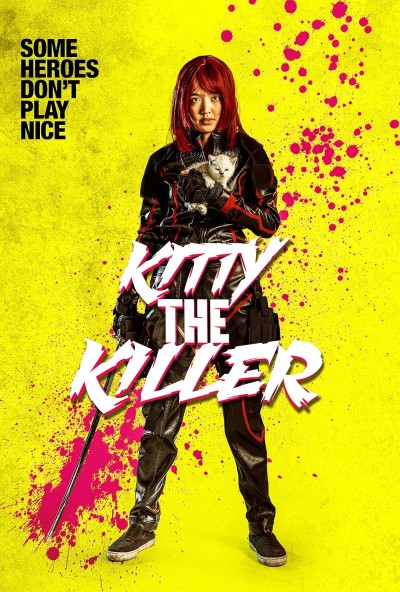
The Chinese title is 狙击之王:暗杀, which Google Translate informs me translates as “Sniper King: Assassination”. I don’t want to assume anyone’s gender, but I think I’m going to go with the alternate title above, as more appropriate, over the one on the poster. Because there’s no doubt about the amazing talents possessed by Anna (Yang), for whom a shot at three kilometers range is barely an inconvenience. We get right into the action with her being committed as a psychopath after begin captured, following her assassination of a drug lord. Yet another drug lord, actually – she has a deep hatred of them, for reasons we eventually discover, and has been taking them out with regularity.
It’s not long before someone tries to kill her in the psychiatric facility, but she’s able to escape (somewhat), with the help of struck-off former doctor, Nasipan (Tao). However, she is forced, with the aid of a nano-bomb injected into her bloodstream, to take a mission for Artest (Mak). There’s a war of succession going on in the country of “Libiwala”, with the prospect of drug production becoming legal in the country – to the joy of crime boss Roger (Lee). Artest requires Anna to liquidate all those in line for the leadership to prevent this. Or maybe encourage this. It’s all a bit murky, and the plot twists and turns until the very last scene, though never gets incoherent.
This one captivated me inside five minutes, with the hellacious firefight in the asylum, culminating in Anna sniping a sniper right through their scope. The action doesn’t let up for long thereafter, with some excellent set pieces involving both weapons and hand-to-hand combat. For the latter, Artest probably gets the bulk of it. But on the opposing side is a henchwoman who makes Gogo Yubari look like the picture of mental balance (I think she may be played by Guo Muhan, but I don’t recall hearing her name), and cuts a striking figure in her long blond hair and sword. It’s just one of the numerous things this film gets right, including occasional moments of comedy that genuinely made me laugh out loud, the movie winking at its own excesses.
It’s simply a fun experience, with characters you can get behind, and an impressively strong anti-drug message. All the players are given depth to their roles, and the chance to develop them. Even the little kid, playing the third in line to the Libiwalian throne, is not irritating – and that’s high praise coming from me, as far as child actors go. All told, this is one of the most purely enjoyable ninety minutes I’ve spent of late, easily surpassing bigger budget films like Cleaner or The Gorge, and given my expectations, is likely going to be the most pleasant surprise of the year. The whole movie is embedded below. Take five minutes to check out the opening sequence, and see if it hooks you as well as it hooked me!
Dir: Huo Sui-qiang Star: Yang Xing, Henry Prince Mak, Tao Tao, Lee Dong Hyuk
a.k.a. Sniper King: Assassination




 Genuinely good Tubi Original shocker! Well, that’s a bit harsh: there have have been decent ones before – such as Lowlifes, which certainly has some DNA in common. But this is likely the best I’ve yet seen, anchored by an excellent performance from Richardson. This takes place on a dark and stormy night, in a remote Scottish farmhouse. Rose (Richardson) is taking care of her disabled husband, with the help of daughter Maisy (Soverall), where there’s a frantic knocking at the door. It’s two men, Matty (Cadby) and his badly injured brother, Jack (Linpow). Their car got into a wreck nearby, and they are in desperate need of help. Naturally, they aren’t innocent passers-by.
  Not to be confused, in any way, with Zero Hour!, the 1957 Canadian film which was spoofed mercilessly in Airplane! This unfolds mostly over one night in a high-rise, where Ida (Hoover) is the last person left in the building, having taken over from best friend Katrina (Dumont). She finds herself being harassed by a pair of masked figures, and simultaneously receiving messages on her phone and computer from her husband, Isaac (Groetsch). Which is perhaps even more disturbing to her, because Isaac was killed in the home invasion which opens the movie. So what’s going on? Has he become a ghost in the machine? Do they have cellphones in the afterlife? Or is there a more prosaic explanation?
 I suspect the main problem here is a story which takes too long to get going. By the time things do kick off, my interest was already on… if not quite life support, it was likely seeing a doctor regularly. While things do then perk up in the second half, it feels too late. We begin with Abby Gardner (Ohm), a recovering alcoholic and mother to a young daughter, whose marriage falls apart after a car accident with the child in the back-seat. Her husband gets custody, and Abby begs for them to come visit her. Before that can happen, her home is entered by Bennet (Rand) and his wounded partner, who have absconded with a duffel-bag full of drug money.
 We return to the prolific well of Jeff Profitt, last seen here with
  I’m not sure whether this is too long or too short for its own good. Could be a little bit of both. As the tag-line for this review suggests, it bears more than a superficial resemblance to
  Sira (Cissé) is a young African woman, travelling through the fringes of the Sahara Desert in Burkina Faso, on the way to get married to Jean-Sidi (Barry). However, their caravan gets involved in an incident with Islamic terrorists, which escalates into murder, with Sira being abducted by the terrorist leader, Yéré (Minoungou). He changes his mind, raping Sira and leaving her in the desert, because she is “not worthy” to die by his weapon. She survives, and stumbles across the terrorist camp, and takes shelter nearby, sneaking in to obtain food and water. After a group of other kidnapped women show up, to be used as sex slaves, Sira begins to put a plan in motion, with help from an unexpected ally.
 I quite liked the idea here, but the execution just wasn’t quite good enough to do justice to the concept. It feels like a matter of resources to some degree. But I also feel that a few tweaks to things would have paid significant dividends. The heroine is Tara Croydon (Fox), a CIA agent who experiences a crisis after an operation means she’s not around when her father passes away. In her depression, she signs up for a cutting-edge but rather dubious experimental project under the oversight of Hype (Medina). This involves her being given the ability to transform, physically, into one of fifteen different personas which have been implanted into her.
 I was rather surprised to see the name of Alexander Witt pop up as the director, at the end of the first movie in this Chilean trilogy. He has been a stalwart second-unit director in Hollywood for decades, going back to Speed in 1994. With regard to the site, he fulfilled the same role on
  As a jumping-off point, this is… okay, I guess. It begins with a po-faced caption which informs the viewer this is going to be an Important Message Movie. The early going is a bit of a slog, leading to me coming to the conclusion, just because something is “traditional” doesn’t necessarily make it any good. Once granny is gunned down, the film shifts gears and gets more energy. However, I was expecting Sayen to go full Rambo, using the environment to her advantage. She doesn’t really, short of crafting a bow, which she uses one (1) time, and a bit of impromptu first-aid. Meanwhile, the bad guys could hardly be less subtle about their villainy, if they were given wax mustaches to twirl.
 Sayen: The Huntress
 The easiest way to describe this is a Thai version of
  It’s not long before someone tries to kill her in the psychiatric facility, but she’s able to escape (somewhat), with the help of struck-off former doctor, Nasipan (Tao). However, she is forced, with the aid of a nano-bomb injected into her bloodstream, to take a mission for Artest (Mak). There’s a war of succession going on in the country of “Libiwala”, with the prospect of drug production becoming legal in the country – to the joy of crime boss Roger (Lee). Artest requires Anna to liquidate all those in line for the leadership to prevent this. Or maybe encourage this. It’s all a bit murky, and the plot twists and turns until the very last scene, though never gets incoherent.