
Deep Fear

★★
“Shallow entertainment”

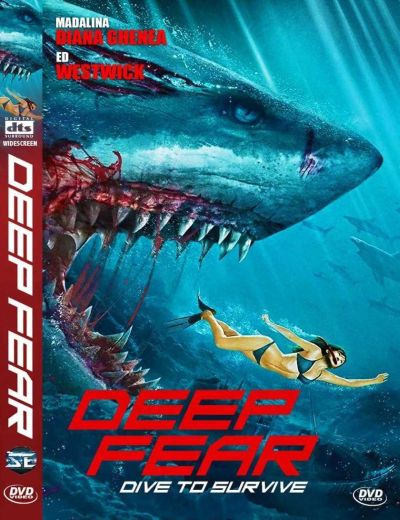
Naomi (Ghenea) is sailing a schooner single-handed in the Caribbean, returning it from Antigua to Grenada so it’ll be ready for a charter customer to take out. Her boyfriend, Jackson (Westwick) has already gone ahead to prepare things there. But a squall diverts Naomi off course, and she then stumbles across boat wreckage to which Maria (Gómez) and Jose (Coppet) are desperately clinging. They tell her there’s still a survivor trapped on the sea bottom, and Naomi dives down to rescue Tomas from his watery tomb. However, on returning to the surface with him, she gets a nasty surprise and finds her work is not over. For the survivors were also transporting 200 kg of cocaine.
Naomi is now key to salvaging it, whether she wants to be or not. Complicating matters is the presence of a large, predatory shark prowling the area, which makes simply going up and down from the sea bottom a perilous endeavour. Especially after one such encounter, where we get the immortal line, “The shark bit into the bags and now the shark is probably high on cocaine.” Sadly, hopes that this was going to become a sequel to Cocaine Bear never materialized [there is a film out there called Cocaine Shark, but it’s so bad, even a hardened connoisseur of badfilm like I, couldn’t get through the trailer] . Instead, there’s just an awful lot of sub-aqua shenanigans, and there’s really only so much SCUBA-ing I can take.

I will say, it all looks lovely. Malta actually stood in for the Caribbean, and if you’re looking for a picturesque tourist destination, combining beautiful scenery with clear water, it seems a good bet. However, as a thriller, it’s distinctly lacking in thrills, whether it’s a shark whose diet seems exclusively to consist of the bad people, through a cast for whom English is not their native tongue in many cases, to a heroine whose lips appear recently to have encountered a swarm of wasps [I note Ghenea’s credit in Zoolaander 2 as “Hot Shepherdess”]. The pacing is also off, especially early, when irrelevancies like Naomi and Jackson renting an apartment show up, serving no apparent purpose except delaying her arrival on the scene.

Gómez, whom you might remember from SexyKiller, is likely the best element the film has to offer, switching from cowering victim to manipulative sociopath. For instance, Maria conceals her nautical skills because if Naomi realizes she’s surplus to requirements after bringing up the coke, she might not be willing to do so. That kind of smarts is something the film needs to have more, ideally replacing the apparently endless amounts of moist mischief. I did like how the shark attacks don’t hold back on the blood, something you don’t see often. However, the creature rarely feels more than a toothy plot-device, thrown into scenes whenever the film-makers run out of other ways to generate tension. And that is far too often, to be honest.

Dir: Marcus Adams
Star: Mãdãlina Ghenea, Ed Westwick, Macarena Gómez, Stany Coppet

Adrenaline

★★
“Taking on organ-ized crime.”

You know you’re in for a shaky experience when the film can’t even spell its own title right. That proves a fairly accurate assessment of the overall experience: while not without its merits, these are outweighed by the negatives in the final analysis. The heroine is Victoria Travers (Payne), an FBI agent on holiday with her family in Romania, when she spots a fugitive from justice, John Slater (Mandylor). She attempts to extract him over the border, to where he can be extradited, but while that takes place, her husband is killed, and her daughter snatched by an organ harvesting ring, run by Ivan Raj (Saini). Suddenly, Slater with his local knowledge, is the only hope of Victoria rescuing her child.

It’s all very basic and quite linear. The plot feels almost like it might have been lifted from a video-game, as the odd couple roam Bucharest, working their way up the criminal organization. with the occasional side quest such as rescuing another kidnapped child, freeing hookers, etc.There’s an NPC, in the form of hacker Tony (Hauck), who provides helpful information whenever Victoria and John appear to be at a dead end. The low-budget nature does work for the film, in that there’s an overall scuzzy feel to proceedings which is appropriate, and the location enhances this. It feels like the kind of place where organ harvesting would take place, though I suspect any such organization would, in reality, be more ruthless – and considerably more competent, to be frank.

Mandylor helps elevate proceedings, as he usually does: nice that his brother, Costas, also appears in this, playing Victoria’s long-suffering boss. Shame the Mandylors don’t get any scenes together. Payne is just about adequate as the relentless mother, and much less convincing as an FBI agent. However, she’s still better than certain members of the supporting cast. Some don’t even appear to have English as a second language, but there are others who can’t lean on that excuse.  The action is intermittent, albeit not badly-staged in general. We could have done with more, perhaps in lieu of the interminable scenes of our heroine and hero driving around town, talking to people on the telephone or, occasionally for variety, driving around town while talking to people on the telephone.

I wobbled back and forth for much of this between 2 and 2½ stars. While low-budget, often obviously, it keeps moving forward, and there’s something to be said for simplicity, rather than burdening the viewer with unnecessary subplots. It’s never boring, over its seventy-five minute duration. But the ending is particularly weak, falling well short of providing Constance with an opportunity to face off against a final boss, something the movie undeniably needs. This passed the time adequately, yet I cannot say I was ever engaged, and there’s not enough to make me look into other work by Cerchi, whose talents appear limited to making sure the image is mostly in focus.

Dir: Massimiliano Cerchi
Star: Constance Payne, Louis Mandylor, Adam Saini, Alexander Hauck 

The Dive

★★
Breaking bad.”

This is an English language remake of Breaking Surface, a 2020 film from Sweden. It is also a sterling demonstration of what happens when you do not follow the Golden Rule of Remakes. “Only remake a film if you can improve on the original.” The first red flag here is the quick turnaround, just three years after the original. It’s clear that the idea here is simply to copy the film, for an English language audience who don’t want to read subtitles. We’ve seen this kind of thing before, when Nikita was turned into Point of No Return, also three years later. There, as here, the remake is entirely superfluous if you’re familiar with the original, and does not fare well in any comparison. 

As you’d expect, the basic story is the same. Sisters Drew (Lowe) and May (Krause) have drifted apart over the years. But a shared passion for diving brings them back together for a trip on a remote stretch of coastline, to explore an underwater cave system. Initially, it goes well, until a rock slide leaves May with her leg pinned at the bottom of the sea. Her oxygen running out, it’s up to Drew to return to the surface, call for help, and bring down fresh tanks to keep her sister breathing. Naturally, it’s not as simple as that, with Drew having to overcome a slew of obstacles, from a car boot that won’t open, to equipment that malfunctions.

I’m quite hard-pushed to work out specifically why this had more or less the same ingredients as Breaking Surface, yet is so much less effective. It just feels like each element is a third- or fourth-generation photocopy of the original. The sisters, for example, are less appealing. There’s the same dynamic, in that May is the calm and collected one, while Drew is not suited to handling a crisis. But May comes off almost as robotic, while Drew is shrill and aggravating. There’s also a similar back story, involving a childhood incident. Here though, it seems to get in the way of the main plot, rather than enhancing it, with useful or interesting background. It sometimes feels like you need to know diving stuff too, and I don’t. 

To be fair, if I hadn’t seen the original, this would certainly score higher, perhaps around three stars. It’s still a good scenario, and I did like some elements, like the pointed note the sisters’ car is a rental. I just hope they got the damage waiver. But most of the changes, such as swapping out the chilliness of a Scandinavian fjord for the warmth of the Mediterranean (Malta, to be precise), seem pointless at best, and a detriment more often than not. By the end, which seems significantly more contrived in the original, I had an overwhelming urge to run off and watch Breaking Surface again. Though it did reaffirm my beliefs that caving = nope, diving = nope, and cave-diving = nope squared.

Dir: Maximilian Erlenwein
Star: Louisa Krause, Sophie Lowe

The Squad

★★½
“#SquadGoals: Try not to suck.”

I was braced for this to be terrible, based on IMDb user comments which were either scathing, or came from accounts with one review – a sure sign they were astroturfed. On that basis, I guess I was pleasantly surprised. Don’t get me wrong: it’s not great, and only occasionally brushes against good. But it’s semi-competent, at least once the director calms the hell down, and stops giving us musical montages in lieu of content. The titular trio are Gina (Carrasquillo), Bella (Hansinger), and Dani (Evans), orphans who grew up together and have now turned to a life of crime. In particular, this spring break is spent by a lake in Oklahoma, seeking to muscle in on the local drug trade.

If you have ever seen Ozark, you will know that such activities are never received kindly, and it’s not long before the expected trouble shows up. This is most notably in the shape of rival drug dealar J.C. (UFC fighter Avila), but she is only the tip of the problem-shaped iceberg. People want The Squad out of the way, and/or to provide the source of their supplies. Double-crosses, backstabbings, police activity, abductions, rescue and a fairly significant body count follow as a result, though largely in a by the numbers approach, all the way to an ending that is clearly hoping for this to become a franchise. I would not be holding my breath for this to come to fruition, shall we say.

The three leads are both the best thing this has to offer, and its biggest problem. They’re photogenic, and spent much of the time wearing bikinis, which is not a chore for this viewer. However, when it comes to being convincing drug dealers, the results are much less consistent. It’s only now and again that they succeed in projecting the necessary sense of threat when facing off against their rivals: Gina probably does best in this department. The rest of the time they feel more like coeds cosplaying as drug lords, and seem about as dangerous pushers as Ed from Shaun of the Dead. The whole orphan thing feels like padding, despite the short running time of seventy-eight minutes.

To a certain degree, it feels like it wants to be Charlie’s Angels for bad girls, though regrettably, seems more inspired by the “gritty” reboot version, than the fluffy concoction of the original movie. It’s also hampered by the lack of personality to be found here: there is only one character, sliced up thinly and divided across the three protagonists, where again, Gina seems to have co-opted the lioness’s share of proceedings. Despite a plot that does keep moving forward – occasionally, a little too forward – the action is nothing special, with the trio ending up having to be rescued by a man on more than one occasion. Not exactly empowering. Looks better than it sounds, and I think that applies to almost every aspect of this.

Dir: Rick Walker
Star: Meghan Carrasquillo, Alea Hansinger, Grace Evans, Julia Avila

Escape

★★★
“Now, I always fight back…”

This feels almost like a throwback to the silent era, and ‘white slave’ films with titles like Traffic in Souls, combined with a significant fear of ‘the other’. As such, it’s both painfully simplistic, and endlessly fascinating in the layers of interpretation which can be read into it, should you be so inclined. On the most basic level, it’s your everyday tale of “good” girls, kidnapped for sale to the highest bidder, who need to fight to retain their modesty and virtue. [Though let the record show, at no point is there any bikini-wearing wielding of automatic weapons, despite what the poster clearly wants you to think. The heroines here prefer weapons of the blunt and/or pointy variety]

Director Ford is no stranger to this site, having previously given us Never Let Go and The Ledge. This is similarly workmanlike, benefiting from a straightforward approach and uncomplicated plot. Young, attractive women on holiday (this was filmed in the Canary Islands) are being abducted and sold off as sex slaves. The tactics used by Andras (Cronin) and his gang vary from luring their targets to a remote cabin, to barging into their vacation apartment and chloroforming them. The net result is the same: they end up in a cell, deep in the bowels of a remote building, awaiting shipment to a buyer, located somewhere even more foreign. The latest victims are Tamsin and nurse Karla (Marks), who join seven other girls in peril, including Lucy (Rankin).

As well as the clearly xenophobic approach – foreign places are bad, and foreigners worse – there’s also a notable class element here. All the girls appear “nice”, from middle- to upper-class families, while their captors are rough-hewn working-class thugs. The exception is Jude (James): also the only one with a conscience, he provides Karla and friends with the opportunity to free themselves. This mass escape definitely feels like it’s taken from women-in-prison films, the women turning the tables on their captors. Karla, in particular, initially intends to leave, but for reasons connected to her past (everyone here has issues – see the quote, top), decides to go back and make Andras pay, using the pointy weapons mentioned above.

This is the gnarliest, though not the only bit of violence here, and the film doesn’t hold back. Despite some digital blood, other effects are clearly practical and the audio work enhances the effect nicely. There’s an subplot about the search for the girls back in Britain, which is almost entirely superfluous, and could surely have been replaced with some gratuitous nudity. The film is so chastely moral in that department, it could almost pass the Hays Code. It feels like there are too many interchangeable victims as well, who sometimes blur together, especially when they are running in different directions. Is that Tamsin? Or Karla? But it’s rarely boring, and as a melodramatic throwback, pushes enough of the right buttons.

Dir: Howard J. Ford
Star: Sarah Alexandra Marks, Sophie Rankin, Sean Cronin, Louis James

Knuckle Girl

★★★
“Punches below its weight.”

This film is based on a Korean webcomic, but has been relocated to Japan. I can’t help wondering if something was lost in the process, because it feels like I should have liked this more than I did. Ran Tachibana (Miyoshi) is a promising amateur boxer, who gets devastating news when the body of her sister Yuzuki is found inside a burned-out vehicle. The cops call it suicide and quickly close the case. Except Ran doesn’t believe the corpse is Yuzuki, and begins to investigate what might have happened. The search leads her to an underground fight club run by the brutal Nikaido (Ito), who is holding Yuzuki hostage. He makes Ran an offer: beat his undefeated champion, and he’ll let Yuzuki go.
Naturally, it’s not as simple as that, with Nikaido reneging on his word. Fortunately, Ran has help in the shape of bike mechanic Kamiya (Maeda) and hacker Naruse (Hosoda), who help her go after Nikaido and take down his operation. There’s also concerns on the criminal side, with Nikaido’s bosses feeling he’s a loose cannon. It all feels too much to cram into a single movie, and I suspect it might have been better served in the form of a TV series. As is, elements like Yuzuki’s “magic blood” don’t appear to have much purpose. They seem there purely so fans of the comic will go “Oh, yeah!” and make little or no sense to casual viewers like me.

I think it’s probably a case whee less would have been more in terms of plotting. Keep it simple, perhaps removing side characters like Kamiya or Naurse, and focus just on Ran infiltrating the fight club and working her way up through it. Sure, it wouldn’t score points for originality, but it might have sustained my attention better. As is, in between the action, I must confess this sometimes struggled to retain focus. Considering the obviously non-trivial amount of resources that went into the production, it’s a shame they didn’t put as much effort into the story. For this undeniably looks spiffy, with the underground arena, in the shape of an eye, well-designed, and I liked the over-perky pair of MCs as well.

But I’m here for the fights, and these were… decent enough. I appreciated that the film acknowledged the heroine’s lack of size, and explicitly discussed how she would need to use her speed and agility to beat larger opponents. That’s true, even with the equalizer of knuckle-dusters, given to her by Nikaido to even up the betting odds a little. Miyoshi only had a few months training, but it’s likely easier to train an actress to fake fight, than a fighter to fake act, and it’s adequately convincing. But there are really only three or four sequences in the whole thing, with the story having to rush past most of them, because it has to deal with all the other elements. It’s all okay, I suppose, yet definitely feels like a wasted opportunity.

Dir: Hong-Seung Yoon
Star: Ayaka Miyoshi, Gôki Maeda, Hideaki Ito, Kanata Hosoda

Miss Adrenaline: A Tale of Twins

★★★
“Life going in cycles.”

The concept of twins, separated at birth, is one which has been used frequently in films and television. Sometimes for comedic effect, such as Arnold Schwarzenegger and Danny DeVito in Twins, or the two Jackie Chans in Twin Dragons. But also for dramatic impact: the most famous example is probably that of Luke and Leia in the Star Wars franchise, who were parted in order to hide them from their father. In our genre, Orphan Black works along similar lines. But this Colombian telenovela goes full-bore into it, across almost the entire duration of its sixty-seven episodes, with the concept a young woman adopting her twin’s identity being at the core of the show.

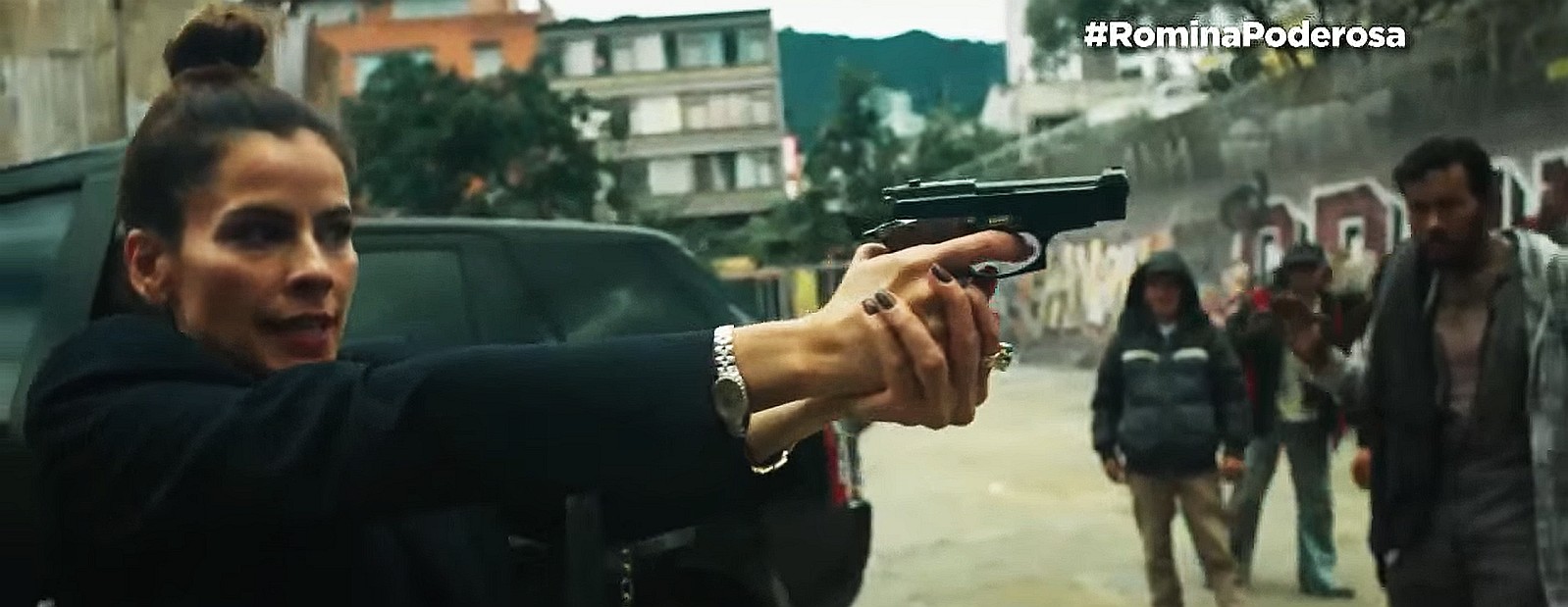
It begins with Romina Paez (Molina), who is a BMX champion in the Mirla, a poor neighbourhood. After winning a race, she uses the interview to rail against the loan sharks who prey on the locals, offering much-needed money at extortionate rates, and extracting repayment with brutal violence. This interview has two results. Firstly, the Chitiva brothers who run the loan sharkage, are unimpressed, and decide Romina should pay. Secondly, it brings Romina to the attention of rich girl Laura Vélez (also Molina), who sees Romina is her spitting image. She goes to investigate, and finds that they actually have a common mother. Mom used to work for Laura’s dad, got pregnant and had them both. Dad took Laura to his family as “an adoptee”, while Romina remained with her natural mother.

These two elements clash, when the Chitiva brothers order the assassination of Romina and her mother. Except, it’s actually Laura is killed, while visiting her mother in the barrio. Romina escapes, and decides the best option is to pretend to be dead, and indeed, pretend to be Laura. However, Romina/Laura is intent on bringing those responsible for “her” death to justice, and it’s not long before reports of Romina’s ghost haunting her old stomping grounds are passing around. Investigating from the position of law is honest cop Cristobal “Whiz” Ruíz, who eventually comes to know Romina’s secret. But in another twist, the crime lord at the top of the tree, above the Chitivas… is Laura’s mother, Virgina Vélez (León).


Yeah, it’s a fairly ridiculous concept, and what unfolds over the rest of the show often teeters on the brink of implausibility. While I get the “twins” thing, the idea that after twenty entirely separate years of upbringing, in utterly different circumstances, they would still perfectly resemble each other physically, to the extent that even their own parents can’t tell them apart, strains credulity. Romina basically blames everything from the sudden loss of memory to her changes in personality on a head injury, and after a quick visit to the doctor, who naturally pronounces her right as rain, that’s the end of the matter. She still has to manage her double life, and the ever-expanding circle of people who know about it, on both sides of the class divide.

Inevitably, there’s a whole lot of soap-opera nonsense going on here, across the uniformly photogenic cast. Laura’s boyfriend falls for Romina, Whiz falls for Romina, Whiz’s colleague falls for him, and it all gets incredibly messy emotionally. This is probably the least interesting part of the show, though it does occasionally work. The final episode, for example, has Whiz pouring out heart in wedding karaoke, but it’s done with such obvious and heartfelt sincerity, that it powers past the obvious schmaltzy aspects, and I was genuinely happy for the man. On the other side, Leo Chitiva (Bury) is the most interesting of the low-level villains. He’s another one who loved Romina, but his criminal life is incompatible with that, leaving him with difficult, yet interesting, choices.

I say “low-level,” because I think my favourite character is likely Virginia, especially as the show proceeds and she needs to become increasingly ruthless (as shown, top) as she struggles to escape the net closing around her. I would love to have seen a prequal series, explaining in more details exactly how she went from humble origins, both to running a major criminal organization, and also marrying her, apparently utterly oblivious husband. I get that some spouses are oblivious to their other halves being a serial killer, and also there’s Virginia’s “charitable foundation” which probably operates as a front. Still, I suspect I’d have at least something of a clue, if Chris was running the Cuban mafia out of the office here.

There is a bit of weirdness here: the Colombian version of the show runs for 67 episodes, but there are only 65 on Netflix. It’s possible there may also be differences in the ordering, but I haven’t been able to confirm that. I’m not sure why two episodes would not be available on Netflix. While other streaming services have removed episodes for content (such as the blackface episodes on It’s Always Sunny in Philadelphia, I can’t think of anything here which would be so contentious. My instinct might be music rights: the show uses a lot of popular Colombian songs and artists, and getting clearance globally could have proved too problematic. I can’t say I noticed at the time, though it isn’t really the kind of show that demands 100% of your attention.

I would like to have seen Romina make more use of her BMX skills. This is significantly stressed earlier, but definitely fades out of the picture as we get deeper into things. But between Virginia and some of the other women characters, such as Whiz’s partner Alex Bedoya (Camila Rojas), who is occasionally a bit of a bad-ass, it does end up qualifying for the site. It ends more or less as you would expect, but if my somewhat shaky Spanish is to be believed, there is a second series on the way. Though with the Spanish language title perhaps being Romina Embarazada, which translates as “Pregnant Romina,” I’m not certain I’ll be writing about it here!

Dir: Rafael Martínez Moreno 
Star: Juanita Molina, David Palacio, Zharick León, Kevin Bury 
a.k.a. Romina Poderosa 

Apaches: Gang of Paris

★★★
“Creuser deux tombes”

I guess the title is trying to riff off Gang’s of New York, though this is set significantly later. It begins in 1884, when the Apache gang run the Parisian underworld. Young orphans Billie, Paulie and Tricky are on the fringes, until Tricky is killed when forced to play Russian roulette by the gang’s leader, Jésus (Schneider). Billie is framed for the death by a corrupt cop, and spends fifteen years in jail. When she gets out, now a grown woman, Billie (Isaaz) seeks revenge on all those responsible for Tricky’s death, infiltrating the Apaches to get close to Jésus. Matters are complicated, by the presence in the gang of Paulie (Paradot), who was brought up by Jésus, and also by the seductive nature on her of the Apache lifestyle. 

There’s a fair bit of truth to the history here. From what I’ve read, the Apaches were a force to be reckoned with in Paris, from about the turn of the century through the outbreak of World War I. They valued style as much as savagery, preying on the middle- and upper-classes. I’ve not been able to find any indication women were a significant part of the Apaches, beyond using prostitutes as decoys to lure and distract the intended targets of a mugging. Still, can’t argue Billie makes the necessary impression, stabbing the Paris police chief (who is also the man who framed her) to death in a cinema, when she was indeed supposed just to be there as bait.

To this point, the film has done well at generating the atmosphere of a wild, anarchic setting, and populating it with interesting characters. It even manages to overcome the deliberate use of anachronistic songs on the soundtrack, opening up with the not-so sultry 1880’s sounds of… um, Iggy Pop? The problem is, the further in we and Billie get, the less interested she appears to be in her vengeance. The turning point might be when she goes after someone who has abandoned the Apache lifestyle entirely. My reaction to this was, “Oh. Is that it?” – and not for the last time either. You may well find yourself saying the same thing when the end credits abruptly roll.

The problem is less her diversion from revenge, than the absence of anything significant to replace it. I’m usually the last person to want romance in a genre film, but that would at least have helped explain her growing indifference to something which clearly sustained Billie through her fifteen years in jail. The nearest is when Paulie tries to kiss her and she repels her advances. It’s only when Jésus gives her an order she can’t obey, that Billie remembers why she’s there, though what results is hardly redemptive. I’ve read the budget was 4.5 million Euros, and if that’s true, I’m very impressed, since it looks consistently good. With a decent lead performance too, it feels they were just half a script short of having a successful feature.

Dir: Romain Quirot
Star: Alice Isaaz, Niels Schneider, Rod Paradot, Artus

[A version of this review previously appeared on Film Blitz]

Safehouse

★★
“Safehouzzzzzz…”

I ended up having to watch this twice. The first time, I literally fell asleep. In the film’s defense, it had been a tough day, highlighted by a trip to the dentist to get a crown reattached [in related news, I’m now off Milk Duds]. But a couple of days later, I watched it again. While I did manage to retain consciousness this time, I can’t say I enjoyed the film significantly more than the dental work. This is mostly down to a script which seems to mistake being confused and borderline incoherent, with being mysterious and interesting. Not giving the audience enough information simply results in them tuning out, rather than becoming intrigued. 

Carla Perez (Delgado) lives in the dangerous border town of Mexicali, with her brother, and hoping to become a doctor. He’s playing a dangerous game, informing on the local cartel to the American authorities. This, inevitably, gets him a visit from their hitmen. In the ensuing gun-battle, he is killed and Carla, fleeing for her life, finds a tunnel in a scrap yard. Using it to escape, she surfaces on the other side of the border, in a residence being used by federal agents Caskill (Seay) and Marshall (Jenkins) as a safehouse for a key witness. However, before even meeting them, she finds herself on the wrong end of a shotgun being wielded by a wounded woman. While fleeing that, she discovers a corpse in the next room. 

It is, sadly, more or less downhill from here, in terms of a plot, with the film almost willfully concealing relevant details from the viewer. This simply allows us the chance to ruminate on the ludicrous central idea. Specifically, that the best place to hide a cartel witness is… right by the Mexican border. In a house which just happens to have a smuggler’s tunnel exiting in it. And when things go pear-shaped, don’t bother to call in reinforcements, or anything like that. Mind you, Carla’s actions don’t exactly make much sense, right from the point she pops out of the tunnel like a cork, and just kinda hangs around, rather than high-tailing it to anywhere else. It’s not as if she’s being chased by the carte… Er, never mind. 

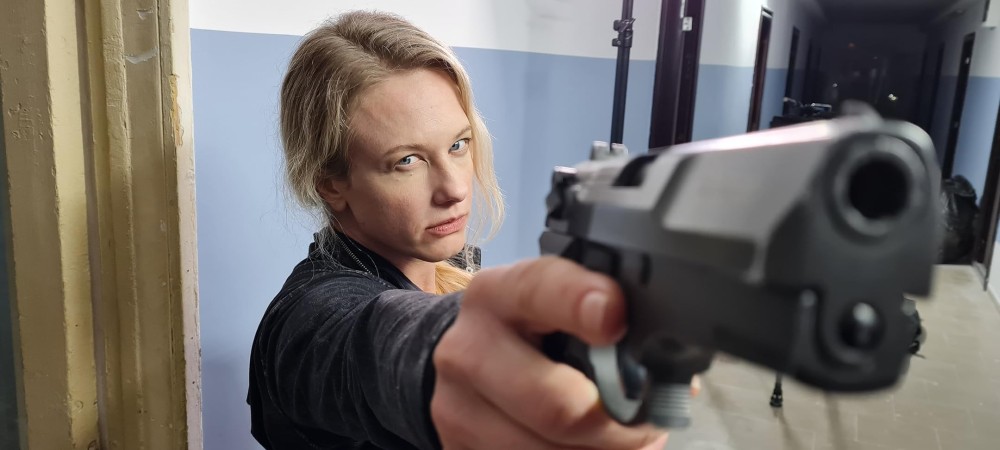
This is a shame, since some of the other elements aren’t bad. The performances do the job, and Street seems to have a decent amount of directorial talent, shooting the action in a way that is energetic without being hyperactive. Carla isn’t an especially action-oriented heroine, yet she shows plenty of courage, and empathy for those she ends up nursing (though the medical elements are probably not a strong suit!). Other female characters do more, such as the blonde cartel sharpshooter who shows up for the final assault (top). She’s cool. In the end though, I think that my initial reaction – falling asleep – was probably an accurate assessment of the film’s overall quality, and I should have stuck to that.

Dir: Paul Street
Star: Alondra Delgado, Robert Seay, David Thomas Jenkins, Jessica Martin del Campo

Baby Assassins 2

★★★
“2 Much 2 Young”

After the unexpected pleasure of Baby Assassins, it’s more or less back to the same well for the sequel. Young slacker assassins Chisato (Takaishi) and Mahiro (Izawa) are still gamboling casually through life, staggering from one adult problem to the next. The latest crisis is a massive unpaid gym bill, accumulated and ignored for several years. At the bank to pay it off, they have the misfortune to be there during a robbery, and their dispatch of the perps gets them suspended from the assassins’ association, for unapproved use of their skills. As in the first film, menial work beckons, in this case as business mascots. It… does not go well. 

Bigger problems lurk, in the shape of lower-tier assassins Yuri Kamimura (Iwanaga) and Makoto Kamimura (Hamada). They want in to the association, and the benefits which come with it – I guess, pensions, healthcare and paid time off. But the only way in, is to create vacancies by killing current members. No prizes for guessing which two come into their crosshairs. It makes for an interesting contrast, with the two young men not dissimilar to the two young women. They’re close friends, yet are in many ways socially inept: there’s an ongoing plot thread about Makoto being too shy, to ask out a waitress on whom he has a crush. They don’t have quite the same food obsession though: witness the extended post-credit discussion about dumplings between Chisato and Mahiro. 

Initially, this seems like a lot of fun, through approximately the point of thebattle between the two heroines in their gigantic headed mascot costumes. However, it feels as if the makers don’t have enough ideas, beyond recycling concepts from last time: the mascot work feels like a mild spin on their equally unsuitable maid cafe jobs. It leaves things stretched thin. I don’t think the women actually carry out any genuine assassinations in the entire 101-minute running-time. There is, instead, discussion about desserts, an extended game of shogi, and a lot of references which I suspect may make considerably more sense to a local audience. This is fair enough, considering it was made for a local audience. It just left me feeling it should have come with liner notes.

The action remains decent though, being both imaginative and well-executed. The bank robbery was a particular highlight, and the inevitable climax, pitting our pair against the duo who have been hunting them, also works and makes good use of the environments. The characters are still fun to be around, and enough of the absurdist humour works, to make for decent enough entertainment – albeit a step below its predecessor. However, if there are any further installments in the lives of Chisato and Mahiro, I hope to see more rigour in the structure. The novelty value of just hanging out with them has now definitively worn off, and I’d need to see development of an actual, significant plot to convince me it’s worth my while.

Dir: Yugo Sakamoto 
Star: Akari Takaishi, Saori Izawa, Joey Iwanaga, Tatsuomi Hamada
a.k.a. Baby Assassins: 2 Babies