




★★★
“Full of hot air.”
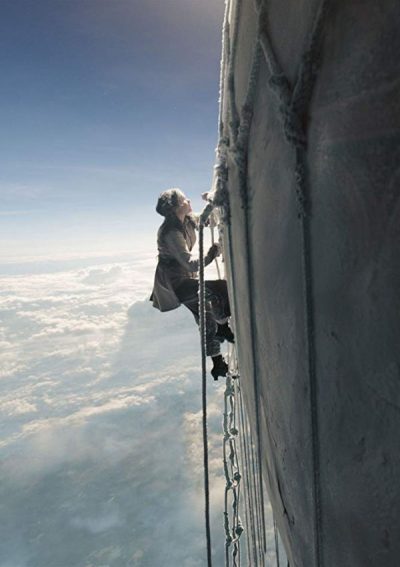 I was genuinely stoked when I got to the end of this one, which details the derring-do of 19th-century pioneers James Glaisher (Redmayne) and Amelia Wren (Jones). The former is a scientist in the fledgling field of meteorology, who wants to obtain data from the upper atmosphere. The latter is a balloon pilot, carrying on despite the death of her husband on a previous flight. Together, they team up, to fly higher than any person had ever gone before. Indeed, further than even they wanted to go, as a frozen valve prevents them from descending when they need to do so. With Glaisher out of commission through oxygen deprivation, it’s up to Wren to climb, by herself, up the outside of the balloon, in order to reach the top and clear the valve.
The in-flight entertainment is excellent, right from the take-off, in front of a sizable crowd of onlookers, to whom Wren is delighted to play. But as they rise up, you do get a real sense of the appeal of flight, in a way which feels almost like a Hayao Miyazaki film. That matters, having gone into this wondering why someone would willingly dangle from a wicker basket, below what is effectively a large bomb (here, lifted by inflammable coal gas). But the beauty of the air is well-captured, as well as its immense scale, with any number of shots depicting the giant balloon reduced to little more than a speck, beside the massive clouds. And Wren’s solo ascent is the stuff of heroic legend.
But that’s also the problem. For she never existed. Oh, Glaisher did. And so did his flight, in 1862. It set an altitude record for any craft of 36,000 feet, which would endure for more than sixty years. And after Glaisher lost consciousness, his companion did end up needing to pull the release valve by mouth, having lost all feeling in his limbs. Yeah: his. Because it was professional balloonist Henry Coxwell who was the hero in fact. Now, I get that cinema will play fast and loose with facts. But swapping out a real person for a fictional one of the opposite gender? Really? There weren’t any actual aeronautical heroines about whom a film could be made? Oh, hang on: there were. Most obviously, Sophie Blanchard, a Frenchwoman on whom the character of Wren was partially-based, and who was Napoleon’s head of aeronautics. A future feature on her may beckon.
The more grounded stuff in the film also doesn’t work as well. There’s a narrative conceit which holds back information about the circumstances surrounding Mr. Wren’s death. And background stuff on Glaisher’s struggles to raise funds for his expedition into the sky, as well as his relationship with his father (Courtenay), don’t add much to proceedings. I’d have been happier with a real-time recounting, purely focused on the flight up and down. The contrast between the staid Glaisher and show-womanship of Wren, offers enough fuel to keep things going, until the latter’s perilous ascent is needed. Just don’t ask why neither of them thought to pack a pair of gloves.
Dir: Tom Harper
Star: Felicity Jones, Eddie Redmayne, Himesh Patel, Tom Courtenay
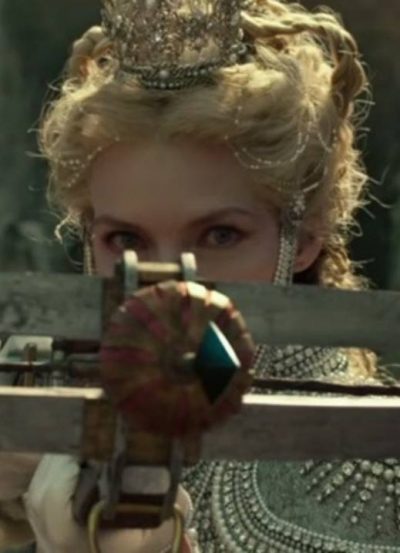 Dear god, the scenery in this is almost unutterably lovely to look at. It’s the kind of film which left me wishing I’d seen it at the cinema, even if I fear my head would have exploded at the beauty of it all. Right from the opening sequence, featuring an insane swooping shot which seems to last forever, it is just gorgeous. The final battle is so lush, a war occurring in a castle the approximate size of Bavaria, against a back-drop of exploding red-clouds made from fae genocide dust, it should be bottled and sold in the skin-care aisle.
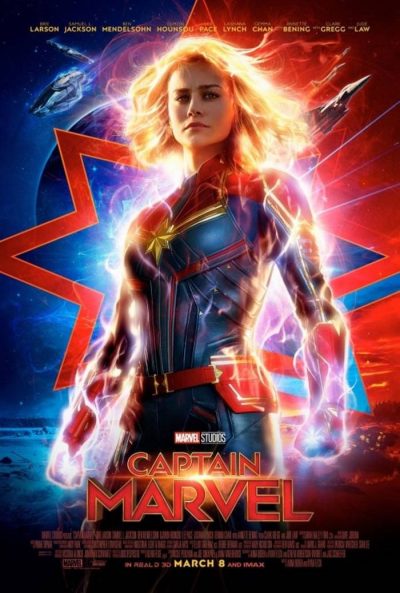 I had a couple of potential concerns going into this. Firstly, my general unfamiliarity with the Marvel Cinematic Universe. This was film #21 in their Infinity Saga. I had seen seven. Would this be like trying to follow Game of Thrones‘s penultimate episode, after having missed two-thirds of what preceded it? Secondly, Brie Larson’s press complaints about movie critics being “overwhelmingly white male.” Yep, guilty as charged, m’lord. Would this questionable attitude – that your skin colour and genital configuration matter more than what you do or say – carry over into the movie?
 I wanted to like this more than I did: director Skiba is a veteran of the Arizona film scene, though his other film previously covered here,
 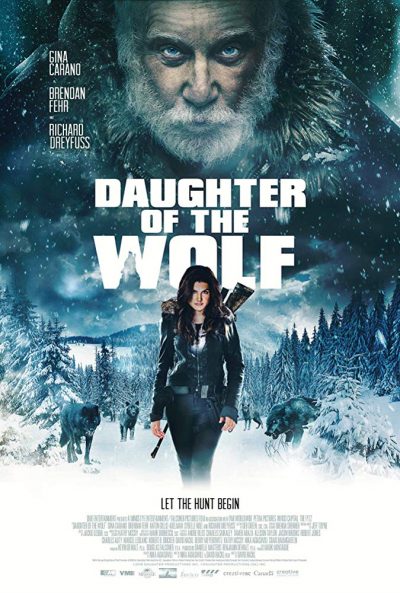 The cinematic goodwill Carano accumulated as the result of her electric debut in
 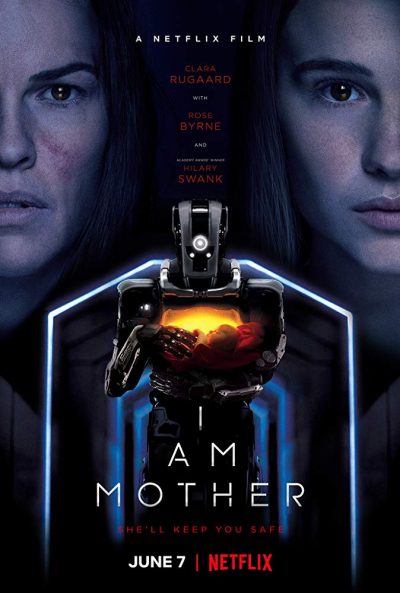 After an extinction-event has turned Earth uninhabitable, an underground “ark” holds thousands of human embryos, overseen by a robotic Mother (voiced by Byrne, performed by Hawker). One embryo is brought to fruition, becoming Daughter (Rugaard, resembling a young Jennifer Garner), who grows up into a young woman, educated by Mother to believe she’s alone on the planet. But she begins to doubt what Mother tells her, and these doubts are confirmed when another, older woman (Swank) shows up. Let in by Daughter, she tells tales of humanity outside struggling for survival against robot killers. Everything Daughter has been told is a lie. Or is the new arrival telling the whole truth either?
 ★★½
★★½
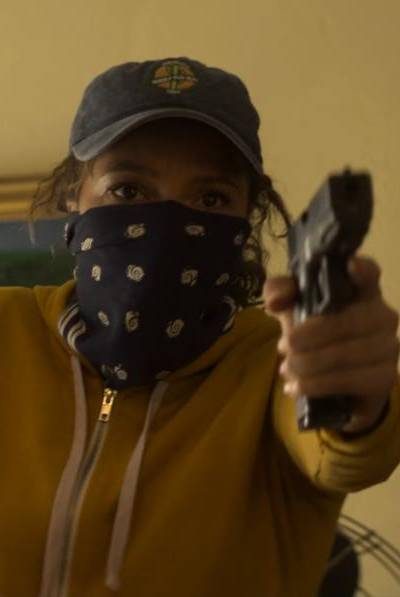 This occupies a rather odd middle-ground between a meditation on what it means to take a life, and a violent thriller. I’m not sure it manages to pull either off entirely successfully, yet some striking imagery helped sustain our interest. Katrina (Ejogo) is driving from Phoenix to Oklahoma City, with her young daughter, Clara (Pratt), to start a new life: it’s hinted that there may be an abusive partner in the rear-view mirror. The route takes her across the Texas Panhandle, and in an effort to avoid a traffic jam, she hits the back roads. This turns out to be mistake, as she first gets a flat, then Clara is bitten by a rattlesnake.
 This is neither a prequel nor a sequel to He Never Died, but is clearly related, and takes place in the same universe. Like its predecessor, it was written by Jason Krawczyk, who hands the directorial reins over to Cummings for this. And it probably works better as a result. I tend to think having a separate writer and director allows each to build on the other’s talents, while countering the weaknesses. In particular, He, which starred Henry Rollins, didn’t have quite enough plot to sustain it. That isn’t an issue here, resulting in improved pacing. Combine this with the ultimate “give no damns” performance at its core, and you’ve got one of the best action heroine films of 2019.
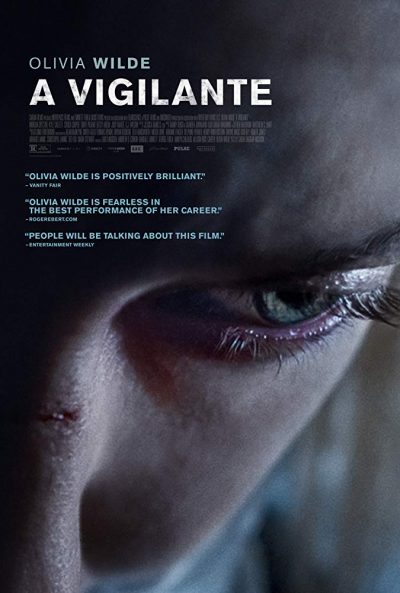 Sadie (Wilde) has escaped from an abusive relationship with her husband (Spector), but at a terrible cost: the death of her son. In an effort to come to terms with her grief, and make use of the survivalist skills forcibly imposed on her, she becomes a vigilante. Responding to coded messages left on her phone, she travels around to confront abusers and prove that there is someone tougher, willing to stand up for the victims against them. But this doesn’t give Sadie the closure or peace that she seeks. Before she can help others, she’s first going to have to help herself, and confront the man who made her what she is.