



★★½
“Give the policewoman a big hand!”
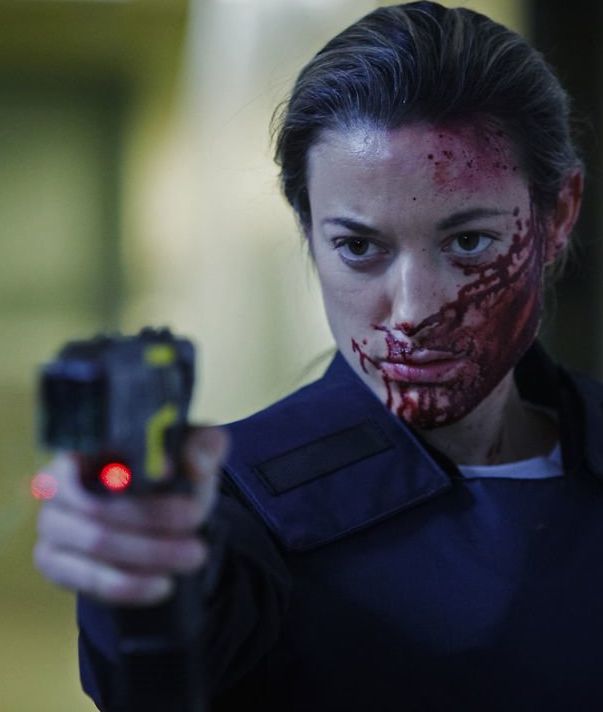 Cop Francis Jane (Palmer) is assigned to guard jewel thief Eddie Cordero (Robbins), who was shot while being captured, and is now cuffed to his bed in an all but deserted wing of a local hospital. What should be a tedious task turns out to be far from it, as his former colleagues, led by crew leader Louis Holland (MacDonald) show up. They are eager both to discover the location of the stolen goods, and extract revenge for the death of one member, which they blame on Cordero, but which he swears was the act of a corrupt cop. The resulting assault leads to an uneasy alliance between policewoman and criminal, as they try to avoid his former colleagues. But is Cordero as easy-going and affable as he seems? Or does he have a hidden agenda of his own?
The film was basically the result of the producer having access to a deserted hospital, and getting a script written to fit the location. That’s not necessarily a bad idea, but it’s just one aspect of a storyline that requires too much suspension of disbelief. Another is the inordinate number of occasions one character or another is knocked unconscious by someone else, for exactly the amount of time necessary to the plot. Or, perhaps most obviously of all (at the risk of a spoiler), getting your hand sawn off by an untrained civilian not only does not lead to major blood loss, here, it’s the kind of injury you pretty much shake off, and which is little more than a minor inconvenience the rest of the way. Now, I guess there’s some precedent (127 Hours showed dismemberment can be non-lethal), but combined with the other issues, it’s a combo-breaker fatality as far as this story is concerned.
The characters deserve better. There’s a nice dynamic between Jane and Cordero, the latter frequently needling the cop that they’re not so different, and MacDonald makes for a fine villain, capable of conveying threat with a look or a few words. Lapeyre is obviously going for Reservoir Dogs, with a story that’s less about a crime and more about back-stabbing treachery in its aftermath, building to a confrontation in an operating theatre, with one participant strapped to the table, about to undergo the film’s second bout of impromptu surgery. But it never captures anything like the same sense of grit, playing more like a nasty, bloody cartoon. About all it’s missing is a few falling anvils and a pair of Acme rocket-powered roller-skates.
Dir: Jason Lapeyre
Star: Zoie Palmer, Ryan Robbins, William MacDonald, Sergio Di Zio

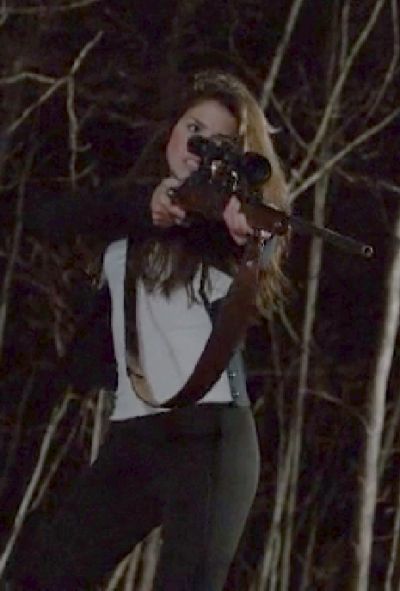


 The introduction tries to make it seem as if this could take place at any point in history, but there’s not much effort put into maintaining the illusion. The guns and overall setting – best described as “distressed warehouse” – puts this firmly into the post-apocalypse genre, though it’s very much at the bargain basement end of the spectrum. The heroine (adult actress Asuka) stumbles across naively innocent Anne (Akiyama), being pawed by some bad guys after straying into the danger zone to pick flowers; clearly a kinder, gentler apocalypse. After punching them out, assisted by remarkable reactions and her metal exo-skeleton, Anne is escorted back to her
 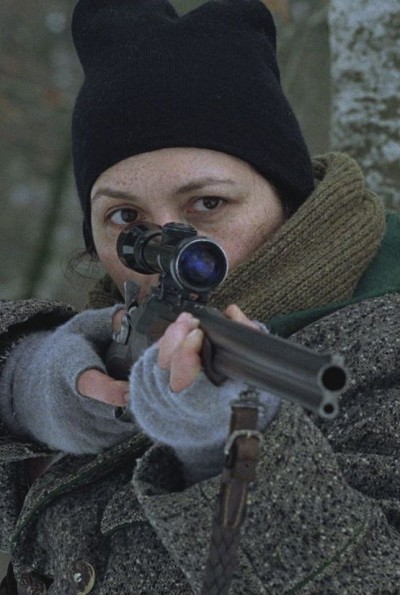 This is a very different kind of GWG film: indeed, it could almost be called an inaction heroine movie. It starts from a very simple presence. A woman (Gedeck) wakes up in a cabin in the Austrian Alps. When she tried to head to a nearby village, the path is blocked by an unseen, impenetrable barrier that has sprung up overnight, and now defines the boundary of her world. Everyone outside is dead. What do you do? How do you survive, both short- and long-term? Could you handle the loneliness? Can you retain your humanity, when you are, apparently, the only human being left?
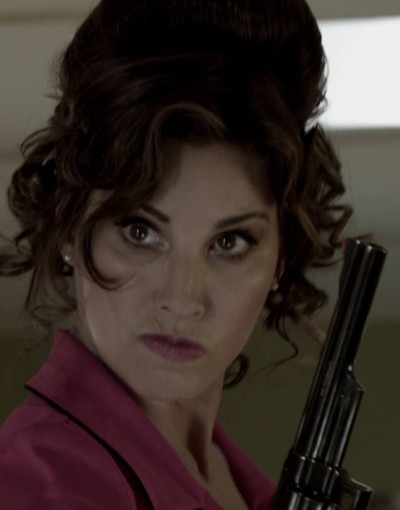 There’s something almost theatrical about this, because virtually the entire film takes place in a single location, the downscale home of Lorna (Gershon), who has just knocked her husband Dale (Kilmer) out with a frying-pan, after discovering he was apparently involved in a bank robbery which netted $100,000. She has now called over her best friend, local barmaid Tiny (Giddish), to try and decide what to do next, with the first step being to find the loot, which Lorna is convinced Dale has hidden somewhere in their home. However, the local sheriff (Liotta) is also sniffing around, being fully aware of Dale’s fondness for armed robbery in his younger days. It’s not long before the dead bodies are piling up, requiring alternative uses to be found for the turkey carver and industrial-strength blender. And that’s just the start of the unpleasantness.
 For years, an assassin known as “Jackal”, has eluded all efforts at capture, taking out targets before vanishing without trace. However, it seems that retirement is close, when a note is found, apparently left by the killer. This indicates that they are tired of the chase, and will be in a town’s low-rent hotel, waiting for the police. The cop (Han) who has been hunting Jackal is, understandably, wary and suspects a trick, but sets up a stakeout in the hotel to see what unfolds. However, already in one of the rooms there is K-Pop superstar Choi Hyun (Kim)., who had been hoping to hide out for a bit of peace and quite, only to be kidnapped by a rookie killer (Song), hired by his jilted lover. She’s apparently not very good at her job, especially after Choi convinces her he isn’t actually the star, but a celebrity lookalike. Meanwhile, a local cop (Oh) has been drafted in to help with the stakeout, and the hotel staff are proving rather less than helpful, treating the stakeout as a bonus cash-cow to be milked, rather than a chance to help the authorities.
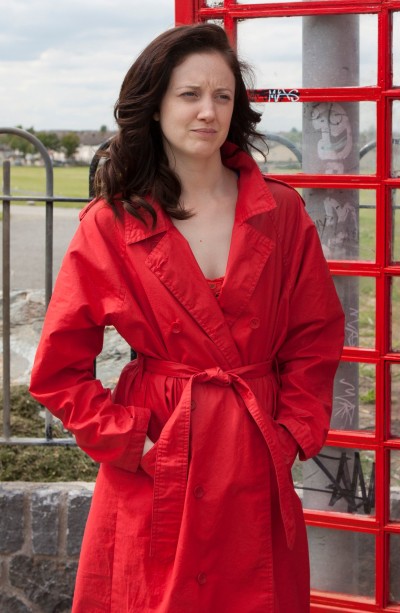 It’s 1993, and the peace process in Northern Ireland is cautiously inching forward – though there are some who prefer a more robust method of rebellion, shall we say. Among them is Collette McVeigh (Riseborough) whose little brother was killed by the British Army when she was 12. Along with her brothers Gerry (Gillen, whom you’ll know as Littlefinger from Game of Thrones) and Connor, she is part of the armed struggle, until a mission to plant a bomb in London leads to her capture. MI5 officer Mac (Owen) gives her a stark choice: face a long stretch in prison, separated from her children, or become an informer on her own family. Collette chooses the later, perhaps influenced by Mac showing her it was an IRA sniper who killed her brother. But it soon becomes clear more is at play, with Mac’s boss (Anderson) apparently intent on sacrificing Collette, in order to protect another, more valuable asset.