




★½
“Half a star deducted, for being only half a movie.”
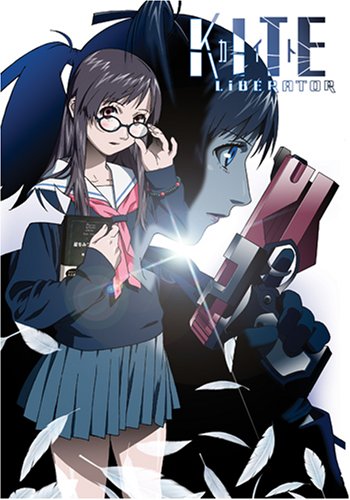 And not a very good movie at that, suffering from such multiple personality disorder, it sometimes feels that two completely different anime were spliced together in some mad scientist’s laboratory. If so, he clearly got bored and drifted off while the project was half complete, because this ends in a way which doesn’t so much suggest another part, as demand it unconditionally. Six years on, that still hasn’t materialized, making this about as appetizing as a half-cooked chicken. Oh, and speaking of mad scientists, there’s one of those in here too.
We’re a decade on from the events of the original Kite, and it seems Sawa has – without explanation – morphed into Monaka (Inoue). In between tracking down and killing paedophiles, she has a regular identity as a klutzy waitress at a cafe, where he co-worker Mukai (Okamura) protects her from the sleazy patrons. Monaka’s father is an astronaut, who has been in space for years. His space-station is visited by Kōichi Doi, a researcher investigating ways to preserve bone density in zero-G. However, it appears a combination of factors such as radiation, results in the astronauts mutating into monstrous creatures. After a firefight, Doi and his team bail out as the station disintegrataes, but the monster that Monaka’s father has become, is also on their craft, which crash-lands – conveniently right in her neighbourhood. A cover-up ensues, despite a trail of corpses, and Monaka is given her next mission: to kill the monster, unaware that it’s actually her father.
Which is pretty much where it ends, after a first battle between Monaka and him. Really: WTF? On its own, this is such an entirely pointless release, you have to wonder what happened. Even up to that point, this is problematic in a bunch of way, not least that Monaka is almost a minor character, and it appears to be a sequel in little more than name. While I’m not normally one to criticize a film for a lack of sex, this also lacks the severely transgressive or original qualities which made the original infamous. This is mostly a monster mash, which we’ve seen any number of times before. There is some potential for a second half, but I doubt it will ever happen. This is like tearing a book in two, selling the first half and never publishing the rest. If I had actually paid any money for this, I would be righteously pissed.
Dir: Yasuomi Umetsu
Star (voice): Marina Inoue, Akemi Okamura, Masakazu Morita, Setsuji Satō
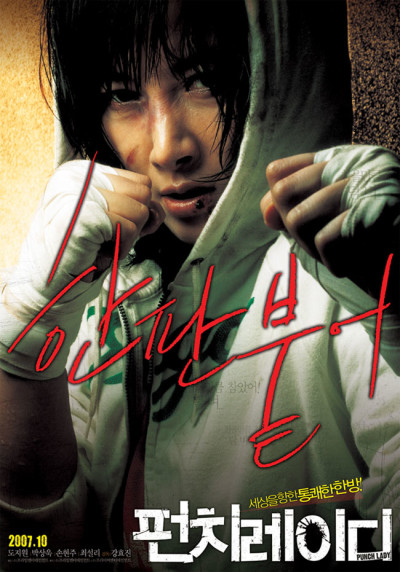 Not unlike
 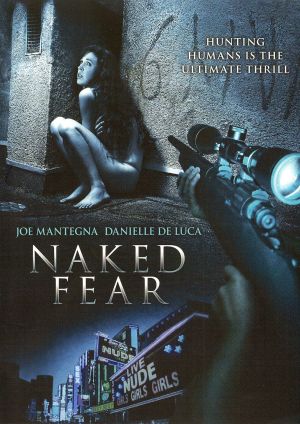 The concept of “hunting humans” has been popular cinematic fodder for over 80 years, since The Most Dangerous Game came out in 1932. This isn’t the first specifically to target women – the Roger Corman produced The Woman Hunt did so in the seventies – but the prey in that needed male help to accomplish much, which isn’t the case here. The heroine is Diana Kelper (DeLuca), whose new dance job turns out not to be quite as expected – she’s more or less coerced into working as a stripper, unable to leave until she pays off the debts to the man who brought her in. The only way to do that is to turn tricks on the side, but her first client is Colin Mandel (Garfield), who is interested in a longer-term relationship. Specifically, one where he can take his female victims into the remote wilderness, where they wake up, unclothed and eventually on the wrong end of a crossbow bolt or bullet. However, with Kelper, he may have bitten off more than he can chew.
 You can almost imagine the trailer for this anime series being done by The Trailer Guy [y’know, who does all the voice-overs for Hollywood action flicks]: “In a world where demons stalked the land… One woman… Was humanity’s final hope…” The particular focus here is Clare (Kuwashima), one of 47 Claymores, an all-female sect of nomadic warriors who travel a fictional country, battling the flesh-eating Yoma, with combat abilities that border on the magical. But doing so requires them to unleash their own Yoma power, an act which runs the risk of them becoming what they hunt if they lose control. Clare rescues Raki (Takagi), who becomes her companion and cook, but out heroine has a mission of her own: hunting down and killing the Yoma who, years previously, killed her own mentor, Teresa of the Faint Smile.
 In contrast to
 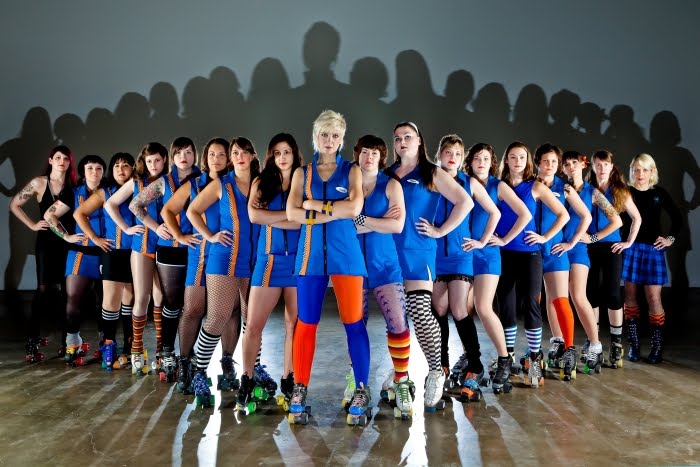 Not that there is any shortage of said personalities, such as the mother and daughter who both take part in the sport, or the three sisters who have been roller-skating virtually their entire life, and are feared across the entire Seattle league. There are, admittedly stories about romance and marriage included, but even these have a close connection to roller-derby, like the guy who proposes after his girlfriend became part of the championship-winning team [I can relate to this, having proposed to my wife immediately after the Arizona Diamondbacks won the 2001 World Series!]. I also enjoyed the insight into the different teams, like the Sockit Wenches (right) or the Derby Liberation Front, and the different ways in which they both perceive themselves and are perceived from the outside. Each has a different group personality, which of course, attracts other like-minded individuals, reinforcing that aspect of the team.
 In a dark, grim future, Michelle (Ling) is an assassin, taking out DNA hackers for pay. However, her income is drained as fast as she earns it by her Jackie (Shen), her brother, who has a gambling addiction. To try and pay off his mob debts, he breaks into the apartment of their next-door neighbour, Christian (Newman), a renegade DNA hacker himself, and steals a device on which he was working. The “transcoder” can take a subject’s DNA and, more or less, rewrite it, thereby having the potential to end disease – yet it could also be turned into an enormously destructive weapon. Needless to say, when word gets out that Jackie has this device, everyone wants to get their hands on it.
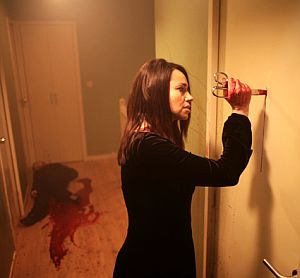 Let me be perfectly clear: this is hardcore horror of the most unrelenting sort, completely unsuitable for those of a nervous disposition, and particularly pregnant women. In the 1980’s, Dalle was a sexpot, for her role in Betty Blue, but you can flush all memory of that down the toilet: here, she has a feral, near-demonic intensity, and god help anyone who is unfortunate enough to get in her way. Particularly the men, who are disposed of with complete dispassion and brutality; as the film goes on, her relationship with Sarah becomes complex, and more a case of, “I’m taking your baby, and we can do this the hard way or… Well, really, that’s all there is. Sorry.” Friends, family, even an entire patrol of cops – no-one can help Sarah. She’s completely on her own, and her fate is entirely in her own hands.
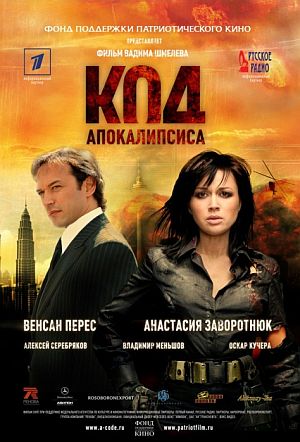 About ten minutes into this, as another large explosion filled the screen, Chris turned to me and said, “Is this a Michael Bay movie?” While it isn’t, confusion is understandable: this is just the kind of dumb action film for which he is renowned, featuring basic plotting and large-scale mayhem. Terrorist Jaffad is just about to sell four nuclear warheads he has hidden in major cities worldwide back to the Americans, when his entire compound is taken out, at the command of a mysterious figure known as “The Butcher.” FSB Agent Marie (Zavorotnyuk), who had previously been working undercover to get to Jaffad, just manages to escape the slaughter, and is now assigned to track down the Butcher, by getting close to his financial advisor, Louis (Perez). Jaffad gave parts of the eleven-digit code that can be used to detonate the devices, to trusted colleagues in Italy, Norway and Malaysia, and Marie needs to find the code before the Butcher.
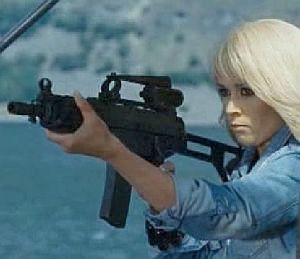 However, the plot is not novel at all, the efforts to give Marie backstory are near-laughable, and once the novelty of the Russian heroes wears off, the script has little to offer: significant fragments don’t make much sense, and other scenes seem to be there, just to prove the makers actually went to the locations. Action-wise, it’s somewhat of a mixed bag; it seems pretty clear the lead actress isn’t doing much of the action herself, but there’s a nice fight at the end between Marie and the villain, in front of the console which can be used to detonate the bombs, as a self-destruct timer counts down. You can also enjoy a gun-battle on a boat, and Marie stocking the corridors of a hotel [you’ll understand why I spelled it like that, hohoho].
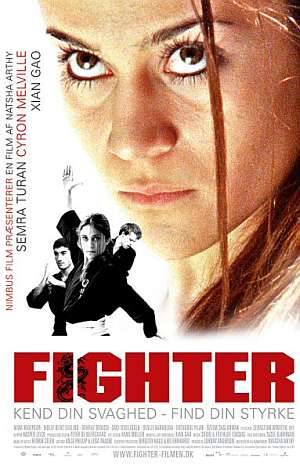 Certainly one of a kind, this coming-of-age film tells the story of Aicha (Turan), a Muslim girl born of Turkish parents, who is obsessed with learning martial arts – the last thing her father wants. This thoroughly unfeminine interest, in the eyes of her community, is carried out in secret, but Omar (Banissi), a friend of her brother’s fiancee’s family finds out, and is thoroughly unimpressed. “I don’t fight girls,” he says dismissively, when ordered to spar with Aicha, and this leads to his ejection from the club by their teacher (Xian). When he confronts Aicha at the engagement party, the resulting argument becomes a brawl, and leads to the breaking off of the engagement – which is doubly unfortunate, as the bride-to-be is discovered to be pregnant. Meanwhile, Aicha has to prepare for an upcoming tournament, alongside her training partner, Emil (Melville) – and for which Omar has also signed up as a contestant.