Barely Lethal

★★½
“Barely entertaining.”

barelylethalI could hear Chris’s eyebrows raising when the title here rolled: what kind of film was this? Fortunately, the arrival of Samuel L. Jackson reassured her ruffled eyebrows – and is that Sansa Stark as well? Alright, then: if you insist… It turns out to be a mash-up of two genres: the ‘teenage killing machine’ and the ‘high-school drama’, and is every bit as awkward as that sounds. Since being orphaned, Megan Walsh (Steinfeld) has been brought up as an assassin in a remote location, under the tutelage of the appropriately-named Hardman (Jackson), and with another trainee, Heather (Turner), a fractious rival. However, Megan begins to wonder what she’s missing in “real life”; after a mission to capture evil nemesis Victoria Knox (Jessica Alba), ends with Megan plummeting into a river, and presumed lost by her employers, she opts to start a new life. She becomes an ‘exchange student’, falls for the local hot kid (Mann), ignores the AV geek (Cameron) who falls for her – the usual sort of drama. After an incident at school goes viral, Hardman realizes his top agent is not as dead as he thought, and worse still, Knox has broken out of custody, and has revenge on her mind. Can Megan handle all that and still make it to Homecoming?

It’s an interesting idea, not least because Megan bases her knowledge and understanding of the world on the likes of Mean Girls and 10 Things I Hate About You. A satirical skewering of the difference between those and reality would be welcome, or even something darker in tone, along the lines of Heathers, with Megan’s lack of moral compass letting her clean out the dregs of the school with no qualms. However, the film seems less interested in satire, than going through the same cliches: it doesn’t help that Mann resembles a cross between Justin Beiber and Robert Pattinson. There’s nothing new or remotely interesting about this aspect, and it brings the film to a grinding halt. That’s something of a shame, as the action plot is nicely-handled, with some decent set-pieces. Jackson and Alba are old hands at this kind of thing, and I’d far rather have seen a film concentrating entirely on their struggles with each other, using the likes of Steinfeld and Turner as proxies.

It’s hard to say who the target audience is for this, or at least find one which would be satisfied by both aspects. Those who enjoy the school drama are likely to be uninterested in high-jinks out the back of a plane. Certainly, those who are looking for action – raises hand – will find themselves bored to tedium in the middle of this. At the end, Chris turned to me and said, “I didn’t think this would be your sort of film.” I think she has a point. I’m perhaps three decades or more, and a sex-change, from being able to appreciate this.

Dir: Kyle Newman
Star: Hailee Steinfeld, Thomas Mann, Dove Cameron, Sophie Turner

Mad Max: Fury Road

mad max 15★★★★½
“Mad (Wo)Men”

Compared to my normal reviews, this is going to be long, somewhat rambling and by no means limited to the movie itself. Because reactions to it, are in many ways as interesting as the film itself. Often, films that generate a lot of chatter or furore don’t live up to the hype – think 50 Shades of Grey or The Blair Witch Project. So it’s refreshing to find a controversial movie that would be quite capable of standing on its own. It’s also surprising to find myself writing about the film here at all, considering that the original series, to which this is a kinda-sequel, sorta-reboot, is among the most masculine of movie series. The most feminine character of note in the entire trilogy is Tina Turner, which says… Well, let’s just leave it at “something,” shall we? So, much as I was looking forward to seeing the original director revisit his creation – the second film, in particular, is an action classic – I was hardly expecting this to qualify for the site.

mad max 06But it does. For, make no mistake, this is the story of Imperator Furiosa (Theron), not Max Rockatansky (Hardy). Sure, Max is significant, and we experience the film from his perspective. But he isn’t the hero. It’s Furiosa who drives – literally – the storyline, by leaving the complex belonging to Immortan Joe (Keays-Byrne) with five of his ‘brides’, seeking the sanctuary of the “Green Place”, an oasis Furiosa remembers from her childhood. Joe, needless to say, is unimpressed with betrayal and sends his minions in pursuit, along with support from nearby settlements, specializing in the production of gasoline and ammunition. Max is part of that chasing group, being used as a living (and now mobile) blood-bank, after having been captured. After Furiosa tries to slip away in a sandstorm – guess she must have seen Star Trek II: The Wrath of Khan – Max escapes, and joins Furiosa’s group, which also grows to include one of Joe’s “War Boys”, Nux (Hoult), who switches sides to help the escapees. Their intended destination, however, proves untenable, and Max suggests their best bet is to head back and take Joe’s mountain citadel, which is now undefended.

To be clear, I don’t give a damn about a movie’s sexual politics (or politics of any kind). The films that have been given our Seal of Approval here run the complete gamut, from feminist classics such as Thelma & Louise through to grindhouse trash like Naked Killer, and even some which are both feminist AND grindhouse: Ms. 45 comes to mind. They all have strengths to be appreciated, and weaknesses that should be acknowledged, but good films are capable of making you see and appreciate the point of view from which they operate, whether or not it’s yours. In short, you don’t have to agree with a film to enjoy it. Indeed, I am inclined to look kindly on those which challenge how I see the world in some way – not taking a polemic approach, shrieking how I am bad and should feel bad, but by making their case for an alternative point of view, and bringing the audience along with them. It’s a bigger challenge than adopting the obvious stance, and is particularly subversive in genres like action movies, not normally known for such thing.

In some way, this is a a masterly piece of bait-and-switch by Miller, because no-one would have given him $150 million to tell Furiosa’s story outside the Maxiverse. Allowing for inflation, that’s about the same price-tag as 1995’s Cutthroat Island, and we all know how well that ended. Taking an established, popular genre franchise and rebooting it for a new generation is a much easier sell in Hollywood, having been done successfully with Bond, Star Trek, Batman, Planet of the Apes, etc. Now, if you were interested only in a Mad Max film, I can see this version being not what you expected. But what matters to me is not whether a movie is what I expected; it’s whether it’s good. And Fury Road certainly delivers on that aspect. The fact it has the best big-budget action heroine since The Bride? Call that a wonderful and pleasant surprise.

The flak aimed at the film has, perhaps surprisingly, come from extremists on both sides – neither of which I care much for, because I’ve found truth is rarely found in extremism of any form. On the one hand, you have Aaron Clarey on Return of Kings, who wrote the problem was, “Whether men in America and around the world are going to be duped by explosions, fire tornadoes, and desert raiders into seeing what is guaranteed to be nothing more than feminist propaganda, while at the same time being insulted AND tricked into viewing a piece of American culture ruined and rewritten right in front of their very eyes.” Firstly, Mad Max was, is and always will be Australian culture. Secondly, yes, give me explosions, fire tornadoes and desert raiders, and I’ll happily take any kind of propaganda with my popcorn. Doesn’t make me a bad person. Oh, and he hadn’t – presumably still hasn’t – seen the movie, basing his opinion on second-hand reports. At the risk of stating the obvious, this is never a good thing.

The other end of the spectrum is little better: I certainly do not care Fury Road passes the shitty, lazy Bechdel test. Or for social media troll/martyr Anita Sarkeesian, who opined sniffily “Mad Max’s villains are caricatures of misogyny which makes overt misogynists angry but does not challenge more prevalent forms of sexism. Viewers get to feel good about hating cartoon misogyny without questioning themselves or examining how sexism actually works in our society.” This would be exactly the kind of polemic approach mentioned above. as massively off-putting. As ever, Sarkeesian proves unable to separate reality from entertainment: “Sometimes violence may be necessary for liberation from oppression, but it’s always tragic. Fury Road frames it as totally fun and awesome.” Why, yes: yes, it does. It’s called escapism, dates back to at least ancient Greece, and is entirely harmless. But, of course, acknowledgment would derail Sarkeesian’s tubthumping agenda, that entertainment content e.g. video-games is the problem, rather than being (as I firmly believe) an exaggerated reflection of society.

mad max 04Enough of other people’s opinions! What about mine! Let’s start with a couple of things I really liked. Firstly, Miller does a great job of exposition through action, showing rather than telling us; outside of an opening voice-over. That applies not just the story, but also the setting and the characters, the last-named of which are defined almost entirely by their actions. This avoids the tedious grinding to a halt which might have been required, for example, to explain why Furiosa has one arm. Or how she managed to rise to become one of Joe’s most trusted allies. Or what happened to convert her from that and turn her thoughts towards rebellion and escape. Actually, I might not have minded hearing more about those; maybe they’ll do a prequel? But the ratio between talk and action is likely more heavily tilted toward the latter than any major film I’ve seen in a long while, if ever.

This could become an issue, particularly given the relatively monotonous, in the original sense, content – it is, more or less, a single, two-hour chase sequence. However, there are easily more than enough variations spun on the basic theme to provide for entertainment. I’m not sure these necessarily make a great deal of logical sense, such as the people swaying on poles 20-30 ft off the ground, or wheeling a flamethrowing guitarist around with you as part of your entourage. I guess, after the apocalypse, Rammstein will still be popular. I did have a problem with the use of CGI to enhance the practical stunt work, in what looks like a poor effort to jazz things up and justify the 3D ticket price [we saw it in 2D; Chris has found her inner-ears do not play well with 3D]. One of the great things about the original was, when things blew up, flew through the air and smashed into each other, they were really doing so. Here, while still generally the case, there seems too much stuff added for effect, such as airborne bodies  – which I found reduced the sense of reality, and hence, impact.

mad max 07It’s also worth noting the other female characters – even the heavily-pregnant bride! – are pretty decent too. Obviously, they’re no Imperator Furiosa, but on the way to the Green Place, they’re forced to dig deep and find reserves of courage which, one imagines, aren’t required in their everyday lives. As least, judging by the not-particularly feminist scene where Max staggers out of the sandstorm, and up to the truck to find the brides literally hosing each other down, in their garments from the Victoria’s Secret Post-apocalypse collection. More hardened are the all-female collective who brought up Furiosa, met at the midpoint of the journey, who seem to inhabit a strange philosophical territory where they try to lure men in, yet want nothing to do with them. They’re an odd bunch: yet like everyone else who has survived, they’re hard as nails. “One man, one bullet,” yells one as they go into battle. Inexplicably, Miller saw fit to call them the Vulvalini, which is the most wretched name for anything in a big-budget movie, since we got “Unobtainium” in Avatar.

Overall, though, it’s a solid success, and Furiosa is a remarkable bad-ass, with an appearance that is entirely unconventional in every way, yet Theron still manages to have a statuesque presence, as in all her films [well, almost all. Monster is the stuff of nightmares]. She’s actually taller than Hardy. The lack of even the slightest morsel of romantic chemistry between Furiosa and Max is great, not least because it would be hideously inappropriate in every way, given the characters’ situations. It’s still remarkable some studio exec didn’t feel the need to shoehorn it in, or at least provide some moments of unresolved sexual tension. Instead, these are two intense and focused individuals, working together for a common goal. That one of them is a woman is irrelevant – which in many ways, is how I tend to think it should be in the action genre. Does feeling so make me a “feminist”? I’ll leave the nattering nabobs of negativity online to be the judges of that. The rest of us should take in a slick, well-produced, all-you-can-eyeball action buffet, which sets the bar high for Hollywood action heroines this year.

Dir: George Miller
Star: Charlize Theron, Tom Hardy, Nicholas Hoult, Hugh Keays-Byrne

Sword and Sorceress, edited by Marion Zimmer Bradley

Literary rating: ★★★★★
Kick-butt quotient: Variable

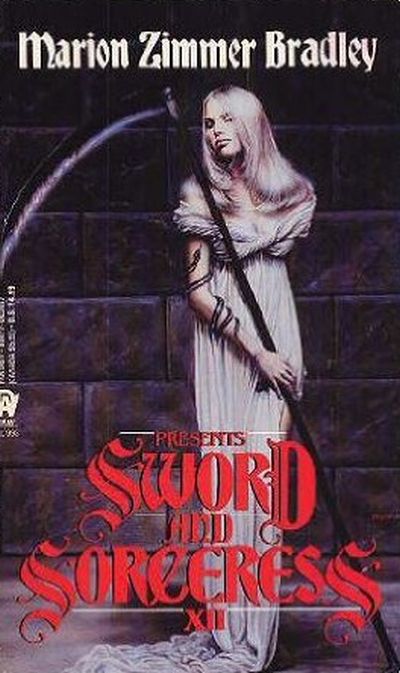
swordandsorceressIn the series of anthologies of original stories which began with this volume, the late editor Bradley mines similar territory, and deals with similar strong female protagonists, as does Esther Freisner in the later Chicks in Chainmail series. The quality of writing (at least in the initial volumes) is high in both; the main difference being that Bradley’s series tends to feature tales that are more serious in tone, with less humor. (Though that doesn’t mean that they all necessarily have none of the latter; and a couple would have been at home in the later series as well.) That doesn’t reduce their entertainment value, and often makes them more compelling.

The 15 stories in this volume come in great variety, as do the settings, and the heroines. Some of the latter can be rough-edged, and may sometimes do some things I wouldn’t do, or recommend; but all of them have good hearts at their core, and earn the reader’s goodwill and respect. (Some of them, like Charles de Lint’s bounty huntress Aynber, and Charles R. Saunders’ alternate-African warrior woman Dossouye, are series characters who appear in a number of stories elsewhere by these authors.) Some of my favorites here are “The Valley of the Troll,” “Gimmile’s Songs,” “Severed Heads” (which isn’t as grisly-gory as the title makes it sound), “Child of Orcus,” “Daton and the Dead Things” and “Sword of Yraine.” But virtually all of these are worth reading; the only one here that I felt was a little weak is “House in the Forest.”

Bradley’s substantial introduction is an added benefit of the book; she provides a good historical sketch of the role of female characters in sword-and-sorcery fantasy fiction, and some really insightful comments on the appeal and value of strong, three-dimensional heroines in this field. (Her meaty bio-critical notes on each story’s author are a very worthwhile feature, as well!) She very rightly outlines an equalitarian perspective that explicitly differentiates her purpose from “feminist propaganda” and Woman-uber alles male-bashing; the female perspective here is rightly seen as an essential part of the human perspective, that includes both genders as important, needed and responsible contributors to the world and the human story.

Even so, I would differ with her on one point. Though she dedicates this volume to C. L. Moore and to “all of us who grew up wanting to be Jirel,” she faults Moore here for Jirel’s realization in “Black God’s Kiss,” (which isn’t included here) after killing her adversary Guillaume, that she loved him; Bradley thinks this weakens the character, and sends the message that “woman’s pride only stood in the way of true happiness –interpreted as surrender to a man.” Personally, I didn’t take Moore’s story that way; I interpreted it as a true-to-life reflection of the fact that sometimes underneath anger and enmity there can be a bond between two people –just as a male, too, might feel attracted to a woman who can fight him tooth-and-nail, and even defeat him. (And it’s as much, or more, Guillaume’s pride as Jirel’s that separates them.) But that’s a quibble –and one that has nothing to do with the great stories in this collection!

Editor: Marion Zimmer Bradley
Publisher: DAW Books, available through Amazon, currently only as a printed book.

A version of this review previously appeared on Goodreads.

Angel of Fury

★★
“Never mind the action quality, feel the quantity!”

angel of furyJust to confuse matters, there are actually two Rothrock flicks by this title: in 1993, the year after this, the same title was used as an alternative name for Lady Dragon 2, starring her and Billy Drago. There is no Drago to be found in this entry. Indeed, there is not much to be found except for an abundance of mediocre action, and a surprising degree of violence aimed at children. There’s no denying the almost non-stop volume of fights and chases: however, it’s like a copious, all-you-can-eat buffet consisting entirely of vanilla pudding: you’ll likely walk away unsatisfied.

Cynthia plays Nancy Bolan, the head of security for a tech company, who is charged with delivering a special computer to the company’s Indonesian offices. No soon has she arrived than she is attacked, and the computer stolen. But that’s okay, because it turns out there are actually three computers, two of them decoys, and they have a large explosive payload which goes off if someone tries to access them without the deactivation code. They are being sought by ‘Bolt’ (O’Brian), a terrorist who wants them because…. Mumble mumble something terrorist? And he is prepared to stop at nothing, even involving the little moppet befriended by our heroine, who is taken to what appears to be an Indonesian Disneyland knockoff, featuring some guy dressed as a rat. Fortunately, there’s also Nancy’s former squeeze (Barnes), who was so attached to her, he left Nancy believing he was dead for three year. I’ve had girlfriends like that too.

This does possess some certifiably insane moments, likely none more so than Nancy riding a motorcycle straight at a car, leaping through the air, kicking the driver through the windshield which triggers it to roll over out of control, while she walks away. Sadly, is is filmed in such an amateur way, the results are nowhere near as awesome as that sounds, since it just looks stupid and unbelievable. Such is the approach for much of the rest of the movie, right from the start where the bad guys apparently do have guns, yet don’t use them when they first fight Nancy, only when they’re subsequently chasing after her boat on jet-skis. While there are occasional moments where you do see what Rothrock is capable of, these are sporadic at best, and a pale imitation of her best work in Hong Kong. Director Anwari was also responsible for Virgins From Hell, which was at least amusingly bad. For much of its running time, this is simply a large helping of that vanilla pudding mentioned earlier.

Dir: Ackyl Anwari
Star: Cynthia Rothrock, Chris Barnes, Peter O’Brian, Zainal Abidin
a.k.a. Triple Cross

The Trail

★★★½
“God told me to do it.”

thetrailI’m not religious, and “faith-based” films normally have me running a mile, though I confess a certain guilty fondness for the more extreme, Revelations-based work [I mean, have you ever read Revelations? The things that go down are certifiably insane. This is what Hollywood should be making, not Noah or Moses stories]. But it was only at the end of this, with a final title quoting a Bible verse, that I realized The Trail likely falls into the category, as shown by the alternate title; fortunately, it’s very much understated, and can be appreciated even by godless heathens like myself. Amelia (Jandreau) is on her way to California as part of a wagon train with her husband (Brown), when they decided to split off on their own, he believing he knows a short cut. Unfortunately, they are attacked by Indians, and Amelia is left, on her own, in the middle of nowhere, to try and make her way through a vast, unforgiving wilderness.

The closest cousin is Nicolas Roeg’s brilliant Walkabout, not least because Jandreau bears more than a passing resemblance to Walkabout‘s star, Jenny Agutter: both have a similar pale beauty, and habit of opening their mouths just a smidge. The similarity is also in the relationship Amelia strikes up with a young indigenous child (Nash) she meets, that proves crucial to her chances of survival, echoing the one in Roeg’s film. However, the take here is a good deal less earthy and primitive in its themes, and Amelia is a good deal less dependent, instead being a lot more pro-active, which is why it merits coverage on this site, being equally a story of self-discovery and survival against the odds. Indeed, perhaps its main weakness is, rather too much against the odds: while there’s not much idea of the overall timeframe here, she survives blizzards clad only in a light dress (the kid is sensibly wearing furs), and doesn’t seem to do much hunting or gathering beyond a tiny fish. Maybe that’s supposed to represent the power of her faith?

Despite throwing this on late at night, it managed to hold my interest better than you think it might, considering the lack of conventional action sequences: it’s more or less 95 minutes of Amelia versus the great outdoors. It helps that the heroine is given an inner strength of character – again, I presume in hindsight, this is a religious thing – and determination to overcome any obstacle, sometimes with inventiveness, such as when she turns her wedding dress into a fishing-net. The landscapes are fabulous, and the photography does both them and the heroine justice, capturing the latter with an almost luminescent glow. As a different take on the era, eschewing the obvious characters and situations, it’s worth a look if you’re in a more contemplative mood.

Dir: William Parker
Star: Jasmin Jandreau, Tommy Nash, Shannon Brown
a.k.a. Let God

Did You Say Chicks?, edited by Esther Friesner

Literary rating: ★★★★
Kick-butt quotient: ☆

didyousaychicksPublished in 1998, this is the second of several installments in editor Friesner’s series of original-story anthologies featuring strong, mostly warrior women in (mostly) a sword-and-sorcery fantasy milieu. Marion Zimmer Bradley’s older, long-running Sword and Sorceress series is the closest counterpart, but the stories Friesner selects are much more often on the humorous side, and relatively lighter on actual violence –the protagonists here can handle themselves well in a fight, but tend in practice to triumph more by the use of intelligence, or to be able to find common ground with potential opponents where that’s possible. (Lethal violence is more apt to be mentioned, if at all, as an event that happened before the action in the particular story.) Many of my comments in my review of the first collection, Chicks in Chainmail, are relevant here, and my overall enjoyment was similar. (I rated both books at four stars.)

There are 19 stories here, written by 23 authors (three are two-person collaborations); as she did the first time, Friesner herself contributes a story, in addition to her role as editor. Eleven of these, including Harry Turtledove, Elizabeth Moon, Elizabeth Ann Scarborough, and Margaret Ball, also contributed to the 1995 first collection. Among the authors new to the series (and to me) here are Barbara Hambly, Sarah Zettel and S. M. Stirling. (Short biocritical endnotes are provided for all of the authors.) Besides her story, Friesner also prefaces the book with a dedicatory poem to Lucy Lawless, star of the then still-running Xena, Warrior Princess TV show. In keeping with the tone of most of the stories, her poetic style is more Ogden Nash than Dante, and she doesn’t take herself too seriously (after the poem, she appends a quote from Dr. Johnson, “Bad doggerel. No biscuit!”) –but there’s an underlying seriousness of equalitarian feminist message as well. (The final selection, Adam-Troy Castro’s “Yes, We Did Say Chicks!” is a similarly tongue-in-cheek flash fiction, but it’s cute!)

Not all of the stories are actual sword-and-sorcery, or fantasy. One of the two strictly serious ones, Turtledove’s “La Difference,” is a science-fiction yarn set on the Jovian moon Io, as a male-female pair of scientists trek across a dangerous and unforgiving alien terrain as they flee from enemy soldiers bent on slaughtering them. (This is also one where the female doesn’t singlehandedly save the day; she and her male partner work as a very good team.) Laura Anne Gilman’s “Don’t You Want to Be Beautiful?” is set in our own all-too-familiar world, where females are pressured by advertising and culture to fixate on their appearance and spend vast sums on products that supposedly enhance it; and it isn’t clear if the surreal aspects of the story are really happening or are the protagonist’s hallucinations. (This is one of a few stories that women readers will probably relate to more easily than men will.) Slue-Foot Sue, the heroine of Laura Frankos’ contribution, is the bride of Pecos Bill in the American tall-tale tradition, of which this story is definitely a continuation (though it’s also one of two stories that feature Baba Yaga, the witch figure from Russian folklore). And while the story is fantasy, the title character of Doranna Durgin’s “A Bitch in Time” isn’t a woman, but a female dog –albeit one who’s trained to detect and guard against magic.

My favorite story here is Hambly’s “A Night With the Girls,” the other strictly serious tale in the group. This features her female warrior series character, Starhawk, here on an adventure without her male companion Sun Wolf; I’d heard of these two before, but never read in that fictional corpus. (I’m definitely going to remedy that in the future!) Both Moon and Ball bring back their protagonists from their stories in the first book for another outing here, to good effect. The protagonist of Lawrence Watt-Evans’ “Keeping Up Appearances” is a professional hired assassin, who approaches her chosen line of work pretty matter-of-factly, without noticeable moral qualms. But she’s also capable of genuine love and loyalty, especially towards her business partner and common-law husband, with whom she hopes to one day settle down and retire.

So when she returns from a trip to find that he’s unilaterally accepted a contract on a powerful wizard and, while trying to scout the job by himself, gotten turned into a hamster, we can sympathize with her distress, and hope she can reverse the situation. (Can she? Sorry, no spoilers here!) If you’ve read Beowulf and want to know what really happened to Grendel, check out Friesner’s “A Big Hand for the Little Lady.” And Steven Piziks’ “A Quiet Knight’s Reading” is another tale that’s close to my heart (you’ll see why if you read it!). At the other end of the spectrum, two stories I didn’t especially care for were Scarborough’s “The Attack of the Avenging Virgins” and Mark Bourne’s “Like No Business I Know.” The former story, among other things, delivers an essentially sound message, but in a story so message driven that it’s more of a tract, and with an annoyingly “PC” vibe.

As with the original book, bad language is absent or minimal in most stories. Bourne’s is the exception, with quite a bit of it, including religious profanity and one use of the f-word. Sexual content is more noticeable in this volume, with unmarried sex acts (not explicit) in a couple of selections, rape of males by females in another, and a lesbian/bisexual theme thrown into another one as a surprise. “Oh Sweet Goodnight!” is the most frankly erotic story, with its focus on the heroine’s sex life; but the male-female author team treats sexual situations realistically rather than salaciously, and the ultimate message here isn’t as far from traditional morality as some might expect. (This is also a story where magic is absent; Fern’s a sword-toting guardswoman in a low-tech society, but she could just as easily be a divorced single mom in modern America, making a living as a cop or security guard –and modern readers will find her easy to relate to on that basis.)

Editor: Esther Friesner
Publisher: Baen, available through Amazon, currently only as a printed book

A version of this review previously appeared on Goodreads.

Solo

★★
“…and this is why we don’t camp.”

soloGillian (Clark) takes a job as a summer-camp counselor, only to discover that part of the training involves her spending two nights, by herself, on an island in the middle of a nearby lake. That isn’t an ideal sitation for Gillian, since she’s troubled by nightmares of her past, and is unsettled to discover a previous trip by campers to the island, ended when a young girl sleepwalked her way to tragedy. Her spirit is still supposed, according to camp counselor lore, to roam the island, etc. etc. There may be less parapsychological threats to Gillian’s safety, although are they real or just her paranoia playing up? She finds a broken doll, and then finds a tent, with photos of young women taped to the roof inside. Ok: it’s probably not just her paranoia then. The potential culprits include Fred (Clarkin), the creepy owner of the camp, who was part of the previous expedition; his creepy son, Marty (Love), called “Martian” by the other councillors, for reasons that are obscure; and apparently friendly fisherman, Ray (Kash), who shows up and offers first-aid, after Gillian gashes her leg.

Clark is a decent heroine, although one perhaps too defined by her vulnerabilities. The main issue is a script that is astonishingly dumb. For instance, as with any modern wilderness horror, it has to deal with The Cellphone Issue. Here, it does so by Gillian being forbidden from taking hers on to the island, which is kinda neat. Except she does. But there’s still no signal. So she swims out into the water, the phone in a plastic bag held between her teeth, and tries to send a text. When that doesn’t work, she hurls it away in a fit of pique. At some point later, the phone unilaterally decides to send the text. But the recipient doesn’t bother doing anything significant with it. WHAT WAS THE POINT? They should simply have stopped at her being forbidden to take hers on to the island. It’s this kind of inanity which plagues much of the proceedings here, with people behaving in ways that don’t seem credible.

This is just about plausible for the villain – after all, you are a loony stalking camp counselors in the middle of a lake,  critical thinking may not be your forte. However, the second half of the film, consists of little more than four people stumbling around, making poor decisions. Much though you want to root for Gillian, and she does find a decent amount of inner fortitude at the end (Let’s just say, “Anchors aweigh!” and leave it at that), the overall feeling is that everyone deserves to be voted off this island.

Dir: Isaac Cravit
Star: Annie Clark, Daniel Kash, Steven Love, Richard Clarkin

Restless (2012)

★★★½
“Before she was Agent Carter…”

restlessWatching Atwell walking the streets of forties New York as British agent Eva Delectorskaya does little to dissuade you from the feeling that this could be a prequel to Agent Carter, telling about some of her wartime exploits, before she goes to work for the Strategic Scientific Reserve. There’s actually a good deal more going on: the two-part TV miniseries starts 30 years after the end of the war, when Sally Gilmartin (Rampling) reveals to her daugher, Ruth (Dockery), the truth about her identity as the former Miss Delectorskaya, recruited in pre-war Paris by British intelligence, after her brother is killed by fascists. After things kick off, she is sent first to Belgium, and then to New York where she works on efforts to get America into the war, and continues a relationship with her boss, Lucas Romer (Sewell). However, sent on what appears to be a simple courier mission to New Mexico, she finds evidence pointing to another agenda, and which suggests a traitor within the department. It’s this which leads to her going off-grid: but it appears her fake identity has been compromised back in the present day, with her home under surveillance, by person or persons unknown.

The vast spread of this, taking place over four decades or so, requires the use of two actresses to play the lead, and that can often be an issue. However, here it’s possible to imagine Atwell aging into someone like Rampling – if you look at pictures of the latter from the seventies, they are not entirely dissimilar. [It certainly works much better than the idea of Sewell becoming Michael Gambon, which is the other half of the equation] At three hours, this may be a bit over-stretched, particularly in the second half, where there seems to be a lot of going from one place to another without much purpose. Contrast this to the tenseness delivered by the first part, in particular when Eva and Lucas go to a Dutch border town, where a Gestapo officer is supposed to be defecting, only for the operation to go horribly wrong after a botched exchange of pass-phrases. But whose fault was that? I’d like to have seem more of these thriller aspects, as Hall (who has worked both on Spooks and Strike Back) seems to have a good handle on these.

The ending was a little bit of a damp squib as well: it became apparent early on who the traitor is, if only because all the other credible candidates get bumped off. From that point, you are more or less waiting for the inevitable face-off between the parties concerned, although the acting abilities of those involved certainly help. After a few years, in the acting wilderness, Rampling seems to be undergoing a bit of a late career renaissance, between roles like this, and in Dexter and Broadchurch. Maybe she’ll follow the footsteps of Helen Mirren and become an action heroine for the older generation: on the basis of this, she would probably do rather well.

Dir: Edward Hall
Star: Hayley Atwell, Rufus Sewell, Charlotte Rampling, Michelle Dockery

Chicks in Chainmail, edited by Esther Friesner

Literary rating: ★★★★
Kick-butt quotient: Variable

chainmailWhile the stereotypical image of the warrior in our culture tends to be male, warrior women were not unknown in the world of antiquity; they left their mark on classical, Celtic, and Norse-Teutonic legend, and found a literary prototype in the “lady knight” Britomartis, who rides through the pages of Sir Edmund Spenser’s The Faerie Queen. The creators of the sword-and-sorcery fantasy tradition in the early pulps drew on this background to create a few sword-swinging heroines such as C. L. Moore’s Jirel of Joiry and Conan’s comrade-in-arms Valeria in Robert E. Howard’s “Red Nails.”

With the rise of women’s liberation, their ranks have been considerably swelled in contemporary fantasy, and two anthology series of original short stories have appeared to showcase them: the Sword and Sorceress collections begun by Marion Zimmer Bradley, and the Chicks in Chainmail series begun with this volume. Having read the first volumes of both, I’d say they’re both quality work; to the extent that they have a difference, it would be that the tone of the stories in this collection tends to be more on the lighthearted and humorous side than that of the stories in the Bradley collection –though there are exceptions in both groups. (It should be noted that the term “chicks” in the title here isn’t used in any disrespectful sense, any more than “gal” is in the parlance of an older generation.)

Twenty authors are represented with stories in this volume, some of them well-known in speculative fiction circles, such as Roger Zelazny, Harry Turtledove, Josepha Sherman, George Alec Effinger (who contributes a story featuring his series heroine, Muffy Birnbaum, “barbarian swordsperson”) and Elizabeth Ann Scarborough. The great majority of the stories are quite entertaining, and they not infrequently have good messages (like much of the fiction in this genre, they tend to extol heroic qualities of character). My personal favorite is “The New Britomart” by Eluki Bes Shahar (she also writes as Rosemary Edghill), set in England in 1819, where a country baronet, inspired by Ivanhoe, decides to stage a medieval-style tournament. (Toss in a powerful closeted sorceress with no scruples, a couple of visitors from Faerie, an Ivanhoe character brought to life by magic, a genuine dragon, a girl who wants to compete as a knight and a guy who wants to be a librarian, and anything may happen.)

Other especially good selections are Sherman’s “Teacher’s Pet,” Elizabeth Waters’ “Blood Calls to Blood” (I’d welcome seeing her heroine as a series character!), and David Vierling’s spoof of old-time pulp fantasies, “Armor/Amore.” Margaret Ball’s “Career Day,” despite its invidious portrayal of its only Christian character, manages to be a strong story about personal growth, where the heroine learns some worthwhile lessons. But almost all of the stories are well worth reading, not just these five. Any collection of 20 stories is likely to have one or two that not every reader cares for, and this one is no exception. IMO, Susan Schwartz’ bizarre “Exchange Program,” in which Hillary Clinton is killed in an Amtrak accident and winds up going to Valhalla (or a grotesque parody of Valhalla) is the weakest selection; it falls flat, in my estimation. But in the main, these tales are well worth a read.

Note: Bad language is absent or very rare in these stories, and there’s no explicit sex; most stories don’t have sexual content as such. The exception is Lawrence Watt- Evans’ “The Guardswoman,” whose heroine finally becomes “one of the boys” when she’s able to join her male colleagues in traipsing to the local brothel for sex (she falls into an affair with the male bouncer). But in general, the other sword-wielding ladies in this book display high morals — they respect themselves, and insist on being respected.

Editor: Esther Friesner
Publisher: Baen, available through Amazon, currently only as a print book.

A version of this review previously appeared on Goodreads.

Avengers Grimm

★★★
“Once Upon an Enchanted Time.”

Avengers-GrimmI don’t mind The Asylum studio at all. They are notorious for churning out their “mockbusters” – low-budget, similarly-titled movies intended to cash in on a bigger budget film’s publicity e.g. Transmorphers. And, let’s be honest, most of those do suck. However, they have achieved some renown for cheerfully silly creature features, the best-known of which is the Sharknado series. [Though in our house, we worship at a shrine to Mega Python vs. Gatoroid, starring those titans of 80’s bubblegum pop, Tiffany and Debbie Gibson.] Avengers Grimm occupies an odd middle territory: while its title is clearly intended to be riding the coat-tails of Avengers: Age of Ultron, yet a more accurate mockbuster title would be the one given above. The sole reference justifying the A word is when one character says, to no particular purpose, “We’re not heroes, we’re avengers.” Marvel’s legal department would probably beg to differ there.

For this is actually about the crossing over into the modern world of fairy-tale characters. The villain here is Rumpelstiltskin (Van Dien), who hijacks the magic mirror belonging to Snow White (Parkinson) since it can – an ability inexplicably omitted by the Brothers Grimm – act as a portal to our own, magic-free universe. He travels through dragging her with him, and by the time Snow’s princess posse catch up, he has become mayor of Los Angeles, because time flows at a different rate here. He is creating an army of “thralls,” mind-controlled minions that will do his bidding and allow him to expand his realm from a city to much further, and must be stopped. While Snow is trying to do just that, the arrival of her allies poses a problem, as they bring with them the last fragment of the mirror: it can be used to return to their world, or allow Rumpelstiltskin’s pals to join him. Making matters worse, he has enlisted the help of Iron John (Lou Ferrigno) and turned him into an unstoppable killing machine to hunt down the princesses.

This is as much an exercise in limiting expectations. Do not expect anything to do with Marvel, and instead something that’s an energetically low-budget riff on Once Upon a Time crossed with Enchanted, and you’ll be about there. There are probably a couple of princesses too many: outside of Snow, only Red Riding Hood (Peteron) and Rapunzel (Vanderbilt) made much impression, the latter swinging her weighted hair around like an offensively-coiffeured version of GoGo Yubari. There’s a nice subplot which has Red more or less going on her own mission, to take down the big, bad Wolf – one of Rumpel’s sidekicks – because he killed her parents. That’s the kind of inventive storytelling we could have used more of, or perhaps showing how the princesses adjust to modern life, which seems to happen with little more than a flick through a fashion magazine. However, Van Dien and Ferrigno make good foils for the ladies (many of whom come from Team Unicorn), and there are adequate quantities of princess ass-kicking. I was adequately entertained: and that’s more than can be said for my short-lived attempt to watch Once Upon a Time. This is a case where, as far as I’m concerned, the mockbuster tag probably does the film more harm than good.

Dir: Jeremy M. Inman
Star: Lauren Parkinson, Casper Van Dien, Elizabeth Peterson, Rileah Vanderbilt