




★★★
“Don’t call it Star Wars…”
 Despite critical derision, this is actually perfectly serviceable pulp SF. Sure, it’s derivative as hell. But the critics getting all huffy about the similarities to Star Wars seem to have forgotten George Lucas only made his film, after failing to acquire the rights to Flash Gordon. This is Snyder’s equivalent to The Fifth Element, in that it’s a long-gestating SF idea, originally conceived well before he became a director. “The Dirty Dozen in space” was the high concept, although there is no denying the SW similarities, especially in the early going. I mean, young orphan on a backwater farming planet gets sucked in to galaxy-hopping adventures, joining a rebellion against an evil empire? Yeah, a little more originality would be welcome.
It is a bit more “adult”, though the PG-13 certificate holds it back. I still want to see a hard-R take on the concept. Here, it’s limited to stiffer violence and a sprinkling of sexual assault. [An R-rated cut will follow: presumably with more blackjack and hookers.] The heroine is Kota (Boutella), rescued from a crashed spaceship and now living a quiet life on Veldt. That ends when Admiral Atticus Noble (Skrein) and his forces arrive, hunting rebels against the Motherworld. We know they’re the bad guys, because they shop for clothes at some kind of Nazi Outlet Mall. Soon, Kota and fellow farmer Gunnar (Huisman) are on galactic tour, seeking warriors who help defend Veldt, and joining up with the rebels.
If all fairly basic, that’s not a bad thing. I got significant Chronicles of Riddick vibes, though it had a stronger central character. This isn’t necessarily Boutella’s fault, more a result of there being so many to handle here. Editing would have helped: for example, there’s one lengthy animal training scene which feels like it wandered in from Avatar. As you would expect from Snyder, it looks very nice, certainly an improvement in this area over Army of the Dead. There is a similar theme – you could call it’s predecessor “The Dirty Dozen in Vegas, with zombies”. But outside of Kota, not many of the characters here make much impression. Save perhaps the regrettable Oirish accent sported by mercenary pilot Kai (Hunnam).
It does suffer from part-one-itis – the inevitable lack of any conclusion, with nothing of significance being decided. Even the apparent death of a major character ends up being a fake out. But it does rather better than, say, Dune, in terms of narrative division. The action is generally nifty too: Boutella has had her moments before, and gets to build on that experience here, especially in her final battle against Admiral Noble. Doona Bae makes a good impression as cyborg swordmistress Nemesis, not least in a hellacious fight against – and this is a phrase I did not expect 2023 to bring me – an arachnid Jena Malone. Bottom line is, I was entertained for two hours, and have enough interest in seeing part two in April. Good enough for me.
Dir: Zack Snyder
Star: Sofia Boutella, Ed Skrein, Charlie Hunnam, Michiel Huisman
[This review originally appeared on Film Blitz]
 When I see “Reader discretion is advised,” on an Amazon page, I tend to take it with a grain of salt. I’ve been enjoying media at the outer edges for longer than most readers here have been alive, and so am not easily shocked, disturbed or offended, to put it mildly. I’m ussure this quite managed to do any of those, but I will definitely say this: yes, reader discretion
 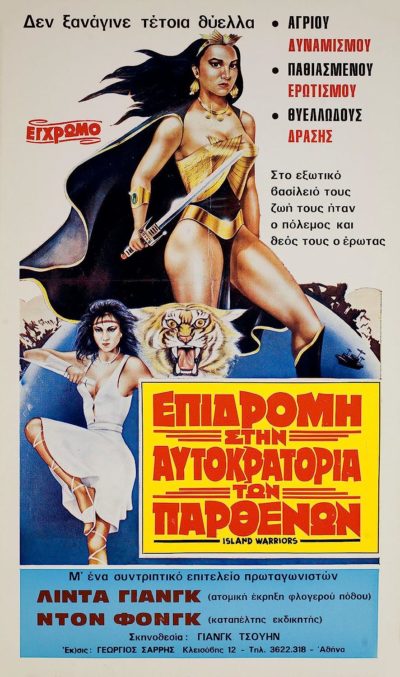 This Taiwanese production takes place on an island where women have been separate from men for 23 generations, developing more or less your stereotypical Amazonian society. Men are rejected, male babies tossed out to see to sink or swim (typically the former) and they have build a giant, albeit largely unconvincing, statue of their founding ruler, which fires cannonballs out of its eyes. This is not inappropriate, since the current occupant of the throne, Queen Nadanwa (Yeung). has a harsh line in anti-male rhetoric (“All men are dangerous!”), accompanied by castration. Her subjects dress either in flimsy white robes or shiny battle armour, and engage in gymnastic or circus-related forms of entertainment.
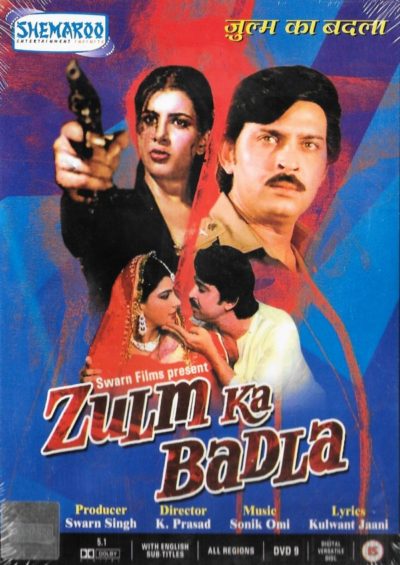 In recent years, the gap in cinema between Bollywood and Hollywood has closed dramatically. The likes of Indian blockbusters such as RRR (technically Tollywood rather than Bollywood) can stand, in terms of technical competence, beside their American equivalents. It’s mostly due to a dramatic improvement from Asia, because it wasn’t always the case, as we see when we go back to the mid-eighties for this slice of vengeance served cold. It looks pretty rough if you compare it to what Hollywood was making at the time, and in many ways feels like it’s about twenty years older than it is. I still found it more watchable than I expected, but then, I’m somewhat used to the style of Indian cinema. Newcomers might find this a bumpy ride.
 A decade after the splattery joy which was
  Zombies and jail aren’t quite as new an idea as you might think. The Walking Dead had a major arc which took place at a prison, the facility’s fences now more useful for keeping things out than in. And back in 2005, The Asylum released the (surprisingly decent)
 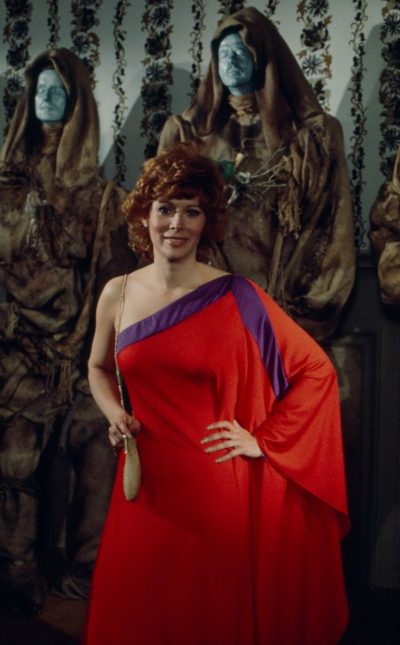 No, not the eighties version of Brenda Starr: that is well known, and justifiably much derided, to the point it didn’t even reach the necessary level for inclusion here. But neither was it the first version of the comic-strip to reach the screen. Well, at least the small screen. There had previously been a 1945 series, Brenda Starr, Reporter, though some reports describe this as nearly action-free. But the late seventies saw two television efforts: as well as the one under discussion here, three years later in 1979, there was an unsold television pilot movie (now apparently lost) in which Sherry Jackson played the intrepid girl journalist. In contrast, this appears to have been intended as a stand-alone from the get-go. While I’m sure ABC wouldn’t have minded had this been successful enough to become a franchise, it suffers from much the same problem as all the other adaptations, with a heroine that’s too passive to pass muster
 I was disappointed by the lack of tentacles. However, there were certainly no shortage of teeth in this post-apocalyptic tale, which takes place decades after the arrival of monsters, from an uncertain source, has led to the collapse of civilization on Earth. The survivors are left to scratch out a fragile existence, trying to dodge the many kinds of lethal new fauna which inhabit the landscape. Askari is a young woman who forms part of one such nomadic group, but finds herself increasingly questioning the strict rules by which they operate. As punishment for breaking these laws, is sent by elders of her tribe on a hazardous mission into a long-abandoned urban area.
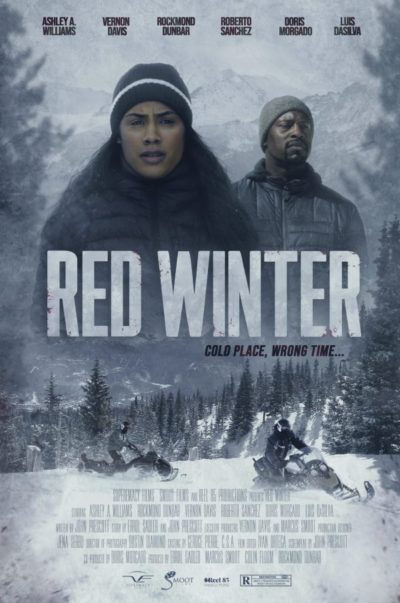 Carla (Williams) and her boyfriend Daniel (Davis) are all set for a nice weekend in the mountains. Unfortunately, the snowmobile trip runs into difficulty, in particular coming in the shape of a pair of cartel assassins. What, you may ask, are a pair of cartel assassins doing half-way up a snowy mountain in [I’m guessing] the Colorado Rockies? Good question. I’m glad you asked. They are after a robber who made the ill-advised decision to rob a bar which was a front for their organization. He’s now hiding out, half-way up the aforementioned snowy mountain, in the belief he’s safe. Turns out not to be the case.
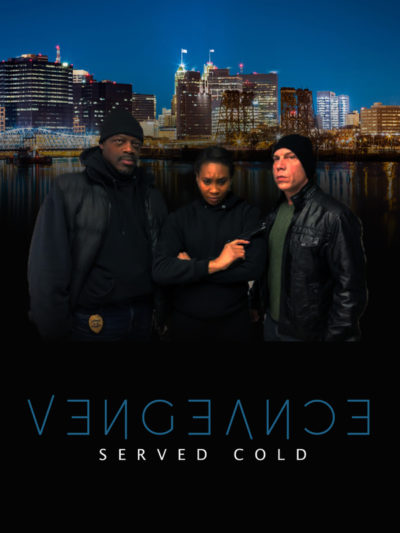 At the age of fifteen, Madison Michaels saw her prostitute mother beaten and killed by Renegade (Cross), a vicious local pimp. His homicide goes unpunished. Ten years later, Madison (Linton) is a counsellor, trying to help drug addicts and hookers get off the streets. She discovers that Renegade is still abusing women, and gets no help from the police, with Detective Straker (Williams) saying he can do nothing based on her hearsay. Against the advice of her friends and sister Lydia (Jeffries), Madison hatches a plan to take the pimp down, and clean the streets of thus piece of scum. Naturally, it doesn’t initially go quite as planned, with the trap set for Renegade backfiring, followed by betrayal from an unexpected direction.