★½
“May contain boredom, stupidity and poor action.”
There’s an old joke about bad movies: “This film wasn’t released, it escaped.” It seems disturbingly appropriate here, however, considering the shooting of this finished in October 2021, and it has been part of our annual previews for 2022, 2023 and 2024. Quite why Netflix sat on the end product close to three years, I don’t know. But having watched it, I can confidently say: it wasn’t long enough. This is the kind of movie that left me feeling actively more stupid by the end of it. Alba plays Parker, a soldier who returns to her hometown in rural New Mexico after her father is killed in a mile accident. Only, of course [and that whirring sound is my eyes rolling], it turns out not to be an accident.
From here spirals off a ludicrous plot in which local ne’er-do-well Elvis (Weary) is selling heavy armaments, include machine guns and RPGs, to domestic terrorists. His family basically runs the town: brother, Jesse (Webber), is the town sheriff, and his father is Senator Ezekiel Swann (Hall), an obviously Republican politician running for re-election. It’s up to Parker to stop the bad guys, who are so evil, they burn down the bar which is Parker’s inheritance from her father. Named after her grandmother, he apparently built it when he wasn’t busy being a miner. Or a Green Beret. It’s all a bit vague. This is as authentic a portrayal of Hispanic culture as you’d expect, given a script written by three white people, which unironically uses the word “Latinx”.
It’s also directed by an Indonesian which, in a nod to the politics criticized by the movie, makes me want to go on a rant about foreigners coming over here and takin’ er jerbs. For, after all, there are plenty of American directors who are perfectly capable of making shitty action films with ham-handed social commentary. We do not need to be outsourcing this work. However, we maybe should look at outsourcing Jessica Alba. Possibly replacing her with a stick insect, since she is among the least convincing soldiers I’ve seen. The action is equally dumb: it’s the kind of movie where a bad guy picks up a chainsaw in a hardware store fight, and it starts, apparently being fully fuelled.
The whole thing is littered with similar elements which had me shaking my head. Parker can waltz into any location at will, such as finding the exact file she needs in the police station within ten seconds. While most recent Netflix action heroine films have been forgettably acceptable ways to pass a couple of hours, this one probably competes with Interceptor over the coveted crown of Worst Netflix Original. It’s amazing to think how far Alba has fallen from the glory days of work like Sin City. For Jessica’s sake, I hope her cosmetics company endeavour is working out. Because she seriously needs to rethink this whole acting thing.
Dir: Mouly Surya Star: Jessica Alba, Mark Webber, Anthony Michael Hall, Jake Weary
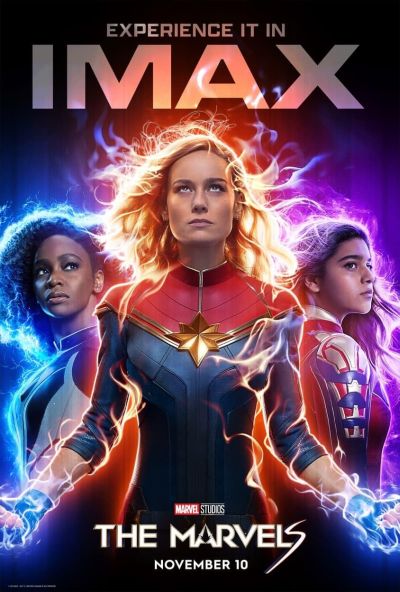
Like it or not, the history of action heroines is littered with commercial failures. Cutthroat Island set the gold standard for a long time, but there have been many others, from Barb Wire through to Mulan (no – the other one…). The reasons for their failure varied: sometimes the film was at least partly to blame; sometimes, it was external factors. But last year, The Marvels took things to a new height. Not just the biggest bomb of the year. Or even the biggest bomb in girls with guns movies. While Hollywood accounting will always leave such things uncertain, The Marvels may well be the biggest loss-maker in film history. It had a production budget of $270 million, which doesn’t take into account marketing or other post-production costs, and took in only about $206 million worldwide. Take off things like the cinemas’ cut, and the loss for Disney and Co. is estimated at a staggering $237 million.
Why did The Marvels fall so hard? To be honest, discussing that is perhaps more interesting than talking about the film itself. Not that it’s terrible. There are movies where, you see three minutes and are left wondering, “What the hell were they thinking?” and whose failure was inevitable. Cats, for example: even as something of a connoisseur of bad movies, I’ve not been able to bring myself to watch more than clips. The Marvels is not on that level. Sure, it’s not very good, and we will get to that. But it’s no worse than other movies from the Marvel and DC Cinematic Universes. Line this up with Morbius, Suicide Squad and Madame Web – I’d defy someone without prior knowledge to point the finger at The Marvels as being the worst-ever bomb.
I think a whole slew of factors went into its failure, beyond the quality of the movie. As we saw recently with Furiosa: A Mad Max Saga, even good films can tank abysmally. Here, in no particular order, are the elements I think were involved:
Superhero fatigue. After Avengers: Endgame, interest and ticket sales could only go down.
A sequel to a film no-one wanted. Sure, Captain Marvel did well. But it was certainly helped because it came between Infinity War and Endgame. She is not anything like an iconic character.
A run of underwhelming Marvel entries. Thor, Black Panther, Ant-Man, Guardians of the Galaxy. All made less than the preceding films in those franchises, and were less well received critically. At some point people will just stop watching.
General downtown in cinema going. The pandemic whacked the legs out from box-office returns, and people haven’t come back. In this case, perhaps related to:
Quick release on streaming. It was available on Disney+ less than three months after hitting cinemas. Anyone on the fence would be forgiven for thinking, “I’ll just catch it at home.”
It’s worth mentioning a couple of reasons I don’t think had much impact. Some suggest the actors’ strike handcuffed the film, preventing the stars from doing publicity for it. Others blame a backlash against women-led movies. But neither of these seem to have affected other entries. For instance, you might have heard of this little woman-led film called Barbie? It did okay, or so I’ve heard. You don’t need to invoke conspiracy theories to explain The Marvels‘ failure. The fact it’s taken me, a devoted fan of action heroine movies, more than seven months to get round to watching it, probably tells you all you need to know.
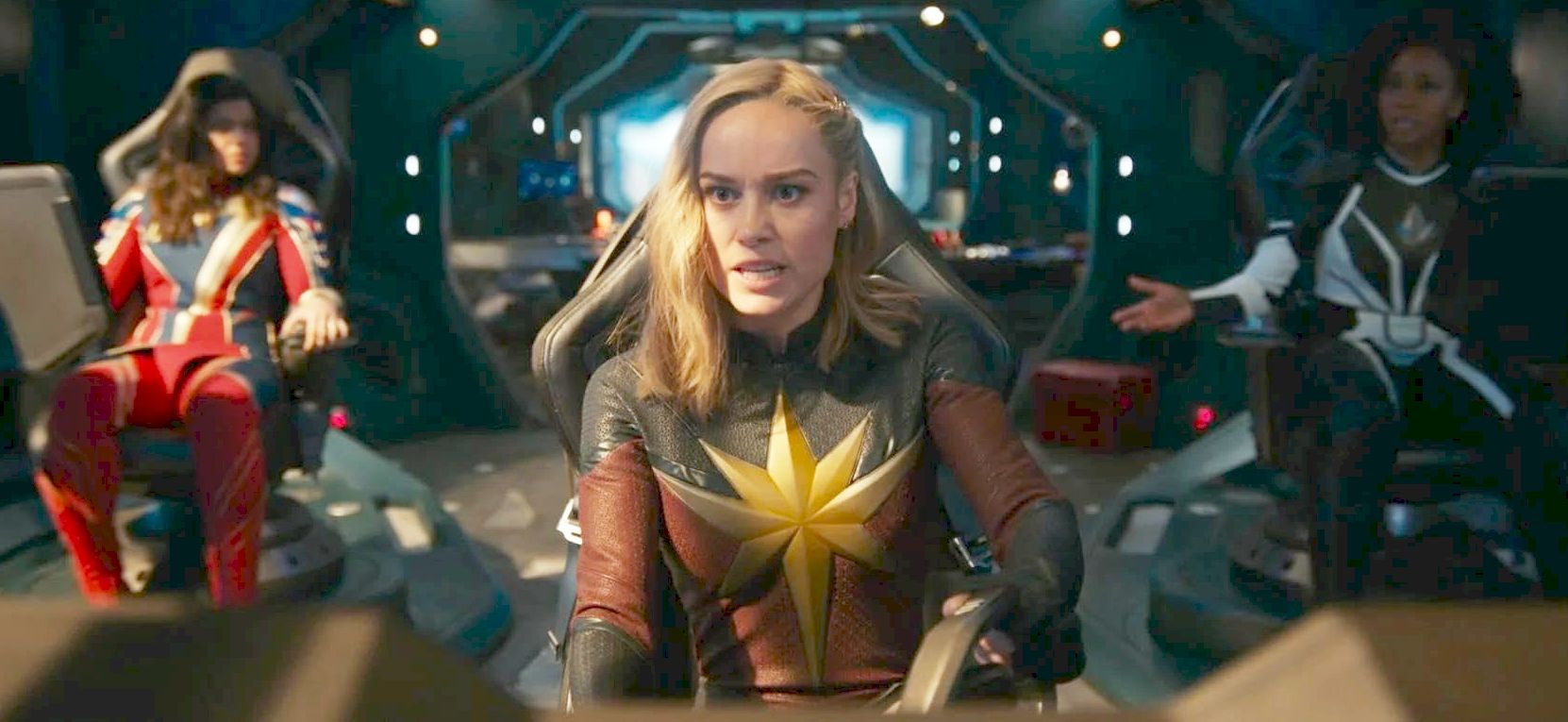
So, let’s get to the film, which sees three action heroines for the prices of one! How can you go wrong? Well… As well as Carol Danvers, a.k.a. Captain Marvel (Larson), there’s Monica Rambeau (Parris), whom I last saw as a little girl in Captain Marvel, so I guess several decades have passed since then? Like so much here, don’t expect an explanation. She apparently got superpowers after some “Hex” thing, and can manipulate electromagnetic radiation. There’s also Kamala Khan (Vellani), Ms. Marvel, who is a dedicated Captain Marvel fan-girl, but has powers courtesy of a magical bangle. However, the other bangle is in the possession of Dar-Benn (Ashton), leader of the Kree who intends to use it for malicious purposes. Because reasons, Danvers, Rambeau and Khan swap places with each other whenever they use their powers, which complicates trying to stop Dar-Benn.
I’m not prepared to swear to all of the above, since the film makes the assumption I have seen the related TV shows WandaVision and Ms. Marvel, which fill in the background of both Monica and Kamala. I have, in fact, not. This, combined with my general apathy about the MCU, left me frequently confused and/or uninterested in the finer points of whatever was going on. The lack of internal characterization present here which resulted from it, left me not caring very much about anyone – especially Khan, who seems like an annoying teenager, shoehorned in purely to appeal to other annoying teenagers. [Memo to Marvel: make movies to appeal to a minority, and only a minority will find them appealing] Rambeau isn’t much better, and Danvers just seemed like your basic, overpowered superhero.
Most of the running-time – and, at least, it’s relatively short, not much more than 90 minutes before the closing credits start – is spent bipping around the galaxy, going to places the film presumes we know, and meeting people we are supposed to recognize. I would say, the budget shows up on screen, and the action is decent, especially when the three heroines figure out how to team-up properly. But it tends to have the same problem as in Captain Marvel, where the fights frequently feel so artificial as to be lacking in impact. The only sequence which genuinely entertained me had the crew of a space-station pursued and eaten by feline-shaped extra-terrestrials, while Midnight from the musical Cats plays. It’s utterly glorious. Shame it is also so totally at odds with the po-faced approach generally taken elsewhere, which leaves little or no impression at all.
To be honest, I’d rather have five $50 million movies than one costing $270 million, and if this brings an end to the fondness for ridiculously over-priced Hollywood movies, it’s a price I’m willing to pay. It’s a shame it will, almost certainly, have a negative impact on our genre, because we’ll be forced to hear again that nobody wants to see action heroines. That’s not the case, of course. But if you spend more than a quarter-billion dollars and this underwhelming result – complete with, inexplicably, musical numbers – is all you can manage, it’s not hard to conclude something needs to change.
This starts off strong, with an attention grabbing scene where a woman gets a visit from a plumber. She offers him a glass of water, and… Things do not go as expected. For the woman is Jessie (Shay), a psychiatrist on a mission. She has made it her purpose in life to punish paedophiles whom she feels have been too lightly punished by the law. The man is one such, and it does not end well for him. Specifically, he is stabbed, and buried in a shallow grave, deep in the Australian outback. Safe to say the film has got my attention. Unfortunately, it’s more or less downhill all the way from here.
The main problem is probably the script, which fails to build on this dramatic opening. For example, shortly after, we see a policewoman, Detective Swan (McKenzie) puzzling over the unexplained disappearances of a number of paedophiles, and it appears to be setting up a cat-and-mouse hunt. Except, she all but vanishes for the next hour, only reappearing significantly at the end. There’s also Jessie’s relationship with her younger sister. Or the hint that some kind of PTSD is responsible for Jessie’s vigilante activity – either connected to her own childhood, or perhaps her experiences in the military, where she served in the Middle East. None of these elements ever come together, feeling more like loose ends than coherent parts of the story.
Instead, she eventually kidnaps Grace (Flowers), a woman who helped her boyfriend to traffic in young children, but who claimed to be abused by him, and so was considered a victim as well. Similarly, if properly developed, this could have been a good source of tension. Was she actually an accomplice, just playing the abuse card? Again, the script seems almost to get bored with itself and drifts away to Vigilante Movie Cliche #45, where Jessie discovers that one of her previous victims was actually innocent. This triggers an existential crisis in Jessie, and she carelessly leaves her thoroughly incriminating diary for the receptionist at work to find, giving Detective Swan the break in her case she needs. Yeah, you’ll understand why I rolled my eyes a bit at that.
I did appreciate the effort to be nuanced. Given the topic of avenging angel versus child molesters, it would have been very easy to become a one-sided and shrill polemic (we’ve seen those in the past). Here, there’s a bit more subtlety, acknowledging that everything isn’t necessarily black and white. It’s also very female-centred, with almost all the significant roles going to women, and the individual performances are decent or better. But the lack of a compelling narrative sinks this ship, with it left feeling like a series of largely unconnected strands. Perhaps if we’d been brought along on Jessie’s journey, and saw how she became a vigilante, it might have been different? As is, there’s not even much resolution, and we are simply 95 minutes later in the day.
Dir: Karl Jenner, Lyndsay Sarah Star: Janet Shay, Hayley Flowers, Mikaela, Franco, Kirsty McKenzie
This ended up turning into an Internet investigation. The title above is the one by which it appeared on Tubi. But it’s clearly pasted onto the opening credits, and I ended up having to go through the IMDb credits for the one identifiable actress to find it there – where it appears under another title, with some promo materials giving it a third name. The end credits are entirely in Chinese, and provide absolutely no information as to who is playing who. So that also had to be pieced together. But least helpful of all, were subtitles that may be generated by a drunk AI, operated by a seven-year-old
Seriously, I’ve only the vaguest idea of what’s going on. Do not take what follows as more than my best guess, and it may be wrong in any number of ways. It seems to be a battle between two groups: the good guys (and gals) of GWS, under Uncle Liao (Zhang), versus the bad guys (and gal) of Alpha, run by cartoon villain Davis, who frequently sounds like he is being dubbed by Borat. Are these two factions industrial organizations? Agencies of rival governments? Criminal gangs? No idea. They’re clearly both very well-funded, and are fighting over a computer program called “Blue Sword and Shield”, which can be used to blackmail the rich and powerful. Key to this is a programmer (Wei), whose loyalties are… flexible.
But it becomes personal for GWS’s top agent, Chen You (Li), after Alpha kill her friend and colleague, Merrill Lynch. Yes, that’s what those subtitles assure me is a character’s name. Maybe this was a not-so subtle form of product placement. More likely, it’s just another example of how this is a grab-bag of elements taken from elsewhere. Most obviously, in its basic structure of “three women with an older, male boss” is Charlie’s Angels, though this is considerably less fluffy. Put it this way: Uncle Liao will have some recruiting to do by the time the movie is over. But there is clear influence from old-school Hong Kong girls-with-guns movies as well, such as Naked Weapon, and also the John Wick franchise.
At less than seventy minutes, it doesn’t have time to hang around, and the action is pretty decent as well. Although sometimes it is a little over-edited and CGI’d, it’s always stylishly shot and imaginative. The highlight is probably the knife fight between Chen and Davis’s lieutenant (Zina Blahusova), with the two women going at each other hard: by this point it’s very personal for Chen. I would like see more of both actresses. It’s just a shame the presentation, in both sub and dubbing, is so slipshod. Had it not been, this could well have been looking at a seal of approval. While I get these films are not intended for a Western audience, with a little more care, they could be; the quality elsewhere is there.
Dir: Liu Bayin Star: Mengmeng Li, Shuangli Zhang, Wei Chen, Zhang Dong
a.k.a. Action team overlord flower or Secret Agent Dangerous Flowers.
★★★½
“We kill people so we don’t have to get these annoying jobs.”
I’ve read complaints that the trailer mis-sells this, over-hyping the action components. Fortunately, I went in largely blind, so had no such preconceptions. I can see how it could be fair comment: while bookended by solid action, the middle is much more an oddball Japanese comedy. [If you’d told me this was directed by Sion Sono, I’d believe you] I still found it largely engaging, while occasionally hilarious and – sometimes simultaneously – utterly baffling. It’s about two teenage assassins, Chisato (Takaishi) and Mahiro (Izawa), who have been told by their handler they need to start fending for themselves. That means moving into an apartment, and finding work which doesn’t involve killing people.
As the line of dialogue above suggests, these are tasks for which both young women are singularly unsuited. Mahiro, in particular, is a self-confessed sociopath, who can barely keep up a normal conversation for five minutes, without wanting to shoot somebody. And it’s an urge that usually wins. We see this at the beginning, when a convenience store interview turns violent, and she has to fight her way out, past the manager and his (surprisingly loyal) employees. In the end, Chisato helps her get a job at the maid cafe where she works. I’d heard of those, but… yeah. Not sure if the depiction here is exaggerated for comedic purposes: it’s startlingly bizarre. Things ultimately go awry there when a Yakuza boss visits, and does not follow establishment etiquette, shall we say.
I was reminded of Violet and Daisy, in that this is as much about the relationship between the two young hired killers, as their actual killing. However, here the duo’s background is entirely opaque. How did they become hitwomen? Who is hiring them? Where are their parents? These are all questions that the film is utterly disinterested in answering. To be honest, the concept is a little shaky. Surely murder pays well enough that a part-time job in a 7-11 is not necessary? However, if you can roll with it, there’s a lot of amusement in getting a glimpse of what assassins do when not assassining, especially if you’ve ever lived in a similar arrangement.
Izawa, a stuntwoman who doubled for Rina Sawayama in John Wick 4, handles most of the action. In addition to the early convenience store brawl, there’s also a final fight against the much larger Mimoto. It works, because Mahiro makes no attempt to out-power her opponent or go toe-to-toe with him, instead opting to use her advantages in speed and agility to gain an edge. I would like to have seen more of this, and some of the humour here is perhaps trying too hard to be “quirky”, complete with air quotes. But these are a pair of characters with which it’s fun to spend time, and certainly provides more amusement than I needed. I’ll be checking out the sequel, Baby Assassins 2 Babies, in short order.
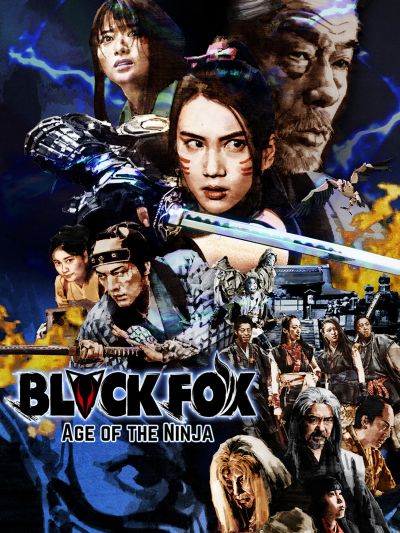
I’d not heard of this, and we pleased to find it was directed by Sakamoto, a well-respected action choreographer, best known for Power Rangers, but who also worked on 009-1: The End of the Beginning, among others. There’s an interesting back-story here, in that this was created as a live-action spin-off to accompany the anime film BLACKFOX, and was released on the same date. It’s a prequel, with one of the heroines here, Rikka Isurugi (Yajima), a distant ancestor of the heroine in the contemporarily-set anime movie – they have the same name. This, however, takes place back in feudal Japan, and we start with Miya (Yajima), a young girl with an unusual, if uncontrolled, power to manipulate electricity.
Her father was teaching her to use it, until he was killed by the Negoroshu clan, under Lady Hakku (Fujioka) – they are also after Miya. To get revenge on them, Miya seeks out a mercenary gang called the Foxes, run by Hyoe Isurugi (Kurata). They agree to take on the mission, and Miya befriends Hyoe’s grand-daughter, Rikka. However, Hyoe gets a better offer, and hands Miya over to Hakku. This causes a rift between him and Rikka, who feels they should honour a deal once struck. She sets out to rescue Miya, though that’s going to be tougher than ever, since she has now been passed on to the person who hired the Negoroshus in the first place.
While most of the plot unfolds as you would expect, there are enough twists and surprises along the way to sustain interest. In particular, loyalties are not necessarily what they seem, and as well as our saintly heroines, there’s more moral grey on view here than I thought there might be. Never mind the plot though. We are here mostly for the action, and Sakamoto does not disappoint, with Yamamoto doing most of the heavy lifting. There are perhaps too many times when she’s masked – albeit, usually with masks that are necessary to the plot – to give her full credit. But she definitely is executing enough of her own stunts to make me interested in seeing her elsewhere. And she’s a World Junior Wushu Championship gold medalist, so there’s that.
Fujioka also does well, both in action and acting, making Lady Hakku perhaps the most interesting and well-rounded character in the film. I will confess to initially suspecting I’d seen this before. But I was clearly confusing it with another film which had ninjas and/or samurai running around in the forest. There are quite a few, to be fair. It is clear that this was not a large-budget production, and the ending is a little too sequel-leaning. Yet the limited resources don’t often distract from the important things: the story, characters and action, which are all decently-handled. My expectations were low going in, until I saw the director’s name, and for something stumbled across by accident in the depths of Tubi, it punches well above its weight. It’s also available on YouTube, and is embedded below for your viewing pleasure.
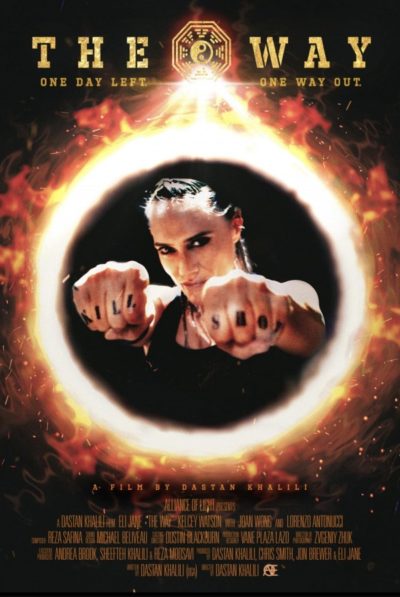
I think it has been a long time since a film has so completely yanked the carpet out from under me. We might have to go back all the way to David Lynch’s Lost Highway, and that was 1997. So it has been a while. I’m not sure if it works here. It did in Highway; I’m just uncertain whether Khalili is as good a film-maker as Lynch. It’d likely require a second viewing to decide, and I wasn’t that impressed elsewhere to justify a repeat. I will remember it though, and that’s more than can be said for many of the films I review here. So it was not a complete waste of time.
It’s the story of Jane Arcs (Jane), whom we first meet as she is on death row, preparing for her execution. Over a decade previously, she had killed another woman during an underground mixed martial-arts match, and was subsequently sentenced to death for it. Initially bitter and still filled with rage, in jail she met Qi Gong Master Xin (Wong), and learned from her how to manage her emotions, through both physical and mental training. Now, Jane is considerably more at peace with her imminent death than others around her. Most notably, guard Max Stone (Watson), who has come to care for Jane over the previous 13 years, and will go to any lengths to stop her being executed.
This is, at least for the first hour, more of a redemptional drama than anything. There are a lot of flashbacks to Jane’s life on the outside, and we see what happened there. First, there’s the fight in question: while undeniably brutal, I am still not sure why it was deemed a capital crime. That’s especially so, given the extenuating circumstances which we then see, going a long way to explaining why Jane was overflowing with anger at life. Oddly – and this is another Lynchian touch – Watson also plays Ben Jorden, the father of Jane’s child on the outside. Otherwise, though, it’s a fairly straightforward story, albeit one that leans heavily into cliché. For instance, Xin often sounds more like a fortune cookie, saying things like, “The only respect you need is self-respect.”
And then… Wait, what just happened? You will take a few minutes to figure that out, and even when you do, you may well not be able to wrap your head around it adequately. I even Googled for an interview with the director, hoping to get some explanation. No dice – and in the end, it may be better that way. I suspect it might well fall short of satisfying. By the end, I was left with a furrowed brow, and it’s perhaps a little unfortunate. For if the story is otherwise too obvious and with gaps in its logic, I did appreciate the performances. Jane puts over an inner strength that is impressive. Shame it is so thoroughly overshadowed by the abrupt left-turn towards the end.
Dir: Dastan Khalili Star: Eli Jane, Kelcey Watson, Joan Wong, Lorenzo Antonucci
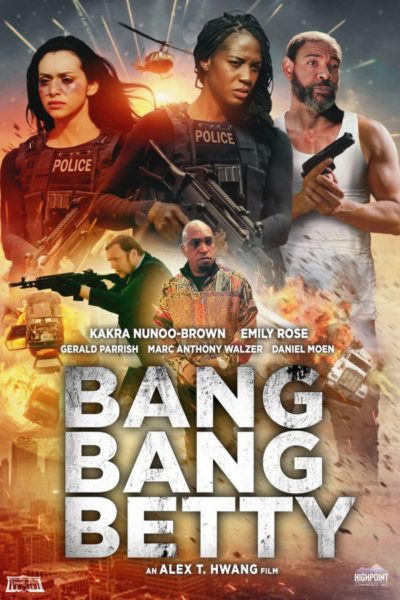
If I was feeling mean, I’d have tagged this as “Pretty shitty Bang Bang”. But while undoubtedly amusing, that wouldn’t be 100% fair. For in the field of low-budget urban action heroines, this is actually better than most. Now, by broader standards, that’s still not exactly great. However, I’ve seen enough of the genre to appreciate and welcome mere technical proficiency. Simply by having decent audio, I was already impressed. It’s the story of Kiara Sommers (Nunno-Brown), a former soldier who is now a prosecuting attorney. During a meet with one of her informants, she is shot and left for dead, but rescued by another veteran, Ray Smith (Parrish) and nursed back to health. [I’ve vague memories of a Chow Yun-Fat film with this plot]
She’s then able to take revenge on the man responsible, local crime-lord Darnell (Walzer). Which is a bit awkward, because he is her boyfriend. There’s also Valerie Mendez (Hernandez), who used to be a colleague of Kiara in the army, and is now walking a dangerous line, playing for both sides, as a cop and an inside woman for Darnell. It feels as if considerably more thought has gone into this than many in this field, whose plot could typically be written on the back of a beer-mat, and leave room for your pint. Some other elements also deserve praise, such as a soundtrack which isn’t just the director’s rapper mates on shuffle (though there is still a fair bit of that).
While Nunoo-Brown and Hernandez are decent enough in their roles, there are several elements that manage to stop this reaching three stars, which would be close to an all-time high for the genre. There’s a serious question over Kiara’s complete ignorance of her boyfriend being a organized crime boss. I mean, really? Some of the supporting cast are not very good: Walzer in particular struggles with his delivery. There’s also a point where a significant character is killed in front of another. It should have a devastating impact, yet their lack of reaction is notable. A few minutes later in the film, they’re cracking wise with Kiara and Valerie. The bruising on Valerie’s face is a continuity disaster.
My biggest issue, however, was the bad CGI. The muzzle flashes were marginally acceptable, but the explosions are poor, and the CGI blood close to the worst I’ve ever seen. Having no blood at all would have been a vast improvement. It’s a particular shame, as some of the hand-to-hand action is decent enough (again, compared to what I’ve seen previously), with both lead actresses occasionally impressing. I did laugh when Valerie attempted a lucha libre throw on Darnell’s henchman, only to be tossed aside, and told “That superhero shit doesn’t work in real life, does it?” More of this degree of self-awareness might have been welcome, yet it’s probably wise not to ask for too much. I’ll settle for competence, and there’s just enough here to leave me mildly interested in the sequel, already in post-production: Bang Bang Betty – Valerie’s Revenge.
Dir: Alexander T. Hwang Star: Kakra Nunoo-Brown, Gerald Parrish, Emily Rose Hernandez, Marc Anthony Walzer
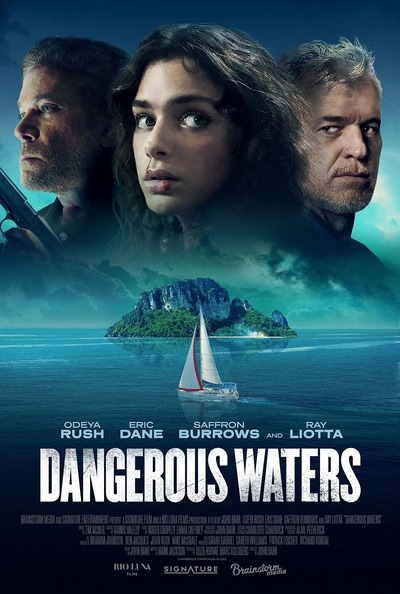
This was Ray Liotta’s last movie: he died during shooting. Cruel though it may be, I can’t help wondering if he died of embarrassment. Certainly, I note that his character never gets a proper send-off: while I must remain vague for spoiler purposes, you don’t see his face. Not that he’s in this much. A rambling conversation with the heroine is the bulk of it. But that’s getting ahead of ourselves. We begin with single mom Alma (Burrows) dragging unwilling teen daughter Rose (Rush) on a sailing trip from Florida to Barbados. The boat belongs to her new boyfriend, ex-cop Derek (Dane), and at first, things are pleasant, despite Rose’s obvious desire to be anywhere else but on the high seas.
She’s right to be concerned. A mysterious encounter in the middle of the night leaves one of the passengers dead, and the other two having to fend for themselves, on a badly crippled craft. Turns out, Derek wasn’t quite the above board law enforcement officer Alma thought. He was in cahoots with some very nasty people, in particular one individual known only as The Captain (Liotta). Surviving will require Rose to get on a liferaft, go to a desert island, get back on the liferaft, and finally get picked up by the boat belonging to The Captain. Fortunately, she is both the daughter of a deceased soldier, and has taken shooting lessons. Who better to take out a ship full of hardened criminals?
Yeah, that whirring sound are my eyes rolling. It’s all pretty dumb and largely implausible. I’m not sure what’s less credible: Rush as a teenager, or Burrows as a woman in her late thirties [Put it this way: I’d like to wish a happy 25th birthday in July to Saffron’s performance in Deep Blue Sea] Then there’s the plot, which wanders round in circles aimlessly, between sporadic bouts of action. I guess it gives the viewer plenty of time to try and figure out what Derek’s plan was supposed to be. Similarly, Rose swings between being an unbeatable bad-ass, and whimpering in the corner or unable to hold an oar. But since the movie opens with Rose telling her story to law enforcement, there’s no tension or threat to her. We know she’s going to survive.
I will say, it looks slick, and the action is fairly well-staged, especially once we get to the boat. This is certainly watchable, though I almost dozed off during one of the longer liferaft sequences. It’s the story that’s the problem here, not least because the big surprises are little or no surprise at all. Maybe the unscheduled loss of Liotta, and the obvious rewrite required was a factor. However, that tragedy can only go so far in explaining the welter of problems with the story. It’s the kind of thing which might pass muster as a TV movie on a lower-tier cable channel. I was expecting more, and certainly, Liotta deserves better as a memorial.
Dir: John Barr Star: Odeya Rush, Eric Dane, Saffron Burrows, Ray Liotta
It was a good run. There was a point, not long ago, when action heroines could do no wrong. In hindsight, the golden era may have started in 2012 when the Hunger Games franchise began, along with Brave. Summers which followed brought us blockbusters such as Gravity, Maleficent and Lucy. Subsequent years covered the entire run of the Hunger Games and the end of the Resident Evil franchises (or, at least, phase 1 for them), and things probably peaked with Wonder Woman in 2017. Thereafter things began to decline, though I’d say returns remained strong through much of 2019. That’s when Maleficent: Mistress of Evil and Alita: Battle Angel each made over $400 million worldwide, finishing in the top 25 movies of the year.
The cracks began to show with Captain Marvel, odd though it is to say, given it made over a billion. But to a large extent I suspect it mostly surfed on the success of Avengers: Endgame. Thereafter, Wonder Woman: 1984 flopped just before the pandemic hit, Black Widow underperformed, and since then it’s been almost entirely a series of failures, with only the arguable Hunger Games reboot reaching even $250 million worldwide over almost three years since. Instead, we had one of the biggest bombs of all time in the The Marvels, followed up by the disastrous box-office of Madame Web. And now the prequel to Mad Max: Fury Road, managed an opening weekend in North America of only $26.3 million. That’s forty-two percent below its predecessor’s opening, excluding nine years of inflation.
It’s not all action heroines’ fault (though some on social media are claiming so). This year has been dismal in general. With three midweek days left on the month at time of writing, box-office for May is down 36% on May 2023 – and even that was the lowest non-pandemic May since 2001, again without adjusting for inflation. People just aren’t going to the movies in anything like the same numbers. I can’t say I blame them, when films appear on streaming services as little as three weeks after their theatrical release. Going to the pictures is expensive, and especially with the improvements in home theatre, the overall experience can end up being worse than staying at home, between travel, over-priced concessions, idiots talking on their phones, etc. Why not wait?
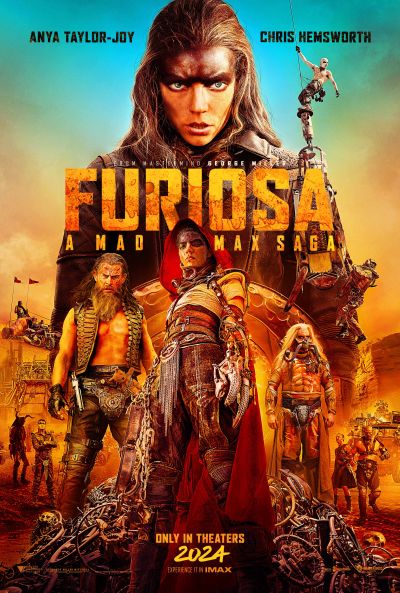
The counterpoint is experiences like this, a full-on, bombastic, in your face event that made full use of everything IMAX has in its locker, and surpassed anything I could get at home. Now, your mileage may vary. Poor Chris, in particular, found it too overwhelming, triggering motion sickness which forced her to close her eyes any time things got too kinetic – which was a lot of the time. We probably will not be IMAXing again in future. But the only recent comparable experience for me was Godzilla: Minus One. Re-reading my review of Fury Road, I’m a bit surprised I only gave it four stars. I’ve seen it again since, and I’ve just upgraded it an extra half-star. Put another way, Furiosa is every bit its equal. Different, but equal.
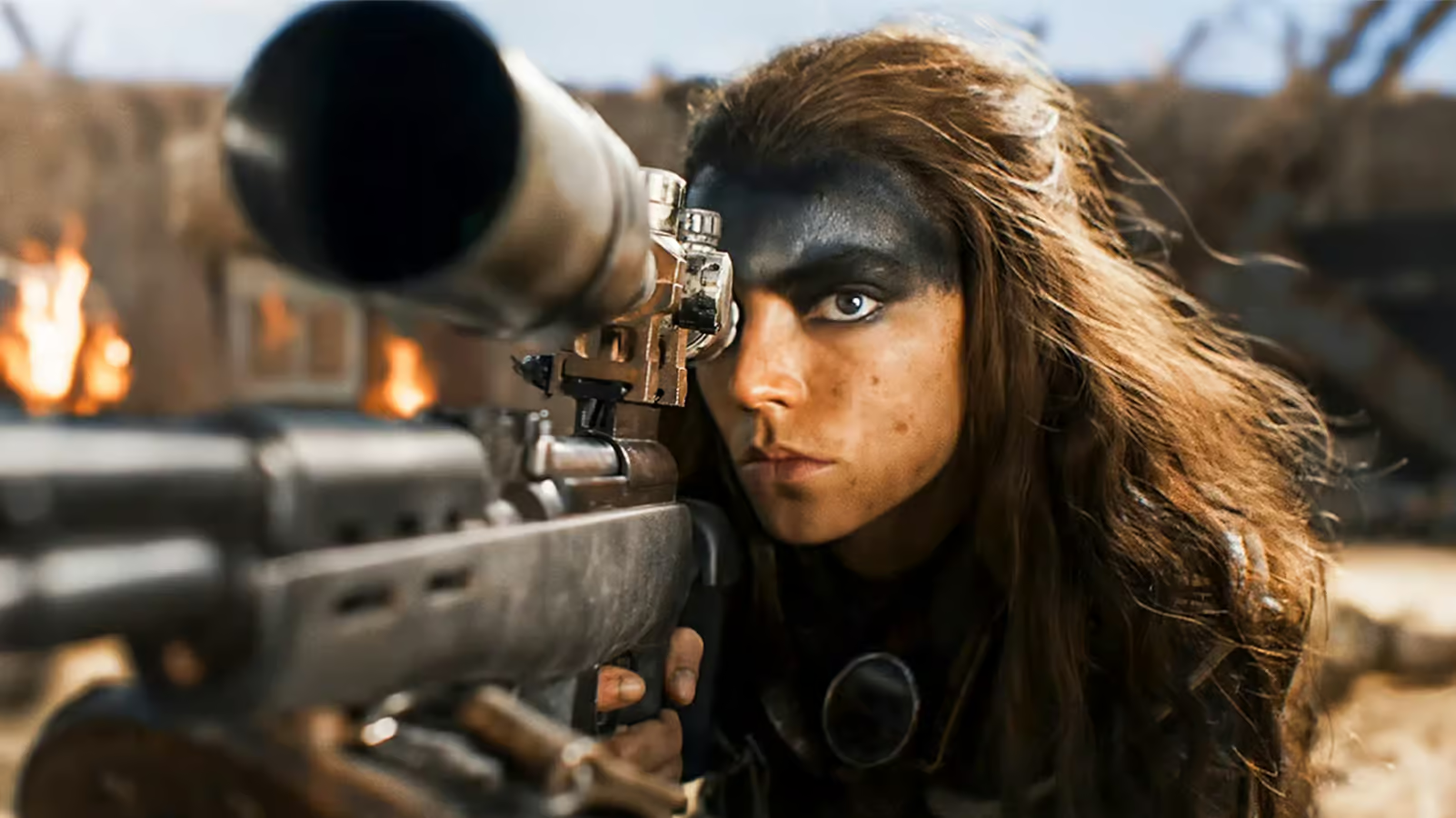
It’s a direct prequel, ending at the point when Furiosa (Taylor-Joy) leads the wives to escape from The Citadel. It begins with a much younger Furiosa (Browne) living in the Green Place, a rare place of plenty in the post-apocalyptic hell which Australia has become, along with the rest of the world. She’s kidnapped from there by minions of Dr. Dementus (Hemsworth), leader of the Biker Horde. Her mother is killed trying to rescue her, and Furiosa becomes the little, mute pet of Dementus, until he trades her to Immortan Joe, who runs the Citadel. Over the subsequent years, she becomes a key part of operations, becoming the partner of Praetorian Jack (Burke), who trains Furiosa and falls in love with her.
Dementus, meanwhile, is working to become the wasteland’s supreme ruler by taking over the Citadel, Gastown and the Bullet Farm. In an ambush at the last-named, Jack is captured and tortured to death, while Furiosa escapes only by tearing off her own arm. She returns to the Citadel, providing key advice to Joe in the ensuing war. But she never loses sight of her final goal: to make Dementus pay for what he did to her and her mother. Given she appears in Fury Road and Dementus does not… Well, you can probably figure out how this is going to end. Though the reported final nature of her revenge is not what you might expect, and has a certain poetic resonance, given what happened previously.
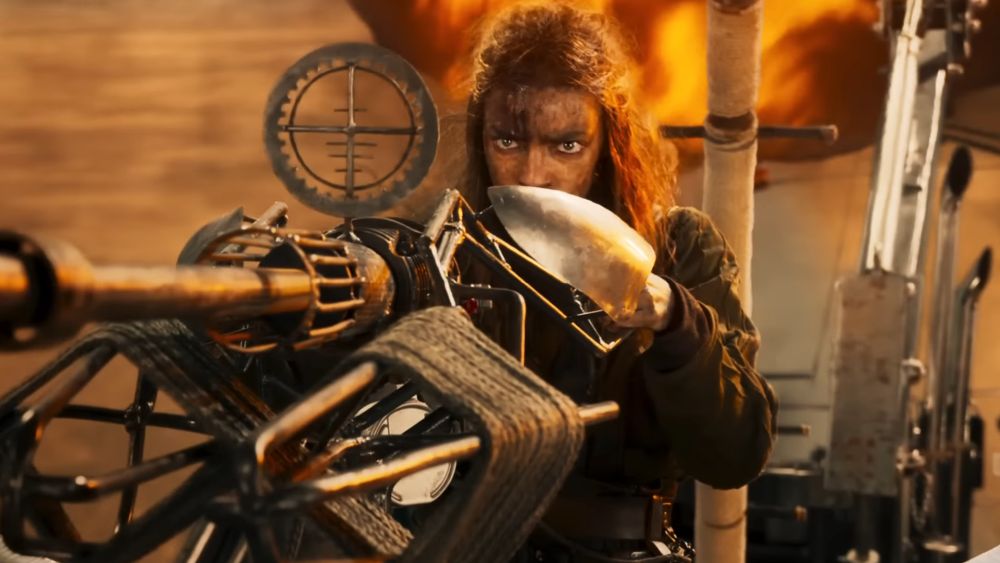
It isn’t quite the same relentless stream of action as Fury Road, and at almost half an hour longer, that’s no bad thing. There’s no shortage of action, but it tends to align with the way the story is broken into chapters. So you get a series of Drama-Action-pause segments – or occasionally for variety, Action-Drama-pause. There were concerns regarding the amount of CGI in the trailer, and I will say, it’s not as almost entirely physical as Fury Road either. However, what’s used is integrated very well, with only a couple of moment wheres the action momentarily seems obviously adjusted digitally. I suspect some of the landscapes were also enhanced: they and cinematographer John Seale’s work is so stunning, I don’t care there.
My other concern was having Taylor-Joy replace Charlize Theron, who simply has more presence. That does remain an issue, though to the new actress’s credit, to a lesser degree than I feared. It’s also countered by having much more of a real antagonist here in Dementus. The first film was mostly an extended chase sequence: Furiosa was running from Immortan Joe, after helping his wives escape, and they shared very few scenes together. Here, Dementus gives us a stronger “villain,” and the film as a whole is better for it. Hemsworth brings a charismatic power to his character, to the point where you can see why his henchmen follow him, unto death. Furiosa, in contrast, is really not much of a people person.
It’s difficult to pick out any one action highlight, because they are all very, very good. I think the ambush at the Bullet Farm might me the one which sticks most in my mind for now, though this may change on (the almost certain) re-viewing at home. It’s one which offers the most interesting environment, including buildings and smoke stacks, while the others are somewhat limited by operating in a desert. I mean, it is called “the Wasteland” for a reason. However, when Miller puts Jack and Furiosa in their rig, which is being stormed by almost endless waves of raiders, you really do not need a backdrop. Indeed, you could argue that any such would be at best irrelevant, and at worst a distraction.
You would be hard-pushed to argue that the $168 million budget is not up on screen. I lost count of the times when I wondered whether what I was looking at really existed in the physical world, or was matte paintings and CGI. Part of me wants to peer behind the curtain and watch the behind the scenes videos. However, part of me would prefer to sustain the illusion, which was a factor in the sense of wonder that often washed over me during the screening. It’s the quest for that sense of awe which keeps me going to cinemas, even if most of the time, I end up leaving disappointed [I’m looking at you, Godzilla X Kong…]
I also want to praise one other aspect, which may not transfer as well to my home environment (and I admit it is limited in this area): the audio. There are not many times when I can specifically point to this in particular as significantly enhancing the experience. I’m not an audiophile, and generally put what I see considerably ahead of what I hear. But in this case, Tom Holkenborg’s score and the rest of the sound elements were a notable and impressive component. From the rumblings of the engines through to the wind whipping across the Wasteland, the sonic design really worked, and allowed me to feel like I was being brought into the world of Furiosa. Well played
The problem from a business perspective is, it seems all but certain the makers are not going to recoup their investment, making it less likely you will see investments like this going forward. Fury Road probably just about broke even, so this was always going to be a gamble, especially without your leads. And, indeed, outside of the title, entirely without the character who has powered the franchise since its first installment, all the way back to forty-five years ago. In hindsight, a reaction of “What the hell were they thinking?” is probably understandable. But I am glad less-wise heads prevailed. If this is to be the end of the Mad Max universe, it goes out on another spectacular high, and not many franchises are able to say that.
Dir: George Miller Star: Anya Taylor-Joy, Chris Hemsworth, Tom Burke, Alyla Browne




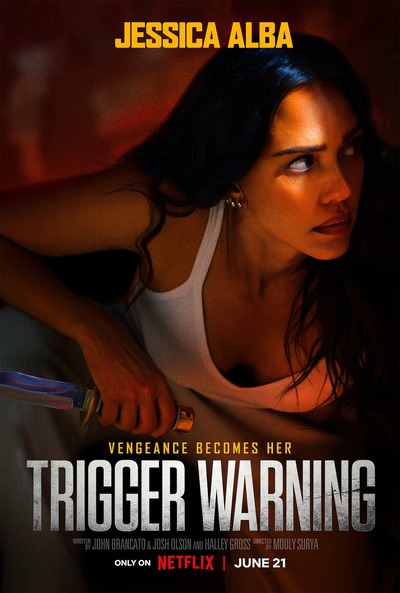 There’s an old joke about bad movies: “This film wasn’t released, it escaped.” It seems disturbingly appropriate here, however, considering the shooting of this finished in October 2021, and it has been part of our annual previews for 2022, 2023 and 2024. Quite why Netflix sat on the end product close to three years, I don’t know. But having watched it, I can confidently say: it wasn’t long enough. This is the kind of movie that left me feeling actively more stupid by the end of it. Alba plays Parker, a soldier who returns to her hometown in rural New Mexico after her father is killed in a mile accident. Only, of course [and that whirring sound is my eyes rolling], it turns out not to be an accident.
 ★★
★★ It’s worth mentioning a couple of reasons I don’t think had much impact. Some suggest the actors’ strike handcuffed the film, preventing the stars from doing publicity for it. Others blame a backlash against women-led movies. But neither of these seem to have affected other entries. For instance, you might have heard of this little woman-led film called Barbie? It did okay, or so I’ve heard. You don’t need to invoke conspiracy theories to explain The Marvels‘ failure. The fact it’s taken me, a devoted fan of action heroine movies, more than seven months to get round to watching it, probably tells you all you need to know.
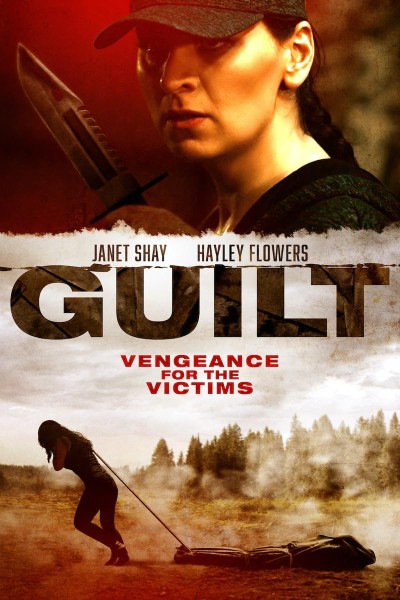 This starts off strong, with an attention grabbing scene where a woman gets a visit from a plumber. She offers him a glass of water, and… Things do not go as expected. For the woman is Jessie (Shay), a psychiatrist on a mission. She has made it her purpose in life to punish paedophiles whom she feels have been too lightly punished by the law. The man is one such, and it does not end well for him. Specifically, he is stabbed, and buried in a shallow grave, deep in the Australian outback. Safe to say the film has got my attention. Unfortunately, it’s more or less downhill all the way from here.
 This ended up turning into an Internet investigation. The title above is the one by which it appeared on Tubi. But it’s clearly pasted onto the opening credits, and I ended up having to go through the IMDb credits for the one identifiable actress to find it there – where it appears under another title, with some promo materials giving it a third name. The end credits are entirely in Chinese, and provide absolutely no information as to who is playing who. So that also had to be pieced together. But least helpful of all, were subtitles that may be generated by a drunk AI, operated by a seven-year-old
 I’ve read complaints that the trailer mis-sells this, over-hyping the action components. Fortunately, I went in largely blind, so had no such preconceptions. I can see how it could be fair comment: while bookended by solid action, the middle is much more an oddball Japanese comedy. [If you’d told me this was directed by Sion Sono, I’d believe you] I still found it largely engaging, while occasionally hilarious and – sometimes simultaneously – utterly baffling. It’s about two teenage assassins, Chisato (Takaishi) and Mahiro (Izawa), who have been told by their handler they need to start fending for themselves. That means moving into an apartment, and finding work which doesn’t involve killing people.
 I’d not heard of this, and we pleased to find it was directed by Sakamoto, a well-respected action choreographer, best known for Power Rangers, but who also worked on
  I think it has been a long time since a film has so completely yanked the carpet out from under me. We might have to go back all the way to David Lynch’s Lost Highway, and that was 1997. So it has been a while. I’m not sure if it works here. It did in Highway; I’m just uncertain whether Khalili is as good a film-maker as Lynch. It’d likely require a second viewing to decide, and I wasn’t that impressed elsewhere to justify a repeat. I will remember it though, and that’s more than can be said for many of the films I review here. So it was not a complete waste of time.
  If I was feeling mean, I’d have tagged this as “Pretty shitty Bang Bang”. But while undoubtedly amusing, that wouldn’t be 100% fair. For in the field of low-budget urban action heroines, this is actually better than most. Now, by broader standards, that’s still not exactly great. However, I’ve seen enough of the genre to appreciate and welcome mere technical proficiency. Simply by having decent audio, I was already impressed. It’s the story of Kiara Sommers (Nunno-Brown), a former soldier who is now a prosecuting attorney. During a meet with one of her informants, she is shot and left for dead, but rescued by another veteran, Ray Smith (Parrish) and nursed back to health. [I’ve vague memories of a Chow Yun-Fat film with this plot]
 This was Ray Liotta’s last movie: he died during shooting. Cruel though it may be, I can’t help wondering if he died of embarrassment. Certainly, I note that his character never gets a proper send-off: while I must remain vague for spoiler purposes, you don’t see his face. Not that he’s in this much. A rambling conversation with the heroine is the bulk of it. But that’s getting ahead of ourselves. We begin with single mom Alma (Burrows) dragging unwilling teen daughter Rose (Rush) on a sailing trip from Florida to Barbados. The boat belongs to her new boyfriend, ex-cop Derek (Dane), and at first, things are pleasant, despite Rose’s obvious desire to be anywhere else but on the high seas.
 ★★★★½
★★★★½ It was a good run. There was a point, not long ago, when action heroines could do no wrong. In hindsight, the golden era may have started in 2012 when the Hunger Games franchise began, along with
  The counterpoint is experiences like this, a full-on, bombastic, in your face event that made full use of everything IMAX has in its locker, and surpassed anything I could get at home. Now, your mileage may vary. Poor Chris, in particular, found it
  You would be hard-pushed to argue that the $168 million budget is not up on screen. I lost count of the times when I wondered whether what I was looking at really existed in the physical world, or was matte paintings and CGI. Part of me wants to peer behind the curtain and watch the behind the scenes videos. However, part of me would prefer to sustain the illusion, which was a factor in the sense of wonder that often washed over me during the screening. It’s the quest for that sense of awe which keeps me going to cinemas, even if most of the time, I end up leaving disappointed [I’m looking at you, Godzilla X Kong…]