
★★★★
“A thoroughly satisfactory snapshot of a pop-culture element from another era. “

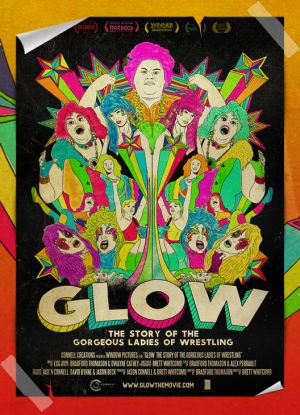 It has now been almost a quarter-century since GLOW was cancelled in 1990, and there still hasn’t been anything quite like it on television in the Western world: a pro wrestling federation entirely populated by women wrestlers. The brainchild of David McLane, and funded by Pia Zadora’s husband, the owner of the Riviera casino in Las Vegas, GLOW was a marvel of eighties low-budget television, mixing self-effacing comedy (it depicted McLane as having his office in a phone booth) with larger-than-life characters such as Matilda the Hun, and of course, wrestling matches. This documentary tells the story of the federation’s rise and fall – largely through the eyes of the women, as McLane and Matt Cimber, the show’s director, both declined to be formally interviewed (which is a shame, as it would definitely have provided another dimension for the film).
It’s a fascinating story, of something which probably never should have worked, but succeeded in a way that remains unmatched. Almost all the women had no wrestling experience, but were trained under Mando Guerrero (the brother of late WWE superstar Eddie) to develop skills that, from the relatively brief clips shown, weren’t much worse than certain current WWE divas I could mention. The stars didn’t just work together, but also roomed together, with rules governing their behaviour, more reminiscent of A League of Their Own than late-eighties Las Vegas! They don’t hold back on their distrust of Cimber and his often dubious motivational methods, insulting the women, but respect the fact they were allowed input into and control over their characters, which were often just larger-than-life versions of themselves. There’s also cringe-inducing footage of a match where one of the wrestler seriously damaged her elbow, proving again the fallacy of “wrestling = fake”.
But the most touching part, which gives the film an emotional heart not often seen in documentaries, concerns “Mount Fuji”, a.k.a. Emily Dole, a Samoan and former shot-putter, who was part of the roster. However, her weight (over 300 lbs) caused her health to deteriorate, and when she was located during filming, she was unable to walk, but still spoke very fondly of her time with the girls. One of the GLOW wrestlers, inspired by the documentary, organized a reunion, bringing women together who in some cases hadn’t seen each other for twenty years. I won’t say any more than that, but let’s just say, it’s been a bad season for allergies here in Phoenix. :) It’s a fine ending, that wraps up the loose ends and completes this in more than adequate fashion.
Dir: Brett Whitcomb
Star: Mount Fiji, Tina Ferrari, Ninotchka, Big Bad Mama
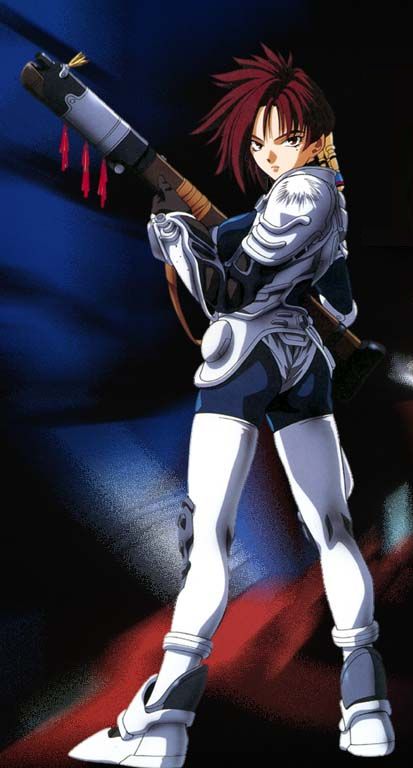 Though released several years later, this is a prequel to the two Zeiram movies, telling the story of the first encounter between Iria (Hisakawa, who was also Sailor Mercury) and Zeiram. At the time, she was an apprentice bounty-hunter, working alongside her brother Gren. They take a mission to rescue a VIP and recover the cargo from a stranded space-ship. However, once there, they discover the “cargo” is actually the alien Zeiram, which a corporation is interested in using as a weapon. The result leaves her brother apparently dead, and Iria now the target for the corporation, who want to hush up their thoroughly-dubious plan, by any means necessary. Fortunately, as well as her own skills, our heroine has the assistance of former rival bounty-hunter, Fujikuro (Chiva), endearing urchin Kei (Kanai), and Bob (Ikeda), a colleague whose consciousness has been turned into an AI.
 In the late seventies, British television was notable for series which generally kicked ass on the performance front, but suffered from woefully inadequate production values. The most well-known example is Doctor Who, but that was just the tip of a dramatic iceberg which included the likes of Blake’s 7 and this series: in some cases, you can look past or ignore the deficiencies, because the acting is good enough to counteract them. That, sadly, isn’t the case here, with Phillips (a compatriot of Diana Rigg and Glenda Jackson at RADA) sadly adrift as Boudicca, the queen of the Iceni who takes on the occupying Roman forces after her daughters are assaulted. Having enjoyed the 2003 version, with Alex Kingston in the title role, I thought I’d give this one a chance, but when a supposed army of 6,000 is represented by four chariots and, maybe, ten guys in animal skins, it’s hard not to notice.
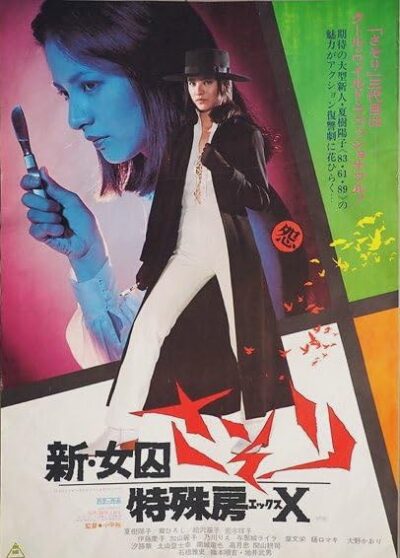 The comparisons of Takigawa to Lazenby above proved appropriate in another way, both being canned after one entry playing the iconic title character, which is probably just as symptomatic of something. The replacement here as Nami Matsushima is Natsuki, who seems to go back toward a more taciturn heroine, closer to the original. But it’s, effectively, another reboot, with not even a nod to the previous entry. In this case, the heroine is a nurse, framed for her involvement in the hospital murder of a politician who was threatening to expose corrupt practices.
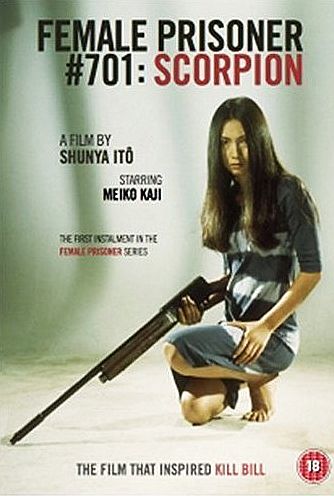
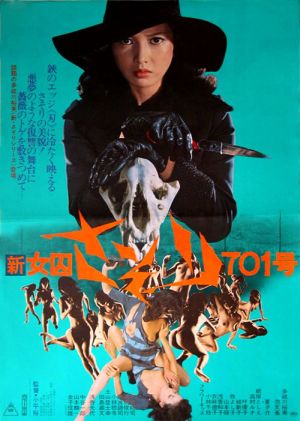 Just goes to show that the “cinematic reboot” is not a 21st-century invention, e.g. Batman or James Bond. For a mere three years after Meiko Kaji showed her sting as Nami, the studio reset the series, giving it a new director, new (and much more talkative) lead actress, and returning Nami Matsushima to a happy, criminal record-free young women, with a loving boyfriend. Except, of course, he turns out not to love her quite as much. Things start to collapse after her sister uncovers evidence of major government corruption, and passes it to Nami, shortly before being kidnapped. After Nami uncovers the truth – her sister is killed and she is framed for the murder, with the help of her boyfriend, and sentenced to 15 years in prison. Initially an easy mark for the tough girls in her cell, Nami soon develops her mean streak. And she’s going to need it, because the politician behind it all is looking to tidy up the loose end she represents, by killing her and making the death look like a suicide. Name turns the tables, in incendiary fashion, and it’s clear that she’s one loose end that won’t be quietly disposed of.
 Nami (Kaji) is about to get married, but her wedding day is rudely interrupted by the arrival of the cops, who arrest her. On the way to prison (and, unsurprisingly, death row, given the body count left behind in the previous three movies), she takes out the driver, causing a crash. The injured Scorpion staggers away, and is rescued by Kudo (Tamura), a former political radical who was brutalized by the police for his actions, and so has a massive load of resentment against them. After being informed of Kudo’s harbouring of Nami by a worked at the sex-club where he works, the cops take him in: and use both physical and psychological torture to try and make him give up her location. Eventually arrested, Nami is sentenced to death, but the cops intend to make sure the time leading up to her execution is as unpleasant and possible, and the detective in charge, Hirose (Tsukata), is intent on making even Nami’s death as lonely an experience as possible.
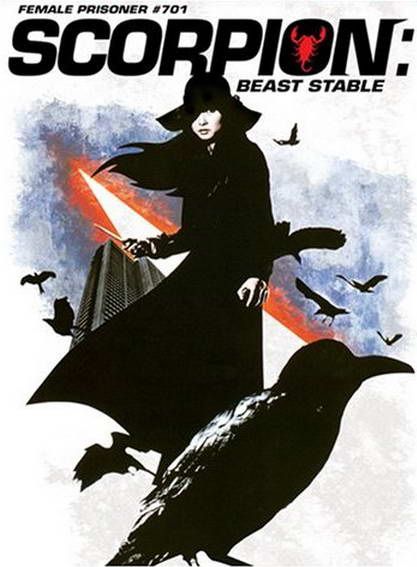 When this begins, Nami (Kaji) is on the run, and slices the arm off Detective Kondo (Narita) after he handcuffs himself to her. She befriends street hooker Yuki (Watanabe), who runs foul of the locak Yakuza gang by turning tricks on their turn, while trying to care for her brain-damaged brother, whom she also services sexually, to stop him from raping women(!). After Nami is involved in the death of a gang member who was blackmailing her, the gang’s madam Katsu (Lee), who knew the Scorpion from her own prison days, captures her, locking our heroine up in a literal big bird-cage. But after the true horror of the Yakuza’s treatment of their women is revealed (it starts with a golf-club going where no golf-club should ever go), Nami escapes and carves a bloody path of revenge on those responsible. When Katsu realizes what’s going on, she turns herself in to the police, figuring jail will be safe from Sasori’s wrath. Take a wild stab in the dark… Which, by coincidence is exactly what Katsu deserves.
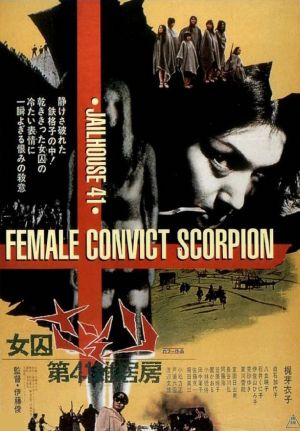 Right from the start, Nami (Kaji) established her utterly hardcore credentials, as she’s trying to dig her way out of the dungeon where she has been for the past year. With a spoon. Held in her teeth. She’s let out for the day because a bigwig is visiting, but takes the opportunity to attack warden Goda (Watanabe), almost depriving him of the sight of his other eye. As punishment for the resulting riot, Goda sends four guards to gang-rape Nami, and all the inmates are sent to a hard-labour camp. On the way back, they beat Nami as punishment, leaving her near-dead but it turns out that was just her ruse to get the guards to open the back of the van and escape. She leads the women across a blasted landscape, revenge once more on her mind, with Goda’s men in hot pursuit.