



★★★½
“How I stopped worrying about jungle ridiculousness, and embraced my love for scantily-clad jungle girls!”
It’s actually astonishing how much info one can dig up on a specific subject when you put your mind to it. So, where to start? Let’s see…
Quite recently, the big success of Wonder Woman made Hollywood aware that you actually can make money with comic book heroines. after so many years where the common wisdom – also in the comic book industry – was that “heroines don’t sell”. That the success of almost any given product might also depend on the quality (and of course “enjoyability”) of its execution, seems to have escaped those of such a mind-set. But sometimes it may also just have something to do with the right timing; sometimes the era is not ripe for this or that, or something isn’t en vogue or contemporary anymore – that’s also a factor that one always should take into consideration.
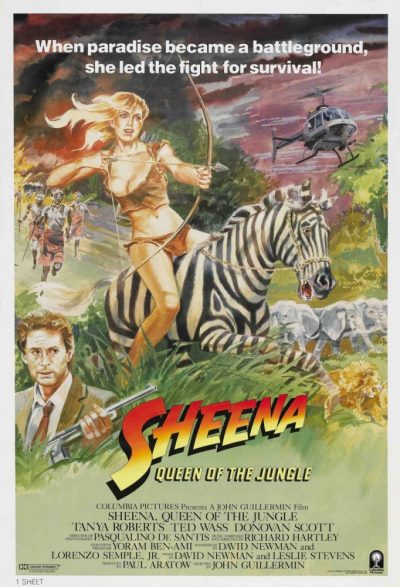
One of the properties which has become interesting for Hollywood again after WW’s success, is the old comic heroine, Sheena. Millenium Films, who were also recently considering a new Red Sonya movie have been rumored to considering a film with said heroine. Which is enough reason for me to revisit the movie Sheena, Queen of the Jungle from 1984!
The first important thing to mention here, is that when we talk Sheena, we are essentially talking Tarzan territory here. So, if one you have a problem in essence with jungle warriors hanging from trees and lianas, or being on a first-name basis with virtually any animal in Africa, you won’t be able to experience the charm a movie like Sheena offers. For the movie already has lost you. I’m saying this, because when Sheena came out, it was torn into pieces by critics. They may have been just a bit too cynical or overly critical, for an innocent entertainment movie that never was intended to be deep and meaningful.
Wikipedia tells me that the movie “was nominated for five Golden Raspberry Awards (Worst Picture, Worst Actress, Worst Director, Worst Screenplay and Worst Musical Score) but reportedly did find some cult success on home video and DVD.” I say: Sheena is harmless fluff that can be enjoyed when in the right mood – maybe with a beer and a pizza or some ice cream on a rainy Saturday afternoon. And in any case it’s many times better than Halle Berry’s Catwoman! My point is: When is something “good entertainment” and when is it downright “cinematic trash”? I myself have no answer to that. We accept the most lunatic premises in every Marvel movie at regular intervals and don’t feel the need to second-guess its logic.
The year after “Sheena”, another fantasy movie with an absolute ridiculous premise was released, about immortals that are fighting each other over centuries, hacking off their heads to consume their life energy to finally receive some dubious prize after the grand finale came out in cinemas. It flopped equally hard. But, over time, Highlander became a big hit on home video, and its own franchise that has a devoted fandom and stands in line for its own remake right now. So the question here is: What makes the one movie a “good” movie and the other not? My guess? Sometimes it just depends who watches a movie and if it was a financial success or not. It’s not always a question about quality: too often you can find many good “logical” reasons to critique a movie negatively, even though it may not be that bad (or, at least, any worse than others of its kind) at all.
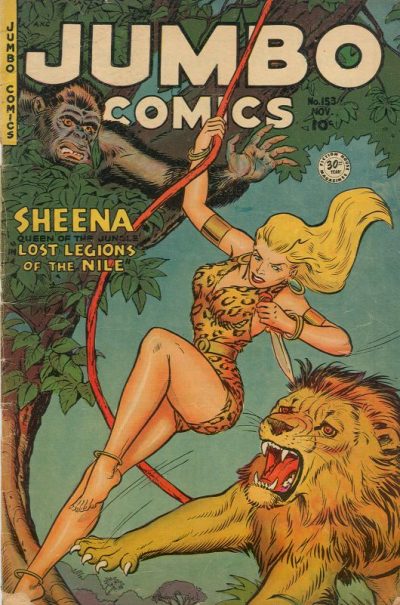 But let’s jump a bit back in time: I love those flashbacks! Sheena started as a British (!) comic strip in 1937, co-created by Will Eisner (The Spirit), and debuting in the US in 1938. That was a good 3 years before Wonder Woman appeared for the first time, which essentially makes her the first female comic book hero ever. The character is essentially a female version of Tarzan, strongly taking inspiration from a 1904 book, “Green Mansions” by William Henry Hudson. In this, a cynical rebel from civilization meets cute feral girl Rina in the South American jungle. The book was filmed in 1959, starring a pre-Psycho Anthony Perkins and Audrey Hepburn, produced by her then-husband Mel Ferrer. But as Rina and Sheena have very little in common, we won’t go into more detail here.
Sheena was successful as a comic strip,so much so that she got her own TV show a couple of years earlier, in 1955 starring Irish McCalla as the main role. I’ve not seen this series, so can’t judge it but there are some episodes of it as a bonus on my Sheena DVD box-set (ordered from the US for a reasonable price!), so sooner or later I will have to have a look at them, too. The Sheena character then seemed to be dormant for many years until she was suddenly re-awakened with the 1984 picture. The logic according to the producer was quite strange: Raiders of the Lost Ark had been a great hit, cementing the reputations of George Lucas and Steven Spielberg as “can’t do wrong” filmmakers, and everyone in Hollywood was trying to find a way to climb on board the fantasy-adventure cash-train.
This led to some very different films and series during the eighties, ranging from the Conan movies with Schwarzenegger bringing Robert E. Howard’s pulp hero of the 1930s (and the later Marvel comic book version) on the big screen, to resurrecting Africa explorer and adventurer Alan Quartermain, in the form of action-comedies starring Richard Chamberlain and Sharon Stone. The producer of Sheena just figured – and it’s not such a bad assumption at all – that since 1980’s audiences were interested in all those old heroes from the 1930s, it was therefore logically to bring a contemporary version of Sheena into cinemas.
Here’s the resulting story in a nutshell: Reporter Vic Casey (Wass) and his camera man Fletch (Scott) are filming on an official event when they witness the murder of King Jabalani of the African country Tigora. The shaman of the free-living Zambouli tribe (played by Princess Elizabeth of Toro, who was the first East African woman admitted to the English bar, and briefly Idi Amin’s foreign secretary in Uganda!) is accused of the murder and thrown into prison but freed by Sheena, a white girl that she adopted and raised, after Sheena’s parents died years ago in an earthquake.
Fascinated by this unusual woman who can command wild animals with her thoughts, and in possession of evidence that can prove how the murder was actually committed, Vic follows Sheena into the jungle. They’re unaware of the fact that the real ring-leaders, Prince Otwani, brother of the deceased king, and Countess Zanda, the dead king’s wife, are on their trail with an army of mercenaries on their trail. They conspired to kill the king to get possession of the Zambouli land, whose soil is Titanium-rich and has special healing abilities, and now need to kill the pesky witnesses.
The movie was directed by John Guillermin who already had some experience in this territory having directed Tarzan’s Greatest Adventure in 1959, including a young Sean Connery in a supporting villain role and the Dino de Laurentiis mega-production of King Kong in 1976. He also was once on the short-list to direct the first Bond movie, Dr. No, but lost out to Terence Young. The script was written by David Newman and Lorenzo Semple Jr., also indicating the filmmakers were relying on people with experience in the genre. Semple had been responsible for the sixties Batman TV show and movie. He got a credit for unofficial Thunderball remake Never Say Never Again (though, according to sources nothing of what Semple wrote for that movie made it into the final script), and did the similarly comic-book inspired Flash Gordon at the start of the eighties. Meanwhile, together with his wife, Newman reportedly re-wrote the final script that would be turned into the movies Superman and Superman II.
The music by Richard Hartley is something the viewer really has to get used to; this was the era of synthesizer soundtracks (even Jerry Goldsmith would get into that for a certain time) and the score here reminds me of similar sounding music by the then-popular Tangerine Dream. It often comes across as too bland and unfitting – it feels deeply wrong when something that sounds almost romantic is played in scenes were people die or get killed. I wonder how this movie might have played with a classic Goldsmith, James Horner or John Barry soundtrack. and is again a reminder of what a pivotal role music plays in a movie.
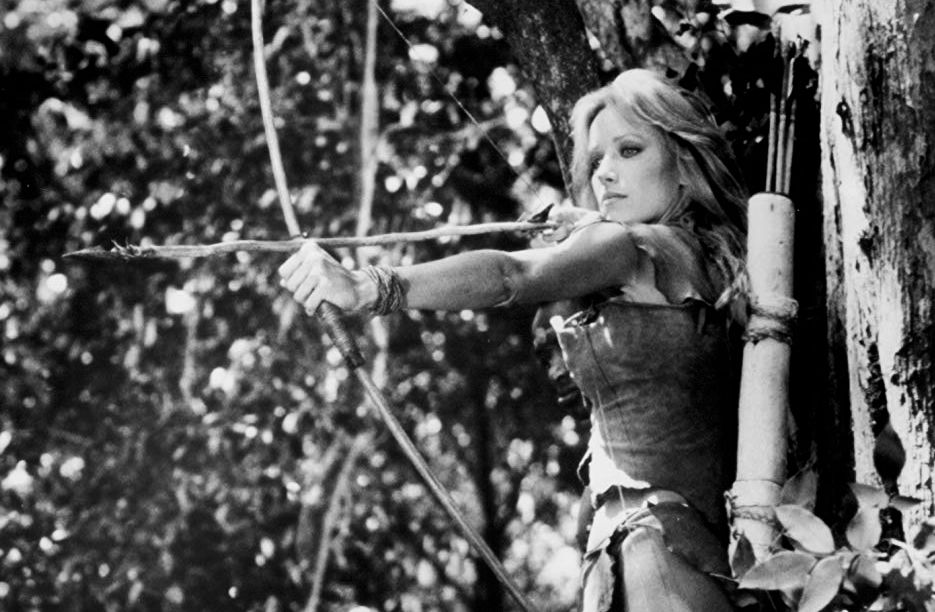 The actors… Well… There’s not so much to say about the actors: Tanya Roberts (“3 Angels for Charlie“, the original TV show) is definitely the most well-known here which already tells you enough. Her performance has been often mocked and ridiculed, but I don’t find it terrible. If you play an orphan that has grown up in the jungle. it seems logical that most things from civilization must appear for you like magic e. g. binoculars. The dialogue could have been better here and there but hey, at least we are miles away from Johnny Weismueller Tarzan-talk.
My personal feeling is that reviewers had fun putting the whole thing down as some kind of “dumb blonde” joke, ignoring completely that Sheena is definitely not an idiot: she knows her way around the jungle, how to ride, command the animals in battle, etc. The recent Tarzan movie with Alexander Skarsgard, Christoph Waltz, Margot Robbie and Samuel L. Jackson did much the same and there weren’t any big complaints about these similar animal scenes (apart from their bad CGI), or how to become invisible in the jungle and make an ad hoc bow and arrow out of the material Mother Nature provides.
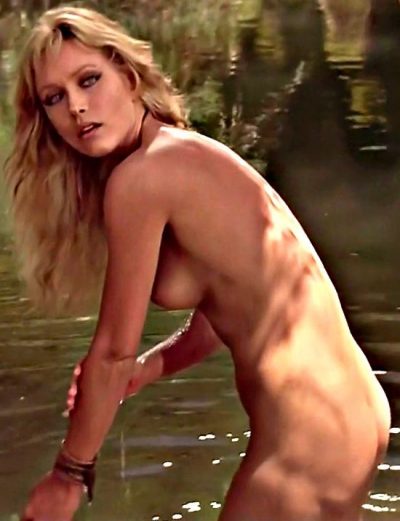
Of course the movie shoots itself in the foot a couple of times. Sheena is quite often objectified, even though it’s played for laughs thanks to the awkward reactions of the man accompanying her. Those prudish boys from civilization! But gosh, I’m really the last ever to complain about a naked Tanya Roberts taking a bath in a river or watching her climb up a mountain or a tree with very small panties on… Of course this was fan-service (did such a thing exist in 1984?) and I don’t mind. This is not really so bad: anyone who ever saw the tedious Bo Derek version of Tarzan – which essentially played like a soft-porn-tease-movie with a bit of drunken Richard Harris thrown in for good measure – will probably agree.
Roberts plays Sheena as some kind of nature child and that’s fine. There is something enormously cute to this innocent ethereal spirit, who doesn’t know about the evils of civilization and is limited to what she has experienced up until then in the areas of her territory. I think that innocence is the direction the movie is consistently aiming for, especially at the end. Additionally, there are some Rousseau-esque ideas about the noble savage going on here, though you can take or leave those.
One thing worthy of criticism in regard to Roberts’ acting is, she seems to overdo it a bit here and there. It’s much the same complaint frequently levelled against her when people discuss her performance in A View to a Kill, the James Bond movie which she was offered due to this film. So there was at least one positive result of Sheena! Sure, I wouldn’t have ever hired her for a Shakespeare play and her status as a possible star evaporated very quickly after Bond. But I just don’t think she is as terrible an actress as a lot of people think.
 The only other actor known to me here is Ted Wass, playing the reporter who follows Sheena into the jungle and falls in love with her. Wass appears terribly bland and uninteresting for me, like a stand-in for a much better actor, but as he essentially has the “Jane” role here, I didn’t really care. The movie I know him from was Curse of the Pink Panther, where he was an American police man chosen to find the missing Inspector Clouseau. As Peter Sellers had already died, this was obviously Blake Edwards’ attempt to continue the series with another actor in a similar role. But Wass appeared very awkward; you can’t just replace Peter Sellers like that.
There’s not much else to say about this movie. It came, it flopped in cinemas and was forgotten but in retrospect it’s not that bad. I definitely find it a better movie than the recent Tarzan movie with Skarsgard, and 1000 times more entertaining than Bo Derek’s Tarzan the Ape Man trash audiences had endured a couple of years before. My feeling is that Sheena. though definitely not a lost classic from the mid-80s. makes for decent entertainment if in the mood for a jungle adventure. Seeing it on a big TV screen actually makes it look quite cinematic as the beautiful landscapes of Africa were nicely captured here – as well as the natural beauty of Mrs. Roberts!
I do think there was not really an audience for this in its day. I really do think today’s generation of girls and females are much more interested in the comic book movie genre and that male comic book fans in the 1980s may have consciously avoided movies like this. But I do think that – given the right attitude – Sheena makes a good combo with Supergirl, or perhaps Clan of the Cave Bear. Most would give this movie 2 stars, but for me it’s not that far from beloved trash like One Million Years BC and give it a generous 3½ stars. I simply like the movie, not least the ending in which Vic leaves Sheena in Africa, despite his love for her, knowing that our modern world would just corrupt and destroy her beautiful character. It’s an astonishing and thoughtful bitter-sweet ending for a movie that hardly wants to be more than just two hours of easy entertainment.
I say it again: Critics were overly harsh to this little Africa adventure. Maybe there’s just something in Tanya Roberts acting that triggers that kind of reaction?
Dir: John Guillermin
Star: Tanya Roberts, Ted Wass, Donovan Scott. Princess Elizabeth of Toro
Sheena
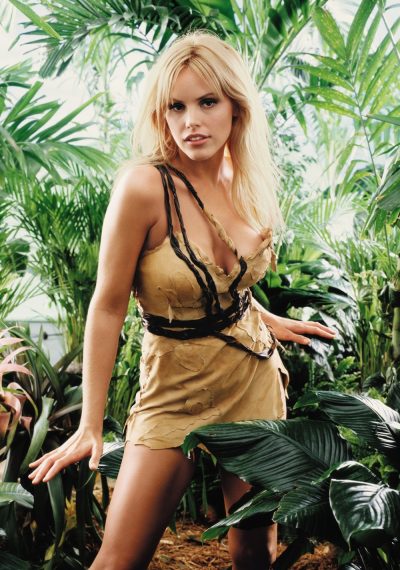 “Sheena” would eventually return in form of another TV-series that ran for two seasons and 35 episodes from 2000-2002. It’s quite likely that producers Douglas Schwartz and Steven L. Sears hoped to cash in on the trend of action-adventure TV-shows that were then popular thanks to series like “Hercules” and “Xena”. Sears himself was enjoying quite some success with “Xena – Warrior Princess” which he wrote several scripts of and partly co-produced.
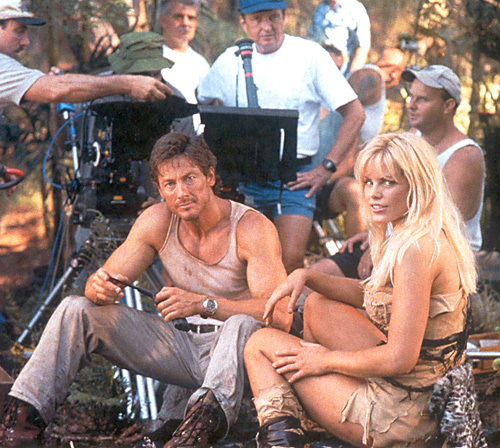
Unfortunately, the “Sheena” show was nowhere near as captivating as “Xena” was. Sheena (Nolin) is far from the “cute but a bit naive” version that Tanya Roberts played. Here, Sheena is more a kind of eco-terrorist, fiercely protecting “her” jungle of Maltaka – so you’d better behave if you go there! Along comes Matt Cutter (Nelson) with his constantly ironically snarky companion Mendelson (Quigley). Cutter is out for the quick buck, leading tourists in the jungle, trying to forget his former career as a CIA-agent (!). But after clashing with Sheena in the beginning they quickly establish a working relationship – usually meaning Sheena will draw the poor man into another harrowing adventure of hers.
Obviously, there are plenty of terrible things that can happen in the jungle, be it big game hunters, terrorists, military coups or tribal wars that have to be prevented. While the show quite obviously had a very limited budget – I couldn’t escape the fact after some time that they always filmed at the same five locations – I give the film makers credit. They tried to make their show as diverting as possible as they could, with the time and money they had at their disposal.
Sheena has changed quite a bit from her previous version; she is no dumb blonde in the jungle, she reads Tom Clancy and romantic novels, has her own cave, is trained in the mystical art of transforming into any animal with whom she has eye-contact (I immediately had to think of the old TV-show “A case for Professor Chase” when seeing this) by Shaman Kali (Moorer) and has absolutely no qualms about killing off evil-doers in the jungle – and there are plenty over the course of the show).
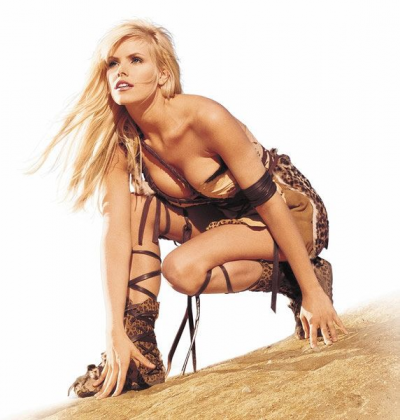
 Usually she transforms into what she calls the “Darakna” – which essentially means she puts black mud on her body and gloves, with bone claws on to slash her enemies to death. Don’t worry: it’s neither bloody nor (after the first time they show it to us) very exciting. I just wonder if, by doing that, she also immediately became super-powered. though she already is a strong fighter. Or if it just made the killing easier for her, as she then wasn’t “quite herself” (to quote Norman Bates!).
It seems the producers were going for some kind of developing love story – differently to “Xena”, there are no overlapping story-arcs, just stand-alone episodes. But if so, they blew it. It seems all the efforts of Cutter were in vain, after early in the second season, Sheena has sex with a random stranger after a couple of unsubtle compliments from him. A couple of episodes later, we are asked to believe that Cutter gets together with an Asian women he once met in a training unit at the CIA. Oh, and we have to suffer through the usual episode where Sheena meets her “first love,” or the one where a special-mission leads Cutter’s ex-wife into the jungle.
Nolin and Nelson never have much chemistry with each other, that would let them appear as anything more than good friends. There’s no Xena-Gabrielle spark here, if that’s what you were hoping for! So if you thought we were getting the Sheena-Cutter-happy ending no one was asking for, you’d be wrong. Cutter says good-bye to another beautiful blonde at the beginning of the last episode, who thanks him for “showing him the world”, and the rest deals with a tribe mistaking constantly monotonously babbling wanna-be-snark Mendelson for a wise, old leader with the same name. The series ends as unspectacularly as it began.
 That said, while the show (like most shows of its ilk at the time) is underwhelming compared to “Hercules” and “Xena”, I do think the screenwriters really tried to come up with as inventive stories as possible, given the fact that the “adventures in the jungle” was already a genre as dead as a door-nail. There are some good ideas here: plants that raise certain hormones in your blood, making you love-struck as well as murderous (therefore having Cutter and Sheena try to kill each other); a female black Rocky in the jungle, faced with countless attacks by her opponents; a kind of “X-files”-episode, with the audacity to play that show’s musical theme a couple of times in the episode; or the dangerous giant ants that eat anything. setting Cutter and Sheena in quite a distressing position.
There are also some “guest stars” though you shouldn’t expect the A-class of actors here. I noticed Grand L. Bush (whom I know from a minor role in the James Bond-movie Licence to Kill some 11 years earlier), make-up specialist and occasional actor Tom Savini (From Dusk till Dawn) and the Tarzan of the 60s, Ron Ely in a villain role. At least the team tried, though you hardly ever can speak of three-dimensional villains here. You also have to forgive the typical 90s CGI-morphing and masks that were terrible, even in better and more prestigious TV shows of the time than this one.
All in all, “Sheena” is not a great show but given its limitations I would say the people in charge tried to do their very best. Though while I could still binge-watch “Xena” today, “Sheena” is something that I would probably only watch again if I woke up at 2 a.m. and regular TV didn’t offer anything better at that time.
Star: Gena Lee Nolin, John Allen Nelson, Kevin Quigley, Margo Moorer
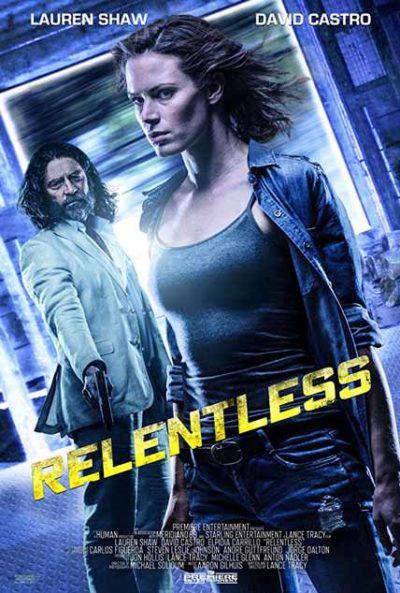 From just about all I’ve read, the director seems entirely earnest in his desire to make a serious film about a serious problem, human trafficking in Central America. That the end result falls almost entirely wide of the mark is a bit of a double-edged sword. In terms of making its intended point, that it feels more like a B-movie from the fifties is a bad thing. But on the other hand, the serious film about the serious problem would likely be considerably less amusing.
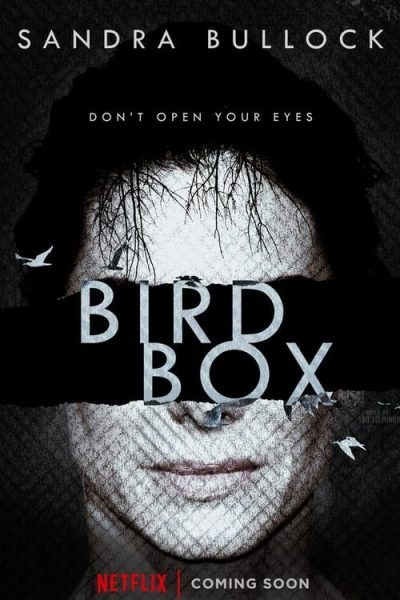 Malorie Hayes (Bullock) is nervously heading towards the birth of a child, supported by her sister (Hayes), when a mysterious epidemic of suicidal psychosis breaks out worldwide. In the ensuing carnage, Malorie finds shelter in the home belonging to the acidic Douglas (Malkovich), whose wife dies trying to help Malorie, and a small number of other survivors. They figure out the epidemic is triggered by entities of some kind who are now prowling the planet – if you see them, you are overwhelmed by your worst fears and kill yourself. The obvious defense is not to make eye contact. Yet how do you survive in a world you cannot see? Especially when it turns out that those who were previously psychopathically inclined are immune to the effects, and are free to roam that world, with their sight intact.
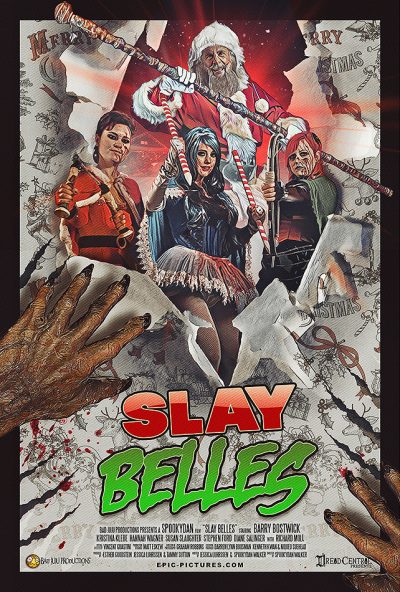 Not to be confused with RuPaul’s 2015 album (
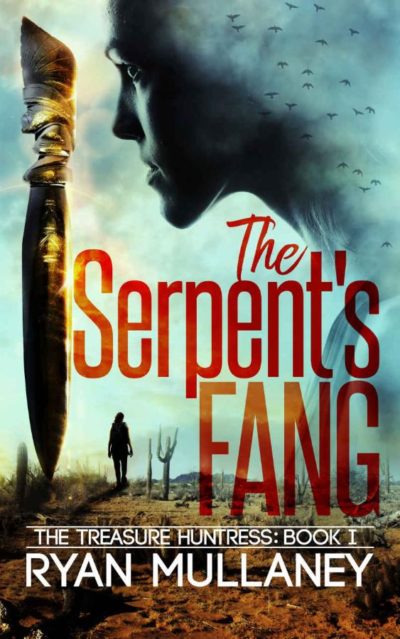 This book comes with a fairly lengthy note at the end, in which the author explains how he came to the idea here. Five words are all that were necessary: “I ripped off Lara Croft.” Because this is the closest I’ve yet seen to the literary version of an Asylum mockbuster movie, such as
 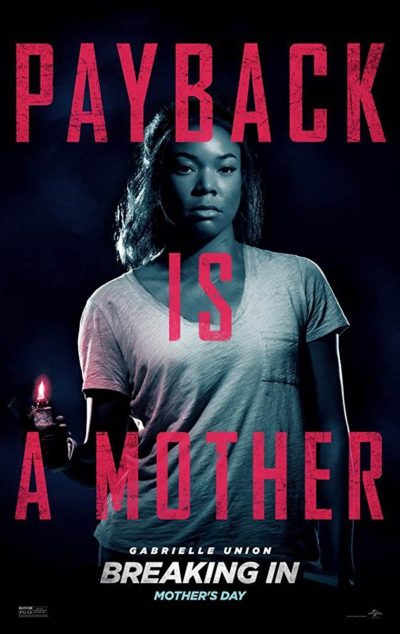 After her father is killed, Shaun (Union – yes, I know “Shaun” is an odd name for a woman) heads to the remote home Dad owned in the country, with her two young children, to clear it out. Unfortunately, she crosses paths there with Eddie (Burke) and his gang of three thugs. They are at the house, in the belief there’s a safe which contains a large quantity of money. Shaun and family represent an unwelcome interruption, because they’re on a strict schedule, before the security company makes it out to investigate their disabling of the phone lines. The thugs take the kids hostage, with Shaun stuck outside the very secure home. Fortunately, she has taken a hostage of her own – the safe-cracker Eddie brought along.
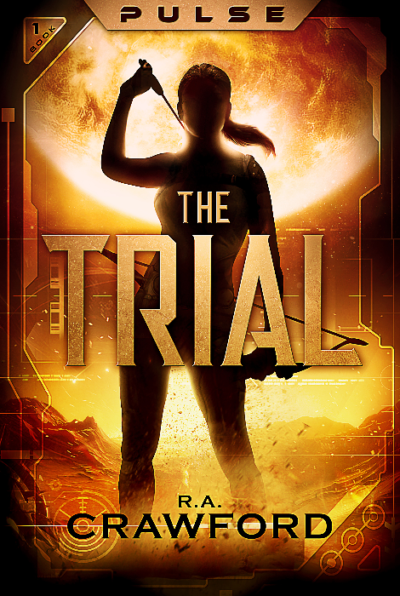 The synopsis starts, “
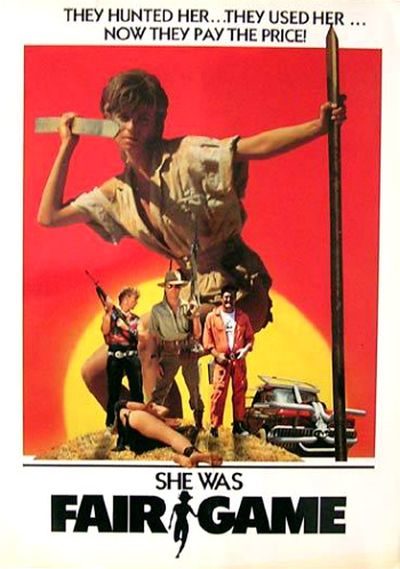 First off, this is not to be confused with the other Australian film of the eighties
 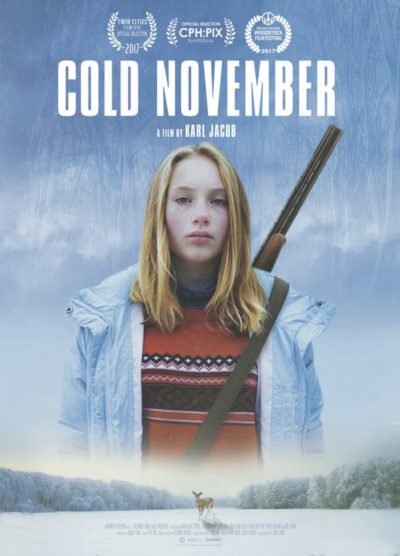 If you think children are of one mind with regard to the gun debate, thanks to the zealots of Marjory Stoneman, the alternative view portrayed by this movie will feel amazingly transgressive and almost alien. The world it depicts is one where schools will actually teach kids how to use guns safely, handing out gun permits, and a teenage girl can receive a treasured family heirloom, in the shape of a .30-30 rifle, passed down the generations. Hunting is a way of life, and an important resource, with a particularly strong matriarchal tradition, in which three generations of women will be going into the woods together. For 12-year-old Florence (Abas), it’ll be her first excursion: in a not-too-subtle parallel, she also gets her first period.
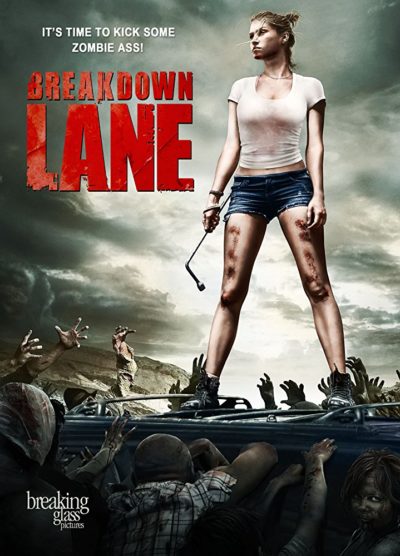 An initial twist on the zombie apocalypse and an appealing heroine aren’t enough to save this. By the end, while said heroine has transformed into a mayhem-dealing machine, any fresh elements have been discarded, for a low-budget rehash of ones which we’ve seen far too often already. It starts intriguingly, with Kirby Lane (Moore) “ambushed” by a woman in a camper with a sick man at a gas station, while on the way to meet her boyfriend (Cushing). When her car breaks down in the middle of absolutely nowhere, the only connection to the outside world is Max (Howell), the agent for her on-board emergency help provider. But things in the outside world are deteriorating rapidly, and the tow-truck Max dispatches… well, let’s just say, it might be a while. Meanwhile, Kirby has to handle the perils which threaten her, including humans both infected and cannibalistic, as she tries to fulfill her promise to link up with Max.