



★★
“Here in my car, I feel safest of all…”
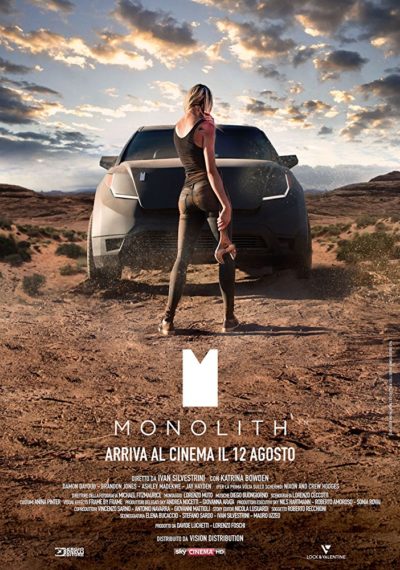 As a joke I saw on Facebook went, “With all these self-driving cars, it won’t be long before there’s a country song about your truck leaving you.” The rise of smart vehicles is inevitable, and likely, so are other films like this, which falls somewhere between Christine and 2001. In this case, mother Sandra (Bowden) is driving to see her husband, whom she suspects of cheating on her, with their young child David (played by the two Hodges brothers, whom I’m assuming are twins!) in the back seat. Her car is the state-of-the-art Monolith, equipped with every safety feature imaginable, and then some. But a series of events – a diversion, an encounter with roadkill on the hoof, and Sandra giving David her smartphone as a distraction – lead to a tricky situation. She is stuck on a remote desert road, outside of a car that has now entered its impenetrable “vault mode”, with David trapped in its interior.
It’s not necessarily a bad idea, with the Monolith (voiced by Lang) having a personality that’s somewhere between Siri and GLaDOS from the Portal games. But there are quite a few problems with the execution. Once Sandra is locked out, it’s less “Man vs. Wild” and more “Woman vs. Brick,” as the car is simply sitting there. It isn’t particularly exciting, which is why the script tries to inject various exterior threats, most obviously a feral canine attracted by the roadkill. Though it’s kinda hard to care much, given the heroine’s situation is largely the result of her own poor decisions. I mean, for heavens’ sake, what kind of mother chooses to light up a cigarette, while in the car with her asthmatic child? At that point, being raised by the feral canine and its pack, is probably the kid’s best hope. And don’t even get me started on the finale, which takes ludicrous to a whole new level. [It turns out this car truly is completely indestructible]
There are a few subplots which don’t particularly go anywhere: the whole “husband affair” thing, for example. Or the fact that Sandra used to be the lead singer for a pop group, which seems to be there purely for vaguely regretful thoughts about having settled down to start a family. Neither it, nor the fans she runs into at a gas-station, serve any purpose once we get to the meat of the story. On the plus side, the film looks great, with Utah’s wilderness providing a wonderfully scenic backdrop, and Bowden isn’t bad, as a woman clearly out of her depth and forced to desperate lengths to try and rescue her child. However, the script is at least two rewrites from reaching a point, where the makers should have looked at it and decided to abandon the resulting project altogether as poorly conceived. For in its current in-car-nation (hohoho), there isn’t enough meat on its bones to make it through the road-trip.
Dir: Ivan Silvestrini
Star: Katrina Bowden, Krew + Nixon Hodges, Katherine Kelly Lang
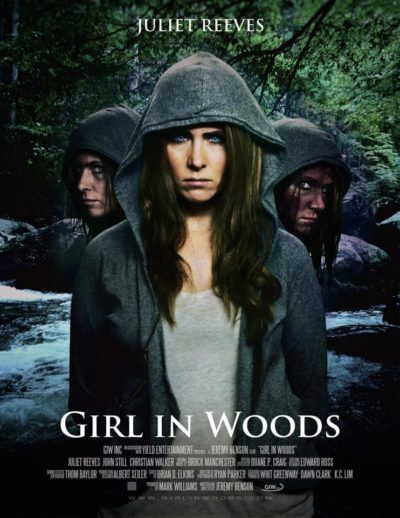
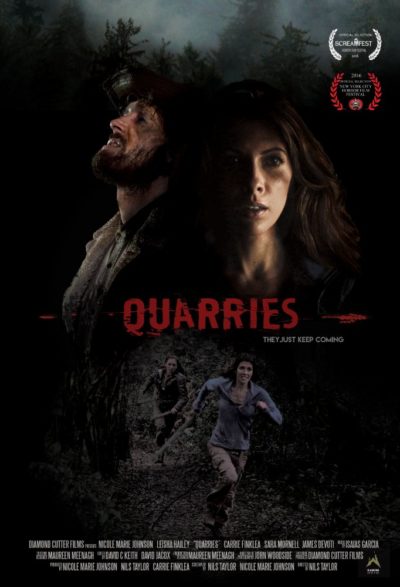 It’s not often a film manages to be under-written AND over-written. Yet this tale of wilderness survival does both. A group of women are out on what’s supposed to be an empowering hike through the forest, designed to boost self-reliance, esteem and all that good stuff. But they come under attack from a group of local men, apparently intent on a hunting expedition, with the woman as the prey. They’ll need to learn survival skills, that’s for sure.
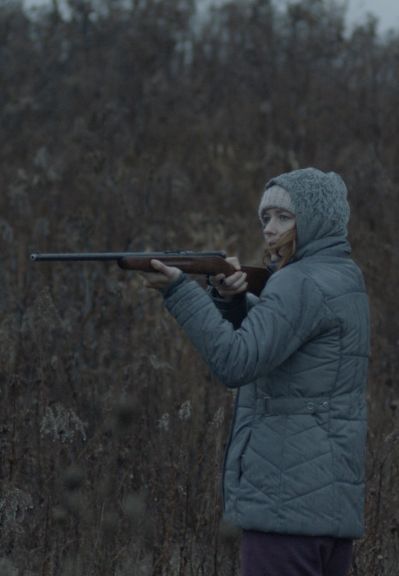 A viral plague has decimated mankind, turning its victims in mindless, flesh-craving ghouls. One of the few to have survived is Ann (Walters), who has taken up residence in the woods, where she has camped out. Ann uses the survival skills she received from her now-absent husband, Jason (West), only occasionally having to emerge and risk the threat of the infected, in order to gather supplies. Her secluded, yet relatively safe existence is disturbed, when she finds an injured man, Chris (Thompson) and his teenage daughter, Liv (Piersanti) on a road. They are supposed to be on their way north, to where the epidemic is reported to be in check. Yet Chris, in particular, seems curiously unwilling to be on his way.
 It’s always interesting when reviews of a film are deeply polarized, and that’s the case here. The first page of Google results run the gamut from “I simply despised the film as a whole” to “The images are frightening within, and the only thing better than the scares are the performances.” While I lean toward the latter, I can see how this could have failed to make a connection with some viewers, and if that happens, then there isn’t much else to prevent the former opinion. It’s the kind of film where there isn’t likey to be a middle ground in reactions.
 Stealing from both Open Water and
 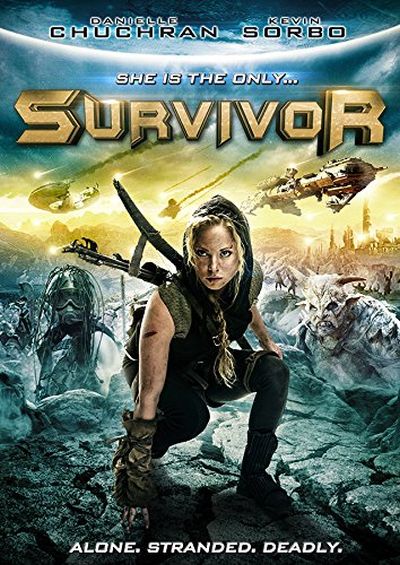 Arrowstorm Entertainment appear to have quietly become a minor creator of action heroine flicks. We’ve previously written about several entries in their
  ★★½
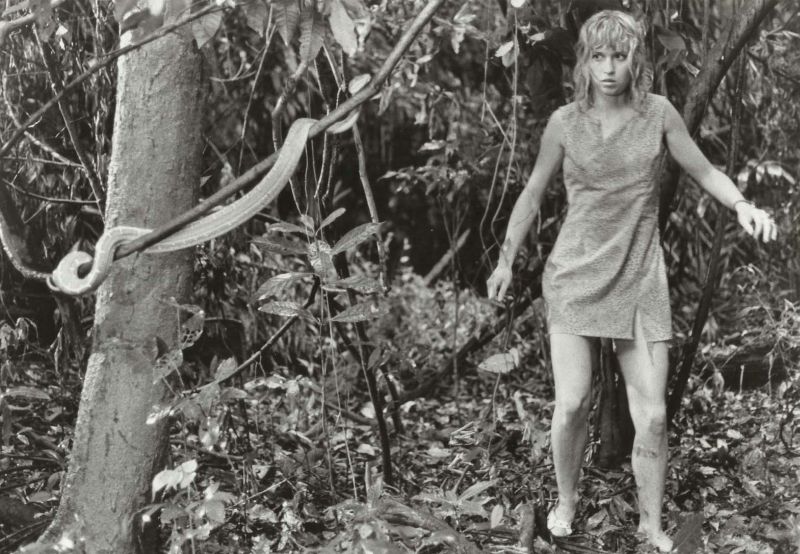
★★½ Admittedly, Juliane Koepcke was not your average teenager. Indeed, she could hardly have been better prepared for her ordeal. Her family moved to a research station in the Peruvian rainforest when she was 14, so her father, zoologist Hans-Wilhelm Koepcke, could continue his work. Juliane was initially home-schooled, and the curriculum covered much more than the traditional three R’s.
 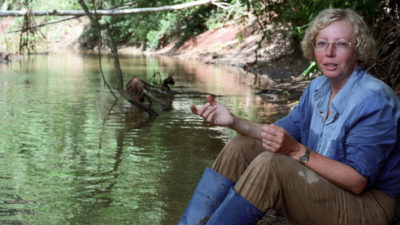 The authorities hadn’t been able to locate the crash site, but with Juliane’s help, they found it, and her mother’s body was eventually recovered on January 12, more than three weeks later. The
  There’s something admirable about a film entirely cast with and directed by women, especially in such a generally male-dominated genre as horror. Unfortunately, all this effort really goes to prove, is that the fairer sex are every bit as capable of turning out uninteresting crap as any man. An ill-conceived cross between The Descent and The Blair Witch Project, this has four old school friends reuniting, along with the workmate of one of them, who tags along because… Well, as with so much in the movie, for no particularly good reason. There’s friction between the friends, from the moment Nancy (Bernadette) shows up four hours late, forcing their departure to be pushed back.
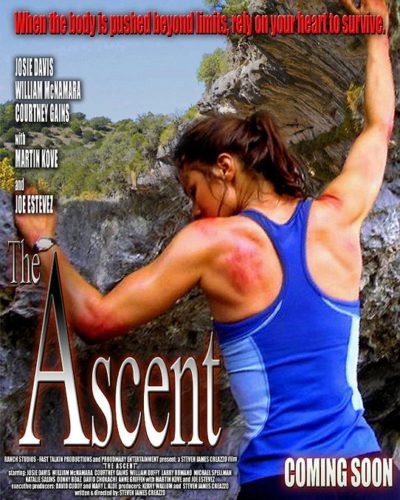 One year ago, the boyfriend of Emily Wilks (Davis) vanished, along with the mountaineering party he was taking on an ascent of the notoriously lethal Devil’s Peak summit. Emily is no mean climber herself, and still works as a trail guide on the mountain. But the group who have booked her services on this day have another motive: finding the legendary stash of gold they believe is hidden on the mountain, which they believe Emily knows the location. Unable to convince them it’s just a myth, she’s forced to lead the gang through the wilderness. Fortunately, it has many,