




★★★
“Bah, humbug.”
It’s the festive season, and Holly (Rogers), Cali (Turshen), and Mel (Molina) are bored. At the suggestion of Cali, they head over to her uncle’s fabulous mansion – conveniently, he’s out of town for the holidays – for a little par-tay. Except, it’s not actually her uncle’s house. Worse is to follow, ending with the caretaker (Fessenden) lying, apparently dead, at the foot of the stairs. The three young ladies are left having to decide whether to ‘fess up and face the consequences, or cover up and create an alternative version of events.
According to Wikipedia, the three characters “represent Sigmund Freud’s model of the id, ego, and superego.” I guess that’s something you don’t see every day. Certainly, they’re radically different characters, to the extent you wonder somewhat, quite why they’re hanging out with each other. Cali is prepared to go to absolutely any lengths, to avoid responsibility. Holly is at the other end of the spectrum, convinced they are only making things worse for themselves by committing further crimes. Mel is the undecided voter, and it’s her shifting support which largely drives the second half, as Cali and Holly solicit her support. Who knew teenagers were such sticklers for the democratic process?
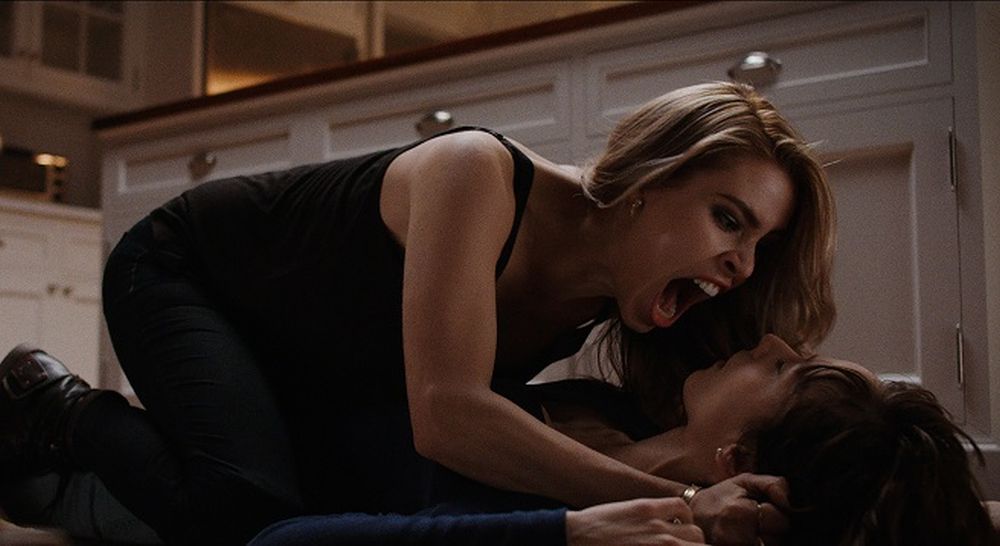 It kinda works, mostly for the dynamics between the trio of leading ladies. At first, Cali’s approach seems sensible, arguably a legitimate way to make the best of a bad situation. However, a change in the scenario shifts things seismically, and even the toughest of her supporters would have to admit an unpleasant streak of psychopathy is opened in her make-up. Evil sometimes wears a pretty face, and Turshen reminded me more than a little of Denise Richards in Wild Things – manipulative and . Less successful, to the point of entire irrelevance, is the boyfriend who shows up and yells for a bit. I suspect, given the slight running time of 75 minutes, his presence may have been a late-added necessity in order to reach feature length.
However, if the ending is probably when the film is most fun, it’s also where the script seems to be weakest. The eventual conclusion would likely not withstand scrutiny, by anyone with even a passing knowledge of forensic investigative techniques. In the film’s defense, that might be the point. Though given one of the girls is supposedly looking to attend law school, her pre-legal knowledge inexplicably appears about the level obtained from a few episodes of C.S.I. On the other hand, Berk and Olsen have done a fairly good job of crafting a story that fits within their resource limitations,
Dir: Dan Berk and Robert Olsen
Star: Helen Rogers, Alexandra Turshen, Lauren Molina, Larry Fessenden
 Maggie Marvel (Beretta) is a single mom, with all the issues that implies. She has to try and juggle work with raising young daughter, Samantha (Katherine Brennan), on her own. But complicating matters enormously, is that work in this case is operating as an assassin for criminal kingpin Dutch – who also happens to be Maggie’s estranged father, who sent her away after his wife (and thus, Maggie’s mother) tried to poison him. Maggie was raised instead by Dixie Brown (Barron), who also works for Dutch as a killer. For he believes women are better at the job, and though he employs men, such as Bobby Shea (Dan Brennan) and his brothers, they are kept for non-lethal work. However, this line gets blurred as Bobby has fallen for Dixie, and his request that Maggie work with him on a bank robbery – hoping to make Dixie jealous – kicks off a series of events that threaten to destroy Maggie, her family and the entire crime organization.
 At this point, five movies into the franchise, it probably becomes churlish to complain about the aspects that have sustained the series thus far. You’re watching an epic war, waged down the centuries, between vampires and werewolves. It is, literally, non-sense. This, however, is separate and independent from any entertainment value, and despite some issues, this is perhaps the best in the series since the original [some may argue for the third entry, but that appears to have strayed in from a different franchise entirely, containing only peanut-allergy level traces of Selene].
 On the plus side, we get a couple of bonus strong female characters. Lara Pulver makes a good impression as the scheming vampire, and Clementine Nicholson does a fine imitation of a low-rent Emilia Clarke, playing the Nordic Coven’s leading warrior, Lena (maybe another GoT nod in that name?). On the downside, the CGI werewolves still look awful, particularly during their transformations, and there’s another (sigh) vampire-werewolf romance, which works out as well as they always do i.e. not very. You’d think people would have learned by now. Then again, this is a universe where Kate Beckinsale is basically the same as she was in 2003 when the first film came out, and is still capable of kicking ass while being easy on the eye.
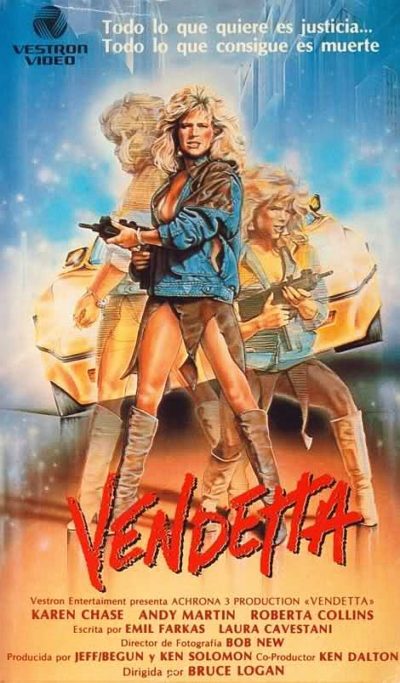 Movie stunt-woman Laurie Collins (Chase) is out for the night with her sister, Bonnie, until the latter accepts the company of a young man. When things get more than a bit rape-y, and Bonnie ends up shooting her attacker dead. She is convicted of second-degree manslaughter, much to the chagrin of her sister. Worse is to follow after Bonnie is sent to prison, as there, she then falls foul of the jail’s top dog, Kay Butler (Martin). Bonnie soon turns up a corpse, with the incident written off as suicide, due to the heroine found in her veins. But Laurie doesn’t believe a word of it, and deliberately commits grand theft auto, among other crimes, in order to be sent to the same prison, where she can find those responsible, and make them pay for what they did to Bonnie.
 Initially a web series, the eight episodes are combined into a feature-length production here, and it’s done well enough you can’t see the join. It’s inspired by a Sid + Marty Krofft creation from the mid-seventies, which parodied the Batman and Robin dynamic. Four decades later, when it seems every other movie is a superhero of one form or another, the updated concept works deliciously well, helped by a winning lead performance from Hart as Dyna Girl. She and her partner Electra Woman (Helbig) are low-tier superheroines – without any particular powers, in fact – who operate out of Akron, Ohio until video of them disarming (literally) a convenience store robber goes viral.
 A date appears to go badly wrong for Julia (Azlynn), when her companion (Sorbo) turns out to be a serial-killer who has been using Internet dating sites to find the young women he targets. However, it turns out the tables are eventually turned, for Julia and her sister Jessica (Willis) are every bit as monstrous, who have been luring in and killing men, as a result of the abuse they both suffered at the hands of their father. But Jessica is a bit fed up of taking a back seat to her big sis, and wanders across the street to kidnap a victim of her own (Moore). But Julia’s captive is not exactly prepared to give up his liberty without a fight.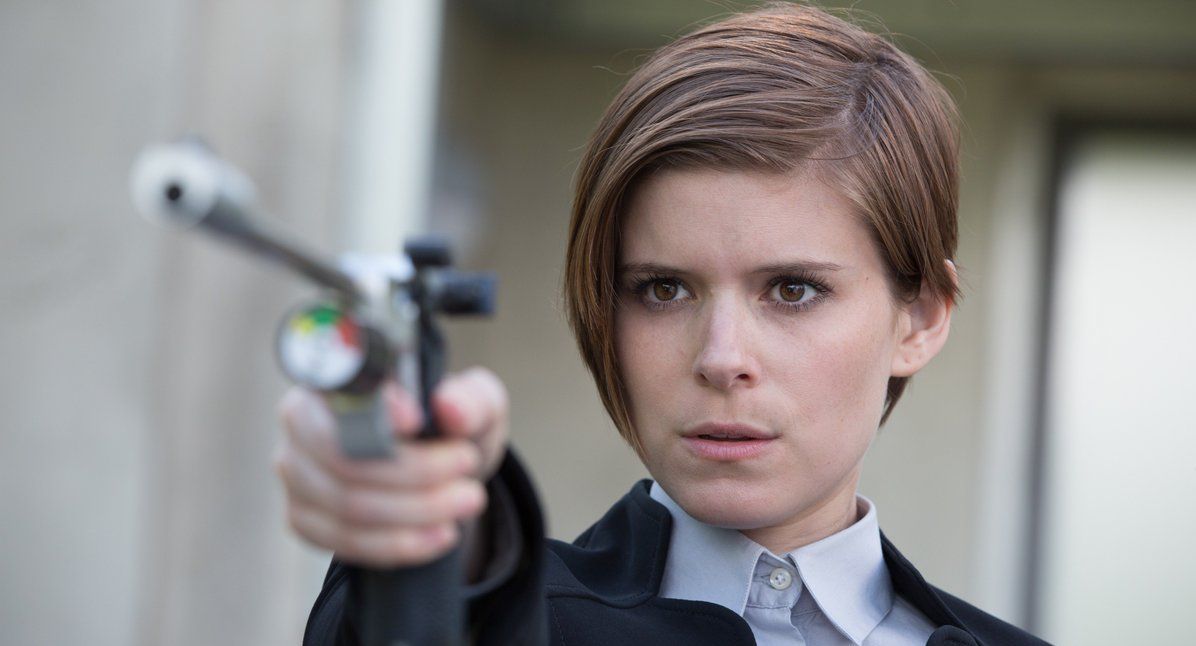
 Returning from a stint in the military, Rachel Baldwin (Kabasinski) is looking forward to reuniting and reconnecting with her family. But any hope of happiness is rudely disrupted when her niece slits her wrists in the bathtub. After the funeral, Rachel finds her late relative’s phone and realizes the reason for the suicide was a sex tape she’d made with her boyfriend (Wieczorek), which he had traded to a drug dealer for cocaine, and then ended up on the Internet, to her fatal shame. A thoroughly unimpressed Rachel decides to take her army skills and apply them to the sleazy individuals responsible, working her way up the ladder to Beverly (Hamblin), the woman at the top of the scumball chain of command.
 If you’re looking for unsubtle social commentary, you’re in the right place, because this take on The Most Dangerous Game ticks off the trifecta of -isms:
 This probably seemed better than it is, simply because it had the benefit of being watched immediately after